 Movie
Movie Controller

[English] 日本語
 Yorodumi
- PDB-8t7r: Crystal structure of human leukocyte antigen A*0101 in complex wi... -
+ Open data

- Basic information
| Entry | Database: PDB / ID: 8t7r | ||||||||||||||||||||||||
|---|---|---|---|---|---|---|---|---|---|---|---|---|---|---|---|---|---|---|---|---|---|---|---|---|---|
| Title | Crystal structure of human leukocyte antigen A*0101 in complex with the Fab of alloreactive antibody E07 | ||||||||||||||||||||||||
 Components Components |
| ||||||||||||||||||||||||
 Keywords Keywords | IMMUNE SYSTEM / human leukocyte antigen / HLA / HLA class I / antibodies / autoimmunity / Fab / alloreactive | ||||||||||||||||||||||||
| Function / homology |  Function and homology information Function and homology informationregulation of natural killer cell mediated immunity / early endosome lumen / Nef mediated downregulation of MHC class I complex cell surface expression / DAP12 interactions / Endosomal/Vacuolar pathway / Antigen Presentation: Folding, assembly and peptide loading of class I MHC / lumenal side of endoplasmic reticulum membrane / regulation of iron ion transport / negative regulation of iron ion transport / negative regulation of forebrain neuron differentiation ...regulation of natural killer cell mediated immunity / early endosome lumen / Nef mediated downregulation of MHC class I complex cell surface expression / DAP12 interactions / Endosomal/Vacuolar pathway / Antigen Presentation: Folding, assembly and peptide loading of class I MHC / lumenal side of endoplasmic reticulum membrane / regulation of iron ion transport / negative regulation of iron ion transport / negative regulation of forebrain neuron differentiation / antigen processing and presentation of exogenous peptide antigen via MHC class Ib / MHC class Ib protein complex / peptide antigen assembly with MHC class I protein complex / ER to Golgi transport vesicle membrane / HFE-transferrin receptor complex / MHC class I peptide loading complex / transferrin transport / negative regulation of receptor-mediated endocytosis / cellular response to iron ion / positive regulation of T cell cytokine production / antigen processing and presentation of endogenous peptide antigen via MHC class I / peptide antigen assembly with MHC class II protein complex / MHC class I protein complex / negative regulation of epithelial cell proliferation / cellular response to nicotine / positive regulation of receptor-mediated endocytosis / MHC class II protein complex / negative regulation of neurogenesis / antigen processing and presentation of exogenous peptide antigen via MHC class II / positive regulation of immune response / specific granule lumen / peptide antigen binding / phagocytic vesicle membrane / positive regulation of T cell activation / Interferon gamma signaling / recycling endosome membrane / Immunoregulatory interactions between a Lymphoid and a non-Lymphoid cell / sensory perception of smell / tertiary granule lumen / Modulation by Mtb of host immune system / positive regulation of cellular senescence / MHC class II protein complex binding / DAP12 signaling / late endosome membrane / ER-Phagosome pathway / early endosome membrane / amyloid fibril formation / protein homotetramerization / intracellular iron ion homeostasis / learning or memory / immune response / endoplasmic reticulum lumen / Amyloid fiber formation / external side of plasma membrane / Golgi membrane / focal adhesion / lysosomal membrane / Neutrophil degranulation / SARS-CoV-2 activates/modulates innate and adaptive immune responses / structural molecule activity / Golgi apparatus / cell surface / endoplasmic reticulum / protein homodimerization activity / extracellular exosome / extracellular region / membrane / identical protein binding / plasma membrane Similarity search - Function | ||||||||||||||||||||||||
| Biological species |  Homo sapiens (human) Homo sapiens (human) Cytomegalovirus Cytomegalovirus | ||||||||||||||||||||||||
| Method |  X-RAY DIFFRACTION / SYNCHROTRON / MOLECULAR REPLACEMENT / Resolution: 3.84 Å X-RAY DIFFRACTION / SYNCHROTRON / MOLECULAR REPLACEMENT / Resolution: 3.84 Å | ||||||||||||||||||||||||
 Authors Authors | Green, T.J. / Killian Jr, J.T. / Qiu, S. / Macon, K.J. / Yang, G. / King, R.G. / Lund, F.E. | ||||||||||||||||||||||||
| Funding support |  United States, 7items United States, 7items
| ||||||||||||||||||||||||
 Citation Citation | Journal: Immunity / Year: 2025 Title: Topography of the HLA-A protein enforces shared and convergent immunodominant B cell and antibody alloresponses in transplant recipients. Authors: John T Killian / R Glenn King / Aaron C K Lucander / James L Kizziah / Christopher F Fucile / Ruben Diaz-Avalos / Shihong Qiu / Aaron Silva-Sanchez / Betty J Mousseau / Kevin J Macon / ...Authors: John T Killian / R Glenn King / Aaron C K Lucander / James L Kizziah / Christopher F Fucile / Ruben Diaz-Avalos / Shihong Qiu / Aaron Silva-Sanchez / Betty J Mousseau / Kevin J Macon / Amanda R Callahan / Guang Yang / M Emon Hossain / Jobaida Akther / Daryl B Good / Susan Kelso / Julie A Houp / Frida Rosenblum / Paige M Porrett / Song C Ong / Vineeta Kumar / Erica Ollmann Saphire / John F Kearney / Troy D Randall / Alexander F Rosenberg / Todd J Green / Frances E Lund /  Abstract: Donor-specific antibody responses against human leukocyte antigen (HLA) proteins mismatched between transplant donors and recipients cause allograft loss, yet the structural HLA epitopes targeted by ...Donor-specific antibody responses against human leukocyte antigen (HLA) proteins mismatched between transplant donors and recipients cause allograft loss, yet the structural HLA epitopes targeted by alloreactive B cells and antibodies remain largely unresolved. We profiled the HLA-A01:01-specific B cell response in the transplanted kidney and blood of a recipient undergoing antibody-mediated rejection and identified immunodominant B cell and antibody responses that emerged early in the alloimmune response. These responses were focused on topographically exposed mismatched HLA residues located in the α helices along the peptide-binding groove of HLA-A01:01. We demonstrated that the anti-HLA-A01:01 B cell alloresponse converged and was maintained on this same immunodominant HLA subregion, which comprises only 20% of the HLA molecule, in a diverse group of HLA-A01:01-mismatched transplant recipients. Thus, the B cell and antibody alloresponses appear tightly focused on a topographically defined region on the HLA-A01:01 crown that is conserved across individuals expressing distinct constellations of self-HLA-A. | ||||||||||||||||||||||||
| History |
|
- Structure visualization
| Structure viewer | Molecule: MolmilJmol/JSmol |
|---|
- Downloads & links
-Download
| PDBx/mmCIF format | 8t7r.cif.gz | 1.5 MB | Display | PDBx/mmCIF format |
|---|---|---|---|---|
| PDB format | pdb8t7r.ent.gz | 1.2 MB | Display | PDB format |
| PDBx/mmJSON format | 8t7r.json.gz | Tree view | PDBx/mmJSON format | |
| Others |  Other downloads Other downloads |
-Validation report
| Arichive directory | https://data.pdbj.org/pub/pdb/validation_reports/t7/8t7rftp://data.pdbj.org/pub/pdb/validation_reports/t7/8t7r | HTTPS FTP |
|---|
-Related structure data

-Links
 PDBj
PDBj
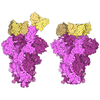
- Assembly
| Deposited unit | 
| ||||||||
|---|---|---|---|---|---|---|---|---|---|
| 1 |
| ||||||||
| Unit cell |
|
-Components
| #1: Antibody | Mass: 22731.115 Da / Num. of mol.: 12 Source method: isolated from a genetically manipulated source Source: (gene. exp.) Homo sapiens (human) / Production host: Homo sapiens (human)#2: Antibody | Mass: 25938.840 Da / Num. of mol.: 12 Source method: isolated from a genetically manipulated source Source: (gene. exp.) Homo sapiens (human) / Production host: Homo sapiens (human)#3: Protein | Mass: 31636.955 Da / Num. of mol.: 9 Source method: isolated from a genetically manipulated source Source: (gene. exp.) Homo sapiens (human) / Gene: HLA-A / Production host:   Escherichia coli (E. coli) / References: UniProt: F6IQR9 Escherichia coli (E. coli) / References: UniProt: F6IQR9#4: Protein/peptide | Mass: 1091.191 Da / Num. of mol.: 9 / Source method: obtained synthetically / Source: (synth.) Cytomegalovirus#5: Protein | Mass: 11748.160 Da / Num. of mol.: 8 Source method: isolated from a genetically manipulated source Source: (gene. exp.) Homo sapiens (human) / Gene: B2M, CDABP0092, HDCMA22P / Production host: Escherichia coli (E. coli) / References: UniProt: P61769Has protein modification | Y | |
|---|
-Experimental details
-Experiment
| Experiment | Method: X-RAY DIFFRACTION / Number of used crystals: 1 |
|---|
- Sample preparation
| Crystal | Density Matthews: 4.44 Å3/Da / Density % sol: 72.3 % |
|---|---|
| Crystal grow | Temperature: 294 K / Method: vapor diffusion, sitting drop / pH: 6.5 Details: sodium citrate tribasic dihydrate, sodium cacodylate |
-Data collection
| Diffraction | Mean temperature: 100 K / Serial crystal experiment: N |
|---|---|
| Diffraction source | Source: SYNCHROTRON / Site: APS / Beamline: 22-ID / Wavelength: 1 Å |
| Detector | Type: DECTRIS EIGER X 16M / Detector: PIXEL / Date: Oct 15, 2022 |
| Radiation | Protocol: SINGLE WAVELENGTH / Monochromatic (M) / Laue (L): M / Scattering type: x-ray |
| Radiation wavelength | Wavelength: 1 Å / Relative weight: 1 |
| Reflection | Resolution: 3.84→30.13 Å / Num. obs: 154424 / % possible obs: 99.2 % / Redundancy: 3.8 % / CC1/2: 0.981 / CC star: 0.995 / Rmerge(I) obs: 0.172 / Rpim(I) all: 0.1 / Rrim(I) all: 0.199 / Net I/σ(I): 8.05 |
| Reflection shell | Resolution: 3.89→3.977 Å / Rmerge(I) obs: 0.597 / Mean I/σ(I) obs: 1.77 / Num. unique obs: 7737 / CC1/2: 0.71 / CC star: 0.911 / Rpim(I) all: 0.36 / Rrim(I) all: 0.699 / % possible all: 99.4 |
- Processing
| Software |
| |||||||||||||||||||||||||||||||||||||||||||||||||||||||||||||||||||||||||||||||||||||||||||||||||||||||||
|---|---|---|---|---|---|---|---|---|---|---|---|---|---|---|---|---|---|---|---|---|---|---|---|---|---|---|---|---|---|---|---|---|---|---|---|---|---|---|---|---|---|---|---|---|---|---|---|---|---|---|---|---|---|---|---|---|---|---|---|---|---|---|---|---|---|---|---|---|---|---|---|---|---|---|---|---|---|---|---|---|---|---|---|---|---|---|---|---|---|---|---|---|---|---|---|---|---|---|---|---|---|---|---|---|---|---|
| Refinement | Method to determine structure: MOLECULAR REPLACEMENT / Resolution: 3.84→30.13 Å / SU ML: 0.42 / Cross valid method: FREE R-VALUE / σ(F): 1.36 / Phase error: 25.55 / Stereochemistry target values: ML
| |||||||||||||||||||||||||||||||||||||||||||||||||||||||||||||||||||||||||||||||||||||||||||||||||||||||||
| Solvent computation | Shrinkage radii: 0.9 Å / VDW probe radii: 1.1 Å / Solvent model: FLAT BULK SOLVENT MODEL | |||||||||||||||||||||||||||||||||||||||||||||||||||||||||||||||||||||||||||||||||||||||||||||||||||||||||
| Refinement step | Cycle: LAST / Resolution: 3.84→30.13 Å
| |||||||||||||||||||||||||||||||||||||||||||||||||||||||||||||||||||||||||||||||||||||||||||||||||||||||||
| Refine LS restraints |
| |||||||||||||||||||||||||||||||||||||||||||||||||||||||||||||||||||||||||||||||||||||||||||||||||||||||||
| LS refinement shell |
|
