 Movie
Movie Controller


+ Open data

- Basic information
| Entry | Database: PDB / ID: 8qyj | |||||||||||||||
|---|---|---|---|---|---|---|---|---|---|---|---|---|---|---|---|---|
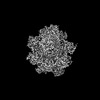
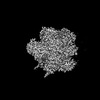
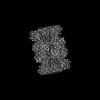
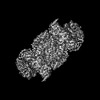
| Title | Human 20S proteasome assembly structure 1 | |||||||||||||||
 Components Components |
| |||||||||||||||
 Keywords Keywords | HYDROLASE / Complex | |||||||||||||||
| Function / homology |  Function and homology information Function and homology informationpurine ribonucleoside triphosphate binding / CD8-positive, alpha-beta T cell differentiation / CD8-positive, alpha-beta T cell homeostasis / thymic T cell selection / Antigen processing: Ub, ATP-independent proteasomal degradation / proteasome core complex assembly / negative regulation of regulatory T cell differentiation / T-helper 1 cell differentiation / Regulation of ornithine decarboxylase (ODC) / proteasome core complex ...purine ribonucleoside triphosphate binding / CD8-positive, alpha-beta T cell differentiation / CD8-positive, alpha-beta T cell homeostasis / thymic T cell selection / Antigen processing: Ub, ATP-independent proteasomal degradation / proteasome core complex assembly / negative regulation of regulatory T cell differentiation / T-helper 1 cell differentiation / Regulation of ornithine decarboxylase (ODC) / proteasome core complex / Proteasome assembly / cellular response to type I interferon / T-helper 17 cell differentiation / Cross-presentation of soluble exogenous antigens (endosomes) / Somitogenesis / flagellated sperm motility / sperm end piece / proteasome binding / myofibril / ciliary tip / protein folding chaperone complex / proteasomal ubiquitin-independent protein catabolic process / proteasome storage granule / chaperone-mediated protein complex assembly / proteasome endopeptidase complex / NF-kappaB binding / proteasome core complex, beta-subunit complex / threonine-type endopeptidase activity / proteasome core complex, alpha-subunit complex / proteasome assembly / immune system process / regulation of G1/S transition of mitotic cell cycle / positive regulation of interleukin-2 production / proteasome complex / response to type II interferon / : / regulation of proteasomal protein catabolic process / sarcomere / Regulation of activated PAK-2p34 by proteasome mediated degradation / negative regulation of inflammatory response to antigenic stimulus / Autodegradation of Cdh1 by Cdh1:APC/C / proteasomal protein catabolic process / APC/C:Cdc20 mediated degradation of Securin / Asymmetric localization of PCP proteins / lipopolysaccharide binding / Ubiquitin-dependent degradation of Cyclin D / SCF-beta-TrCP mediated degradation of Emi1 / NIK-->noncanonical NF-kB signaling / AUF1 (hnRNP D0) binds and destabilizes mRNA / TNFR2 non-canonical NF-kB pathway / positive regulation of type II interferon production / Assembly of the pre-replicative complex / P-body / Vpu mediated degradation of CD4 / Cdc20:Phospho-APC/C mediated degradation of Cyclin A / Dectin-1 mediated noncanonical NF-kB signaling / Degradation of DVL / Degradation of AXIN / Degradation of CRY and PER proteins / meiotic cell cycle / Hh mutants are degraded by ERAD / Activation of NF-kappaB in B cells / G2/M Checkpoints / Degradation of GLI1 by the proteasome / Hedgehog ligand biogenesis / Autodegradation of the E3 ubiquitin ligase COP1 / Regulation of RUNX3 expression and activity / Defective CFTR causes cystic fibrosis / GSK3B and BTRC:CUL1-mediated-degradation of NFE2L2 / response to virus / Negative regulation of NOTCH4 signaling / AMPK-induced ERAD and lysosome mediated degradation of PD-L1(CD274) / Hedgehog 'on' state / APC/C:Cdh1 mediated degradation of Cdc20 and other APC/C:Cdh1 targeted proteins in late mitosis/early G1 / Vif-mediated degradation of APOBEC3G / FBXL7 down-regulates AURKA during mitotic entry and in early mitosis / Degradation of GLI2 by the proteasome / GLI3 is processed to GLI3R by the proteasome / MAPK6/MAPK4 signaling / GSK3B-mediated proteasomal degradation of PD-L1(CD274) / Degradation of CDH1 / Degradation of beta-catenin by the destruction complex / Oxygen-dependent proline hydroxylation of Hypoxia-inducible Factor Alpha / CDK-mediated phosphorylation and removal of Cdc6 / ABC-family protein mediated transport / CLEC7A (Dectin-1) signaling / SCF(Skp2)-mediated degradation of p27/p21 / FCERI mediated NF-kB activation / SPOP-mediated proteasomal degradation of PD-L1(CD274) / nuclear matrix / Regulation of expression of SLITs and ROBOs / Regulation of PTEN stability and activity / Ubiquitin-Mediated Degradation of Phosphorylated Cdc25A / Ribosome Quality Control (RQC) complex extracts and degrades nascent peptide / Interleukin-1 signaling / Orc1 removal from chromatin / Regulation of RUNX2 expression and activity / Regulation of RAS by GAPs / positive regulation of tumor necrosis factor production / The role of GTSE1 in G2/M progression after G2 checkpoint Similarity search - Function | |||||||||||||||
| Biological species |  Homo sapiens (human) Homo sapiens (human) | |||||||||||||||
| Method | ELECTRON MICROSCOPY / single particle reconstruction / cryo EM / Resolution: 2.73 Å | |||||||||||||||
 Authors Authors | Schulman, B.A. / Hanna, J.W. / Harper, J.W. / Adolf, F. / Du, J. / Rawson, S.D. / Walsh Jr, R.M. / Goodall, E.A. | |||||||||||||||
| Funding support |  Germany, Germany,  United States, 4items United States, 4items
| |||||||||||||||
 Citation Citation | Journal: Nat Struct Mol Biol / Year: 2024 Title: Visualizing chaperone-mediated multistep assembly of the human 20S proteasome. Authors: Frank Adolf / Jiale Du / Ellen A Goodall / Richard M Walsh / Shaun Rawson / Susanne von Gronau / J Wade Harper / John Hanna / Brenda A Schulman / Abstract: Dedicated assembly factors orchestrate the stepwise production of many molecular machines, including the 28-subunit proteasome core particle (CP) that mediates protein degradation. Here we report ...Dedicated assembly factors orchestrate the stepwise production of many molecular machines, including the 28-subunit proteasome core particle (CP) that mediates protein degradation. Here we report cryo-electron microscopy reconstructions of seven recombinant human subcomplexes that visualize all five chaperones and the three active site propeptides across a wide swath of the assembly pathway. Comparison of these chaperone-bound intermediates and a matching mature CP reveals molecular mechanisms determining the order of successive subunit additions, as well as how proteasome subcomplexes and assembly factors structurally adapt upon progressive subunit incorporation to stabilize intermediates, facilitate the formation of subsequent intermediates and ultimately rearrange to coordinate proteolytic activation with gated access to active sites. This work establishes a methodologic approach for structural analysis of multiprotein complex assembly intermediates, illuminates specific functions of assembly factors and reveals conceptual principles underlying human proteasome biogenesis, thus providing an explanation for many previous biochemical and genetic observations. #1: Journal: bioRxiv / Year: 2024 Title: Visualizing chaperone-mediated multistep assembly of the human 20S proteasome. Authors: Frank Adolf / Jiale Du / Ellen A Goodall / Richard M Walsh / Shaun Rawson / Susanne von Gronau / J Wade Harper / John Hanna / Brenda A Schulman / Abstract: Dedicated assembly factors orchestrate stepwise production of many molecular machines, including the 28-subunit proteasome core particle (CP) that mediates protein degradation. Here, we report cryo- ...Dedicated assembly factors orchestrate stepwise production of many molecular machines, including the 28-subunit proteasome core particle (CP) that mediates protein degradation. Here, we report cryo-EM reconstructions of seven recombinant human subcomplexes that visualize all five chaperones and the three active site propeptides across a wide swath of the assembly pathway. Comparison of these chaperone-bound intermediates and a matching mature CP reveals molecular mechanisms determining the order of successive subunit additions, and how proteasome subcomplexes and assembly factors structurally adapt upon progressive subunit incorporation to stabilize intermediates, facilitate the formation of subsequent intermediates, and ultimately rearrange to coordinate proteolytic activation with gated access to active sites. The structural findings reported here explain many previous biochemical and genetic observations. This work establishes a methodologic approach for structural analysis of multiprotein complex assembly intermediates, illuminates specific functions of assembly factors, and reveals conceptual principles underlying human proteasome biogenesis. | |||||||||||||||
| History |
|
- Structure visualization
| Structure viewer | Molecule: MolmilJmol/JSmol |
|---|
- Downloads & links
-Download
| PDBx/mmCIF format | 8qyj.cif.gz | 449.4 KB | Display | PDBx/mmCIF format |
|---|---|---|---|---|
| PDB format | pdb8qyj.ent.gz | 355.2 KB | Display | PDB format |
| PDBx/mmJSON format | 8qyj.json.gz | Tree view | PDBx/mmJSON format | |
| Others |  Other downloads Other downloads |
-Validation report
| Arichive directory | https://data.pdbj.org/pub/pdb/validation_reports/qy/8qyjftp://data.pdbj.org/pub/pdb/validation_reports/qy/8qyj | HTTPS FTP |
|---|
-Related structure data
| Related structure data |  18755MC 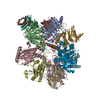 8qylC 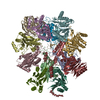 8qymC 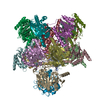 8qynC 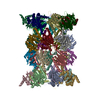 8qyoC 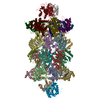 8qysC 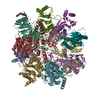 8qz9C M: map data used to model this data C: citing same article ( |
|---|---|
| Similar structure data |



-Links
 PDBj
PDBj

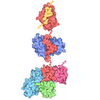
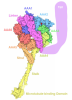
- Assembly
| Deposited unit | 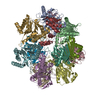
|
|---|---|
| 1 |
|
-Components
-Proteasome subunit alpha type- ... , 7 types, 7 molecules ABCDEFG
| #1: Protein | Mass: 25927.535 Da / Num. of mol.: 1 Source method: isolated from a genetically manipulated source Source: (gene. exp.) Homo sapiens (human) / Gene: PSMA2, HC3, PSC3 / Production host:  Trichoplusia ni (cabbage looper) / References: UniProt: P25787 Trichoplusia ni (cabbage looper) / References: UniProt: P25787 |
|---|---|
| #2: Protein | Mass: 29525.842 Da / Num. of mol.: 1 Source method: isolated from a genetically manipulated source Source: (gene. exp.) Homo sapiens (human) / Gene: PSMA4, HC9, PSC9 / Production host: Trichoplusia ni (cabbage looper) / References: UniProt: P25789 |
| #3: Protein | Mass: 27929.891 Da / Num. of mol.: 1 Source method: isolated from a genetically manipulated source Source: (gene. exp.) Homo sapiens (human) / Gene: PSMA7, HSPC / Production host: Trichoplusia ni (cabbage looper) / References: UniProt: O14818 |
| #4: Protein | Mass: 26462.016 Da / Num. of mol.: 1 Source method: isolated from a genetically manipulated source Source: (gene. exp.) Homo sapiens (human) / Gene: PSMA5 / Production host: Trichoplusia ni (cabbage looper) / References: UniProt: P28066 |
| #5: Protein | Mass: 29621.662 Da / Num. of mol.: 1 Source method: isolated from a genetically manipulated source Source: (gene. exp.) Homo sapiens (human) / Gene: PSMA1 / Production host: Trichoplusia ni (cabbage looper) / References: UniProt: P25786 |
| #6: Protein | Mass: 28469.252 Da / Num. of mol.: 1 Source method: isolated from a genetically manipulated source Source: (gene. exp.) Homo sapiens (human) / Gene: PSMA3, HC8, PSC8 / Production host: Trichoplusia ni (cabbage looper) / References: UniProt: P25788 |
| #7: Protein | Mass: 27432.459 Da / Num. of mol.: 1 Source method: isolated from a genetically manipulated source Source: (gene. exp.) Homo sapiens (human) / Gene: PSMA6, PROS27 / Production host: Trichoplusia ni (cabbage looper) / References: UniProt: P60900 |
-Protein , 2 types, 2 molecules HK
| #8: Protein | Mass: 15804.993 Da / Num. of mol.: 1 Source method: isolated from a genetically manipulated source Source: (gene. exp.) Homo sapiens (human) / Gene: POMP, C13orf12, UMP1, HSPC014, HSPC036, PNAS-110 / Production host: Trichoplusia ni (cabbage looper) / References: UniProt: Q9Y244 |
|---|---|
| #11: Protein | Mass: 34128.711 Da / Num. of mol.: 1 Source method: isolated from a genetically manipulated source Source: (gene. exp.) Homo sapiens (human) / Gene: PSMB7 / Production host: Trichoplusia ni (cabbage looper) / References: UniProt: Q99436 |
-Proteasome assembly chaperone ... , 4 types, 4 molecules IJLM
| #9: Protein | Mass: 32891.887 Da / Num. of mol.: 1 Source method: isolated from a genetically manipulated source Source: (gene. exp.) Homo sapiens (human) / Gene: PSMG1, C21LRP, DSCR2, PAC1 / Production host: Trichoplusia ni (cabbage looper) / References: UniProt: O95456 |
|---|---|
| #10: Protein | Mass: 29449.080 Da / Num. of mol.: 1 Source method: isolated from a genetically manipulated source Source: (gene. exp.) Homo sapiens (human) / Gene: PSMG2 / Production host: Trichoplusia ni (cabbage looper) / References: UniProt: Q969U7 |
| #12: Protein | Mass: 13118.439 Da / Num. of mol.: 1 Source method: isolated from a genetically manipulated source Source: (gene. exp.) Homo sapiens (human) / Gene: PSMG3, C7orf48, PAC3 / Production host: Trichoplusia ni (cabbage looper) / References: UniProt: Q9BT73 |
| #13: Protein | Mass: 13789.648 Da / Num. of mol.: 1 Source method: isolated from a genetically manipulated source Source: (gene. exp.) Homo sapiens (human) / Gene: PSMG4, C6orf86, PAC4 / Production host: Trichoplusia ni (cabbage looper) / References: UniProt: Q5JS54 |
-Details
| Has ligand of interest | N |
|---|---|
| Has protein modification | Y |
-Experimental details
-Experiment
| Experiment | Method: ELECTRON MICROSCOPY |
|---|---|
| EM experiment | Aggregation state: PARTICLE / 3D reconstruction method: single particle reconstruction |
- Sample preparation
| Component | Name: Human 20S proteasome assembly intermediate map 1 / Type: COMPLEX / Entity ID: all / Source: RECOMBINANT |
|---|---|
| Source (natural) | Organism: Homo sapiens (human) |
| Source (recombinant) | Organism: Trichoplusia ni (cabbage looper) |
| Buffer solution | pH: 7.5 |
| Specimen | Embedding applied: NO / Shadowing applied: NO / Staining applied: NO / Vitrification applied: YES |
| Vitrification | Cryogen name: ETHANE-PROPANE |
- Electron microscopy imaging
| Experimental equipment |  Model: Titan Krios / Image courtesy: FEI Company |
|---|---|
| Microscopy | Model: FEI TITAN KRIOS |
| Electron gun | Electron source:  FIELD EMISSION GUN / Accelerating voltage: 300 kV / Illumination mode: FLOOD BEAM FIELD EMISSION GUN / Accelerating voltage: 300 kV / Illumination mode: FLOOD BEAM |
| Electron lens | Mode: BRIGHT FIELD / Nominal defocus max: 2600 nm / Nominal defocus min: 1000 nm |
| Image recording | Electron dose: 66.9 e/Å2 / Film or detector model: GATAN K3 BIOQUANTUM (6k x 4k) |
- Processing
| EM software | Name: SerialEM / Category: image acquisition |
|---|---|
| CTF correction | Type: PHASE FLIPPING AND AMPLITUDE CORRECTION |
| 3D reconstruction | Resolution: 2.73 Å / Resolution method: FSC 0.143 CUT-OFF / Num. of particles: 318973 / Symmetry type: POINT |
