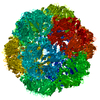
Movie
Movie Controller

[English] 日本語
 Yorodumi
- PDB-8qkp: Asymmetric structure of Satellite Tobacco Necrosis Virus-Like Par... -
+ Open data

- Basic information
| Entry | Database: PDB / ID: 8qkp | |||||||||
|---|---|---|---|---|---|---|---|---|---|---|
| Title | Asymmetric structure of Satellite Tobacco Necrosis Virus-Like Particle with PS2/3 gRNA | |||||||||
 Components Components | Capsid protein | |||||||||
 Keywords Keywords | VIRUS LIKE PARTICLE / STNV / CryoEM | |||||||||
| Function / homology |  Function and homology information Function and homology informationviral capsid / structural molecule activity / metal ion binding / RNA binding Similarity search - Function | |||||||||
| Biological species |  Satellite tobacco necrosis virus 1 Satellite tobacco necrosis virus 1 | |||||||||
| Method | ELECTRON MICROSCOPY / single particle reconstruction / cryo EM / Resolution: 5.26 Å | |||||||||
 Authors Authors | Javed, A. / Mata, P.C. / Stockley, P. | |||||||||
| Funding support |  United Kingdom, 1items United Kingdom, 1items
| |||||||||
 Citation Citation | Journal: J Mol Biol / Year: 2024 Title: Visualizing Viral RNA Packaging Signals in Action. Authors: Emma Wroblewski / Nikesh Patel / Abid Javed / Carlos P Mata / Rebecca Chandler-Bostock / B G Lekshmi / Sabine M Ulamec / Sam Clark / Simon E V Phillips / Neil A Ranson / Reidun Twarock / Peter G Stockley / Abstract: Here we confirm, using genome-scale RNA fragments in assembly competition assays, that multiple sub-sites (Packaging Signals, PSs) across the 5' two-thirds of the gRNA of Satellite Tobacco Necrosis ...Here we confirm, using genome-scale RNA fragments in assembly competition assays, that multiple sub-sites (Packaging Signals, PSs) across the 5' two-thirds of the gRNA of Satellite Tobacco Necrosis Virus-1 make sequence-specific contacts to the viral CPs helping to nucleate formation of its T = 1 virus-like particle (VLP). These contacts explain why natural virions only package their positive-sense genomes. Asymmetric cryo-EM reconstructions of these VLPs suggest that interactions occur between amino acid residues in the N-terminal ends of the CP subunits and the gRNA PS loop sequences. The base-paired stems of PSs also act non-sequence-specifically by electrostatically promoting the assembly of CP trimers. Importantly, alterations in PS-CP affinity result in an asymmetric distribution of bound PSs inside VLPs, with fuller occupation of the higher affinity 5' PS RNAs around one vertex, decreasing to an RNA-free opposite vertex within the VLP shell. This distribution suggests that gRNA folding regulates cytoplasmic genome extrusion so that the weakly bound 3' end of the gRNA, containing the RNA polymerase binding site, extrudes first. This probably occurs after cation-loss induced swelling of the CP-shell, weakening contacts between CP subunits. These data reveal for the first time in any virus how differential PS folding propensity and CP affinities support the multiple roles genomes play in virion assembly and infection. The high degree of conservation between the CP fold of STNV-1 and those of the CPs of many other viruses suggests that these aspects of genome function will be widely shared. | |||||||||
| History |
|
- Structure visualization
| Structure viewer | Molecule: MolmilJmol/JSmol |
|---|
- Downloads & links
-Download
| PDBx/mmCIF format | 8qkp.cif.gz | 1.9 MB | Display | PDBx/mmCIF format |
|---|---|---|---|---|
| PDB format | pdb8qkp.ent.gz | 1.6 MB | Display | PDB format |
| PDBx/mmJSON format | 8qkp.json.gz | Tree view | PDBx/mmJSON format | |
| Others |  Other downloads Other downloads |
-Validation report
| Arichive directory | https://data.pdbj.org/pub/pdb/validation_reports/qk/8qkpftp://data.pdbj.org/pub/pdb/validation_reports/qk/8qkp | HTTPS FTP |
|---|
-Related structure data
| Related structure data |  18469MC  8qkmC M: map data used to model this data C: citing same article ( |
|---|---|
| Similar structure data |

-Links
 PDBj
PDBj
- Assembly
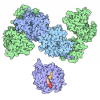
| Deposited unit | 
|
|---|---|
| 1 |
|
-Components
-Protein , 1 types, 60 molecules ABCDEFGHIJKLMNOPQRSTUVWXYZabcd...
| #1: Protein | Mass: 20766.531 Da / Num. of mol.: 60 Source method: isolated from a genetically manipulated source Source: (gene. exp.) Satellite tobacco necrosis virus 1 / Production host:   Escherichia coli (E. coli) / References: UniProt: P03606 Escherichia coli (E. coli) / References: UniProt: P03606 |
|---|
-Non-polymers , 5 types, 224 molecules 


| #2: Chemical | ChemComp-CA /  Mass: 40.078 Da / Num. of mol.: 92 / Source method: obtained synthetically / Formula: Ca / Feature type: SUBJECT OF INVESTIGATION Mass: 40.078 Da / Num. of mol.: 92 / Source method: obtained synthetically / Formula: Ca / Feature type: SUBJECT OF INVESTIGATION#3: Chemical | ChemComp-SRA / 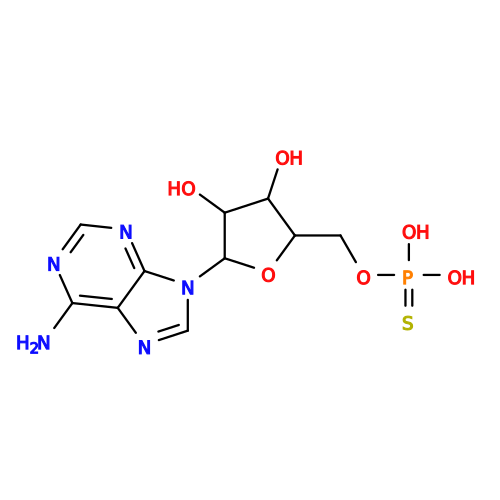 Type: RNA linking / Mass: 363.287 Da / Num. of mol.: 44 / Source method: obtained synthetically / Formula: C10H14N5O6PS Type: RNA linking / Mass: 363.287 Da / Num. of mol.: 44 / Source method: obtained synthetically / Formula: C10H14N5O6PS#4: Chemical | ChemComp-SSU /  Type: RNA linking / Mass: 340.247 Da / Num. of mol.: 44 / Source method: obtained synthetically / Formula: C9H13N2O8PS Type: RNA linking / Mass: 340.247 Da / Num. of mol.: 44 / Source method: obtained synthetically / Formula: C9H13N2O8PS#5: Chemical | ChemComp-G / 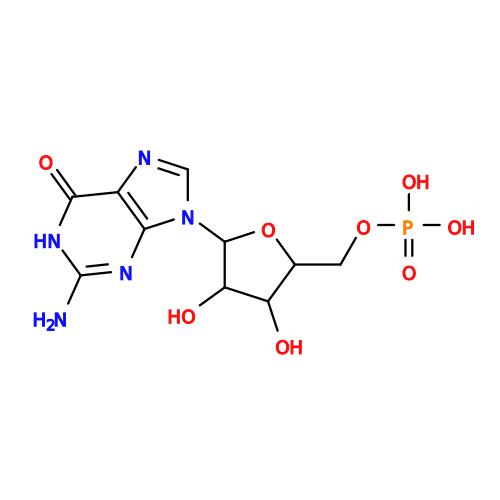 Type: RNA linking / Mass: 363.221 Da / Num. of mol.: 22 / Source method: obtained synthetically / Formula: C10H14N5O8P Type: RNA linking / Mass: 363.221 Da / Num. of mol.: 22 / Source method: obtained synthetically / Formula: C10H14N5O8P#6: Chemical | ChemComp-C /  Type: RNA linking / Mass: 323.197 Da / Num. of mol.: 22 / Source method: obtained synthetically / Formula: C9H14N3O8P Type: RNA linking / Mass: 323.197 Da / Num. of mol.: 22 / Source method: obtained synthetically / Formula: C9H14N3O8P |
|---|
-Details
| Has ligand of interest | Y |
|---|---|
| Has protein modification | N |
-Experimental details
-Experiment
| Experiment | Method: ELECTRON MICROSCOPY |
|---|---|
| EM experiment | Aggregation state: PARTICLE / 3D reconstruction method: single particle reconstruction |
- Sample preparation
| Component | Name: Satellite tobacco necrosis virus 1 / Type: VIRUS / Entity ID: #1 / Source: RECOMBINANT | |||||||||||||||
|---|---|---|---|---|---|---|---|---|---|---|---|---|---|---|---|---|
| Source (natural) | Organism: Satellite tobacco necrosis virus 1 | |||||||||||||||
| Source (recombinant) | Organism: Escherichia coli (E. coli) | |||||||||||||||
| Details of virus | Empty: NO / Enveloped: NO / Isolate: SPECIES / Type: VIRUS-LIKE PARTICLE | |||||||||||||||
| Natural host | Organism: Nicotiana tabacum | |||||||||||||||
| Virus shell | Diameter: 180 nm / Triangulation number (T number): 1 | |||||||||||||||
| Buffer solution | pH: 7.5 | |||||||||||||||
| Buffer component |
| |||||||||||||||
| Specimen | Conc.: 0.5 mg/ml / Embedding applied: NO / Shadowing applied: NO / Staining applied: NO / Vitrification applied: YES / Details: Purified STNV-1 VLP with PS 2/3 genomic RNA. | |||||||||||||||
| Specimen support | Grid mesh size: 400 divisions/in. / Grid type: PELCO Ultrathin Carbon with Lacey Carbon | |||||||||||||||
| Vitrification | Instrument: FEI VITROBOT MARK IV / Cryogen name: ETHANE / Humidity: 100 % / Chamber temperature: 277 K |
- Electron microscopy imaging
| Experimental equipment |  Model: Titan Krios / Image courtesy: FEI Company |
|---|---|
| Microscopy | Model: TFS KRIOS |
| Electron gun | Electron source:  FIELD EMISSION GUN / Accelerating voltage: 300 kV / Illumination mode: FLOOD BEAM FIELD EMISSION GUN / Accelerating voltage: 300 kV / Illumination mode: FLOOD BEAM |
| Electron lens | Mode: BRIGHT FIELD / Nominal magnification: 75000 X / Nominal defocus max: 3750 nm / Nominal defocus min: 1000 nm / Cs: 2.7 mm / C2 aperture diameter: 70 µm / Alignment procedure: ZEMLIN TABLEAU |
| Specimen holder | Cryogen: NITROGEN / Specimen holder model: FEI TITAN KRIOS AUTOGRID HOLDER |
| Image recording | Electron dose: 47.6 e/Å2 / Detector mode: INTEGRATING / Film or detector model: FEI FALCON III (4k x 4k) / Num. of grids imaged: 1 / Num. of real images: 9979 |
| Image scans | Movie frames/image: 39 |
- Processing
| EM software |
| |||||||||||||||||||||||||||||||||||||||||||||||||||||||
|---|---|---|---|---|---|---|---|---|---|---|---|---|---|---|---|---|---|---|---|---|---|---|---|---|---|---|---|---|---|---|---|---|---|---|---|---|---|---|---|---|---|---|---|---|---|---|---|---|---|---|---|---|---|---|---|---|
| CTF correction | Type: PHASE FLIPPING AND AMPLITUDE CORRECTION | |||||||||||||||||||||||||||||||||||||||||||||||||||||||
| Particle selection | Num. of particles selected: 509873 | |||||||||||||||||||||||||||||||||||||||||||||||||||||||
| Symmetry | Point symmetry: C1 (asymmetric) | |||||||||||||||||||||||||||||||||||||||||||||||||||||||
| 3D reconstruction | Resolution: 5.26 Å / Resolution method: FSC 0.143 CUT-OFF / Num. of particles: 81619 / Algorithm: FOURIER SPACE / Num. of class averages: 1 / Symmetry type: POINT | |||||||||||||||||||||||||||||||||||||||||||||||||||||||
| Atomic model building | B value: 265.1 / Protocol: RIGID BODY FIT / Space: REAL / Target criteria: Cross-correlation coefficient | |||||||||||||||||||||||||||||||||||||||||||||||||||||||
| Atomic model building | PDB-ID: 4bcu Accession code: 4bcu / Source name: PDB / Type: experimental model |