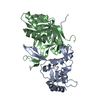
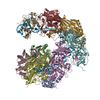
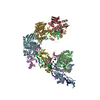
Journal: Nat Chem Biol / Year: 2024 Title: Cas1 mediates the interference stage in a phage-encoded CRISPR-Cas system. Authors: Laixing Zhang / Hao Wang / Jianwei Zeng / Xueli Cao / Zhengyu Gao / Zihe Liu / Feixue Li / Jiawei Wang / Yi Zhang / Maojun Yang / Yue Feng / Abstract: Clustered regularly interspaced short palindromic repeats (CRISPR)-Cas systems are prokaryotic adaptive immune systems against invading phages and other mobile genetic elements. Notably, some phages, ...Clustered regularly interspaced short palindromic repeats (CRISPR)-Cas systems are prokaryotic adaptive immune systems against invading phages and other mobile genetic elements. Notably, some phages, including the Vibrio cholerae-infecting ICP1 (International Center for Diarrheal Disease Research, Bangladesh cholera phage 1), harbor CRISPR-Cas systems to counteract host defenses. Nevertheless, ICP1 Cas8f lacks the helical bundle domain essential for recruitment of helicase-nuclease Cas2/3 during target DNA cleavage and how this system accomplishes the interference stage remains unknown. Here, we found that Cas1, a highly conserved component known to exclusively work in the adaptation stage, also mediates the interference stage through connecting Cas2/3 to the DNA-bound CRISPR-associated complex for antiviral defense (Cascade; CRISPR system yersinia, Csy) of the ICP1 CRISPR-Cas system. A series of structures of Csy, Csy-dsDNA (double-stranded DNA), Cas1-Cas2/3 and Csy-dsDNA-Cas1-Cas2/3 complexes reveal the whole process of Cas1-mediated target DNA cleavage by the ICP1 CRISPR-Cas system. Together, these data support an unprecedented model in which Cas1 mediates the interference stage in a phage-encoded CRISPR-Cas system and the study also sheds light on a unique model of primed adaptation.
In the structure databanks used in Yorodumi, some data are registered as the other names, "COVID-19 virus" and "2019-nCoV". Here are the details of the virus and the list of structure data.
Jan 31, 2019. EMDB accession codes are about to change! (news from PDBe EMDB page)
EMDB accession codes are about to change! (news from PDBe EMDB page)
The allocation of 4 digits for EMDB accession codes will soon come to an end. Whilst these codes will remain in use, new EMDB accession codes will include an additional digit and will expand incrementally as the available range of codes is exhausted. The current 4-digit format prefixed with “EMD-” (i.e. EMD-XXXX) will advance to a 5-digit format (i.e. EMD-XXXXX), and so on. It is currently estimated that the 4-digit codes will be depleted around Spring 2019, at which point the 5-digit format will come into force.
The EM Navigator/Yorodumi systems omit the EMD- prefix.
Related info.:Q: What is EMD? / ID/Accession-code notation in Yorodumi/EM Navigator
Yorodumi is a browser for structure data from EMDB, PDB, SASBDB, etc.
This page is also the successor to EM Navigator detail page, and also detail information page/front-end page for Omokage search.
The word "yorodu" (or yorozu) is an old Japanese word meaning "ten thousand". "mi" (miru) is to see.
Related info.:EMDB / PDB / SASBDB / Comparison of 3 databanks / Yorodumi Search / Aug 31, 2016. New EM Navigator & Yorodumi / Yorodumi Papers / Jmol/JSmol / Function and homology information / Changes in new EM Navigator and Yorodumi
 Movie
Movie Controller


 Open data
 Basic information
 Components
 Keywords
 Function and homology information
 Vibrio phage ICP1_2011_A (virus)
 X-RAY DIFFRACTION /
  Authors
 China, 1items
  Citation
 Structure visualization
 Downloads & links
 Other downloads


 PDBj
PDBj Assembly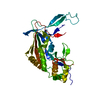

 Escherichia coli (E. coli) / References: UniProt: M1Q7R8
 Mass: 18.015 Da / Num. of mol.: 46 / Source method: isolated from a natural source / Formula: H2O
 Sample preparation
 Processing