positive regulation of somatic stem cell population maintenance / positive regulation of non-canonical Wnt signaling pathway / positive regulation of fibroblast apoptotic process / protein localization to centrosome / protein localization to Golgi apparatus / negative regulation of intracellular estrogen receptor signaling pathway / positive regulation of cell cycle G1/S phase transition / COPII vesicle coat assembly / protein localization to cilium / Developmental Lineage of Mammary Stem Cells ...positive regulation of somatic stem cell population maintenance / positive regulation of non-canonical Wnt signaling pathway / positive regulation of fibroblast apoptotic process / protein localization to centrosome / protein localization to Golgi apparatus / negative regulation of intracellular estrogen receptor signaling pathway / positive regulation of cell cycle G1/S phase transition / COPII vesicle coat assembly / protein localization to cilium / Developmental Lineage of Mammary Stem Cells / tau-protein kinase / The CRY:PER:kinase complex represses transactivation by the BMAL:CLOCK (ARNTL:CLOCK) complex / midbrain dopaminergic neuron differentiation / non-motile cilium assembly / Differentiation of Keratinocytes in Interfollicular Epidermis in Mammalian Skin / microtubule nucleation / COPII-mediated vesicle transport / negative regulation of cellular senescence / TP53 Regulates Transcription of Death Receptors and Ligands / Activation of PUMA and translocation to mitochondria / Regulation of TP53 Activity through Association with Co-factors / tau-protein kinase activity / Phosphorylation and nuclear translocation of the CRY:PER:kinase complex / WW domain binding / positive regulation of Notch signaling pathway / TP53 Regulates Transcription of Caspase Activators and Caspases / regulation of epidermal cell division / Golgi organization / TP53 Regulates Transcription of Genes Involved in Cytochrome C Release / Developmental Lineage of Mammary Gland Myoepithelial Cells / positive regulation of osteoblast differentiation / TP53 regulates transcription of several additional cell death genes whose specific roles in p53-dependent apoptosis remain uncertain / intrinsic apoptotic signaling pathway in response to DNA damage by p53 class mediator / establishment of skin barrier / Developmental Lineage of Mammary Gland Luminal Epithelial Cells / Notch signaling pathway / Pyroptosis / Major pathway of rRNA processing in the nucleolus and cytosol / spindle assembly / Loss of Nlp from mitotic centrosomes / Loss of proteins required for interphase microtubule organization from the centrosome / Recruitment of mitotic centrosome proteins and complexes / endoplasmic reticulum-Golgi intermediate compartment membrane / Recruitment of NuMA to mitotic centrosomes / Anchoring of the basal body to the plasma membrane / MDM2/MDM4 family protein binding / AURKA Activation by TPX2 / spindle microtubule / TP53 Regulates Metabolic Genes / RNA polymerase II transcription regulatory region sequence-specific DNA binding / circadian regulation of gene expression / protein tetramerization / promoter-specific chromatin binding / Wnt signaling pathway / endocytosis / regulation of circadian rhythm / spindle / p53 binding / positive regulation of canonical Wnt signaling pathway / positive regulation of proteasomal ubiquitin-dependent protein catabolic process / Regulation of PLK1 Activity at G2/M Transition / ciliary basal body / spermatogenesis / regulation of apoptotic process / DNA-binding transcription factor activity, RNA polymerase II-specific / protein kinase activity / protein phosphorylation / non-specific serine/threonine protein kinase / RNA polymerase II cis-regulatory region sequence-specific DNA binding / cadherin binding / DNA-binding transcription factor activity / protein serine kinase activity / negative regulation of DNA-templated transcription / protein serine/threonine kinase activity / apoptotic process / centrosome / positive regulation of cell population proliferation / chromatin binding / DNA damage response / dendrite / positive regulation of DNA-templated transcription / chromatin / perinuclear region of cytoplasm / Golgi apparatus / signal transduction / positive regulation of transcription by RNA polymerase II / protein-containing complex / DNA binding / DNA-templated transcription / nucleoplasm / ATP binding / metal ion binding / identical protein binding / nucleus / plasma membrane / cytosol / cytoplasm Similarity search - Function
Tumour protein p63, SAM domain / : / : / p53 family signature. / p53, tetramerisation domain / P53 tetramerisation motif / p53, DNA-binding domain / P53 DNA-binding domain / p53 tumour suppressor family / p53-like tetramerisation domain superfamily ...Tumour protein p63, SAM domain / : / : / p53 family signature. / p53, tetramerisation domain / P53 tetramerisation motif / p53, DNA-binding domain / P53 DNA-binding domain / p53 tumour suppressor family / p53-like tetramerisation domain superfamily / p53/RUNT-type transcription factor, DNA-binding domain superfamily / SAM domain (Sterile alpha motif) / p53-like transcription factor, DNA-binding / Sterile alpha motif. / Sterile alpha motif domain / Sterile alpha motif/pointed domain superfamily / Phosphorylase Kinase; domain 1 / Phosphorylase Kinase; domain 1 / Transferase(Phosphotransferase) domain 1 / Transferase(Phosphotransferase); domain 1 / Serine/threonine-protein kinase, active site / Serine/Threonine protein kinases active-site signature. / Protein kinase domain / Serine/Threonine protein kinases, catalytic domain / Protein kinase, ATP binding site / Protein kinases ATP-binding region signature. / Protein kinase domain profile. / Protein kinase domain / Protein kinase-like domain superfamily / 2-Layer Sandwich / Orthogonal Bundle / Mainly Alpha / Alpha Beta Similarity search - Domain/homology
Resolution: 2.08→46.6 Å / Cor.coef. Fo:Fc: 0.963 / Cor.coef. Fo:Fc free: 0.943 / SU B: 10.187 / SU ML: 0.128 / SU R Cruickshank DPI: 0.2041 / Cross valid method: THROUGHOUT / σ(F): 0 / ESU R: 0.204 / ESU R Free: 0.171 Details: U VALUES : WITH TLS ADDED HYDROGENS HAVE BEEN ADDED IN THE RIDING POSITIONS
Rfactor
Num. reflection
% reflection
Selection details
Rfree
0.2182
2017
4.9 %
RANDOM
Rwork
0.1754
-
-
-
obs
0.1775
39030
99.19 %
-
Solvent computation
Ion probe radii: 0.8 Å / Shrinkage radii: 0.8 Å / VDW probe radii: 1.2 Å
In the structure databanks used in Yorodumi, some data are registered as the other names, "COVID-19 virus" and "2019-nCoV". Here are the details of the virus and the list of structure data.
Jan 31, 2019. EMDB accession codes are about to change! (news from PDBe EMDB page)
EMDB accession codes are about to change! (news from PDBe EMDB page)
The allocation of 4 digits for EMDB accession codes will soon come to an end. Whilst these codes will remain in use, new EMDB accession codes will include an additional digit and will expand incrementally as the available range of codes is exhausted. The current 4-digit format prefixed with “EMD-” (i.e. EMD-XXXX) will advance to a 5-digit format (i.e. EMD-XXXXX), and so on. It is currently estimated that the 4-digit codes will be depleted around Spring 2019, at which point the 5-digit format will come into force.
The EM Navigator/Yorodumi systems omit the EMD- prefix.
Related info.:Q: What is EMD? / ID/Accession-code notation in Yorodumi/EM Navigator
Yorodumi is a browser for structure data from EMDB, PDB, SASBDB, etc.
This page is also the successor to EM Navigator detail page, and also detail information page/front-end page for Omokage search.
The word "yorodu" (or yorozu) is an old Japanese word meaning "ten thousand". "mi" (miru) is to see.
Related info.:EMDB / PDB / SASBDB / Comparison of 3 databanks / Yorodumi Search / Aug 31, 2016. New EM Navigator & Yorodumi / Yorodumi Papers / Jmol/JSmol / Function and homology information / Changes in new EM Navigator and Yorodumi
 Movie
Movie Controller

 Yorodumi
 Open data
 Basic information
 Components
 Keywords
 Function and homology information
 Homo sapiens (human)
 X-RAY DIFFRACTION /
  Authors
 Citation
 Structure visualization
 Downloads & links
 Other downloads
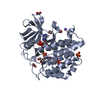


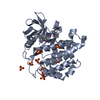
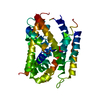
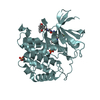

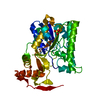

 PDBj
PDBj
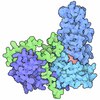
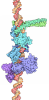
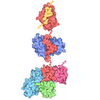
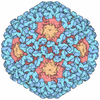
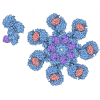
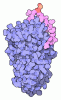
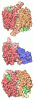
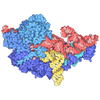
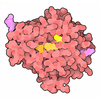
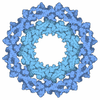
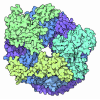
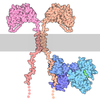
 Assembly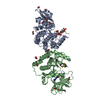

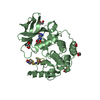

 Escherichia coli BL21(DE3) (bacteria) / Variant (production host): -R3-pRARE2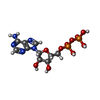


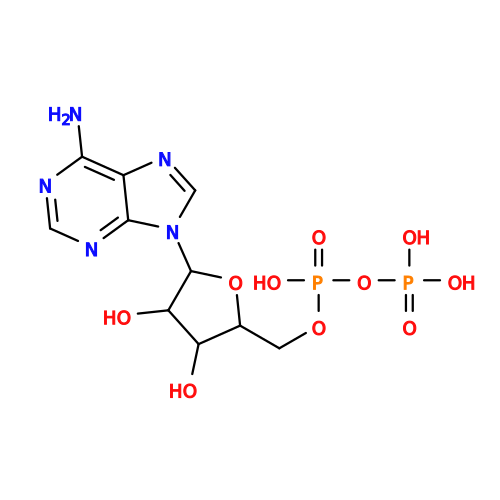 Mass: 427.201 Da / Num. of mol.: 2 / Source method: obtained synthetically / Formula: C10H15N5O10P2 / Comment: ADP, energy-carrying molecule*YM
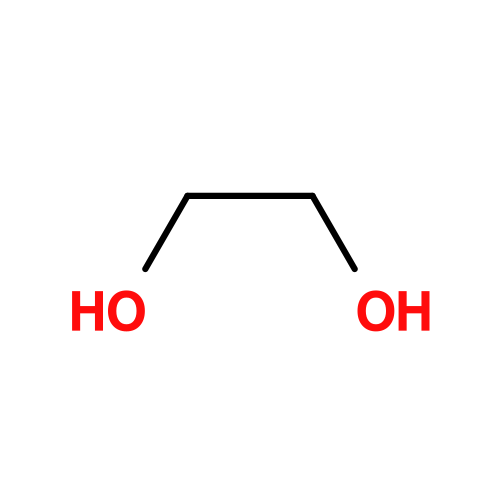 Mass: 62.068 Da / Num. of mol.: 17 / Source method: obtained synthetically / Formula: C2H6O2
 Mass: 22.990 Da / Num. of mol.: 1 / Source method: obtained synthetically / Formula: Na
 Sample preparation
 / Beamline: X06SA / Wavelength: 1 Å
 Processing