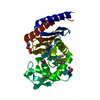
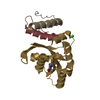
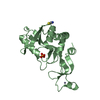
- PDB-6gy2: Crystal structure of human Plk1-PBD in complex with WSSSLATPPTLSS... -
+
Open data
ID or keywords:
Loading...
-
Basic information
Entry
Database: PDB / ID: 6gy2
Title
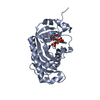
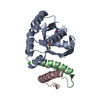
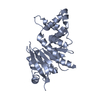
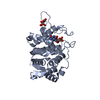
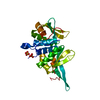
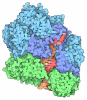
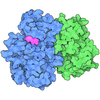
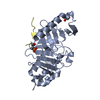
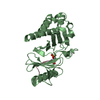
Crystal structure of human Plk1-PBD in complex with WSSSLATPPTLSSpTVLI phosphopeptide from BRCA2
Components
Phosphopeptide of BRCA2
Serine/threonine-protein kinase PLK1
Keywords
CELL CYCLE / phosphorylation / chromosomes alignement / DNA repair
Function / homology
Function and homology information
BRCA2-MAGE-D1 complex / negative regulation of mammary gland epithelial cell proliferation / Mitotic Telophase/Cytokinesis / regulation of protein localization to cell cortex / positive regulation of mitotic nuclear envelope disassembly / Mitotic Metaphase/Anaphase Transition / establishment of protein localization to telomere / Activation of NIMA Kinases NEK9, NEK6, NEK7 / polo kinase / mitotic recombination-dependent replication fork processing ...BRCA2-MAGE-D1 complex / negative regulation of mammary gland epithelial cell proliferation / Mitotic Telophase/Cytokinesis / regulation of protein localization to cell cortex / positive regulation of mitotic nuclear envelope disassembly / Mitotic Metaphase/Anaphase Transition / establishment of protein localization to telomere / Activation of NIMA Kinases NEK9, NEK6, NEK7 / polo kinase / mitotic recombination-dependent replication fork processing / Phosphorylation of Emi1 / metaphase/anaphase transition of mitotic cell cycle / double-strand break repair involved in meiotic recombination / DNA recombinase assembly / mitotic nuclear membrane disassembly / anaphase-promoting complex binding / synaptonemal complex / Phosphorylation of the APC/C / nuclear ubiquitin ligase complex / Golgi inheritance / astral microtubule organization / mitotic cleavage furrow formation / outer kinetochore / lateral element / gamma-tubulin binding / microtubule bundle formation / Impaired BRCA2 translocation to the nucleus / Impaired BRCA2 binding to SEM1 (DSS1) / mitotic chromosome condensation / regulation of mitotic spindle assembly / double-strand break repair via alternative nonhomologous end joining / HDR through MMEJ (alt-NHEJ) / Polo-like kinase mediated events / positive regulation of mitotic metaphase/anaphase transition / Golgi Cisternae Pericentriolar Stack Reorganization / Impaired BRCA2 binding to PALB2 / male meiosis I / DNA repair complex / telomere maintenance via recombination / centrosome cycle / sister chromatid cohesion / positive regulation of ubiquitin-dependent protein catabolic process / regulation of mitotic metaphase/anaphase transition / molecular function inhibitor activity / centriolar satellite / mitotic spindle assembly checkpoint signaling / mitotic spindle pole / regulation of DNA damage checkpoint / regulation of mitotic cell cycle phase transition / spindle midzone / Homologous DNA Pairing and Strand Exchange / Defective homologous recombination repair (HRR) due to BRCA1 loss of function / Defective HDR through Homologous Recombination Repair (HRR) due to PALB2 loss of BRCA1 binding function / Defective HDR through Homologous Recombination Repair (HRR) due to PALB2 loss of BRCA2/RAD51/RAD51C binding function / Resolution of D-loop Structures through Synthesis-Dependent Strand Annealing (SDSA) / mitotic G2 DNA damage checkpoint signaling / regulation of anaphase-promoting complex-dependent catabolic process / Resolution of D-loop Structures through Holliday Junction Intermediates / mitotic sister chromatid segregation / mitotic cytokinesis / Impaired BRCA2 binding to RAD51 / Presynaptic phase of homologous DNA pairing and strand exchange / negative regulation of double-strand break repair via homologous recombination / Regulation of MITF-M-dependent genes involved in cell cycle and proliferation / centrosome duplication / Cyclin A/B1/B2 associated events during G2/M transition / protein localization to chromatin / Loss of Nlp from mitotic centrosomes / Loss of proteins required for interphase microtubule organization from the centrosome / Amplification of signal from unattached kinetochores via a MAD2 inhibitory signal / Recruitment of mitotic centrosome proteins and complexes / centriole / Recruitment of NuMA to mitotic centrosomes / Anchoring of the basal body to the plasma membrane / Mitotic Prometaphase / secretory granule / EML4 and NUDC in mitotic spindle formation / AURKA Activation by TPX2 / Resolution of Sister Chromatid Cohesion / mitotic spindle organization / regulation of mitotic cell cycle / cellular response to ionizing radiation / regulation of cytokinesis / Condensation of Prophase Chromosomes / G2/M transition of mitotic cell cycle / establishment of protein localization / RHO GTPases Activate Formins / double-strand break repair via homologous recombination / positive regulation of protein localization to nucleus / nucleotide-excision repair / APC/C:Cdh1 mediated degradation of Cdc20 and other APC/C:Cdh1 targeted proteins in late mitosis/early G1 / Meiotic recombination / kinetochore / spindle / HDR through Homologous Recombination (HRR) / double-strand break repair / microtubule cytoskeleton / The role of GTSE1 in G2/M progression after G2 checkpoint / Separation of Sister Chromatids / positive regulation of proteasomal ubiquitin-dependent protein catabolic process Similarity search - Function
BRCA2, OB3 / Tower domain / Breast cancer type 2 susceptibility protein, helical domain / BRCA2 helical domain superfamily / : / : / BRCA2, oligonucleotide/oligosaccharide-binding, domain 3 / Tower / BRCA2, helical / BRCA2, OB2 ...BRCA2, OB3 / Tower domain / Breast cancer type 2 susceptibility protein, helical domain / BRCA2 helical domain superfamily / : / : / BRCA2, oligonucleotide/oligosaccharide-binding, domain 3 / Tower / BRCA2, helical / BRCA2, OB2 / BRCA2 TR2 domain / Tower / BRCA2 repeat / BRCA2, OB1 / Breast cancer type 2 susceptibility protein / BRCA2 repeat / BRCA2, oligonucleotide/oligosaccharide-binding, domain 1 / BRCA2 repeat profile. / POLO box domain / Polo-like kinase 1, catalytic domain / Second polo-box domain / First polo-box domain / POLO box domain superfamily / POLO box duplicated region / Arylsulfatase, C-terminal domain / POLO box domain / POLO box domain profile. / Serine/threonine-protein kinase, active site / Serine/Threonine protein kinases active-site signature. / Protein kinase domain / Serine/Threonine protein kinases, catalytic domain / Nucleic acid-binding, OB-fold / Protein kinase, ATP binding site / Protein kinases ATP-binding region signature. / Protein kinase domain profile. / Protein kinase domain / Protein kinase-like domain superfamily / 2-Layer Sandwich / Alpha Beta Similarity search - Domain/homology
Mass: 28193.098 Da / Num. of mol.: 2 Source method: isolated from a genetically manipulated source Details: the six first residues AMDPEF are part of LINKER / Source: (gene. exp.) Homo sapiens (human) / Gene: PLK1, PLK / Production host: Escherichia coli BL21(DE3) (bacteria) / References: UniProt: P53350, polo kinase
#2: Protein/peptide
PhosphopeptideofBRCA2
Mass: 1839.975 Da / Num. of mol.: 2 / Source method: obtained synthetically / Source: (synth.) Homo sapiens (human) / References: UniProt: P51587*PLUS
In the structure databanks used in Yorodumi, some data are registered as the other names, "COVID-19 virus" and "2019-nCoV". Here are the details of the virus and the list of structure data.
Jan 31, 2019. EMDB accession codes are about to change! (news from PDBe EMDB page)
EMDB accession codes are about to change! (news from PDBe EMDB page)
The allocation of 4 digits for EMDB accession codes will soon come to an end. Whilst these codes will remain in use, new EMDB accession codes will include an additional digit and will expand incrementally as the available range of codes is exhausted. The current 4-digit format prefixed with “EMD-” (i.e. EMD-XXXX) will advance to a 5-digit format (i.e. EMD-XXXXX), and so on. It is currently estimated that the 4-digit codes will be depleted around Spring 2019, at which point the 5-digit format will come into force.
The EM Navigator/Yorodumi systems omit the EMD- prefix.
Related info.:Q: What is EMD? / ID/Accession-code notation in Yorodumi/EM Navigator
Yorodumi is a browser for structure data from EMDB, PDB, SASBDB, etc.
This page is also the successor to EM Navigator detail page, and also detail information page/front-end page for Omokage search.
The word "yorodu" (or yorozu) is an old Japanese word meaning "ten thousand". "mi" (miru) is to see.
Related info.:EMDB / PDB / SASBDB / Comparison of 3 databanks / Yorodumi Search / Aug 31, 2016. New EM Navigator & Yorodumi / Yorodumi Papers / Jmol/JSmol / Function and homology information / Changes in new EM Navigator and Yorodumi
 Movie
Movie Controller

 Yorodumi
 Open data
 Basic information
 Components
 Keywords
 Function and homology information
 Homo sapiens (human)
 X-RAY DIFFRACTION /
  Authors
 France, 1items
  Citation
 Structure visualization
 Downloads & links
 Other downloads

 PDBj
PDBj

 Assembly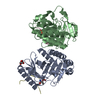

 Escherichia coli BL21(DE3) (bacteria) / References: UniProt: P53350, polo kinase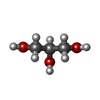
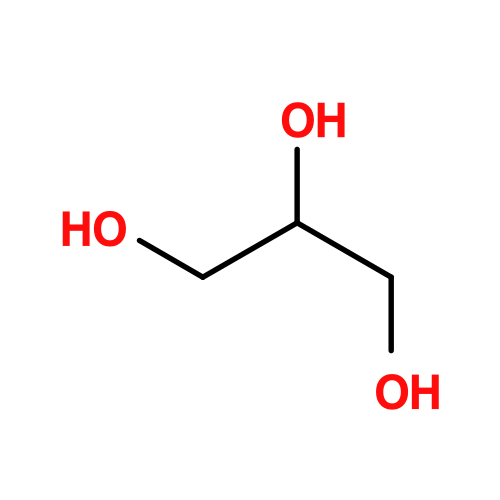 Mass: 92.094 Da / Num. of mol.: 1 / Source method: obtained synthetically / Formula: C3H8O3 / Source: (synth.)
  Mass: 18.015 Da / Num. of mol.: 22 / Source method: isolated from a natural source / Formula: H2O
 Sample preparation
 Processing