 Movie
Movie Controller


+ Open data

- Basic information
| Entry | Database: PDB / ID: 5ypf | ||||||
|---|---|---|---|---|---|---|---|
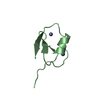
| Title | p62/SQSTM1 ZZ domain with Trp-peptide | ||||||
 Components Components | 78 kDa glucose-regulated protein,Sequestosome-1 | ||||||
 Keywords Keywords | SIGNALING PROTEIN / Complex / p62/SQSTM1 / ZZ domain / Autophagy / N-end rule | ||||||
| Function / homology |  Function and homology information Function and homology informationregulation of ATF6-mediated unfolded protein response / regulation of PERK-mediated unfolded protein response / regulation of protein folding in endoplasmic reticulum / cerebellum structural organization / brown fat cell proliferation / ATF6 (ATF6-alpha) activates chaperones / ATF6B (ATF6-beta) activates chaperones / maintenance of protein localization in endoplasmic reticulum / protein localization to perinuclear region of cytoplasm / regulation of Ras protein signal transduction ...regulation of ATF6-mediated unfolded protein response / regulation of PERK-mediated unfolded protein response / regulation of protein folding in endoplasmic reticulum / cerebellum structural organization / brown fat cell proliferation / ATF6 (ATF6-alpha) activates chaperones / ATF6B (ATF6-beta) activates chaperones / maintenance of protein localization in endoplasmic reticulum / protein localization to perinuclear region of cytoplasm / regulation of Ras protein signal transduction / IRE1alpha activates chaperones / protein targeting to vacuole involved in autophagy / ATF6 (ATF6-alpha) activates chaperone genes / intracellular membraneless organelle / endoplasmic reticulum chaperone complex / aggrephagy / negative regulation of IRE1-mediated unfolded protein response / regulation of IRE1-mediated unfolded protein response / negative regulation of toll-like receptor 4 signaling pathway / response to mitochondrial depolarisation / PERK regulates gene expression / amphisome / protein folding in endoplasmic reticulum / post-translational protein targeting to membrane, translocation / regulation of protein complex stability / cerebellar Purkinje cell layer development / autophagy of mitochondrion / misfolded protein binding / endosome organization / pexophagy / aggresome / membraneless organelle assembly / regulation of mitochondrion organization / phagophore assembly site / Modulation of host responses by IFN-stimulated genes / ubiquitin-modified protein reader activity / Nuclear events mediated by NFE2L2 / regulation of canonical NF-kappaB signal transduction / cellular response to stress / endosomal transport / K63-linked polyubiquitin modification-dependent protein binding / IRE1-mediated unfolded protein response / negative regulation of PERK-mediated unfolded protein response / temperature homeostasis / endoplasmic reticulum-Golgi intermediate compartment / energy homeostasis / Lewy body / non-chaperonin molecular chaperone ATPase / negative regulation of ferroptosis / autolysosome / intracellular membrane-bounded organelle / Regulation of HSF1-mediated heat shock response / molecular sequestering activity / protein serine/threonine kinase inhibitor activity / mitophagy / Dengue Virus Attachment and Entry / response to ischemia / negative regulation of protein-containing complex assembly / cellular response to glucose starvation / endoplasmic reticulum unfolded protein response / ERAD pathway / heat shock protein binding / negative regulation of protein ubiquitination / protein folding chaperone / SH2 domain binding / inclusion body / substantia nigra development / signaling adaptor activity / positive regulation of autophagy / response to endoplasmic reticulum stress / ionotropic glutamate receptor binding / sperm midpiece / autophagosome / protein import into nucleus / positive regulation of protein ubiquitination / p75NTR recruits signalling complexes / NF-kB is activated and signals survival / protein kinase C binding / Pexophagy / NRIF signals cell death from the nucleus / macroautophagy / positive regulation of long-term synaptic potentiation / sarcomere / PINK1-PRKN Mediated Mitophagy / Antigen Presentation: Folding, assembly and peptide loading of class I MHC / ubiquitin binding / Maturation of DENV proteins / positive regulation of protein localization to plasma membrane / autophagy / molecular condensate scaffold activity / protein catabolic process / protein refolding / protein sequestering activity / receptor tyrosine kinase binding / PML body / intracellular protein localization / cytoplasmic ribonucleoprotein granule / Interleukin-1 signaling / positive regulation of protein catabolic process / melanosome Similarity search - Function | ||||||
| Biological species |  Homo sapiens (human) Homo sapiens (human) | ||||||
| Method |  X-RAY DIFFRACTION / SYNCHROTRON / MOLECULAR REPLACEMENT / Resolution: 2.951 Å X-RAY DIFFRACTION / SYNCHROTRON / MOLECULAR REPLACEMENT / Resolution: 2.951 Å | ||||||
 Authors Authors | Kwon, D.H. / Kim, L. / Song, H.K. | ||||||
 Citation Citation | Journal: Nat Commun / Year: 2018 Title: Insights into degradation mechanism of N-end rule substrates by p62/SQSTM1 autophagy adapter. Authors: Kwon, D.H. / Park, O.H. / Kim, L. / Jung, Y.O. / Park, Y. / Jeong, H. / Hyun, J. / Kim, Y.K. / Song, H.K. | ||||||
| History |
|
- Structure visualization
| Structure viewer | Molecule: MolmilJmol/JSmol |
|---|
- Downloads & links
-Download
| PDBx/mmCIF format | 5ypf.cif.gz | 77.4 KB | Display | PDBx/mmCIF format |
|---|---|---|---|---|
| PDB format | pdb5ypf.ent.gz | 60.6 KB | Display | PDB format |
| PDBx/mmJSON format | 5ypf.json.gz | Tree view | PDBx/mmJSON format | |
| Others |  Other downloads Other downloads |
-Validation report
| Arichive directory | https://data.pdbj.org/pub/pdb/validation_reports/yp/5ypfftp://data.pdbj.org/pub/pdb/validation_reports/yp/5ypf | HTTPS FTP |
|---|
-Related structure data
| Related structure data |  5yp7C 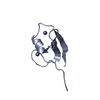 5yp8C 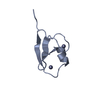 5ypaC 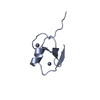 5ypbC  5ypcC 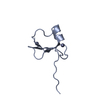 5ypeC 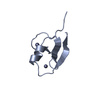 5ypgC 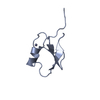 5yphC C: citing same article ( |
|---|---|
| Similar structure data |




-Links
 PDBj
PDBj
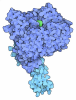

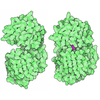
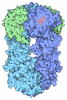
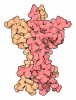
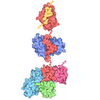
- Assembly
| Deposited unit | 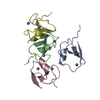
| ||||||||
|---|---|---|---|---|---|---|---|---|---|
| 1 | 
| ||||||||
| 2 | 
| ||||||||
| 3 | 
| ||||||||
| 4 | 
| ||||||||
| Unit cell |
|
-Components
| #1: Protein | Mass: 6542.330 Da / Num. of mol.: 4 Source method: isolated from a genetically manipulated source Source: (gene. exp.) Homo sapiens (human) / Gene: HSPA5, GRP78, SQSTM1, ORCA, OSIL / Production host:   Escherichia coli BL21(DE3) (bacteria) / Strain (production host): BL21(DE3) / References: UniProt: P11021, UniProt: Q13501 Escherichia coli BL21(DE3) (bacteria) / Strain (production host): BL21(DE3) / References: UniProt: P11021, UniProt: Q13501#2: Chemical | ChemComp-ZN /   Mass: 65.409 Da / Num. of mol.: 8 / Source method: obtained synthetically / Formula: Zn Mass: 65.409 Da / Num. of mol.: 8 / Source method: obtained synthetically / Formula: ZnSequence details | Trp (-3 position) is synthetic residue generated by special enzyme | |
|---|
-Experimental details
-Experiment
| Experiment | Method: X-RAY DIFFRACTION / Number of used crystals: 1 |
|---|
- Sample preparation
| Crystal | Density Matthews: 2.42 Å3/Da / Density % sol: 49.16 % |
|---|---|
| Crystal grow | Temperature: 293 K / Method: vapor diffusion / Details: PEG 2000, Tris |
-Data collection
| Diffraction | Mean temperature: 173 K |
|---|---|
| Diffraction source | Source: SYNCHROTRON / Site: SPring-8  / Beamline: BL44XU / Wavelength: 0.9 Å / Beamline: BL44XU / Wavelength: 0.9 Å |
| Detector | Type: MAR CCD 165 mm / Detector: CCD / Date: Aug 10, 2016 |
| Radiation | Protocol: SINGLE WAVELENGTH / Monochromatic (M) / Laue (L): M / Scattering type: x-ray |
| Radiation wavelength | Wavelength: 0.9 Å / Relative weight: 1 |
| Reflection | Resolution: 2.953→40.65 Å / Num. obs: 5464 / % possible obs: 99.9 % / Redundancy: 10.6 % / Net I/σ(I): 50 |
- Processing
| Software |
| |||||||||||||||||||||||||||||||||||
|---|---|---|---|---|---|---|---|---|---|---|---|---|---|---|---|---|---|---|---|---|---|---|---|---|---|---|---|---|---|---|---|---|---|---|---|---|
| Refinement | Method to determine structure: MOLECULAR REPLACEMENT / Resolution: 2.951→40.646 Å / SU ML: 0.39 / Cross valid method: FREE R-VALUE / σ(F): 1.36 / Phase error: 30.66 / Stereochemistry target values: ML
| |||||||||||||||||||||||||||||||||||
| Solvent computation | Shrinkage radii: 0.9 Å / VDW probe radii: 1.11 Å / Solvent model: FLAT BULK SOLVENT MODEL | |||||||||||||||||||||||||||||||||||
| Refinement step | Cycle: LAST / Resolution: 2.951→40.646 Å
| |||||||||||||||||||||||||||||||||||
| Refine LS restraints |
| |||||||||||||||||||||||||||||||||||
| LS refinement shell |
|
