- PDB-5vtb: Crystal structure of RBBP4 bound to BCL11a peptide -
+
Open data
ID or keywords:
Loading...
-
Basic information
Entry
Database: PDB / ID: 5vtb
Title
Crystal structure of RBBP4 bound to BCL11a peptide
Components
B-cell lymphoma/leukemia 11A
Histone-binding protein RBBP4
Keywords
PROTEIN BINDING / RBBP4 / Histone Binding protein / WD40 domain
Function / homology
Function and homology information
negative regulation of neuron remodeling / transcription regulatory region nucleic acid binding / negative regulation of branching morphogenesis of a nerve / negative regulation of dendrite extension / positive regulation of collateral sprouting / negative regulation of protein homooligomerization / negative regulation of collateral sprouting / CAF-1 complex / regulation of dendrite development / negative regulation of axon extension ...negative regulation of neuron remodeling / transcription regulatory region nucleic acid binding / negative regulation of branching morphogenesis of a nerve / negative regulation of dendrite extension / positive regulation of collateral sprouting / negative regulation of protein homooligomerization / negative regulation of collateral sprouting / CAF-1 complex / regulation of dendrite development / negative regulation of axon extension / negative regulation of dendrite development / NURF complex / NuRD complex / regulation of cell fate specification / Formation of the embryonic stem cell BAF (esBAF) complex / negative regulation of stem cell population maintenance / DNA replication-dependent chromatin assembly / cellular response to L-glutamate / regulation of stem cell differentiation / ALK mutants bind TKIs / ESC/E(Z) complex / Transcription of E2F targets under negative control by p107 (RBL1) and p130 (RBL2) in complex with HDAC1 / Formation of neuronal progenitor and neuronal BAF (npBAF and nBAF) / Polo-like kinase mediated events / Transcription of E2F targets under negative control by DREAM complex / paraspeckles / SWI/SNF complex / Sin3-type complex / G1/S-Specific Transcription / positive regulation of stem cell population maintenance / histone deacetylase complex / Transcriptional Regulation by E2F6 / RNA Polymerase I Transcription Initiation / G0 and Early G1 / protein sumoylation / Cyclin E associated events during G1/S transition / Transcriptional regulation of brown and beige adipocyte differentiation by EBF2 / Cyclin A:Cdk2-associated events at S phase entry / Regulation of TP53 Activity through Acetylation / negative regulation of cell migration / Deposition of new CENPA-containing nucleosomes at the centromere / negative regulation of transforming growth factor beta receptor signaling pathway / Regulation of PTEN gene transcription / brain development / ERCC6 (CSB) and EHMT2 (G9a) positively regulate rRNA expression / positive regulation of neuron projection development / PRC2 methylates histones and DNA / Regulation of endogenous retroelements by KRAB-ZFP proteins / negative regulation of neuron projection development / Defective pyroptosis / HDACs deacetylate histones / Regulation of endogenous retroelements by Piwi-interacting RNAs (piRNAs) / Negative Regulation of CDH1 Gene Transcription / DNA-binding transcription repressor activity, RNA polymerase II-specific / PKMTs methylate histone lysines / Activation of anterior HOX genes in hindbrain development during early embryogenesis / histone deacetylase binding / transcription coregulator activity / nuclear matrix / HCMV Early Events / Signaling by ALK fusions and activated point mutants / Regulation of PD-L1(CD274) transcription / nucleosome assembly / heterochromatin formation / histone binding / Oxidative Stress Induced Senescence / DNA-binding transcription factor binding / Potential therapeutics for SARS / nuclear body / DNA replication / chromosome, telomeric region / postsynapse / RNA polymerase II cis-regulatory region sequence-specific DNA binding / chromatin remodeling / DNA-binding transcription factor activity / negative regulation of cell population proliferation / protein heterodimerization activity / negative regulation of DNA-templated transcription / DNA repair / positive regulation of gene expression / regulation of transcription by RNA polymerase II / regulation of DNA-templated transcription / protein kinase binding / positive regulation of DNA-templated transcription / chromatin / negative regulation of transcription by RNA polymerase II / positive regulation of transcription by RNA polymerase II / protein homodimerization activity / protein-containing complex / DNA-templated transcription / nucleoplasm / zinc ion binding / nucleus / cytosol / cytoplasm Similarity search - Function
In the structure databanks used in Yorodumi, some data are registered as the other names, "COVID-19 virus" and "2019-nCoV". Here are the details of the virus and the list of structure data.
Jan 31, 2019. EMDB accession codes are about to change! (news from PDBe EMDB page)
EMDB accession codes are about to change! (news from PDBe EMDB page)
The allocation of 4 digits for EMDB accession codes will soon come to an end. Whilst these codes will remain in use, new EMDB accession codes will include an additional digit and will expand incrementally as the available range of codes is exhausted. The current 4-digit format prefixed with “EMD-” (i.e. EMD-XXXX) will advance to a 5-digit format (i.e. EMD-XXXXX), and so on. It is currently estimated that the 4-digit codes will be depleted around Spring 2019, at which point the 5-digit format will come into force.
The EM Navigator/Yorodumi systems omit the EMD- prefix.
Related info.:Q: What is EMD? / ID/Accession-code notation in Yorodumi/EM Navigator
Yorodumi is a browser for structure data from EMDB, PDB, SASBDB, etc.
This page is also the successor to EM Navigator detail page, and also detail information page/front-end page for Omokage search.
The word "yorodu" (or yorozu) is an old Japanese word meaning "ten thousand". "mi" (miru) is to see.
Related info.:EMDB / PDB / SASBDB / Comparison of 3 databanks / Yorodumi Search / Aug 31, 2016. New EM Navigator & Yorodumi / Yorodumi Papers / Jmol/JSmol / Function and homology information / Changes in new EM Navigator and Yorodumi
 Movie
Movie Controller


 Open data
 Basic information
 Components
 Keywords
 Function and homology information
 Homo sapiens (human)
 X-RAY DIFFRACTION /
  Authors
 Citation
 Structure visualization
 Downloads & links
 Other downloads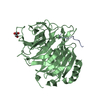
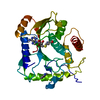

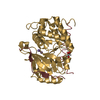
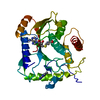

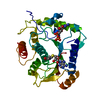

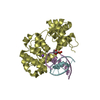
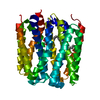

 PDBj
PDBj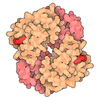
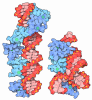
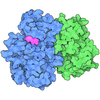

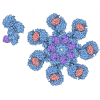
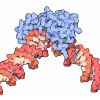
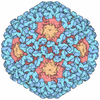

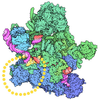
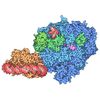
 Assembly
 unidentified baculovirus / References: UniProt: Q09028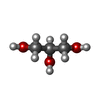
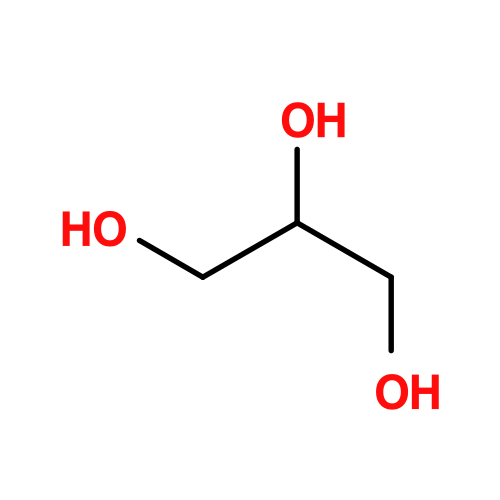 Mass: 92.094 Da / Num. of mol.: 1 / Source method: obtained synthetically / Formula: C3H8O3
 Mass: 18.015 Da / Num. of mol.: 140 / Source method: isolated from a natural source / Formula: H2O
 Sample preparation
 / Beamline: 21-ID-G / Wavelength: 0.9786 Å
 Processing