negative regulation of glucose catabolic process to lactate via pyruvate / regulation of fibroblast apoptotic process / Formation of Senescence-Associated Heterochromatin Foci (SAHF) / Regulation of TP53 Expression / Regulation of TP53 Activity through Acetylation / Transcriptional activation of cell cycle inhibitor p21 / Regulation of TP53 Activity through Association with Co-factors / regulation of thymocyte apoptotic process / PI5P Regulates TP53 Acetylation / RUNX3 regulates CDKN1A transcription ...negative regulation of glucose catabolic process to lactate via pyruvate / regulation of fibroblast apoptotic process / Formation of Senescence-Associated Heterochromatin Foci (SAHF) / Regulation of TP53 Expression / Regulation of TP53 Activity through Acetylation / Transcriptional activation of cell cycle inhibitor p21 / Regulation of TP53 Activity through Association with Co-factors / regulation of thymocyte apoptotic process / PI5P Regulates TP53 Acetylation / RUNX3 regulates CDKN1A transcription / regulation of intrinsic apoptotic signaling pathway by p53 class mediator / intrinsic apoptotic signaling pathway in response to hypoxia / negative regulation of miRNA processing / regulation of tissue remodeling / positive regulation of mitochondrial membrane permeability / DNA Damage/Telomere Stress Induced Senescence / G2/M DNA damage checkpoint / fibroblast proliferation / regulation of mitochondrial membrane permeability involved in apoptotic process / Stabilization of p53 / histone deacetylase regulator activity / negative regulation of DNA biosynthetic process / Regulation of TP53 Activity through Methylation / cardiac septum morphogenesis / Regulation of TP53 Degradation / Oncogene Induced Senescence / T cell proliferation involved in immune response / Autodegradation of the E3 ubiquitin ligase COP1 / G2/M Checkpoints / B cell lineage commitment / T cell lineage commitment / Ovarian tumor domain proteases / negative regulation of neuroblast proliferation / Recruitment and ATM-mediated phosphorylation of repair and signaling proteins at DNA double strand breaks / regulation of DNA damage response, signal transduction by p53 class mediator / PKR-mediated signaling / regulation of cellular senescence / gastrulation / The role of GTSE1 in G2/M progression after G2 checkpoint / cellular response to UV-C / mitochondrial DNA repair / Oxidative Stress Induced Senescence / Regulation of TP53 Activity through Phosphorylation / necroptotic process / somitogenesis / negative regulation of mitotic cell cycle / positive regulation of leukocyte migration / embryo development ending in birth or egg hatching / Ub-specific processing proteases / negative regulation of mitophagy / negative regulation of DNA replication / signal transduction by p53 class mediator / negative regulation of G1 to G0 transition / negative regulation of pentose-phosphate shunt / ATP-dependent DNA/DNA annealing activity / regulation of cell cycle G2/M phase transition / oligodendrocyte apoptotic process / positive regulation of thymocyte apoptotic process / oxidative stress-induced premature senescence / bone marrow development / rRNA transcription / circadian behavior / cellular response to actinomycin D / positive regulation of programmed necrotic cell death / negative regulation of reactive oxygen species metabolic process / mRNA transcription / embryonic organ development / ER overload response / hematopoietic stem cell differentiation / cellular response to stress / response to X-ray / chromosome organization / multicellular organism growth / intrinsic apoptotic signaling pathway by p53 class mediator / entrainment of circadian clock by photoperiod / positive regulation of release of cytochrome c from mitochondria / hematopoietic progenitor cell differentiation / negative regulation of telomere maintenance via telomerase / intrinsic apoptotic signaling pathway in response to DNA damage by p53 class mediator / response to UV / replicative senescence / TFIID-class transcription factor complex binding / intrinsic apoptotic signaling pathway in response to endoplasmic reticulum stress / viral process / response to salt stress / positive regulation of intrinsic apoptotic signaling pathway / negative regulation of proteolysis / T cell differentiation in thymus / cerebellum development / determination of adult lifespan / positive regulation of RNA polymerase II transcription preinitiation complex assembly / negative regulation of fibroblast proliferation / general transcription initiation factor binding / transforming growth factor beta receptor signaling pathway / positive regulation of execution phase of apoptosis / transcription repressor complex / type II interferon-mediated signaling pathway / neuron apoptotic process / positive regulation of cardiac muscle cell apoptotic process / response to ischemia Similarity search - Function
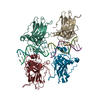
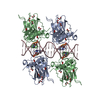
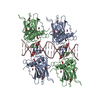
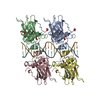
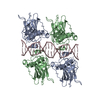
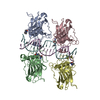
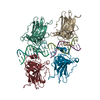
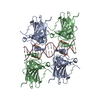
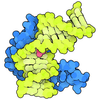
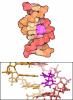
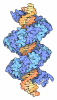
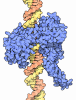
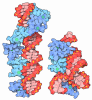
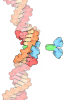
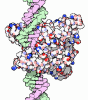
The complete crystallized DNA sequence is 5'-TTGAGCATGCTCGAGCATGCTCA-3'. The sequence in the ...The complete crystallized DNA sequence is 5'-TTGAGCATGCTCGAGCATGCTCA-3'. The sequence in the asymmetric unit is only half of the complete sequence (GAGCATGCTCA for chain C and GAGCATGTCTC for chain D. The biological unit isgenerated by applying the (-X, Y, -Z) symmetry.
In the structure databanks used in Yorodumi, some data are registered as the other names, "COVID-19 virus" and "2019-nCoV". Here are the details of the virus and the list of structure data.
Jan 31, 2019. EMDB accession codes are about to change! (news from PDBe EMDB page)
EMDB accession codes are about to change! (news from PDBe EMDB page)
The allocation of 4 digits for EMDB accession codes will soon come to an end. Whilst these codes will remain in use, new EMDB accession codes will include an additional digit and will expand incrementally as the available range of codes is exhausted. The current 4-digit format prefixed with “EMD-” (i.e. EMD-XXXX) will advance to a 5-digit format (i.e. EMD-XXXXX), and so on. It is currently estimated that the 4-digit codes will be depleted around Spring 2019, at which point the 5-digit format will come into force.
The EM Navigator/Yorodumi systems omit the EMD- prefix.
Related info.:Q: What is EMD? / ID/Accession-code notation in Yorodumi/EM Navigator
Yorodumi is a browser for structure data from EMDB, PDB, SASBDB, etc.
This page is also the successor to EM Navigator detail page, and also detail information page/front-end page for Omokage search.
The word "yorodu" (or yorozu) is an old Japanese word meaning "ten thousand". "mi" (miru) is to see.
Related info.:EMDB / PDB / SASBDB / Comparison of 3 databanks / Yorodumi Search / Aug 31, 2016. New EM Navigator & Yorodumi / Yorodumi Papers / Jmol/JSmol / Function and homology information / Changes in new EM Navigator and Yorodumi
 Movie
Movie Controller


 Open data
 Basic information
 Components
 Keywords
 Function and homology information
 Mus musculus (house mouse)
 X-RAY DIFFRACTION /
  Authors
 Citation
 Structure visualization
 Downloads & links
 Other downloads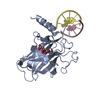

 PDBj
PDBj

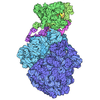
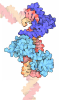
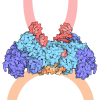
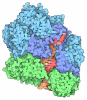
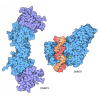
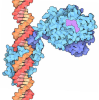
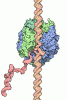
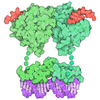
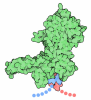

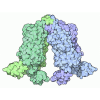
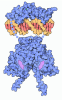
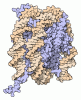
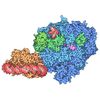
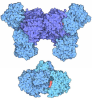
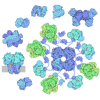
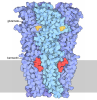
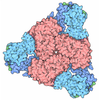
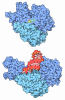
 Assembly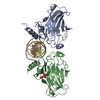
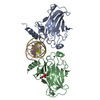

 Escherichia coli (E. coli) / References: UniProt: P02340
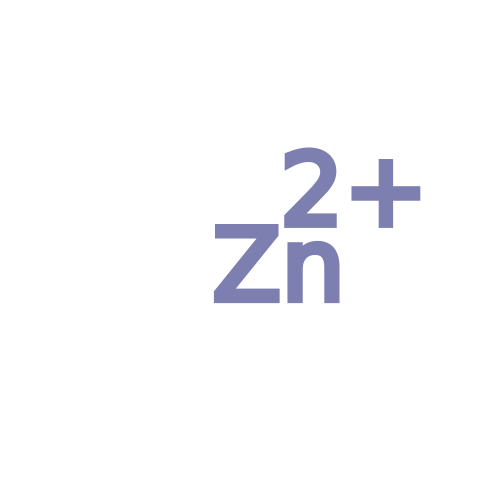 Mass: 65.409 Da / Num. of mol.: 2 / Source method: obtained synthetically / Formula: Zn
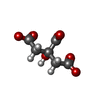
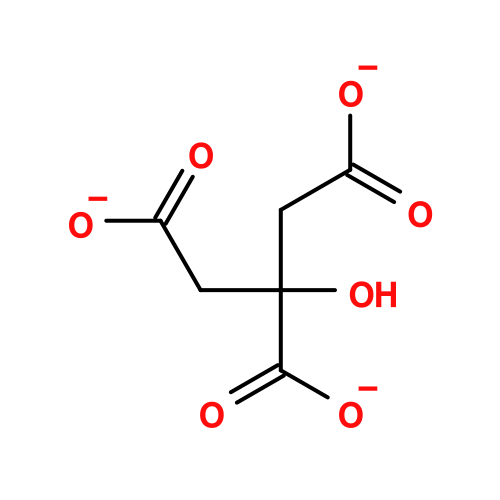 Mass: 189.100 Da / Num. of mol.: 1 / Source method: obtained synthetically / Formula: C6H5O7
 Sample preparation
 / Beamline: 23-ID-B
 Processing