 Movie
Movie Controller


+ Open data

- Basic information
| Entry | Database: PDB / ID: 30gt | |||||||||||||||
|---|---|---|---|---|---|---|---|---|---|---|---|---|---|---|---|---|
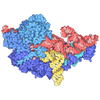
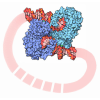
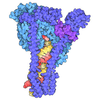
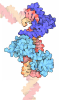
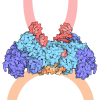
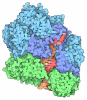
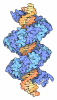
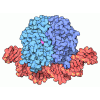
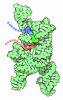
| Title | Cryo-EM structure of the PseCascade-TniQ-TnsC complex | |||||||||||||||
 Components Components |
| |||||||||||||||
 Keywords Keywords | DNA BINDING PROTEIN / Transposase / DNA-binding / RNA-binding / CRISPR-Cas / CRISPR-associated transposon | |||||||||||||||
| Function / homology |  Function and homology information Function and homology information | |||||||||||||||
| Biological species |  Pseudoalteromonas sp. S983 (bacteria) Pseudoalteromonas sp. S983 (bacteria) | |||||||||||||||
| Method | ELECTRON MICROSCOPY / single particle reconstruction / cryo EM / Resolution: 3.3 Å | |||||||||||||||
 Authors Authors | Finocchio, G. / Oberli, S. / Schmitz, M. / Jinek, M. | |||||||||||||||
| Funding support | European Union,  Switzerland, 2items Switzerland, 2items
| |||||||||||||||
 Citation Citation | Journal: bioRxiv / Year: 2026 Title: Structural basis of RNA-guided DNA integration by type I CRISPR-associated transposases. Authors: Giada Finocchio / Seraina Oberli / George Lampe / Michael Schmitz / Samuel H Sternberg / Martin Jinek /  Abstract: CRISPR-associated transposases (CASTs) achieve site-specific DNA integration by coupling the RNA-guided targeting action of a nuclease-deficient CRISPR-Cas system with the assembly of a Tn7-like ...CRISPR-associated transposases (CASTs) achieve site-specific DNA integration by coupling the RNA-guided targeting action of a nuclease-deficient CRISPR-Cas system with the assembly of a Tn7-like transpososome complex. Understanding the detailed mechanisms of this elaborate process is paramount to engineering CAST systems into programmable genetic tools. The type I-F CAST (CAST) displays the highest activity in mammalian cells to date and has been the subject of extensive directed evolution, but efforts to rationally engineer further improvements have been hampered by critical gaps in our understanding of transpososome assembly and activation. Here we use cryo-EM structural analysis, validated by DNA transposition assays, to visualize the CAST system in a series of functional states that define the stepwise mechanism of RNA-guided DNA integration. The structure of a target DNA-bound Cascade-TniQ-TnsC complex reveals that conformational changes induced by R-loop formation are coupled to target DNA stabilization and TnsC heptamerization, which in turn recruits the TnsAB transposase via conserved interactions with its C-terminal tail. Finally, the structure of the 1.2 MDa CAST transpososome holocomplex reveals specific TnsC-TnsB and TnsB-target DNA interactions that drive allosteric remodelling of the TnsB catalytic site to activate donor DNA integration. Together, these findings establish a unified structural and mechanistic blueprint for RNA-guided DNA integration and lay the foundation for engineering next-generation DNA insertion systems for genome editing applications. | |||||||||||||||
| History |
|
- Structure visualization
| Structure viewer | Molecule: MolmilJmol/JSmol |
|---|
- Downloads & links
-Download
| PDBx/mmCIF format | 30gt.cif.gz | 1.2 MB | Display | PDBx/mmCIF format |
|---|---|---|---|---|
| PDB format | pdb30gt.ent.gz | 1 MB | Display | PDB format |
| PDBx/mmJSON format | 30gt.json.gz | Tree view | PDBx/mmJSON format | |
| Others |  Other downloads Other downloads |
-Validation report
| Arichive directory | https://data.pdbj.org/pub/pdb/validation_reports/0g/30gtftp://data.pdbj.org/pub/pdb/validation_reports/0g/30gt | HTTPS FTP |
|---|
-Related structure data
| Related structure data |  57765MC  30gaC  30gbC C: citing same article ( M: map data used to model this data |
|---|---|
| Similar structure data |


-Links
 PDBj
PDBj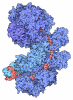
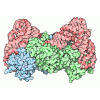
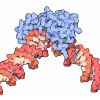
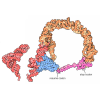
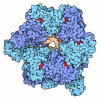
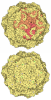
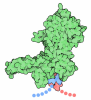
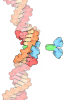
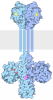

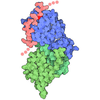
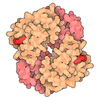
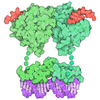
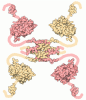
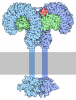
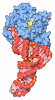
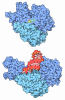
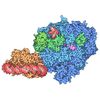
- Assembly
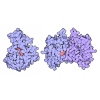
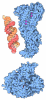
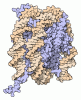
| Deposited unit | 
|
|---|---|
| 1 |
|
-Components
-RNA chain , 1 types, 1 molecules 1
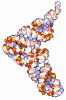
| #1: RNA chain | Mass: 30196.002 Da / Num. of mol.: 1 Source method: isolated from a genetically manipulated source Details: CRISPR RNA (crRNA) from the type I-F PseCAST (Tn7016) Cascade complex of Pseudoalteromonas sp. S983 Source: (gene. exp.) Pseudoalteromonas sp. S983 (bacteria) / Production host:  Escherichia coli BL21(DE3) (bacteria) Escherichia coli BL21(DE3) (bacteria) |
|---|
-DNA chain , 2 types, 2 molecules 23
| #2: DNA chain | Mass: 44605.438 Da / Num. of mol.: 1 / Source method: obtained synthetically Details: Target DNA strand complementary to the crRNA spacer sequence, fused to the transferred strand of the right transposon end via a palindromic target site duplication (TSD) sequence. TSD and ...Details: Target DNA strand complementary to the crRNA spacer sequence, fused to the transferred strand of the right transposon end via a palindromic target site duplication (TSD) sequence. TSD and right transposon end are unstructured. Source: (synth.) Pseudoalteromonas sp. S983 (bacteria) |
|---|---|
| #3: DNA chain | Mass: 29085.531 Da / Num. of mol.: 1 / Source method: obtained synthetically Details: Non-target DNA strand containing a +1 to +18 region identical to the target DNA strand, rather than complementary, to facilitate crRNA annealing to the protospacer. Source: (synth.) Pseudoalteromonas sp. S983 (bacteria) |
-Protein , 5 types, 17 molecules ABCDEFGHIJKLMNOPQ
| #4: Protein | Mass: 39845.145 Da / Num. of mol.: 6 Source method: isolated from a genetically manipulated source Details: CRISPR-associated protein Cas7 from the type I-F PseCAST (Tn7016) Cascade complex of Pseudoalteromonas sp. S983. Source: (gene. exp.) Pseudoalteromonas sp. S983 (bacteria) / Production host: Escherichia coli BL21(DE3) (bacteria) / References: UniProt: A0ABF7PQB9#5: Protein | | Mass: 79290.211 Da / Num. of mol.: 1 Source method: isolated from a genetically manipulated source Details: CRISPR-associated protein Cas8 from the type I-F PseCAST (Tn7016) Cascade complex of Pseudoalteromonas sp. S983. Source: (gene. exp.) Pseudoalteromonas sp. S983 (bacteria) / Production host: Escherichia coli BL21(DE3) (bacteria) / References: UniProt: A0ABF7PQB8#6: Protein | | Mass: 26631.074 Da / Num. of mol.: 1 Source method: isolated from a genetically manipulated source Details: CRISPR-associated protein Cas6 from the type I-F PseCAST (Tn7016) Cascade complex of Pseudoalteromonas sp. S983, bearing a C-terminal Twin-Strep tag. Source: (gene. exp.) Pseudoalteromonas sp. S983 (bacteria) / Production host: Escherichia coli BL21(DE3) (bacteria) / References: UniProt: A0ABF7PQC0#7: Protein | Mass: 49832.406 Da / Num. of mol.: 2 Source method: isolated from a genetically manipulated source Details: CRISPR-associated protein TniQ from the type I-F PseCAST (Tn7016) system of Pseudoalteromonas sp. S983, bearing an N-terminal His10 tag followed by a TEV protease cleavage site. Source: (gene. exp.) Pseudoalteromonas sp. S983 (bacteria) / Production host: Escherichia coli BL21(DE3) (bacteria) / References: UniProt: A0ABF7PQC1#8: Protein | Mass: 38609.902 Da / Num. of mol.: 7 Source method: isolated from a genetically manipulated source Details: AAA+ ATPase TnsC from the type I-F PseCAST (Tn7016) system of Pseudoalteromonas sp. S983. Source: (gene. exp.) Pseudoalteromonas sp. S983 (bacteria) / Production host: Escherichia coli BL21(DE3) (bacteria) |
|---|
-Non-polymers , 2 types, 14 molecules 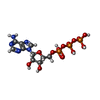

| #9: Chemical | ChemComp-ATP / 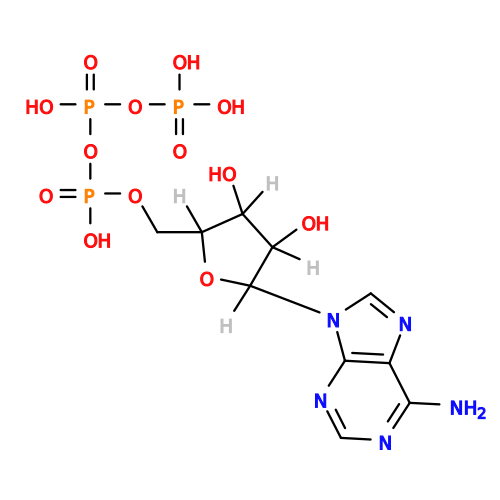 Mass: 507.181 Da / Num. of mol.: 7 / Source method: obtained synthetically / Formula: C10H16N5O13P3 / Feature type: SUBJECT OF INVESTIGATION / Comment: ATP, energy-carrying molecule*YM Mass: 507.181 Da / Num. of mol.: 7 / Source method: obtained synthetically / Formula: C10H16N5O13P3 / Feature type: SUBJECT OF INVESTIGATION / Comment: ATP, energy-carrying molecule*YM#10: Chemical | ChemComp-MG /  Mass: 24.305 Da / Num. of mol.: 7 / Source method: obtained synthetically / Formula: Mg / Feature type: SUBJECT OF INVESTIGATION Mass: 24.305 Da / Num. of mol.: 7 / Source method: obtained synthetically / Formula: Mg / Feature type: SUBJECT OF INVESTIGATION |
|---|
-Details
| Has ligand of interest | Y |
|---|---|
| Has protein modification | Y |
-Experimental details
-Experiment
| Experiment | Method: ELECTRON MICROSCOPY |
|---|---|
| EM experiment | Aggregation state: PARTICLE / 3D reconstruction method: single particle reconstruction |
- Sample preparation
| Component | Name: PseCascade-TniQ-TnsC complex / Type: COMPLEX Details: PseCascade-TniQ-TnsC complex. The CRISPR RNA (crRNA) is base-paired with a double-stranded DNA target. Entity ID: #1-#8 / Source: RECOMBINANT | ||||||||||||||||||||||||||||||
|---|---|---|---|---|---|---|---|---|---|---|---|---|---|---|---|---|---|---|---|---|---|---|---|---|---|---|---|---|---|---|---|
| Molecular weight | Value: 0.73 MDa / Experimental value: NO | ||||||||||||||||||||||||||||||
| Source (natural) | Organism: Pseudoalteromonas sp. S983 (bacteria) | ||||||||||||||||||||||||||||||
| Source (recombinant) | Organism: Escherichia coli BL21(DE3) (bacteria) | ||||||||||||||||||||||||||||||
| Buffer solution | pH: 7.5 | ||||||||||||||||||||||||||||||
| Buffer component |
| ||||||||||||||||||||||||||||||
| Specimen | Conc.: 4.4 mg/ml / Embedding applied: NO / Shadowing applied: NO / Staining applied: NO / Vitrification applied: YES Details: The sample was prepared by mixing and incubating the nucleic acid substrate and the protein components. | ||||||||||||||||||||||||||||||
| Specimen support | Grid material: GOLD / Grid mesh size: 300 divisions/in. / Grid type: Quantifoil R1.2/1.3 | ||||||||||||||||||||||||||||||
| Vitrification | Instrument: FEI VITROBOT MARK IV / Cryogen name: ETHANE / Humidity: 100 % / Chamber temperature: 277.15 K |
- Electron microscopy imaging
| Experimental equipment |  Model: Titan Krios / Image courtesy: FEI Company |
|---|---|
| Microscopy | Model: TFS KRIOS |
| Electron gun | Electron source:  FIELD EMISSION GUN / Accelerating voltage: 300 kV / Illumination mode: FLOOD BEAM FIELD EMISSION GUN / Accelerating voltage: 300 kV / Illumination mode: FLOOD BEAM |
| Electron lens | Mode: BRIGHT FIELD / Nominal magnification: 130000 X / Nominal defocus max: 2400 nm / Nominal defocus min: 1000 nm |
| Specimen holder | Cryogen: NITROGEN / Specimen holder model: FEI TITAN KRIOS AUTOGRID HOLDER |
| Image recording | Average exposure time: 1.25 sec. / Electron dose: 59.672 e/Å2 / Detector mode: SUPER-RESOLUTION / Film or detector model: GATAN K3 (6k x 4k) / Num. of grids imaged: 1 / Num. of real images: 9403 |
| Image scans | Width: 5760 / Height: 4092 |
- Processing
| EM software |
| ||||||||||||||||||||||||||||||||||||||||||||||||||
|---|---|---|---|---|---|---|---|---|---|---|---|---|---|---|---|---|---|---|---|---|---|---|---|---|---|---|---|---|---|---|---|---|---|---|---|---|---|---|---|---|---|---|---|---|---|---|---|---|---|---|---|
| CTF correction | Type: PHASE FLIPPING AND AMPLITUDE CORRECTION | ||||||||||||||||||||||||||||||||||||||||||||||||||
| Particle selection | Num. of particles selected: 745080 | ||||||||||||||||||||||||||||||||||||||||||||||||||
| 3D reconstruction | Resolution: 3.3 Å / Resolution method: FSC 0.143 CUT-OFF / Num. of particles: 76400 / Algorithm: FOURIER SPACE / Num. of class averages: 1 / Symmetry type: POINT | ||||||||||||||||||||||||||||||||||||||||||||||||||
| Atomic model building | Protocol: FLEXIBLE FIT / Space: REAL Target criteria: Real-space map-model correlation and geometry restraints | ||||||||||||||||||||||||||||||||||||||||||||||||||
| Atomic model building | Source name: AlphaFold / Type: in silico model | ||||||||||||||||||||||||||||||||||||||||||||||||||
| Refinement | Highest resolution: 3.3 Å Stereochemistry target values: REAL-SPACE (WEIGHTED MAP SUM AT ATOM CENTERS) | ||||||||||||||||||||||||||||||||||||||||||||||||||
| Refine LS restraints |
|
