[English] 日本語
Yorodumi
- EMDB-57765: Cryo-EM structure of the PseCascade-TniQ-TnsC complex -

+
Open data


ID or keywords:

Loading...

-
Basic information

Entry
Database: EMDB / ID: EMD-57765
TitleCryo-EM structure of the PseCascade-TniQ-TnsC complex
Map data
Sample
  • Complex: PseCascade-TniQ-TnsC complex
    • RNA: CRISPR RNA
    • DNA: TS
    • DNA: NTS
    • Protein or peptide: Cas7.1
    • Protein or peptide: Cas8
    • Protein or peptide: Cas6
    • Protein or peptide: TniQ.1
    • Protein or peptide: TnsC
  • Ligand: ADENOSINE-5'-TRIPHOSPHATE
  • Ligand: MAGNESIUM ION
KeywordsTransposase / DNA-binding / RNA-binding / CRISPR-Cas / CRISPR-associated transposon / DNA BINDING PROTEIN
Function / homology
Function and homology information


maintenance of CRISPR repeat elements / endonuclease activity
Similarity search - Function
TniQ / TniQ / CRISPR-associated endoribonuclease Cas6/Csy4, subtype I-F/YPEST / CRISPR-associated endoribonuclease Cas6/Csy4, subtype I-F/YPEST superfamily / CRISPR-associated protein (Cas_Csy4) / CRISPR-associated protein Csy2 / CRISPR-associated protein (Cas_Csy2) / CRISPR-associated protein Csy3 / CRISPR-associated protein (Cas_Csy3)
Similarity search - Domain/homology
Cas8 / Cas7.1 / Cas6 / TniQ.1
Similarity search - Component
Biological speciesPseudoalteromonas sp. S983 (bacteria)
Methodsingle particle reconstruction / cryo EM / Resolution: 3.3 Å
AuthorsFinocchio G / Oberli S / Schmitz M / Jinek M
Funding supportEuropean Union, Switzerland, 2 items
OrganizationGrant numberCountry
European Research Council (ERC)820152European Union
Swiss National Science Foundation320030-228089 Switzerland
CitationJournal: bioRxiv / Year: 2026
Title: Structural basis of RNA-guided DNA integration by type I CRISPR-associated transposases.
Authors: Giada Finocchio / Seraina Oberli / George Lampe / Michael Schmitz / Samuel H Sternberg / Martin Jinek
Abstract: CRISPR-associated transposases (CASTs) achieve site-specific DNA integration by coupling the RNA-guided targeting action of a nuclease-deficient CRISPR-Cas system with the assembly of a Tn7-like ...CRISPR-associated transposases (CASTs) achieve site-specific DNA integration by coupling the RNA-guided targeting action of a nuclease-deficient CRISPR-Cas system with the assembly of a Tn7-like transpososome complex . Understanding the detailed mechanisms of this elaborate process is paramount to engineering CAST systems into programmable genetic tools . The type I-F CAST ( CAST) displays the highest activity in mammalian cells to date and has been the subject of extensive directed evolution , but efforts to rationally engineer further improvements have been hampered by critical gaps in our understanding of transpososome assembly and activation . Here we use cryo-EM structural analysis, validated by DNA transposition assays, to visualize the CAST system in a series of functional states that define the stepwise mechanism of RNA-guided DNA integration. The structure of a target DNA-bound Cascade-TniQ-TnsC complex reveals that conformational changes induced by R-loop formation are coupled to target DNA stabilization and TnsC heptamerization, which in turn recruits the TnsAB transposase via conserved interactions with its C-terminal tail. Finally, the structure of the 1.2 MDa CAST transpososome holocomplex reveals specific TnsC-TnsB and TnsB-target DNA interactions that drive allosteric remodelling of the TnsB catalytic site to activate donor DNA integration. Together, these findings establish a unified structural and mechanistic blueprint for RNA-guided DNA integration and lay the foundation for engineering next-generation DNA insertion systems for genome editing applications.
History
DepositionApr 24, 2026-
Header (metadata) releaseJun 17, 2026-
Map releaseJun 17, 2026-
UpdateJun 17, 2026-
Current statusJun 17, 2026Processing site: PDBe / Status: Released

-
Structure visualization

Supplemental images

Downloads & links

-
Map

FileDownload / File: emd_57765.map.gz / Format: CCP4 / Size: 824 MB / Type: IMAGE STORED AS FLOATING POINT NUMBER (4 BYTES)
Projections & slices

Image control

Size
Brightness
Contrast
Others
AxesX (Sec.)Y (Row.)Z (Col.)
0.65 Å/pix.
x 600 pix.
= 390. Å
0.65 Å/pix.
x 600 pix.
= 390. Å
0.65 Å/pix.
x 600 pix.
= 390. Å

Surface

Projections

Slices (1/3)

Slices (1/2)

Slices (2/3)

Images are generated by Spider.

Voxel sizeX=Y=Z: 0.65 Å
Density
Contour LevelBy AUTHOR: 4.18
Minimum - Maximum-15.587061 - 39.248474000000002
Average (Standard dev.)0.010783761 (±1.1177087)
SymmetrySpace group: 1
Details

EMDB XML:

Map geometry
Axis orderZYX
Origin000
Dimensions600600600
Spacing600600600
CellA=B=C: 390.0 Å
α=β=γ: 90.0 °

-
Supplemental data

-
Sample components

+
Entire : PseCascade-TniQ-TnsC complex

EntireName: PseCascade-TniQ-TnsC complex
Components
  • Complex: PseCascade-TniQ-TnsC complex
    • RNA: CRISPR RNA
    • DNA: TS
    • DNA: NTS
    • Protein or peptide: Cas7.1
    • Protein or peptide: Cas8
    • Protein or peptide: Cas6
    • Protein or peptide: TniQ.1
    • Protein or peptide: TnsC
  • Ligand: ADENOSINE-5'-TRIPHOSPHATE
  • Ligand: MAGNESIUM ION

+
Supramolecule #1: PseCascade-TniQ-TnsC complex

SupramoleculeName: PseCascade-TniQ-TnsC complex / type: complex / ID: 1 / Parent: 0 / Macromolecule list: #1-#8
Details: PseCascade-TniQ-TnsC complex. The CRISPR RNA (crRNA) is base-paired with a double-stranded DNA target.
Source (natural)Organism: Pseudoalteromonas sp. S983 (bacteria)
Molecular weightTheoretical: 730 KDa

+
Macromolecule #1: CRISPR RNA

MacromoleculeName: CRISPR RNA / type: rna / ID: 1
Details: CRISPR RNA (crRNA) from the type I-F PseCAST (Tn7016) Cascade complex of Pseudoalteromonas sp. S983
Number of copies: 1
Source (natural)Organism: Pseudoalteromonas sp. S983 (bacteria)
Molecular weightTheoretical: 30.196002 KDa
SequenceString:
GUGACCUGCC GUAUAGGCAG CUGAAAAUAC AGUGGGGCCA CUAGGGACAG GAUUGGUGAC GUGACCUGCC GUAUAGGCAG CUGAAAAUG UAGC

+
Macromolecule #2: TS

MacromoleculeName: TS / type: dna / ID: 2
Details: Target DNA strand complementary to the crRNA spacer sequence, fused to the transferred strand of the right transposon end via a palindromic target site duplication (TSD) sequence. TSD and ...Details: Target DNA strand complementary to the crRNA spacer sequence, fused to the transferred strand of the right transposon end via a palindromic target site duplication (TSD) sequence. TSD and right transposon end are unstructured.
Number of copies: 1 / Classification: DNA
Source (natural)Organism: Pseudoalteromonas sp. S983 (bacteria)
Molecular weightTheoretical: 44.605438 KDa
SequenceString: (DG)(DT)(DC)(DA)(DA)(DG)(DG)(DT)(DA)(DT) (DG)(DG)(DT)(DT)(DG)(DC)(DA)(DT)(DT)(DA) (DT)(DG)(DT)(DC)(DA)(DA)(DA)(DC)(DT) (DA)(DT)(DG)(DG)(DT)(DT)(DG)(DC)(DA)(DG) (DC) (DG)(DA)(DC)(DA)(DT)(DA) ...String:
(DG)(DT)(DC)(DA)(DA)(DG)(DG)(DT)(DA)(DT) (DG)(DG)(DT)(DT)(DG)(DC)(DA)(DT)(DT)(DA) (DT)(DG)(DT)(DC)(DA)(DA)(DA)(DC)(DT) (DA)(DT)(DG)(DG)(DT)(DT)(DG)(DC)(DA)(DG) (DC) (DG)(DA)(DC)(DA)(DT)(DA)(DG)(DG) (DC)(DC)(DC)(DA)(DA)(DT)(DA)(DT)(DC)(DA) (DG)(DG) (DA)(DG)(DA)(DC)(DT)(DA)(DG) (DG)(DA)(DA)(DG)(DG)(DA)(DG)(DG)(DA)(DG) (DG)(DC)(DC) (DT)(DA)(DA)(DG)(DG)(DA) (DT)(DG)(DC)(DG)(DC)(DC)(DT)(DT)(DT)(DT) (DC)(DT)(DG)(DT) (DC)(DA)(DC)(DC)(DA) (DA)(DT)(DC)(DC)(DT)(DG)(DT)(DC)(DC)(DC) (DT)(DA)(DG)(DT)(DG) (DG)(DC)(DC)(DC) (DC)(DA)(DC)(DT)(DG)(DT)(DG)(DG)(DC)(DG) (DT)(DG)(DG)(DA)(DC)(DG) (DC)(DA)(DT) (DG)

+
Macromolecule #3: NTS

MacromoleculeName: NTS / type: dna / ID: 3
Details: Non-target DNA strand containing a +1 to +18 region identical to the target DNA strand, rather than complementary, to facilitate crRNA annealing to the protospacer.
Number of copies: 1 / Classification: DNA
Source (natural)Organism: Pseudoalteromonas sp. S983 (bacteria)
Molecular weightTheoretical: 29.085531 KDa
SequenceString: (DC)(DA)(DT)(DG)(DC)(DG)(DT)(DC)(DC)(DA) (DC)(DG)(DC)(DC)(DT)(DG)(DT)(DC)(DA)(DC) (DC)(DC)(DC)(DG)(DG)(DT)(DG)(DA)(DT) (DC)(DC)(DC)(DA)(DC)(DA)(DG)(DG)(DA)(DT) (DT) (DG)(DG)(DT)(DG)(DA)(DC) ...String:
(DC)(DA)(DT)(DG)(DC)(DG)(DT)(DC)(DC)(DA) (DC)(DG)(DC)(DC)(DT)(DG)(DT)(DC)(DA)(DC) (DC)(DC)(DC)(DG)(DG)(DT)(DG)(DA)(DT) (DC)(DC)(DC)(DA)(DC)(DA)(DG)(DG)(DA)(DT) (DT) (DG)(DG)(DT)(DG)(DA)(DC)(DA)(DG) (DA)(DA)(DA)(DA)(DG)(DG)(DC)(DG)(DC)(DA) (DT)(DC) (DC)(DT)(DT)(DA)(DG)(DG)(DC) (DC)(DT)(DC)(DC)(DT)(DC)(DC)(DT)(DT)(DC) (DC)(DT)(DA) (DG)(DT)(DC)(DT)(DC)(DC) (DT)(DG)(DA)(DT)(DA)(DT)(DT)(DG)(DG)

+
Macromolecule #4: Cas7.1

MacromoleculeName: Cas7.1 / type: protein_or_peptide / ID: 4
Details: CRISPR-associated protein Cas7 from the type I-F PseCAST (Tn7016) Cascade complex of Pseudoalteromonas sp. S983.
Number of copies: 6 / Enantiomer: LEVO
Source (natural)Organism: Pseudoalteromonas sp. S983 (bacteria)
Molecular weightTheoretical: 39.845145 KDa
Recombinant expressionOrganism: Escherichia coli BL21(DE3) (bacteria)
SequenceString: MELCNILKYD RSLYPGKAVF FYKTADSDFV PLEADINKIR GPKSGFTEAF TPQFSPKNIS PQDLTHNNIL TLEECYVPPN VEHIFCRFS LRVQANSLVP SGCSDPEVFS LLKELAETFK ECGGYKELAV RYCRNILIGT WLWRNQNTGN TQIEIKTSKG S CYLIDNTR ...String:
MELCNILKYD RSLYPGKAVF FYKTADSDFV PLEADINKIR GPKSGFTEAF TPQFSPKNIS PQDLTHNNIL TLEECYVPPN VEHIFCRFS LRVQANSLVP SGCSDPEVFS LLKELAETFK ECGGYKELAV RYCRNILIGT WLWRNQNTGN TQIEIKTSKG S CYLIDNTR KLAWESKWAS DDLKVLEELS NEIESALTDP NVFWSADITA KIEASFCQEI YPSQILNDKV KQGEASKQFV KA KCADGRY AVSFNSVKIG AALQSIDDWW DEDASKRLRV HEFGADKEIG VARRPPDSEQ NFYSIFKNTE WYLSALKNCI TNK NEKIDP AIYYLFSVLI KGGMFQKKAE AKKA

UniProtKB: Cas7.1

+
Macromolecule #5: Cas8

MacromoleculeName: Cas8 / type: protein_or_peptide / ID: 5
Details: CRISPR-associated protein Cas8 from the type I-F PseCAST (Tn7016) Cascade complex of Pseudoalteromonas sp. S983.
Number of copies: 1 / Enantiomer: LEVO
Source (natural)Organism: Pseudoalteromonas sp. S983 (bacteria)
Molecular weightTheoretical: 79.290211 KDa
Recombinant expressionOrganism: Escherichia coli BL21(DE3) (bacteria)
SequenceString: MHLKELLEIT DTTERDRSLR RAFSPYTAMI DITGSEAVAL IILLNLTYRK NQVDDLLDKK LAKQALKSED HINKCIKEIA WFHTHNLKY PDIRVSKQNL AVEPPTLHSY VLSSANYPKA YGWSHNSAKV NFAKLFVSYF KWQNQVSWLA QVLATNSDNW K SAFTSLGL ...String:
MHLKELLEIT DTTERDRSLR RAFSPYTAMI DITGSEAVAL IILLNLTYRK NQVDDLLDKK LAKQALKSED HINKCIKEIA WFHTHNLKY PDIRVSKQNL AVEPPTLHSY VLSSANYPKA YGWSHNSAKV NFAKLFVSYF KWQNQVSWLA QVLATNSDNW K SAFTSLGL SVKAFKSLCV TVKNSLPEEA IPDSVDRYSR QIRMPYHDGY LAVTPVISHV VQSKIQQAAI DKRARFSNVE FT RPAAVSM LAASLGGVIN VLNYPPYIRS KYHGLSNSRA FKLNNGQTVF NVEALLKPEL IKALEGIIFS NNALALKQRR QQK VKNIKE LRNTLLEWFS PVFEWRLDAI ENGYDLEQLE SASERLEYKI LSLPDNELPS LTIPLFRLLN EMLGGVSMTQ RYAF HPKLM SPLKAALQWL LVNLTDQKHV LIEEDDEHYR YLHLSGIRVF DAQALSNPYC SGIPSLTAVW GMIHSYQRKL NEALG TNVR FTSFSWFIRN YSAVAGKKLP ELSLQGAQQS RLKRPGIIDG KYCDLVFDLI IHIDGYEDDL QAVDSKPDIL KAHFPS NFA GGVMHQPELN SNINWCCLYS NENQLFEKLR RLPLSGCWVM PTEHKIQDLD ELLLLLNSDS KLSPSMMGYM LLTEPMA RV GSLERLHCYA EPAIGVVKYE AATSVRLKGI GNYFNSAFWM LDAQEKFMLM KKV

UniProtKB: Cas8

+
Macromolecule #6: Cas6

MacromoleculeName: Cas6 / type: protein_or_peptide / ID: 6
Details: CRISPR-associated protein Cas6 from the type I-F PseCAST (Tn7016) Cascade complex of Pseudoalteromonas sp. S983, bearing a C-terminal Twin-Strep tag.
Number of copies: 1 / Enantiomer: LEVO
Source (natural)Organism: Pseudoalteromonas sp. S983 (bacteria)
Molecular weightTheoretical: 26.631074 KDa
Recombinant expressionOrganism: Escherichia coli BL21(DE3) (bacteria)
SequenceString: MQRYYFTVHF LPKQANLALL TGRCISIMHG FILKHNIEGM GVTFPAWSDS SIGNEIAFVY TDKEILNTLK DQAYFVDMQD CGFFKVSQV LAVPDSCEEV RFIRNQAVAK IFTGESRRRL KRLQKRALAR GEDFNPKKIE APREIDIFHR VAMTSKSSQE D YILHIQKQ ...String:
MQRYYFTVHF LPKQANLALL TGRCISIMHG FILKHNIEGM GVTFPAWSDS SIGNEIAFVY TDKEILNTLK DQAYFVDMQD CGFFKVSQV LAVPDSCEEV RFIRNQAVAK IFTGESRRRL KRLQKRALAR GEDFNPKKIE APREIDIFHR VAMTSKSSQE D YILHIQKQ DVDCQAEPYF SNYGLASNEK FKGTVPDLSP SIDRNSAWSH PQFEKGGGSG GGSGGSAWSH PQFEKSGGG

UniProtKB: Cas6

+
Macromolecule #7: TniQ.1

MacromoleculeName: TniQ.1 / type: protein_or_peptide / ID: 7
Details: CRISPR-associated protein TniQ from the type I-F PseCAST (Tn7016) system of Pseudoalteromonas sp. S983, bearing an N-terminal His10 tag followed by a TEV protease cleavage site.
Number of copies: 2 / Enantiomer: LEVO
Source (natural)Organism: Pseudoalteromonas sp. S983 (bacteria)
Molecular weightTheoretical: 49.832406 KDa
Recombinant expressionOrganism: Escherichia coli BL21(DE3) (bacteria)
SequenceString: MGHHHHHHHH HHGGSENLYF QSGMAFLFSP KARAFSDESL ESYLLRVVSE NFFDSYEGLS LAIREELHEL DFEAHGAFPV DLKRLNVYH AKHNSHFRMR ALGLLETLLD LPRYELQKLA LLKSDIKFNS SVALYNNGVD IPLRFIRHHA EEAVDSIPVC S QCLAEEAY ...String:
MGHHHHHHHH HHGGSENLYF QSGMAFLFSP KARAFSDESL ESYLLRVVSE NFFDSYEGLS LAIREELHEL DFEAHGAFPV DLKRLNVYH AKHNSHFRMR ALGLLETLLD LPRYELQKLA LLKSDIKFNS SVALYNNGVD IPLRFIRHHA EEAVDSIPVC S QCLAEEAY IKQSWHIKWV NACTKHQCAL LHNCPECYAP INYIENESIT HCSCGFELSC ASTSPVNTLS IEHLNKLLDK GE RNDSNPL FNNMTLTERF AALLWYQERY SQTDNFCLND AVNYFSKWPA VFNTELDELS KNAEMKLIDL FNKTEFKFIF GDA ILACPS TQKQSESHFI YRALLDYLVT LVESNPKTKK PNAADLLVSV LEAATLLGTS VEQVYRLYQN GILQTAFRHK MNQR INPYK GAFFLRHVIE YKTSFGNDKA RMYLSAW

UniProtKB: TniQ.1

+
Macromolecule #8: TnsC

MacromoleculeName: TnsC / type: protein_or_peptide / ID: 8
Details: AAA+ ATPase TnsC from the type I-F PseCAST (Tn7016) system of Pseudoalteromonas sp. S983.
Number of copies: 7 / Enantiomer: LEVO
Source (natural)Organism: Pseudoalteromonas sp. S983 (bacteria)
Molecular weightTheoretical: 38.609902 KDa
Recombinant expressionOrganism: Escherichia coli BL21(DE3) (bacteria)
SequenceString: MNALTEIQIE KLRNFSDCIV MHPQIKTIFN DFDELRLNRK FQSDQQCMLL IGDTGVGKSH TINHYKKRVL ATQNYSRNTM PVLVSRISR GKGLDATLVQ MLADLELFGS SQIKKRGYKT DLTKKLVESL IKAQVELLII NEFQELIEFK SVQERQQIAN G LKFISEEA ...String:
MNALTEIQIE KLRNFSDCIV MHPQIKTIFN DFDELRLNRK FQSDQQCMLL IGDTGVGKSH TINHYKKRVL ATQNYSRNTM PVLVSRISR GKGLDATLVQ MLADLELFGS SQIKKRGYKT DLTKKLVESL IKAQVELLII NEFQELIEFK SVQERQQIAN G LKFISEEA KVPIVLVGMP WAAKIAEEPQ WASRLVRKRK LEYFSLKNDS KYFRQYLMGL AKKMPFDVPP KLESKNTTIA LF AACRGEN RALKHLLLEA LKLALSCNEY LENKHFITAY DKFDFFNDKE KLKSKNPFKQ DIKDIEIYEV IKNSSYNPNA LDP EDMLTD RVFAIVK

+
Macromolecule #9: ADENOSINE-5'-TRIPHOSPHATE
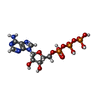
MacromoleculeName: ADENOSINE-5'-TRIPHOSPHATE / type: ligand / ID: 9 / Number of copies: 7 / Formula: ATP
Molecular weightTheoretical: 507.181 Da
Chemical component information

ChemComp-ATP:
ADENOSINE-5'-TRIPHOSPHATE / ATP, energy-carrying molecule*YM

+
Macromolecule #10: MAGNESIUM ION

MacromoleculeName: MAGNESIUM ION / type: ligand / ID: 10 / Number of copies: 7 / Formula: MG
Molecular weightTheoretical: 24.305 Da

-
Experimental details

-
Structure determination

Methodcryo EM
Processingsingle particle reconstruction
Aggregation stateparticle

-
Sample preparation

Concentration4.4 mg/mL
BufferpH: 7.5
Component:
ConcentrationFormulaName
20.0 mMC8H17KN2O4SHEPES potassium salt
10.0 mMMgCl2magnesium chloride
150.0 mMKClpotassium chloride
1.0 mMC4H10O2S2dithiothreitol
1.0 mMC10H14N5Na2O13P3adenosin-5'-triphosphate disodium salt
GridModel: Quantifoil R1.2/1.3 / Material: GOLD / Mesh: 300 / Pretreatment - Type: GLOW DISCHARGE / Pretreatment - Time: 30 sec. / Pretreatment - Atmosphere: AIR / Pretreatment - Pressure: 0.039 kPa
VitrificationCryogen name: ETHANE / Chamber humidity: 100 % / Chamber temperature: 277.15 K / Instrument: FEI VITROBOT MARK IV
DetailsThe sample was prepared by mixing and incubating the nucleic acid substrate and the protein components.

-
Electron microscopy

MicroscopeTFS KRIOS
Image recordingFilm or detector model: GATAN K3 (6k x 4k) / Detector mode: SUPER-RESOLUTION / Digitization - Dimensions - Width: 5760 pixel / Digitization - Dimensions - Height: 4092 pixel / Number grids imaged: 1 / Number real images: 9403 / Average exposure time: 1.25 sec. / Average electron dose: 59.672 e/Å2
Electron beamAcceleration voltage: 300 kV / Electron source: FIELD EMISSION GUN
Electron opticsIllumination mode: FLOOD BEAM / Imaging mode: BRIGHT FIELD / Nominal defocus max: 2.4 µm / Nominal defocus min: 1.0 µm / Nominal magnification: 130000
Sample stageSpecimen holder model: FEI TITAN KRIOS AUTOGRID HOLDER / Cooling holder cryogen: NITROGEN
Experimental equipment
Model: Titan Krios / Image courtesy: FEI Company

+
Image processing

Particle selectionNumber selected: 745080
CTF correctionSoftware - Name: cryoSPARC (ver. 4.3)
Software - details: Patch CTF Estimation was used for CTF correction
Type: PHASE FLIPPING AND AMPLITUDE CORRECTION
Startup modelType of model: INSILICO MODEL
In silico model: AlphaFold 3 models of the individual chains were rigid-body fitted into the cryo-EM density map.
Final reconstructionNumber classes used: 1 / Algorithm: FOURIER SPACE / Resolution.type: BY AUTHOR / Resolution: 3.3 Å / Resolution method: FSC 0.143 CUT-OFF / Software - Name: cryoSPARC (ver. 4.3) / Number images used: 76400
Initial angle assignmentType: MAXIMUM LIKELIHOOD / Software - Name: cryoSPARC (ver. 4.3)
Software - details: Ab-Initio Reconstruction was used for initial angular assignment
Final angle assignmentType: MAXIMUM LIKELIHOOD / Software - Name: cryoSPARC (ver. 4.3)
Software - details: Non-Uniform Refinement was used fo final angular assignment
Final 3D classificationNumber classes: 3 / Software - Name: cryoSPARC (ver. 4.3)
Software - details: Heterogeneous refinement was used for final classification

-
Atomic model buiding 1

Initial modelChain - Source name: AlphaFold / Chain - Initial model type: in silico model
RefinementSpace: REAL / Protocol: FLEXIBLE FIT
Target criteria: Real-space map-model correlation and geometry restraints
Output model

PDB-30gt:
Cryo-EM structure of the PseCascade-TniQ-TnsC complex

+
About Yorodumi

-
News

-
Feb 9, 2022. New format data for meta-information of EMDB entries

New format data for meta-information of EMDB entries

  • Version 3 of the EMDB header file is now the official format.
  • The previous official version 1.9 will be removed from the archive.

Related info.:EMDB header

External links:wwPDB to switch to version 3 of the EMDB data model

-
Aug 12, 2020. Covid-19 info

Covid-19 info

URL: https://pdbj.org/emnavi/covid19.php

New page: Covid-19 featured information page in EM Navigator.

Related info.:Covid-19 info / Mar 5, 2020. Novel coronavirus structure data

+
Mar 5, 2020. Novel coronavirus structure data

Novel coronavirus structure data

Related info.:Yorodumi Speices / Aug 12, 2020. Covid-19 info

External links:COVID-19 featured content - PDBj / Molecule of the Month (242):Coronavirus Proteases

+
Jan 31, 2019. EMDB accession codes are about to change! (news from PDBe EMDB page)

EMDB accession codes are about to change! (news from PDBe EMDB page)

  • The allocation of 4 digits for EMDB accession codes will soon come to an end. Whilst these codes will remain in use, new EMDB accession codes will include an additional digit and will expand incrementally as the available range of codes is exhausted. The current 4-digit format prefixed with “EMD-” (i.e. EMD-XXXX) will advance to a 5-digit format (i.e. EMD-XXXXX), and so on. It is currently estimated that the 4-digit codes will be depleted around Spring 2019, at which point the 5-digit format will come into force.
  • The EM Navigator/Yorodumi systems omit the EMD- prefix.

Related info.:Q: What is EMD? / ID/Accession-code notation in Yorodumi/EM Navigator

External links:EMDB Accession Codes are Changing Soon! / Contact to PDBj

+
Jul 12, 2017. Major update of PDB

Major update of PDB

  • wwPDB released updated PDB data conforming to the new PDBx/mmCIF dictionary.
  • This is a major update changing the version number from 4 to 5, and with Remediation, in which all the entries are updated.
  • In this update, many items about electron microscopy experimental information are reorganized (e.g. em_software).
  • Now, EM Navigator and Yorodumi are based on the updated data.

External links:wwPDB Remediation / Enriched Model Files Conforming to OneDep Data Standards Now Available in the PDB FTP Archive

-
Yorodumi

Thousand views of thousand structures

  • Yorodumi is a browser for structure data from EMDB, PDB, SASBDB, etc.
  • This page is also the successor to EM Navigator detail page, and also detail information page/front-end page for Omokage search.
  • The word "yorodu" (or yorozu) is an old Japanese word meaning "ten thousand". "mi" (miru) is to see.

Related info.:EMDB / PDB / SASBDB / Comparison of 3 databanks / Yorodumi Search / Aug 31, 2016. New EM Navigator & Yorodumi / Yorodumi Papers / Jmol/JSmol / Function and homology information / Changes in new EM Navigator and Yorodumi

Read more


