 Movie
Movie Controller


+ Open data

- Basic information
| Entry | Database: PDB / ID: 29ti | |||||||||||||||||||||||||||
|---|---|---|---|---|---|---|---|---|---|---|---|---|---|---|---|---|---|---|---|---|---|---|---|---|---|---|---|---|
| Title | HRV K4058A mutant | |||||||||||||||||||||||||||
 Components Components |
| |||||||||||||||||||||||||||
 Keywords Keywords | VIRUS / Cryoem / virion / HRV | |||||||||||||||||||||||||||
| Function / homology |  Function and homology information Function and homology informationlysis of host organelle involved in viral entry into host cell / symbiont-mediated suppression of host cytoplasmic pattern recognition receptor signaling pathway via inhibition of RIG-I activity / picornain 2A / symbiont-mediated suppression of host mRNA export from nucleus / symbiont genome entry into host cell via pore formation in plasma membrane / picornain 3C / T=pseudo3 icosahedral viral capsid / host cell cytoplasmic vesicle membrane / ribonucleoside triphosphate phosphatase activity / nucleoside-triphosphate phosphatase ...lysis of host organelle involved in viral entry into host cell / symbiont-mediated suppression of host cytoplasmic pattern recognition receptor signaling pathway via inhibition of RIG-I activity / picornain 2A / symbiont-mediated suppression of host mRNA export from nucleus / symbiont genome entry into host cell via pore formation in plasma membrane / picornain 3C / T=pseudo3 icosahedral viral capsid / host cell cytoplasmic vesicle membrane / ribonucleoside triphosphate phosphatase activity / nucleoside-triphosphate phosphatase / channel activity / monoatomic ion transmembrane transport / DNA replication / RNA helicase activity / endocytosis involved in viral entry into host cell / symbiont-mediated activation of host autophagy / RNA-directed RNA polymerase / cysteine-type endopeptidase activity / viral RNA genome replication / RNA-directed RNA polymerase activity / virion attachment to host cell / host cell nucleus / structural molecule activity / proteolysis / DNA-templated transcription / RNA binding / zinc ion binding / ATP binding Similarity search - Function | |||||||||||||||||||||||||||
| Biological species |  rhinovirus B14 rhinovirus B14 | |||||||||||||||||||||||||||
| Method | ELECTRON MICROSCOPY / single particle reconstruction / cryo EM / Resolution: 3.26 Å | |||||||||||||||||||||||||||
 Authors Authors | Martinez-Romero, J.M. / Caston, J.R. / Mauricio, M.G. | |||||||||||||||||||||||||||
| Funding support |  Spain, 1items Spain, 1items
| |||||||||||||||||||||||||||
 Citation Citation | Journal: J Mol Biol / Year: 2026 Title: Biologically Relevant, Cationic Residues in Human Rhinovirus Stabilize Capsid-Bound RNA Duplexes, and Restrict Capsid Flexibility. Authors: Juan M Martínez-Romero / Luis Valiente / José Luis Vilas / Valentín Riomoros-Barahona / Alejandro Valbuena / Mauricio G Mateu / José R Castón / Abstract: Human rhinoviruses (RV) cause severe socioeconomic problems and are also associated to, or exacerbate, severe respiratory diseases, but no anti-RV drugs are available so far. Understanding the ...Human rhinoviruses (RV) cause severe socioeconomic problems and are also associated to, or exacerbate, severe respiratory diseases, but no anti-RV drugs are available so far. Understanding the functional role(s) of capsid-RNA interactions in the RV virion may contribute to antiviral drug development. Our previous studies showed that the genome inside the RV-B14 virion is organized as a capsid-bound RNA dodecahedral cage formed by 30 intrachain RNA duplexes; and that positively charged capsid residues close to each RNA duplex, including K4058 and K2052, are involved in viral infection by promoting virion assembly and controlling genome uncoating. In this study, cryogenic electron microscopy was used to investigate the structural basis that underlies the functional roles of those positively charged residues in the RV virion. The atomic structure and equilibrium conformation dynamics of mutant virions carrying either K4058A or K2052A substitutions were compared with those of the parental RV-B14 virion under identical conditions. The results showed that both K4058 and K2052 residues stabilize the RNA duplex structure, and modulate capsid conformation and equilibrium dynamics. Notably, the partially disorganized RNA elements in the K4058A mutant virion strongly resemble those previously found by other researchers in an alternative wild-type RV-B14 structure. Comparison of the two alternative wild-type virion structures and the mutant virion structures supports the existence of two conformational states of the RV virion in the absence of cell receptor: a basal state with well-structured RNA duplexes, and an activated, RNA release-prone state in which the RNA duplexes are partially disorganized. | |||||||||||||||||||||||||||
| History |
|
- Structure visualization
| Structure viewer | Molecule: MolmilJmol/JSmol |
|---|
- Downloads & links
-Download
| PDBx/mmCIF format | 29ti.cif.gz | 170.6 KB | Display | PDBx/mmCIF format |
|---|---|---|---|---|
| PDB format | pdb29ti.ent.gz | 132 KB | Display | PDB format |
| PDBx/mmJSON format | 29ti.json.gz | Tree view | PDBx/mmJSON format | |
| Others |  Other downloads Other downloads |
-Validation report
| Arichive directory | https://data.pdbj.org/pub/pdb/validation_reports/9t/29tiftp://data.pdbj.org/pub/pdb/validation_reports/9t/29ti | HTTPS FTP |
|---|
-Related structure data
| Related structure data |  57363MC  29txC  29ubC M: map data used to model this data C: citing same article ( |
|---|---|
| Similar structure data |


-Links
 PDBj
PDBj
- Assembly
| Deposited unit | 
|
|---|---|
| 1 | x 60
|
-Components
| #1: Protein | Mass: 31147.984 Da / Num. of mol.: 1 Source method: isolated from a genetically manipulated source Source: (gene. exp.) rhinovirus B14 / Production host: rhinovirus B14 / References: UniProt: P03303 |
|---|---|
| #2: Protein | Mass: 27903.746 Da / Num. of mol.: 1 Source method: isolated from a genetically manipulated source Source: (gene. exp.) rhinovirus B14 / Production host: rhinovirus B14 / References: UniProt: P03303 |
| #3: Protein | Mass: 26236.754 Da / Num. of mol.: 1 Source method: isolated from a genetically manipulated source Source: (gene. exp.) rhinovirus B14 / Production host: rhinovirus B14 / References: UniProt: P03303 |
| #4: Protein/peptide | Mass: 4706.242 Da / Num. of mol.: 1 Source method: isolated from a genetically manipulated source Source: (gene. exp.) rhinovirus B14 / Production host: rhinovirus B14 / References: UniProt: P03303 |
| Has protein modification | N |
-Experimental details
-Experiment
| Experiment | Method: ELECTRON MICROSCOPY |
|---|---|
| EM experiment | Aggregation state: PARTICLE / 3D reconstruction method: single particle reconstruction |
- Sample preparation
| Component | Name: rhinovirus B14 / Type: VIRUS / Entity ID: all / Source: RECOMBINANT |
|---|---|
| Source (natural) | Organism: rhinovirus B14 |
| Source (recombinant) | Organism: rhinovirus B14 |
| Details of virus | Empty: NO / Enveloped: NO / Isolate: SPECIES / Type: VIRION |
| Virus shell | Diameter: 300 nm / Triangulation number (T number): 3 |
| Buffer solution | pH: 7.4 |
| Specimen | Embedding applied: NO / Shadowing applied: NO / Staining applied: NO / Vitrification applied: YES |
| Vitrification | Cryogen name: ETHANE / Humidity: 95 % |
- Electron microscopy imaging
| Experimental equipment | 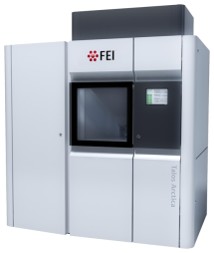 Model: Talos Arctica / Image courtesy: FEI Company |
|---|---|
| Microscopy | Model: FEI TALOS ARCTICA |
| Electron gun | Electron source:  FIELD EMISSION GUN / Accelerating voltage: 200 kV / Illumination mode: FLOOD BEAM FIELD EMISSION GUN / Accelerating voltage: 200 kV / Illumination mode: FLOOD BEAM |
| Electron lens | Mode: BRIGHT FIELD / Nominal defocus max: 2600 nm / Nominal defocus min: 800 nm |
| Image recording | Electron dose: 35 e/Å2 / Film or detector model: FEI FALCON IV (4k x 4k) |
- Processing
| EM software |
| ||||||||||||||||||||||||
|---|---|---|---|---|---|---|---|---|---|---|---|---|---|---|---|---|---|---|---|---|---|---|---|---|---|
| CTF correction | Type: PHASE FLIPPING AND AMPLITUDE CORRECTION | ||||||||||||||||||||||||
| 3D reconstruction | Resolution: 3.26 Å / Resolution method: FSC 0.143 CUT-OFF / Num. of particles: 63778 / Symmetry type: POINT | ||||||||||||||||||||||||
| Refinement | Highest resolution: 3.26 Å Stereochemistry target values: REAL-SPACE (WEIGHTED MAP SUM AT ATOM CENTERS) | ||||||||||||||||||||||||
| Refine LS restraints |
|
