 Movie
Movie Controller

[English] 日本語
 Yorodumi
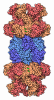
- PDB-29hb: Cryo-EM structure of the ClpE/ClpP degradation complex from E.faecalis -
+ Open data

- Basic information
| Entry | Database: PDB / ID: 29hb | |||||||||||||||||||||||||||
|---|---|---|---|---|---|---|---|---|---|---|---|---|---|---|---|---|---|---|---|---|---|---|---|---|---|---|---|---|
| Title | Cryo-EM structure of the ClpE/ClpP degradation complex from E.faecalis | |||||||||||||||||||||||||||
 Components Components |
| |||||||||||||||||||||||||||
 Keywords Keywords | CHAPERONE / AAA+ chaperone / protease | |||||||||||||||||||||||||||
| Function / homology |  Function and homology information Function and homology informationendopeptidase Clp / endopeptidase Clp complex / ATP-dependent peptidase activity / protein quality control for misfolded or incompletely synthesized proteins / peptidase activity / cellular response to heat / ATPase binding / serine-type endopeptidase activity / ATP hydrolysis activity / proteolysis ...endopeptidase Clp / endopeptidase Clp complex / ATP-dependent peptidase activity / protein quality control for misfolded or incompletely synthesized proteins / peptidase activity / cellular response to heat / ATPase binding / serine-type endopeptidase activity / ATP hydrolysis activity / proteolysis / ATP binding / cytoplasm Similarity search - Function | |||||||||||||||||||||||||||
| Biological species |  Enterobacter (bacteria) Enterobacter (bacteria) | |||||||||||||||||||||||||||
| Method | ELECTRON MICROSCOPY / single particle reconstruction / cryo EM / Resolution: 2.8 Å | |||||||||||||||||||||||||||
 Authors Authors | Carroni, M. / Mogk, A. | |||||||||||||||||||||||||||
| Funding support |  Sweden, 2items Sweden, 2items
| |||||||||||||||||||||||||||
 Citation Citation | Journal: J Biol Chem / Year: 2026 Title: Structure-function analysis of the bacterial ClpE-ClpP AAA+ protease. Authors: Mariasole De Rosa / Lisa Maag / Dirk Flemming / Irmgard Sinning / Marta Carroni / Axel Mogk /  Abstract: General and regulatory proteolysis in bacteria is executed by a set of ATP-dependent proteases composed of hexameric ring-forming AAA+ proteins and associated peptidase barrels (e.g., ClpP). These ...General and regulatory proteolysis in bacteria is executed by a set of ATP-dependent proteases composed of hexameric ring-forming AAA+ proteins and associated peptidase barrels (e.g., ClpP). These AAA+ proteases play crucial roles in stress protection and bacterial virulence. Here, we provide the first biochemical characterization of the potential drug target ClpE-ClpP from Enterococcus faecalis. We show that ClpE-ClpP forms an autonomous and efficient protease, which degrades misfolded and aggregated model substrates and the stress-responsive transcriptional regulator CtsR. This qualifies ClpE-ClpP as a central component of bacterial protein quality control systems and explains formerly reported stress-sensitive phenotypes of clpE mutants. ClpE substrate specificity is mediated by its N-terminal domain, which is crucial for targeting misfolded and aggregated proteins. ClpE assembles into a tetrahedral structure formed by four hexamers that interact via their coiled-coil M-domains. ClpP binding to ClpE tetrahedrons triggers the formation of large clusters of proteolytic complexes in vitro and in vivo. Such assembly in principle can allow for spatially confined proteolysis, separating the proteolytic activity of ClpE-ClpP complexes from other cellular processes. Indeed, ClpE M-domain mutants, which are deficient in cluster formation, exhibit increased toxicity in vivo. | |||||||||||||||||||||||||||
| History |
|
- Structure visualization
| Structure viewer | Molecule: MolmilJmol/JSmol |
|---|
- Downloads & links
-Download
| PDBx/mmCIF format | 29hb.cif.gz | 1.1 MB | Display | PDBx/mmCIF format |
|---|---|---|---|---|
| PDB format | pdb29hb.ent.gz | 915.6 KB | Display | PDB format |
| PDBx/mmJSON format | 29hb.json.gz | Tree view | PDBx/mmJSON format | |
| Others |  Other downloads Other downloads |
-Validation report
| Arichive directory | https://data.pdbj.org/pub/pdb/validation_reports/9h/29hbftp://data.pdbj.org/pub/pdb/validation_reports/9h/29hb | HTTPS FTP |
|---|
-Related structure data
| Related structure data |  57170MC M: map data used to model this data C: citing same article ( |
|---|---|
| Similar structure data |
-Links
 PDBj
PDBj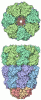
- Assembly
| Deposited unit | 
|
|---|---|
| 1 |
|
-Components
| #1: Protein | Mass: 21640.496 Da / Num. of mol.: 14 Source method: isolated from a genetically manipulated source Source: (gene. exp.) Enterobacter (bacteria) / Gene: clpP, EF_0771 / Production host:  Escherichia coli (E. coli) / References: UniProt: Q837R0, endopeptidase Clp Escherichia coli (E. coli) / References: UniProt: Q837R0, endopeptidase Clp#2: Protein/peptide | | Mass: 1379.692 Da / Num. of mol.: 1 / Source method: isolated from a natural source / Source: (natural) Enterobacter (bacteria)#3: Protein | Mass: 82589.953 Da / Num. of mol.: 6 Source method: isolated from a genetically manipulated source Source: (gene. exp.) Enterobacter (bacteria) / Gene: clpE, EF_0706 / Production host: Escherichia coli (E. coli) / References: UniProt: Q837W9#4: Chemical | ChemComp-ATP / 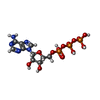 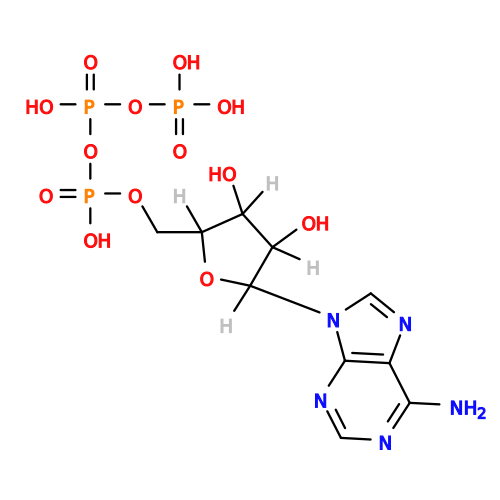 Mass: 507.181 Da / Num. of mol.: 10 / Source method: obtained synthetically / Formula: C10H16N5O13P3 / Feature type: SUBJECT OF INVESTIGATION / Comment: ATP, energy-carrying molecule*YM Mass: 507.181 Da / Num. of mol.: 10 / Source method: obtained synthetically / Formula: C10H16N5O13P3 / Feature type: SUBJECT OF INVESTIGATION / Comment: ATP, energy-carrying molecule*YMHas ligand of interest | Y | Has protein modification | N | |
|---|
-Experimental details
-Experiment
| Experiment | Method: ELECTRON MICROSCOPY |
|---|---|
| EM experiment | Aggregation state: PARTICLE / 3D reconstruction method: single particle reconstruction |
- Sample preparation
| Component | Name: E. faecalis AAA+ protease ClpE/ClpP complex / Type: COMPLEX / Entity ID: #1-#3 / Source: RECOMBINANT |
|---|---|
| Molecular weight | Experimental value: NO |
| Source (natural) | Organism: Enterobacter (bacteria) |
| Source (recombinant) | Organism: Escherichia coli (E. coli) |
| Buffer solution | pH: 7.4 |
| Specimen | Embedding applied: NO / Shadowing applied: NO / Staining applied: NO / Vitrification applied: YES |
| Vitrification | Cryogen name: ETHANE |
- Electron microscopy imaging
| Experimental equipment |  Model: Titan Krios / Image courtesy: FEI Company |
|---|---|
| Microscopy | Model: TFS KRIOS |
| Electron gun | Electron source:  FIELD EMISSION GUN / Accelerating voltage: 300 kV / Illumination mode: FLOOD BEAM FIELD EMISSION GUN / Accelerating voltage: 300 kV / Illumination mode: FLOOD BEAM |
| Electron lens | Mode: BRIGHT FIELD / Nominal defocus max: 2200 nm / Nominal defocus min: 300 nm |
| Image recording | Electron dose: 40 e/Å2 / Film or detector model: GATAN K3 BIOCONTINUUM (6k x 4k) |
- Processing
| EM software |
| ||||||||||||||||||||||||
|---|---|---|---|---|---|---|---|---|---|---|---|---|---|---|---|---|---|---|---|---|---|---|---|---|---|
| CTF correction | Type: PHASE FLIPPING AND AMPLITUDE CORRECTION | ||||||||||||||||||||||||
| 3D reconstruction | Resolution: 2.8 Å / Resolution method: FSC 0.143 CUT-OFF / Num. of particles: 556680 / Symmetry type: POINT | ||||||||||||||||||||||||
| Refinement | Highest resolution: 2.8 Å Stereochemistry target values: REAL-SPACE (WEIGHTED MAP SUM AT ATOM CENTERS) | ||||||||||||||||||||||||
| Refine LS restraints |
|
