Journal: J Biol Chem / Year: 2026 Title: Structure-function analysis of the bacterial ClpE-ClpP AAA+ protease. Authors: Mariasole De Rosa / Lisa Maag / Dirk Flemming / Irmgard Sinning / Marta Carroni / Axel Mogk / Abstract: General and regulatory proteolysis in bacteria is executed by a set of ATP-dependent proteases composed of hexameric ring-forming AAA+ proteins and associated peptidase barrels (e.g., ClpP). These ...General and regulatory proteolysis in bacteria is executed by a set of ATP-dependent proteases composed of hexameric ring-forming AAA+ proteins and associated peptidase barrels (e.g., ClpP). These AAA+ proteases play crucial roles in stress protection and bacterial virulence. Here, we provide the first biochemical characterization of the potential drug target ClpE-ClpP from Enterococcus faecalis. We show that ClpE-ClpP forms an autonomous and efficient protease, which degrades misfolded and aggregated model substrates and the stress-responsive transcriptional regulator CtsR. This qualifies ClpE-ClpP as a central component of bacterial protein quality control systems and explains formerly reported stress-sensitive phenotypes of clpE mutants. ClpE substrate specificity is mediated by its N-terminal domain, which is crucial for targeting misfolded and aggregated proteins. ClpE assembles into a tetrahedral structure formed by four hexamers that interact via their coiled-coil M-domains. ClpP binding to ClpE tetrahedrons triggers the formation of large clusters of proteolytic complexes in vitro and in vivo. Such assembly in principle can allow for spatially confined proteolysis, separating the proteolytic activity of ClpE-ClpP complexes from other cellular processes. Indeed, ClpE M-domain mutants, which are deficient in cluster formation, exhibit increased toxicity in vivo.
In the structure databanks used in Yorodumi, some data are registered as the other names, "COVID-19 virus" and "2019-nCoV". Here are the details of the virus and the list of structure data.
Jan 31, 2019. EMDB accession codes are about to change! (news from PDBe EMDB page)
EMDB accession codes are about to change! (news from PDBe EMDB page)
The allocation of 4 digits for EMDB accession codes will soon come to an end. Whilst these codes will remain in use, new EMDB accession codes will include an additional digit and will expand incrementally as the available range of codes is exhausted. The current 4-digit format prefixed with “EMD-” (i.e. EMD-XXXX) will advance to a 5-digit format (i.e. EMD-XXXXX), and so on. It is currently estimated that the 4-digit codes will be depleted around Spring 2019, at which point the 5-digit format will come into force.
The EM Navigator/Yorodumi systems omit the EMD- prefix.
Related info.:Q: What is EMD? / ID/Accession-code notation in Yorodumi/EM Navigator
Yorodumi is a browser for structure data from EMDB, PDB, SASBDB, etc.
This page is also the successor to EM Navigator detail page, and also detail information page/front-end page for Omokage search.
The word "yorodu" (or yorozu) is an old Japanese word meaning "ten thousand". "mi" (miru) is to see.
Related info.:EMDB / PDB / SASBDB / Comparison of 3 databanks / Yorodumi Search / Aug 31, 2016. New EM Navigator & Yorodumi / Yorodumi Papers / Jmol/JSmol / Function and homology information / Changes in new EM Navigator and Yorodumi
 Movie
Movie Controller

 Yorodumi
 Open data
 Basic information
 Map data
 Sample
 Keywords
 Function and homology information
 Enterobacter (bacteria)
 Authors
 Sweden, 2 items
  Citation
 Structure visualization
 Downloads & links
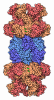
 emd_57170.png
 http://ftp.pdbj.org/pub/emdb/structures/EMD-57170
 Z (Sec.)
 Y (Row.)
 X (Col.)


 Sample components
 Escherichia coli (E. coli)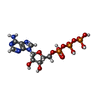
 Processing
 Electron microscopy
 FIELD EMISSION GUN
