 Movie
Movie Controller

[English] 日本語
 Yorodumi
- PDB-28pn: CryoEM structure of native quinol dependent Nitric Oxide Reductas... -
+ Open data

- Basic information
| Entry | Database: PDB / ID: 28pn | |||||||||||||||||||||||||||
|---|---|---|---|---|---|---|---|---|---|---|---|---|---|---|---|---|---|---|---|---|---|---|---|---|---|---|---|---|
| Title | CryoEM structure of native quinol dependent Nitric Oxide Reductase at pH 8.0 on gold grid. | |||||||||||||||||||||||||||
 Components Components | Nitric oxide reductase subunit B | |||||||||||||||||||||||||||
 Keywords Keywords | MEMBRANE PROTEIN / quinol-dependent Nitric Oxide Reductase | |||||||||||||||||||||||||||
| Function / homology |  Function and homology information Function and homology informationnitric oxide reductase (cytochrome c) / nitric oxide reductase activity / cytochrome-c oxidase activity / aerobic respiration / heme binding / membrane Similarity search - Function | |||||||||||||||||||||||||||
| Biological species |  Achromobacter xylosoxidans (bacteria) Achromobacter xylosoxidans (bacteria) | |||||||||||||||||||||||||||
| Method | ELECTRON MICROSCOPY / single particle reconstruction / cryo EM / Resolution: 2.7 Å | |||||||||||||||||||||||||||
 Authors Authors | Khaja, F. / Antonyuk, S.V. / Muench, S.P. / Hasnain, S.S. | |||||||||||||||||||||||||||
| Funding support |  United Kingdom, 1items United Kingdom, 1items
| |||||||||||||||||||||||||||
 Citation Citation | Journal: ACS Bio Med Chem Au / Year: 2026 Title: CryoEM Structures of Native Quinol-Dependent Nitric Oxide Reductase in Resting and Quinol-Bound States. Authors: Faisal T Khaja / Allegra Mboukou / Louie P Aspinall / Charlotte E Hawksworth / Robert R Eady / Svetlana V Antonyuk / Stephen P Muench / S Samar Hasnain / Abstract: The membrane-bound quinol-dependent nitric oxide reductases (qNORs), which are members of the respiratory heme-copper oxidase superfamily, are of major importance to food production, environment, and ...The membrane-bound quinol-dependent nitric oxide reductases (qNORs), which are members of the respiratory heme-copper oxidase superfamily, are of major importance to food production, environment, and human health. They are unique to bacteria and catalyze N-N bond formation, converting nitric oxide (NO) to generate the enzymatic product, nitrous oxide (NO), in agricultural and pathogenic conditions. High-resolution qNOR structures have been reported from two bacterial species, in which the molecular size of the protein was increased by the insertion of apocytochrome b (BRIL) at the C-terminus to facilitate cryoEM structure determination. However, it remains uncertain how BRIL fusion alters the native structure of these metalloenzymes. Here, we present the first high-resolution structure of qNOR (qNOR) determined without a fusion tag at two different pH values, revealing structural differences near the catalytic core as well as overall conformational changes between the native and fusion-tagged structures. The native enzyme shows a bell-shaped pH dependence of enzymatic activity, like nitrite reductase, the preceding enzyme in the denitrification pathway, which generates the substrate NO. In addition, we report structures of qNOR bound to quinol and hydroxyquinol that provide valuable insight into the potential electron transfer pathway originating from Trp718 to the redox centers. | |||||||||||||||||||||||||||
| History |
|
- Structure visualization
| Structure viewer | Molecule: MolmilJmol/JSmol |
|---|
- Downloads & links
-Download
| PDBx/mmCIF format | 28pn.cif.gz | 302.1 KB | Display | PDBx/mmCIF format |
|---|---|---|---|---|
| PDB format | pdb28pn.ent.gz | 240.6 KB | Display | PDB format |
| PDBx/mmJSON format | 28pn.json.gz | Tree view | PDBx/mmJSON format | |
| Others |  Other downloads Other downloads |
-Validation report
| Arichive directory | https://data.pdbj.org/pub/pdb/validation_reports/8p/28pnftp://data.pdbj.org/pub/pdb/validation_reports/8p/28pn | HTTPS FTP |
|---|
-Related structure data
| Related structure data |  56718MC  28ppC  28pqC  28prC  9st9C  9staC  9wykC  9wylC  9wymC M: map data used to model this data C: citing same article ( |
|---|---|
| Similar structure data |


-Links
 PDBj
PDBj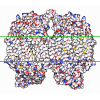
- Assembly
| Deposited unit | 
|
|---|---|
| 1 |
|
-Components
| #1: Protein | Mass: 84724.867 Da / Num. of mol.: 2 Source method: isolated from a genetically manipulated source Source: (gene. exp.) Achromobacter xylosoxidans (bacteria) / Gene: norB_1, ERS451415_02175, IUJ48_17015 / Production host:  Escherichia coli BL21(DE3) (bacteria) Escherichia coli BL21(DE3) (bacteria)References: UniProt: A0ABF7PH53, nitric oxide reductase (cytochrome c) #2: Chemical | ChemComp-HEM / 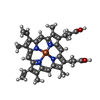 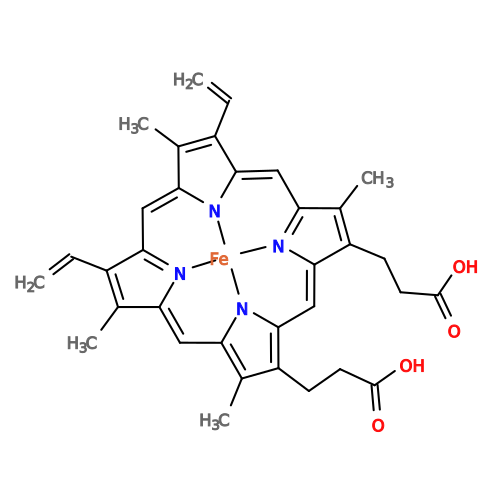 Mass: 616.487 Da / Num. of mol.: 4 / Source method: obtained synthetically / Formula: C34H32FeN4O4 / Feature type: SUBJECT OF INVESTIGATION Mass: 616.487 Da / Num. of mol.: 4 / Source method: obtained synthetically / Formula: C34H32FeN4O4 / Feature type: SUBJECT OF INVESTIGATION#3: Chemical |   Mass: 40.078 Da / Num. of mol.: 2 / Source method: obtained synthetically / Formula: Ca Mass: 40.078 Da / Num. of mol.: 2 / Source method: obtained synthetically / Formula: Ca#4: Chemical |   Mass: 55.845 Da / Num. of mol.: 2 / Source method: obtained synthetically / Formula: Fe Mass: 55.845 Da / Num. of mol.: 2 / Source method: obtained synthetically / Formula: Fe#5: Water | ChemComp-HOH / |  Mass: 18.015 Da / Num. of mol.: 548 / Source method: isolated from a natural source / Formula: H2O Mass: 18.015 Da / Num. of mol.: 548 / Source method: isolated from a natural source / Formula: H2OHas ligand of interest | Y | Has protein modification | Y | |
|---|
-Experimental details
-Experiment
| Experiment | Method: ELECTRON MICROSCOPY |
|---|---|
| EM experiment | Aggregation state: PARTICLE / 3D reconstruction method: single particle reconstruction |
- Sample preparation
| Component | Name: quinol-dependent Nitric Oxide Reductase at pH 8.0 on gold grid. Type: COMPLEX Details: Two HEM and one Fe are the cofactors covalently bound to this protein. Fe is linked with one of the HEM by a water molecule via mu oxo bridge. Entity ID: #1 / Source: RECOMBINANT |
|---|---|
| Source (natural) | Organism: Achromobacter xylosoxidans (bacteria) |
| Source (recombinant) | Organism: Escherichia coli BL21(DE3) (bacteria) |
| Buffer solution | pH: 8 |
| Specimen | Conc.: 5 mg/ml / Embedding applied: NO / Shadowing applied: NO / Staining applied: NO / Vitrification applied: YES |
| Specimen support | Grid material: GOLD |
| Vitrification | Cryogen name: ETHANE |
- Electron microscopy imaging
| Experimental equipment |  Model: Titan Krios / Image courtesy: FEI Company |
|---|---|
| Microscopy | Model: TFS KRIOS |
| Electron gun | Electron source:  FIELD EMISSION GUN / Accelerating voltage: 300 kV / Illumination mode: FLOOD BEAM FIELD EMISSION GUN / Accelerating voltage: 300 kV / Illumination mode: FLOOD BEAM |
| Electron lens | Mode: BRIGHT FIELD / Nominal defocus max: 2700 nm / Nominal defocus min: 700 nm |
| Image recording | Electron dose: 40 e/Å2 / Film or detector model: FEI FALCON I (4k x 4k) |
- Processing
| EM software |
| ||||||||||||||||||||||||
|---|---|---|---|---|---|---|---|---|---|---|---|---|---|---|---|---|---|---|---|---|---|---|---|---|---|
| CTF correction | Type: PHASE FLIPPING AND AMPLITUDE CORRECTION | ||||||||||||||||||||||||
| 3D reconstruction | Resolution: 2.7 Å / Resolution method: FSC 0.143 CUT-OFF / Num. of particles: 91995 / Symmetry type: POINT | ||||||||||||||||||||||||
| Refinement | Highest resolution: 2.7 Å Stereochemistry target values: REAL-SPACE (WEIGHTED MAP SUM AT ATOM CENTERS) | ||||||||||||||||||||||||
| Refine LS restraints |
|
