 Movie
Movie Controller


+ Open data

- Basic information
| Entry | Database: PDB / ID: 24ti | |||||||||||||||||||||
|---|---|---|---|---|---|---|---|---|---|---|---|---|---|---|---|---|---|---|---|---|---|---|
| Title | Cryo-EM structure of the PCO371-bound GHRHR-Gs complex | |||||||||||||||||||||
 Components Components |
| |||||||||||||||||||||
 Keywords Keywords | MEMBRANE PROTEIN/IMMUNE SYSTEM / GHRHR / PCO371 / MEMBRANE PROTEIN-IMMUNE SYSTEM complex | |||||||||||||||||||||
| Function / homology |  Function and homology information Function and homology informationgrowth hormone-releasing hormone receptor activity / positive regulation of circadian sleep/wake cycle, non-REM sleep / positive regulation of multicellular organism growth / positive regulation of growth hormone secretion / positive regulation of insulin-like growth factor receptor signaling pathway / G-protein activation / Activation of the phototransduction cascade / Glucagon-type ligand receptors / Thromboxane signalling through TP receptor / Sensory perception of sweet, bitter, and umami (glutamate) taste ...growth hormone-releasing hormone receptor activity / positive regulation of circadian sleep/wake cycle, non-REM sleep / positive regulation of multicellular organism growth / positive regulation of growth hormone secretion / positive regulation of insulin-like growth factor receptor signaling pathway / G-protein activation / Activation of the phototransduction cascade / Glucagon-type ligand receptors / Thromboxane signalling through TP receptor / Sensory perception of sweet, bitter, and umami (glutamate) taste / G beta:gamma signalling through PI3Kgamma / G beta:gamma signalling through CDC42 / Cooperation of PDCL (PhLP1) and TRiC/CCT in G-protein beta folding / Activation of G protein gated Potassium channels / Inhibition of voltage gated Ca2+ channels via Gbeta/gamma subunits / Ca2+ pathway / G alpha (z) signalling events / G protein-coupled peptide receptor activity / High laminar flow shear stress activates signaling by PIEZO1 and PECAM1:CDH5:KDR in endothelial cells / Glucagon-like Peptide-1 (GLP1) regulates insulin secretion / Vasopressin regulates renal water homeostasis via Aquaporins / Adrenaline,noradrenaline inhibits insulin secretion / ADP signalling through P2Y purinoceptor 12 / G alpha (q) signalling events / nuclear inner membrane / G alpha (i) signalling events / Thrombin signalling through proteinase activated receptors (PARs) / Activation of G protein gated Potassium channels / G-protein activation / G beta:gamma signalling through PI3Kgamma / Prostacyclin signalling through prostacyclin receptor / G beta:gamma signalling through PLC beta / ADP signalling through P2Y purinoceptor 1 / Thromboxane signalling through TP receptor / Presynaptic function of Kainate receptors / G beta:gamma signalling through CDC42 / Inhibition of voltage gated Ca2+ channels via Gbeta/gamma subunits / G alpha (12/13) signalling events / Glucagon-type ligand receptors / G beta:gamma signalling through BTK / ADP signalling through P2Y purinoceptor 12 / Adrenaline,noradrenaline inhibits insulin secretion / Cooperation of PDCL (PhLP1) and TRiC/CCT in G-protein beta folding / Ca2+ pathway / G alpha (z) signalling events / Thrombin signalling through proteinase activated receptors (PARs) / Extra-nuclear estrogen signaling / G alpha (q) signalling events / G alpha (s) signalling events / photoreceptor outer segment membrane / spectrin binding / growth factor binding / Glucagon-like Peptide-1 (GLP1) regulates insulin secretion / G alpha (i) signalling events / High laminar flow shear stress activates signaling by PIEZO1 and PECAM1:CDH5:KDR in endothelial cells / Vasopressin regulates renal water homeostasis via Aquaporins / sensory perception of taste / alkylglycerophosphoethanolamine phosphodiesterase activity / retina development in camera-type eye / adenylate cyclase-activating G protein-coupled bile acid receptor signaling pathway / adenylate cyclase-activating serotonin receptor signaling pathway / peptide hormone binding / regulation of skeletal muscle contraction / nuclear outer membrane / developmental growth / hair follicle placode formation / PKA activation in glucagon signalling / renal water homeostasis / cardiac muscle cell apoptotic process / intracellular transport / photoreceptor outer segment / cAMP/PKA signal transduction / D1 dopamine receptor binding / vascular endothelial cell response to laminar fluid shear stress / Hedgehog 'off' state / activation of adenylate cyclase activity / adenylate cyclase-activating adrenergic receptor signaling pathway / cellular response to acidic pH / photoreceptor inner segment / cellular response to glucagon stimulus / secretory granule / intracellular glucose homeostasis / response to glucocorticoid / adenylate cyclase activator activity / positive regulation of insulin secretion involved in cellular response to glucose stimulus / trans-Golgi network membrane / cellular response to glucose stimulus / positive regulation of insulin secretion / negative regulation of inflammatory response to antigenic stimulus / response to prostaglandin E / bone development / response to insulin / sarcolemma / response to estrogen / platelet aggregation / cognition / cell population proliferation / G protein-coupled receptor activity / G-protein beta/gamma-subunit complex binding / nuclear matrix Similarity search - Function | |||||||||||||||||||||
| Biological species |  Homo sapiens (human) Homo sapiens (human)  Rattus norvegicus (Norway rat) Rattus norvegicus (Norway rat) Bos taurus (domestic cattle) Bos taurus (domestic cattle)synthetic construct (others) | |||||||||||||||||||||
| Method | ELECTRON MICROSCOPY / single particle reconstruction / cryo EM / Resolution: 2.88 Å | |||||||||||||||||||||
 Authors Authors | Wang, M.W. / Hang, K.N. / Qiu, Y. / Chen, X.Y. / Chen, Y.Y. / Huang, S.T. / Cong, Z.T. / Zhou, Q.T. | |||||||||||||||||||||
| Funding support |  China, 1items China, 1items
| |||||||||||||||||||||
 Citation Citation | Journal: Protein Cell / Year: 2026 Title: Structural adaptation associated with signaling preference at the human GHRHR. Authors: Ming-Wei Wang / Kaini Hang / Yue Qiu / Xianyue Chen / Yanyan Chen / Shengtian Huang / Zhaotong Cong / Qingtong Zhou /  | |||||||||||||||||||||
| History |
|
- Structure visualization
| Structure viewer | Molecule: MolmilJmol/JSmol |
|---|
- Downloads & links
-Download
| PDBx/mmCIF format | 24ti.cif.gz | 222.4 KB | Display | PDBx/mmCIF format |
|---|---|---|---|---|
| PDB format | pdb24ti.ent.gz | 168.2 KB | Display | PDB format |
| PDBx/mmJSON format | 24ti.json.gz | Tree view | PDBx/mmJSON format | |
| Others |  Other downloads Other downloads |
-Validation report
| Arichive directory | https://data.pdbj.org/pub/pdb/validation_reports/4t/24tiftp://data.pdbj.org/pub/pdb/validation_reports/4t/24ti | HTTPS FTP |
|---|
-Related structure data
| Related structure data |  69804MC  24tbC M: map data used to model this data C: citing same article ( |
|---|---|
| Similar structure data |

-Links
 PDBj
PDBj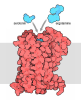
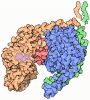
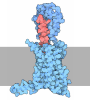
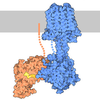

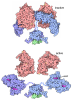
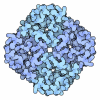
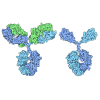
- Assembly
| Deposited unit | 
|
|---|---|
| 1 |
|
-Components
-Protein , 2 types, 2 molecules RN
| #1: Protein | Mass: 61651.438 Da / Num. of mol.: 1 Source method: isolated from a genetically manipulated source Source: (gene. exp.) Homo sapiens (human) / Gene: GHRHR / Production host:  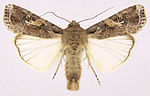 Spodoptera frugiperda (fall armyworm) / References: UniProt: Q02643 Spodoptera frugiperda (fall armyworm) / References: UniProt: Q02643 |
|---|---|
| #5: Protein | Mass: 13711.284 Da / Num. of mol.: 1 Source method: isolated from a genetically manipulated source Source: (gene. exp.) synthetic construct (others) / Production host:   Escherichia coli (E. coli) Escherichia coli (E. coli) |
-Guanine nucleotide-binding protein ... , 3 types, 3 molecules ABG
| #2: Protein | Mass: 45683.434 Da / Num. of mol.: 1 Source method: isolated from a genetically manipulated source Source: (gene. exp.) Homo sapiens (human) / Gene: GNAS, GNAS1, GSP / Production host: Spodoptera frugiperda (fall armyworm) / References: UniProt: P63092 |
|---|---|
| #3: Protein | Mass: 43706.750 Da / Num. of mol.: 1 Source method: isolated from a genetically manipulated source Source: (gene. exp.) Rattus norvegicus (Norway rat) / Gene: Gnb1 / Production host: Spodoptera frugiperda (fall armyworm) / References: UniProt: P54311 |
| #4: Protein | Mass: 7861.143 Da / Num. of mol.: 1 Source method: isolated from a genetically manipulated source Source: (gene. exp.) Bos taurus (domestic cattle) / Gene: GNG2 / Production host: Spodoptera frugiperda (fall armyworm) / References: UniProt: P63212 |
-Non-polymers , 1 types, 1 molecules 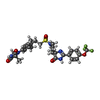
| #6: Chemical | ChemComp-KHF / 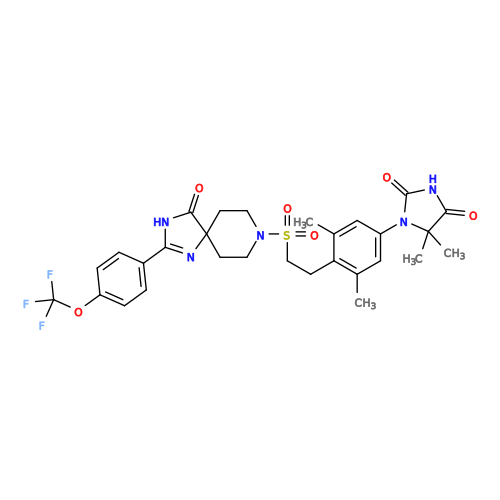 Mass: 635.654 Da / Num. of mol.: 1 / Source method: obtained synthetically / Formula: C29H32F3N5O6S / Feature type: SUBJECT OF INVESTIGATION Mass: 635.654 Da / Num. of mol.: 1 / Source method: obtained synthetically / Formula: C29H32F3N5O6S / Feature type: SUBJECT OF INVESTIGATION |
|---|
-Details
| Has ligand of interest | Y |
|---|---|
| Has protein modification | Y |
-Experimental details
-Experiment
| Experiment | Method: ELECTRON MICROSCOPY |
|---|---|
| EM experiment | Aggregation state: PARTICLE / 3D reconstruction method: single particle reconstruction |
- Sample preparation
| Component | Name: Cryo-EM structure of the PCO371-bound GHRHR-Gs complex Type: COMPLEX / Entity ID: #1-#5 / Source: MULTIPLE SOURCES |
|---|---|
| Source (natural) | Organism: Homo sapiens (human) |
| Source (recombinant) | Organism: Spodoptera frugiperda (fall armyworm) |
| Buffer solution | pH: 7.5 |
| Specimen | Embedding applied: NO / Shadowing applied: NO / Staining applied: NO / Vitrification applied: YES |
| Vitrification | Cryogen name: ETHANE |
- Electron microscopy imaging
| Experimental equipment |  Model: Titan Krios / Image courtesy: FEI Company |
|---|---|
| Microscopy | Model: TFS KRIOS |
| Electron gun | Electron source: OTHER / Accelerating voltage: 300 kV / Illumination mode: OTHER |
| Electron lens | Mode: BRIGHT FIELD / Nominal defocus max: 2000 nm / Nominal defocus min: 1000 nm |
| Image recording | Electron dose: 80 e/Å2 / Film or detector model: GATAN K3 (6k x 4k) |
- Processing
| EM software |
| |||||||||
|---|---|---|---|---|---|---|---|---|---|---|
| CTF correction | Type: PHASE FLIPPING AND AMPLITUDE CORRECTION | |||||||||
| 3D reconstruction | Resolution: 2.88 Å / Resolution method: FSC 0.143 CUT-OFF / Num. of particles: 451520 / Symmetry type: POINT |
