Movie
 Controller


+ Open data

- Basic information
| Entry | Database: PDB / ID: 23km | |||||||||
|---|---|---|---|---|---|---|---|---|---|---|
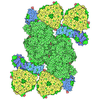
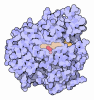
| Title | LHCP-CP29 complex from Mesostigma viride. | |||||||||
 Components | (Chlorophyll a-b binding protein, ...) x 3 | |||||||||
 Keywords | PHOTOSYNTHESIS / LHCP / CP29 | |||||||||
| Function / homology |  Function and homology information | |||||||||
| Biological species |  Mesostigma viride (plant) | |||||||||
| Method | ELECTRON MICROSCOPY / single particle reconstruction / cryo EM / Resolution: 2.94 Å | |||||||||
 Authors | Bai, T.Y. / Mao, Z.Y. / Qian, P. / Wang, Y.M. / Tian, L.R. | |||||||||
| Funding support |  China, 1items
| |||||||||
 Citation | Journal: Sci Adv / Year: 2026 Title: Structural insights into light harvesting and photosystem II evolution in the basal streptophyte . Authors: Tianyu Bai / Zhiyuan Mao / Dapeng Sun / Fei Ma / Bingxin Ma / Yingjie Gao / Yuelin Li / Yi Yang / Wenqiang Tang / Andrew Hitchcock / Matthew P Johnson / Pu Qian / Yumei Wang / Lirong Tian /  Abstract: The basal streptophyte represents a critical evolutionary transition toward land plants, yet the molecular basis of its ancestral light-harvesting strategy remains elusive. Here, we present a 2.25- ...The basal streptophyte represents a critical evolutionary transition toward land plants, yet the molecular basis of its ancestral light-harvesting strategy remains elusive. Here, we present a 2.25-angstrom resolution cryo-EM structure of the PSII-LHCII-LHCP supercomplex, revealing a unique CSML-type architecture. Our structure reveals a nearly complete set of conserved PSII core subunits, indicating that much of the PSII structural framework found in terrestrial plants was established early in the streptophyte lineage. At the periphery, the complex features a specialized antenna module in which two ancestral LHCP monomers flank CP29. These ancestral antenna proteins bind an unusually high number of carotenoids, with seven carotenoids per subunit, and extensively incorporate marine-type keto carotenoids, siphonaxanthin, and siphonein, throughout the complex, thereby broadening absorption in the blue-green region. The canonical LHCII trimer exhibits a distinctive chlorophyll macrocluster and a 96-femtosecond ultrafast energy transfer component. Together, these findings provide a high-resolution molecular framework for an evolutionary intermediate that combines high-capacity aquatic light harvesting with structural features potentially relevant to photoprotection during the transition toward terrestrial life. | |||||||||
| History |
|
- Structure visualization
| Structure viewer | Molecule: MolmilJmol/JSmol |
|---|
- Downloads & links
-Download
| PDBx/mmCIF format | 23km.cif.gz | 215.5 KB | Display | PDBx/mmCIF format |
|---|---|---|---|---|
| PDB format | pdb23km.ent.gz | 174.5 KB | Display | PDB format |
| PDBx/mmJSON format | 23km.json.gz | Tree view | PDBx/mmJSON format | |
| Others |  Other downloads |
-Validation report
| Arichive directory | https://data.pdbj.org/pub/pdb/validation_reports/3k/23kmftp://data.pdbj.org/pub/pdb/validation_reports/3k/23km | HTTPS FTP |
|---|
-Related structure data
| Related structure data |  69051MC  23kkC  23klC M: map data used to model this data C: citing same article ( |
|---|---|
| Similar structure data |


-Links
 PDBj
- Assembly
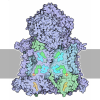
| Deposited unit | 
|
|---|---|
| 1 |
|
-Components
-Chlorophyll a-b binding protein, ... , 3 types, 3 molecules 1Uy
| #1: Protein | Mass: 28222.928 Da / Num. of mol.: 1 / Source method: isolated from a natural source / Source: (natural) Mesostigma viride (plant) / References: UniProt: A2SY27 |
|---|---|
| #2: Protein | Mass: 32585.371 Da / Num. of mol.: 1 / Source method: isolated from a natural source / Source: (natural) Mesostigma viride (plant) / References: UniProt: A2SY24 |
| #3: Protein | Mass: 28519.125 Da / Num. of mol.: 1 / Source method: isolated from a natural source / Source: (natural) Mesostigma viride (plant) / References: UniProt: A2SY26 |
-Non-polymers , 9 types, 61 molecules 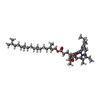
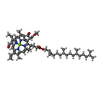

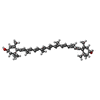
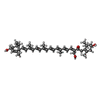
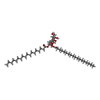
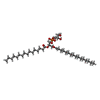
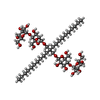
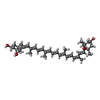
| #4: Chemical | ChemComp-CLA /  Mass: 893.489 Da / Num. of mol.: 33 / Source method: obtained synthetically / Formula: C55H72MgN4O5 #5: Chemical | ChemComp-CHL /  Mass: 907.472 Da / Num. of mol.: 6 / Source method: obtained synthetically / Formula: C55H70MgN4O6 #6: Chemical | ChemComp-0UR /  Mass: 781.157 Da / Num. of mol.: 8 / Source method: obtained synthetically / Formula: C52H76O5 #7: Chemical |  Mass: 568.871 Da / Num. of mol.: 3 / Source method: obtained synthetically / Formula: C40H56O2 #8: Chemical |  Mass: 600.870 Da / Num. of mol.: 3 / Source method: obtained synthetically / Formula: C40H56O4 #9: Chemical |  Mass: 787.158 Da / Num. of mol.: 2 / Source method: obtained synthetically / Formula: C45H86O10 #10: Chemical | ChemComp-LHG / |  Mass: 722.970 Da / Num. of mol.: 1 / Source method: obtained synthetically / Formula: C38H75O10P / Comment: phospholipid*YM #11: Chemical | ChemComp-LMN /  Mass: 1005.188 Da / Num. of mol.: 4 / Source method: obtained synthetically / Formula: C47H88O22 / Comment: detergent*YM #12: Chemical | ChemComp-NEX / ( |  Mass: 600.870 Da / Num. of mol.: 1 / Source method: obtained synthetically / Formula: C40H56O4 |
|---|
-Details
| Has ligand of interest | N |
|---|---|
| Has protein modification | Y |
-Experimental details
-Experiment
| Experiment | Method: ELECTRON MICROSCOPY |
|---|---|
| EM experiment | Aggregation state: PARTICLE / 3D reconstruction method: single particle reconstruction |
- Sample preparation
| Component | Name: LHCP-CP29 complex from Mesostigma viride. / Type: COMPLEX / Entity ID: #1-#3 / Source: NATURAL |
|---|---|
| Source (natural) | Organism: Mesostigma viride (plant) |
| Buffer solution | pH: 7.5 |
| Specimen | Embedding applied: NO / Shadowing applied: NO / Staining applied: NO / Vitrification applied: YES |
| Vitrification | Cryogen name: ETHANE |
- Electron microscopy imaging
| Experimental equipment | 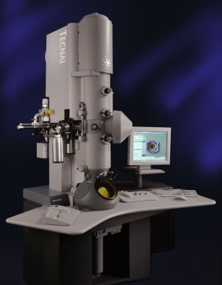 Model: Tecnai Polara / Image courtesy: FEI Company |
|---|---|
| Microscopy | Model: FEI POLARA 300 |
| Electron gun | Electron source: OTHER / Accelerating voltage: 300 kV / Illumination mode: OTHER |
| Electron lens | Mode: OTHER / Nominal defocus max: 2000 nm / Nominal defocus min: 1000 nm |
| Image recording | Electron dose: 60 e/Å2 / Film or detector model: GATAN K3 (6k x 4k) |
- Processing
| EM software |
| |||||||||
|---|---|---|---|---|---|---|---|---|---|---|
| CTF correction | Type: PHASE FLIPPING AND AMPLITUDE CORRECTION | |||||||||
| 3D reconstruction | Resolution: 2.94 Å / Resolution method: FSC 0.143 CUT-OFF / Num. of particles: 299782 / Symmetry type: POINT |