Movie
 Controller


[English] 日本語
 Yorodumi
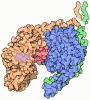
- PDB-22ta: 5HT2AR-miniGq heterotrimer in complex with a novel agonist IHCH-8152 -
+ Open data

- Basic information
| Entry | Database: PDB / ID: 22ta | |||||||||||||||||||||
|---|---|---|---|---|---|---|---|---|---|---|---|---|---|---|---|---|---|---|---|---|---|---|
| Title | 5HT2AR-miniGq heterotrimer in complex with a novel agonist IHCH-8152 | |||||||||||||||||||||
 Components |
| |||||||||||||||||||||
 Keywords | MEMBRANE PROTEIN / GPCR / serotonin receptor / 5HT2AR | |||||||||||||||||||||
| Function / homology |  Function and homology information positive regulation of heat generation / 1-(4-iodo-2,5-dimethoxyphenyl)propan-2-amine binding / Gq/11-coupled serotonin receptor activity / positive regulation of phosphatidylinositol biosynthetic process / G protein-coupled serotonin receptor signaling pathway / G protein-coupled serotonin receptor complex / neurofilament / cell body fiber / artery smooth muscle contraction / positive regulation of cytokine production involved in immune response ...positive regulation of heat generation / 1-(4-iodo-2,5-dimethoxyphenyl)propan-2-amine binding / Gq/11-coupled serotonin receptor activity / positive regulation of phosphatidylinositol biosynthetic process / G protein-coupled serotonin receptor signaling pathway / G protein-coupled serotonin receptor complex / neurofilament / cell body fiber / artery smooth muscle contraction / positive regulation of cytokine production involved in immune response / sensitization / Serotonin receptors / phospholipase C-activating serotonin receptor signaling pathway / G protein-coupled serotonin receptor activity / serotonin receptor signaling pathway / urinary bladder smooth muscle contraction / sensory perception of chemical stimulus / mu-type opioid receptor binding / corticotropin-releasing hormone receptor 1 binding / serotonin binding / positive regulation of platelet aggregation / negative regulation of synaptic transmission, glutamatergic / beta-2 adrenergic receptor binding / neurotransmitter receptor activity / positive regulation of DNA biosynthetic process / negative regulation of potassium ion transport / temperature homeostasis / detection of temperature stimulus involved in sensory perception of pain / developmental growth / PKA activation in glucagon signalling / detection of mechanical stimulus involved in sensory perception of pain / positive regulation of vasoconstriction / regulation of dopamine secretion / positive regulation of execution phase of apoptosis / protein tyrosine kinase activator activity / D1 dopamine receptor binding / G protein-coupled receptor signaling pathway, coupled to cyclic nucleotide second messenger / Hedgehog 'off' state / insulin-like growth factor receptor binding / release of sequestered calcium ion into cytosol / behavioral response to cocaine / presynaptic modulation of chemical synaptic transmission / ionotropic glutamate receptor binding / adenylate cyclase activator activity / bone development / dendritic shaft / memory / platelet aggregation / caveola / intracellular calcium ion homeostasis / G-protein beta/gamma-subunit complex binding / positive regulation of neuron apoptotic process / Olfactory Signaling Pathway / Activation of the phototransduction cascade / positive regulation of inflammatory response / G protein-coupled acetylcholine receptor signaling pathway / G beta:gamma signalling through PLC beta / Presynaptic function of Kainate receptors / Thromboxane signalling through TP receptor / Activation of G protein gated Potassium channels / Inhibition of voltage gated Ca2+ channels via Gbeta/gamma subunits / G-protein activation / Glucagon signaling in metabolic regulation / G beta:gamma signalling through CDC42 / Prostacyclin signalling through prostacyclin receptor / Synthesis, secretion, and inactivation of Glucagon-like Peptide-1 (GLP-1) / photoreceptor disc membrane / G beta:gamma signalling through BTK / ADP signalling through P2Y purinoceptor 12 / Sensory perception of sweet, bitter, and umami (glutamate) taste / Glucagon-type ligand receptors / Adrenaline,noradrenaline inhibits insulin secretion / Vasopressin regulates renal water homeostasis via Aquaporins / Glucagon-like Peptide-1 (GLP1) regulates insulin secretion / G alpha (z) signalling events / ADP signalling through P2Y purinoceptor 1 / cellular response to catecholamine stimulus / G beta:gamma signalling through PI3Kgamma / ADORA2B mediated anti-inflammatory cytokines production / adenylate cyclase-activating dopamine receptor signaling pathway / heterotrimeric G-protein complex / positive regulation of cold-induced thermogenesis / Cooperation of PDCL (PhLP1) and TRiC/CCT in G-protein beta folding / cellular response to prostaglandin E stimulus / GPER1 signaling / G alpha (12/13) signalling events / presynapse / Inactivation, recovery and regulation of the phototransduction cascade / G-protein beta-subunit binding / extracellular vesicle / positive regulation of cytosolic calcium ion concentration / Thrombin signalling through proteinase activated receptors (PARs) / adenylate cyclase-activating G protein-coupled receptor signaling pathway / signaling receptor complex adaptor activity / chemical synaptic transmission / GTPase binding / cytoplasmic vesicle / presynaptic membrane / Ca2+ pathway / High laminar flow shear stress activates signaling by PIEZO1 and PECAM1:CDH5:KDR in endothelial cells Similarity search - Function | |||||||||||||||||||||
| Biological species |  Homo sapiens (human) | |||||||||||||||||||||
| Method | ELECTRON MICROSCOPY / single particle reconstruction / cryo EM / Resolution: 3.2 Å | |||||||||||||||||||||
 Authors | Tang, L. / Cao, M. / Li, H. / Meng, B. / Liu, Z. / Cheng, J. / Wang, S. | |||||||||||||||||||||
| Funding support |  China, 6items
| |||||||||||||||||||||
 Citation | Journal: Nat Neurosci / Year: 2026 Title: Sustained antidepressant-like effects of psychedelics through 5-HTR-β-arrestin signaling. Authors: Licong He / Lingjie Tang / Dongmei Cao / Wenwen Duan / Jing Yu / Pei Zhang / Huiqiong Li / Yumeng Wang / Bing Meng / Huan Wang / Yue Zhou / Wenhao Li / Xiaoyu Li / Zhijie Liu / Lei Zhang / ...Authors: Licong He / Lingjie Tang / Dongmei Cao / Wenwen Duan / Jing Yu / Pei Zhang / Huiqiong Li / Yumeng Wang / Bing Meng / Huan Wang / Yue Zhou / Wenhao Li / Xiaoyu Li / Zhijie Liu / Lei Zhang / Jianjun Cheng / Sheng Wang / Abstract: Psychedelics produce long-lasting antidepressant effects, but their hallucinogenic properties limit clinical use. Using structure-guided design of 5-HTR-β-arrestin-biased agonists, we identified β- ...Psychedelics produce long-lasting antidepressant effects, but their hallucinogenic properties limit clinical use. Using structure-guided design of 5-HTR-β-arrestin-biased agonists, we identified β-arrestin signaling as a critical driver of prolonged antidepressant-like effects in mice. Here we show that the slow-dissociation kinetics of lysergic acid diethylamide (LSD) enable progressive accumulation of 5-HTR engagement during repeated low-dose administration, approaching the receptor occupancy achieved by an acute high dose while avoiding its high peak concentration. This kinetic separation sustains β-arrestin signaling while limiting robust Gα-mediated Ca responses. Consistent with this framework, repeated low-dose LSD and repeated low-dose psilocybin pretreatment followed by a high-dose psychedelic challenge produced sustained antidepressant-like behavioral effects in mice. In parallel, these regimens produced no detectable psychedelic-associated behavioral disruption in mice and cynomolgus macaques. Together, these findings uncover the signaling basis of sustained psychedelic efficacy and provide a rational framework for developing nonhallucinogenic psychedelic therapies for psychiatric disorders. | |||||||||||||||||||||
| History |
|
- Structure visualization
| Structure viewer | Molecule: MolmilJmol/JSmol |
|---|
- Downloads & links
-Download
| PDBx/mmCIF format | 22ta.cif.gz | 228.3 KB | Display | PDBx/mmCIF format |
|---|---|---|---|---|
| PDB format | pdb22ta.ent.gz | Display | PDB format | |
| PDBx/mmJSON format | 22ta.json.gz | Tree view | PDBx/mmJSON format | |
| Others |  Other downloads |
-Validation report
| Arichive directory | https://data.pdbj.org/pub/pdb/validation_reports/2t/22taftp://data.pdbj.org/pub/pdb/validation_reports/2t/22ta | HTTPS FTP |
|---|
-Related structure data
| Related structure data |  68650MC  9wzoC M: map data used to model this data C: citing same article ( |
|---|---|
| Similar structure data |
-Links
 PDBj
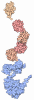
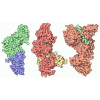
- Assembly
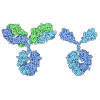
| Deposited unit | 
|
|---|---|
| 1 |
|
-Components
| #1: Protein | Mass: 37507.270 Da / Num. of mol.: 1 Source method: isolated from a genetically manipulated source Source: (gene. exp.) Homo sapiens (human) / Gene: HTR2A, HTR2 / Production host:   Spodoptera frugiperda (fall armyworm) / References: UniProt: P28223 |
|---|---|
| #2: Protein | Mass: 36558.590 Da / Num. of mol.: 1 Source method: isolated from a genetically manipulated source Source: (gene. exp.) Homo sapiens (human) / Gene: GNG2, GNAS, GNAS1 / Production host: Spodoptera frugiperda (fall armyworm)References: UniProt: P59768, UniProt: Q5JWF2, Hydrolases; Acting on acid anhydrides; Acting on GTP to facilitate cellular and subcellular movement |
| #3: Protein | Mass: 37342.785 Da / Num. of mol.: 1 Source method: isolated from a genetically manipulated source Source: (gene. exp.) Homo sapiens (human) / Gene: GNB1 / Production host: Spodoptera frugiperda (fall armyworm) / References: UniProt: P62873 |
| #4: Antibody | Mass: 27531.625 Da / Num. of mol.: 1 Source method: isolated from a genetically manipulated source Source: (gene. exp.) Homo sapiens (human) / Production host: Spodoptera frugiperda (fall armyworm) |
| #5: Chemical | ChemComp-A1EEO / ~{ Mass: 318.454 Da / Num. of mol.: 1 / Source method: obtained synthetically / Formula: C19H30N2O2 / Feature type: SUBJECT OF INVESTIGATION |
| Has ligand of interest | Y |
| Has protein modification | Y |
-Experimental details
-Experiment
| Experiment | Method: ELECTRON MICROSCOPY |
|---|---|
| EM experiment | Aggregation state: PARTICLE / 3D reconstruction method: single particle reconstruction |
- Sample preparation
| Component | Name: 5-HT2A receptor bound to IHCH-8152 in complex with a mini-Gq protein and an active-state stabilizing single-chain variable fragment (scFv16) obtained by cryo-electron microscopy (cryoEM) Type: COMPLEX / Entity ID: #1-#4 / Source: RECOMBINANT |
|---|---|
| Source (natural) | Organism: Homo sapiens (human) |
| Source (recombinant) | Organism: Spodoptera frugiperda (fall armyworm) |
| Buffer solution | pH: 7.4 |
| Specimen | Embedding applied: NO / Shadowing applied: NO / Staining applied: NO / Vitrification applied: YES |
| Specimen support | Grid material: GOLD / Grid mesh size: 300 divisions/in. / Grid type: Quantifoil |
| Vitrification | Cryogen name: ETHANE / Humidity: 100 % / Chamber temperature: 281 K |
- Electron microscopy imaging
| Experimental equipment | 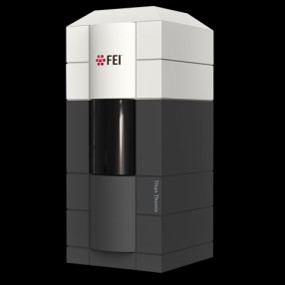 Model: Titan Krios / Image courtesy: FEI Company |
|---|---|
| Microscopy | Model: TFS KRIOS |
| Electron gun | Electron source:  FIELD EMISSION GUN / Accelerating voltage: 300 kV / Illumination mode: OTHER |
| Electron lens | Mode: BRIGHT FIELD / Nominal defocus max: 2000 nm / Nominal defocus min: 1000 nm |
| Image recording | Average exposure time: 2 sec. / Electron dose: 60 e/Å2 / Film or detector model: GATAN K3 BIOQUANTUM (6k x 4k) / Num. of real images: 8564 |
- Processing
| EM software |
| ||||||||||||||||||||||||
|---|---|---|---|---|---|---|---|---|---|---|---|---|---|---|---|---|---|---|---|---|---|---|---|---|---|
| CTF correction | Type: PHASE FLIPPING AND AMPLITUDE CORRECTION | ||||||||||||||||||||||||
| 3D reconstruction | Resolution: 3.2 Å / Resolution method: FSC 0.143 CUT-OFF / Num. of particles: 791492 / Symmetry type: POINT | ||||||||||||||||||||||||
| Refinement | Highest resolution: 3.2 Å Stereochemistry target values: REAL-SPACE (WEIGHTED MAP SUM AT ATOM CENTERS) | ||||||||||||||||||||||||
| Refine LS restraints |
|