 Movie
Movie Controller

[English] 日本語
 Yorodumi
- PDB-21tw: Cryo-EM structure of TNF-alpha in complex with two anti-TNF-alpha... -
+ Open data

- Basic information
| Entry | Database: PDB / ID: 21tw | |||||||||||||||||||||
|---|---|---|---|---|---|---|---|---|---|---|---|---|---|---|---|---|---|---|---|---|---|---|
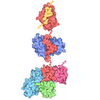
| Title | Cryo-EM structure of TNF-alpha in complex with two anti-TNF-alpha nanobodies, TNF30, derived from the TNF-alpha inhibitor Ozoralizumab (OZR) | |||||||||||||||||||||
 Components Components |
| |||||||||||||||||||||
 Keywords Keywords | CYTOKINE / NANOBODY / VHH / TNF-alpha / HSA / Ozoralizumab / OZR | |||||||||||||||||||||
| Function / homology |  Function and homology information Function and homology informationresponse to Gram-negative bacterium / negative regulation of L-glutamate import across plasma membrane / negative regulation of bile acid secretion / positive regulation of interleukin-33 production / positive regulation of neutrophil activation / response to quercetin / negative regulation of branching involved in lung morphogenesis / positive regulation of fractalkine production / positive regulation of blood microparticle formation / positive regulation of protein transport ...response to Gram-negative bacterium / negative regulation of L-glutamate import across plasma membrane / negative regulation of bile acid secretion / positive regulation of interleukin-33 production / positive regulation of neutrophil activation / response to quercetin / negative regulation of branching involved in lung morphogenesis / positive regulation of fractalkine production / positive regulation of blood microparticle formation / positive regulation of protein transport / positive regulation of vitamin D biosynthetic process / chronic inflammatory response to antigenic stimulus / regulation of endothelial cell apoptotic process / endothelial cell apoptotic process / response to 3,3',5-triiodo-L-thyronine / response to macrophage colony-stimulating factor / negative regulation of myelination / positive regulation of leukocyte adhesion to arterial endothelial cell / response to gold nanoparticle / negative regulation of vascular wound healing / positive regulation of podosome assembly / negative regulation of amyloid-beta clearance / Differentiation of naive CD4+ T cells to T helper 1 cells (Th1 cells) / negative regulation of cytokine production involved in immune response / response to resveratrol / positive regulation of hair follicle development / positive regulation of interleukin-18 production / inflammatory response to wounding / positive regulation of hepatocyte proliferation / negative regulation of bicellular tight junction assembly / positive regulation of action potential / toll-like receptor 3 signaling pathway / TNF signaling / embryonic digestive tract development / vascular endothelial growth factor production / negative regulation of D-glucose import across plasma membrane / positive regulation of fever generation / positive regulation of calcineurin-NFAT signaling cascade / response to fructose / positive regulation of protein localization to cell surface / leukocyte tethering or rolling / negative regulation of mitotic cell cycle / necroptotic signaling pathway / positive regulation of synoviocyte proliferation / regulation of establishment of endothelial barrier / negative regulation of oxidative phosphorylation / positive regulation of mononuclear cell migration / macrophage activation involved in immune response / tumor necrosis factor receptor binding / response to hydrogen sulfide / positive regulation of glial cell proliferation / positive regulation of protein-containing complex disassembly / positive regulation of osteoclast differentiation / cellular response to toxic substance / positive regulation of macrophage derived foam cell differentiation / regulation of fat cell differentiation / positive regulation of chemokine (C-X-C motif) ligand 2 production / positive regulation of heterotypic cell-cell adhesion / positive regulation of membrane protein ectodomain proteolysis / negative regulation of systemic arterial blood pressure / response to L-glutamate / positive regulation of extrinsic apoptotic signaling pathway / positive regulation of leukocyte adhesion to vascular endothelial cell / regulation of canonical NF-kappaB signal transduction / TNFR1-induced proapoptotic signaling / negative regulation of fat cell differentiation / regulation of reactive oxygen species metabolic process / positive regulation of cytokine production involved in inflammatory response / positive regulation of programmed cell death / TNFR1-mediated ceramide production / negative regulation of viral genome replication / negative regulation of heart rate / positive regulation of neuroinflammatory response / positive regulation of amyloid-beta formation / positive regulation of DNA biosynthetic process / extrinsic apoptotic signaling pathway via death domain receptors / positive regulation of immunoglobulin production / negative regulation of endothelial cell proliferation / negative regulation of interleukin-6 production / Interleukin-10 signaling / regulation of synapse organization / regulation of insulin secretion / negative regulation of apoptotic signaling pathway / histone H3K9ac reader activity / negative regulation of blood vessel endothelial cell migration / negative regulation of lipid storage / response to salt stress / negative regulation of extrinsic apoptotic signaling pathway in absence of ligand / detection of mechanical stimulus involved in sensory perception of pain / negative regulation of lipid catabolic process / liver regeneration / negative regulation of osteoblast differentiation / extrinsic apoptotic signaling pathway / lipopolysaccharide-mediated signaling pathway / cellular response to retinoic acid / positive regulation of vascular associated smooth muscle cell proliferation / positive regulation of synaptic transmission / cell surface receptor signaling pathway via JAK-STAT / regulation of synaptic transmission, glutamatergic / response to isolation stress Similarity search - Function | |||||||||||||||||||||
| Biological species |  Homo sapiens (human) Homo sapiens (human) | |||||||||||||||||||||
| Method | ELECTRON MICROSCOPY / single particle reconstruction / cryo EM / Resolution: 2.43 Å | |||||||||||||||||||||
 Authors Authors | Tanaka, Y. / Sato, K. / Mima, M. / Mishima-Tsumagari, C. | |||||||||||||||||||||
| Funding support |  Japan, 1items Japan, 1items
| |||||||||||||||||||||
 Citation Citation | Journal: Biochem Biophys Res Commun / Year: 2026 Title: Cryo-EM elucidates the interaction mechanism of ozoralizumab, a humanized anti-TNFα NANOBODY® compound. Authors: Masashi Mima / Kyohei Sato / Takeshi Yokoyama / Chiemi Mishima-Tsumagari / Tatsuya Ohnuki / Yoshikazu Tanaka / Kunihiko Iwamoto / Abstract: Ozoralizumab (OZR) is a next-generation TNF inhibitor composed of two identical humanized anti-TNFα NANOBODY® molecules (TNF30s) recombinantly linked via one humanized anti-human serum albumin (HSA) ...Ozoralizumab (OZR) is a next-generation TNF inhibitor composed of two identical humanized anti-TNFα NANOBODY® molecules (TNF30s) recombinantly linked via one humanized anti-human serum albumin (HSA) NANOBODY® molecule (ALB8) and two peptide linkers. OZR is designed as a unique format to exert potent inhibitory effects against TNFα with long plasma half-life. However, the three-dimensional structure of OZR-TNFα-HSA complex has not yet been elucidated, and a complete understanding of its interaction mechanism with TNFα is yet to be gained. In this study, we successfully observed the formation of the OZR-TNFα-HSA ternary complex by single-particle cryo-electron microscopy. The single-particle analysis revealed that the two TNF30 molecules of OZR simultaneously bind bivalently to TNFα in a 1:1-bivalent binding mode, while the ALB8 molecule binds to HSA, forming a ternary complex. Thus, OZR exhibits a binding mode significantly different from that of other IgG-type TNFα inhibitors. Furthermore, surface plasmon resonance (SPR) analysis demonstrated that the 1:1-bivalent binding mode confers an exceptionally slow dissociation rate, thereby contributing to the potent TNFα-neutralizing activity of OZR. These findings not only lend support to the favorable clinical efficacy of OZR from a structural standpoint but also lay the foundation for the rational design and development of next-generation TNFα inhibitors with enhanced and sustained efficacy. | |||||||||||||||||||||
| History |
|
- Structure visualization
| Structure viewer | Molecule: MolmilJmol/JSmol |
|---|
- Downloads & links
-Download
| PDBx/mmCIF format | 21tw.cif.gz | 134.3 KB | Display | PDBx/mmCIF format |
|---|---|---|---|---|
| PDB format | pdb21tw.ent.gz | 103.4 KB | Display | PDB format |
| PDBx/mmJSON format | 21tw.json.gz | Tree view | PDBx/mmJSON format | |
| Others |  Other downloads Other downloads |
-Validation report
| Arichive directory | https://data.pdbj.org/pub/pdb/validation_reports/1t/21twftp://data.pdbj.org/pub/pdb/validation_reports/1t/21tw | HTTPS FTP |
|---|
-Related structure data
| Related structure data |  67994MC  21tvC M: map data used to model this data C: citing same article ( |
|---|---|
| Similar structure data |

-Links
 PDBj
PDBj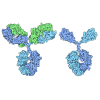

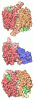
- Assembly
| Deposited unit | 
|
|---|---|
| 1 |
|
-Components
| #1: Protein | Mass: 38471.664 Da / Num. of mol.: 1 Source method: isolated from a genetically manipulated source Source: (gene. exp.) Homo sapiens (human) / Production host:   Cricetulus griseus (Chinese hamster) Cricetulus griseus (Chinese hamster) | ||
|---|---|---|---|
| #2: Protein | Mass: 17427.709 Da / Num. of mol.: 3 Source method: isolated from a genetically manipulated source Source: (gene. exp.) Homo sapiens (human) / Gene: TNF, TNFA, TNFSF2 / Production host:   Escherichia coli (E. coli) / References: UniProt: P01375 Escherichia coli (E. coli) / References: UniProt: P01375Has protein modification | Y | |
-Experimental details
-Experiment
| Experiment | Method: ELECTRON MICROSCOPY |
|---|---|
| EM experiment | Aggregation state: PARTICLE / 3D reconstruction method: single particle reconstruction |
- Sample preparation
| Component |
| ||||||||||||||||||||||||
|---|---|---|---|---|---|---|---|---|---|---|---|---|---|---|---|---|---|---|---|---|---|---|---|---|---|
| Source (natural) | Organism: Homo sapiens (human) | ||||||||||||||||||||||||
| Source (recombinant) |
| ||||||||||||||||||||||||
| Buffer solution | pH: 7 | ||||||||||||||||||||||||
| Specimen | Embedding applied: NO / Shadowing applied: NO / Staining applied: NO / Vitrification applied: YES | ||||||||||||||||||||||||
| Vitrification | Cryogen name: ETHANE |
- Electron microscopy imaging
| Microscopy | Model: JEOL CRYO ARM 300 |
|---|---|
| Electron gun | Electron source:  FIELD EMISSION GUN / Accelerating voltage: 300 kV / Illumination mode: FLOOD BEAM FIELD EMISSION GUN / Accelerating voltage: 300 kV / Illumination mode: FLOOD BEAM |
| Electron lens | Mode: BRIGHT FIELD / Nominal defocus max: 2400 nm / Nominal defocus min: 700 nm |
| Image recording | Electron dose: 40 e/Å2 / Film or detector model: GATAN K3 (6k x 4k) |
- Processing
| EM software |
| ||||||||||||||||
|---|---|---|---|---|---|---|---|---|---|---|---|---|---|---|---|---|---|
| CTF correction | Type: PHASE FLIPPING AND AMPLITUDE CORRECTION | ||||||||||||||||
| 3D reconstruction | Resolution: 2.43 Å / Resolution method: FSC 0.143 CUT-OFF / Num. of particles: 388293 / Symmetry type: POINT |
