 Movie
Movie Controller

[English] 日本語
 Yorodumi
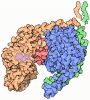
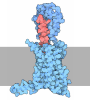
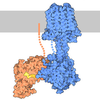
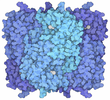
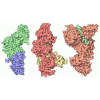
- PDB-21ag: LY334370-bound serotonin 1F (5-HT1F) receptor-miniGoA protein complex -
+ Open data

- Basic information
| Entry | Database: PDB / ID: 21ag | ||||||||||||||||||||||||
|---|---|---|---|---|---|---|---|---|---|---|---|---|---|---|---|---|---|---|---|---|---|---|---|---|---|
| Title | LY334370-bound serotonin 1F (5-HT1F) receptor-miniGoA protein complex | ||||||||||||||||||||||||
 Components Components |
| ||||||||||||||||||||||||
 Keywords Keywords | MEMBRANE PROTEIN/IMMUNE SYSTEM / MEMBRANE PROTEIN-IMMUNE SYSTEM complex | ||||||||||||||||||||||||
| Function / homology |  Function and homology information Function and homology informationGi/o-coupled serotonin receptor activity / serotonin receptor activity / Serotonin receptors / G protein-coupled serotonin receptor activity / neurotransmitter receptor activity / mu-type opioid receptor binding / vesicle docking involved in exocytosis / corticotropin-releasing hormone receptor 1 binding / serotonin binding / G protein-coupled dopamine receptor signaling pathway ...Gi/o-coupled serotonin receptor activity / serotonin receptor activity / Serotonin receptors / G protein-coupled serotonin receptor activity / neurotransmitter receptor activity / mu-type opioid receptor binding / vesicle docking involved in exocytosis / corticotropin-releasing hormone receptor 1 binding / serotonin binding / G protein-coupled dopamine receptor signaling pathway / regulation of heart contraction / parallel fiber to Purkinje cell synapse / G protein-coupled receptor signaling pathway, coupled to cyclic nucleotide second messenger / postsynaptic modulation of chemical synaptic transmission / adenylate cyclase-inhibiting serotonin receptor signaling pathway / G protein-coupled serotonin receptor binding / muscle contraction / locomotory behavior / negative regulation of insulin secretion / GABA-ergic synapse / adenylate cyclase-modulating G protein-coupled receptor signaling pathway / G-protein beta/gamma-subunit complex binding / adenylate cyclase-inhibiting G protein-coupled receptor signaling pathway / Olfactory Signaling Pathway / Activation of the phototransduction cascade / G protein-coupled acetylcholine receptor signaling pathway / G beta:gamma signalling through PLC beta / Presynaptic function of Kainate receptors / Thromboxane signalling through TP receptor / Activation of G protein gated Potassium channels / Inhibition of voltage gated Ca2+ channels via Gbeta/gamma subunits / G-protein activation / Glucagon signaling in metabolic regulation / G beta:gamma signalling through CDC42 / Prostacyclin signalling through prostacyclin receptor / G beta:gamma signalling through BTK / Synthesis, secretion, and inactivation of Glucagon-like Peptide-1 (GLP-1) / photoreceptor disc membrane / ADP signalling through P2Y purinoceptor 12 / Sensory perception of sweet, bitter, and umami (glutamate) taste / Glucagon-type ligand receptors / Adrenaline,noradrenaline inhibits insulin secretion / Vasopressin regulates renal water homeostasis via Aquaporins / Glucagon-like Peptide-1 (GLP1) regulates insulin secretion / G alpha (z) signalling events / cellular response to catecholamine stimulus / ADP signalling through P2Y purinoceptor 1 / ADORA2B mediated anti-inflammatory cytokines production / G beta:gamma signalling through PI3Kgamma / adenylate cyclase-activating dopamine receptor signaling pathway / Cooperation of PDCL (PhLP1) and TRiC/CCT in G-protein beta folding / GPER1 signaling / cellular response to prostaglandin E stimulus / heterotrimeric G-protein complex / G-protein beta-subunit binding / G alpha (12/13) signalling events / Inactivation, recovery and regulation of the phototransduction cascade / extracellular vesicle / sensory perception of taste / Thrombin signalling through proteinase activated receptors (PARs) / signaling receptor complex adaptor activity / retina development in camera-type eye / GTPase binding / cell body / G protein activity / fibroblast proliferation / presynaptic membrane / Ca2+ pathway / High laminar flow shear stress activates signaling by PIEZO1 and PECAM1:CDH5:KDR in endothelial cells / G alpha (i) signalling events / G alpha (s) signalling events / phospholipase C-activating G protein-coupled receptor signaling pathway / G alpha (q) signalling events / chemical synaptic transmission / Hydrolases; Acting on acid anhydrides; Acting on GTP to facilitate cellular and subcellular movement / Ras protein signal transduction / postsynaptic membrane / cell population proliferation / Extra-nuclear estrogen signaling / G protein-coupled receptor signaling pathway / lysosomal membrane / GTPase activity / synapse / dendrite / GTP binding / protein-containing complex binding / glutamatergic synapse / signal transduction / extracellular exosome / membrane / metal ion binding / plasma membrane / cytoplasm / cytosol Similarity search - Function | ||||||||||||||||||||||||
| Biological species |  Homo sapiens (human) Homo sapiens (human)  Mus musculus (house mouse) Mus musculus (house mouse) | ||||||||||||||||||||||||
| Method | ELECTRON MICROSCOPY / single particle reconstruction / cryo EM / Resolution: 3.13 Å | ||||||||||||||||||||||||
 Authors Authors | Cao, C. / Ji, Z. / Wang, Y. | ||||||||||||||||||||||||
| Funding support |  China, 1items China, 1items
| ||||||||||||||||||||||||
 Citation Citation | Journal: Biochem Biophys Res Commun / Year: 2026 Title: Structural basis of LY334370 recognition and selectivity at the 5-HT receptor. Authors: Yumeng Wang / Chunyu Wang / Can Cao / Abstract: The 5-HT receptor is a serotonin receptor subtype highly expressed in trigeminal sensory neurons, where it modulates neuropeptide release and nociceptive signaling without inducing vasoconstriction. ...The 5-HT receptor is a serotonin receptor subtype highly expressed in trigeminal sensory neurons, where it modulates neuropeptide release and nociceptive signaling without inducing vasoconstriction. This makes it an important therapeutic target for migraine. LY334370 was developed as a first-generation selective 5-HTR agonist and demonstrated efficacy in clinical studies. However, the molecular mechanism underlying 5-HTR activation by LY334370 remains poorly understood. Here, we determined a 3.13 Å cryo-EM structure of the LY334370-bound 5-HTR-miniGα complex. Combined with functional analyses, this structure delineates the molecular determinants underlying LY334370 recognition. Comparison with BRL54443 indicates that LY334370 selectivity for 5-HTR is driven by its optimal accommodation within the receptor-specific extended binding pocket. Furthermore, comparative analysis with the lasmiditan-bound 5-HTR-Gα complex reveals distinct agonist binding modes and provides mechanistic insight into Gα subtype-specific coupling. Collectively, these findings elucidate the structural basis of 5-HTR activation, ligand selectivity, and G protein coupling, providing a structural framework for the rational design of safer and more effective anti-migraine drugs. | ||||||||||||||||||||||||
| History |
|
- Structure visualization
| Structure viewer | Molecule: MolmilJmol/JSmol |
|---|
- Downloads & links
-Download
| PDBx/mmCIF format | 21ag.cif.gz | 235.3 KB | Display | PDBx/mmCIF format |
|---|---|---|---|---|
| PDB format | pdb21ag.ent.gz | Display | PDB format | |
| PDBx/mmJSON format | 21ag.json.gz | Tree view | PDBx/mmJSON format | |
| Others |  Other downloads Other downloads |
-Validation report
| Arichive directory | https://data.pdbj.org/pub/pdb/validation_reports/1a/21agftp://data.pdbj.org/pub/pdb/validation_reports/1a/21ag | HTTPS FTP |
|---|
-Related structure data
| Related structure data |  67446MC  21ahC M: map data used to model this data C: citing same article ( |
|---|---|
| Similar structure data |

-Links
 PDBj
PDBj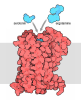
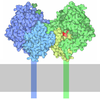
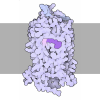
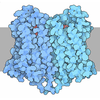
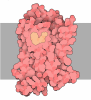


- Assembly
| Deposited unit | 
|
|---|---|
| 1 |
|
-Components
-Guanine nucleotide-binding protein ... , 3 types, 3 molecules BCG
| #1: Protein | Mass: 39418.086 Da / Num. of mol.: 1 Source method: isolated from a genetically manipulated source Source: (gene. exp.) Homo sapiens (human) / Gene: GNB1 / Production host:   Spodoptera frugiperda (fall armyworm) / References: UniProt: P62873 Spodoptera frugiperda (fall armyworm) / References: UniProt: P62873 |
|---|---|
| #2: Protein | Mass: 25435.102 Da / Num. of mol.: 1 Source method: isolated from a genetically manipulated source Source: (gene. exp.) Homo sapiens (human) / Gene: GNAO1 / Production host: Spodoptera frugiperda (fall armyworm)References: UniProt: P09471, Hydrolases; Acting on acid anhydrides; Acting on GTP to facilitate cellular and subcellular movement |
| #3: Protein | Mass: 7861.143 Da / Num. of mol.: 1 Source method: isolated from a genetically manipulated source Source: (gene. exp.) Homo sapiens (human) / Gene: GNG2 / Production host: Spodoptera frugiperda (fall armyworm) / References: UniProt: P59768 |
-Protein / Antibody / Non-polymers , 3 types, 3 molecules RS
| #4: Protein | Mass: 41761.980 Da / Num. of mol.: 1 Source method: isolated from a genetically manipulated source Source: (gene. exp.) Homo sapiens (human) / Gene: HTR1F, HTR1EL / Production host: Spodoptera frugiperda (fall armyworm) / References: UniProt: P30939 |
|---|---|
| #5: Antibody | Mass: 28668.922 Da / Num. of mol.: 1 Source method: isolated from a genetically manipulated source Source: (gene. exp.) Mus musculus (house mouse) / Production host: Spodoptera frugiperda (fall armyworm) |
| #6: Chemical | ChemComp-A1E2G / Mass: 351.417 Da / Num. of mol.: 1 / Source method: obtained synthetically / Formula: C21H22FN3O / Feature type: SUBJECT OF INVESTIGATION |
-Details
| Has ligand of interest | Y |
|---|---|
| Has protein modification | Y |
-Experimental details
-Experiment
| Experiment | Method: ELECTRON MICROSCOPY |
|---|---|
| EM experiment | Aggregation state: PARTICLE / 3D reconstruction method: single particle reconstruction |
- Sample preparation
| Component | Name: GPCR bound with a ligand / Type: COMPLEX / Entity ID: #1-#5 / Source: RECOMBINANT | ||||||||||||
|---|---|---|---|---|---|---|---|---|---|---|---|---|---|
| Molecular weight | Value: 0.13868 MDa / Experimental value: NO | ||||||||||||
| Source (natural) |
| ||||||||||||
| Source (recombinant) | Organism: Spodoptera frugiperda (fall armyworm) | ||||||||||||
| Buffer solution | pH: 7.4 | ||||||||||||
| Specimen | Embedding applied: NO / Shadowing applied: NO / Staining applied: NO / Vitrification applied: YES | ||||||||||||
| Vitrification | Cryogen name: ETHANE |
- Electron microscopy imaging
| Experimental equipment |  Model: Titan Krios / Image courtesy: FEI Company |
|---|---|
| Microscopy | Model: TFS KRIOS |
| Electron gun | Electron source:  FIELD EMISSION GUN / Accelerating voltage: 300 kV / Illumination mode: FLOOD BEAM FIELD EMISSION GUN / Accelerating voltage: 300 kV / Illumination mode: FLOOD BEAM |
| Electron lens | Mode: BRIGHT FIELD / Nominal defocus max: 1600 nm / Nominal defocus min: 800 nm |
| Image recording | Electron dose: 50 e/Å2 / Film or detector model: GATAN K3 BIOQUANTUM (6k x 4k) |
- Processing
| EM software |
| ||||||||||||||||
|---|---|---|---|---|---|---|---|---|---|---|---|---|---|---|---|---|---|
| CTF correction | Type: NONE | ||||||||||||||||
| 3D reconstruction | Resolution: 3.13 Å / Resolution method: FSC 0.143 CUT-OFF / Num. of particles: 114556 / Symmetry type: POINT | ||||||||||||||||
| Refinement | Cross valid method: NONE |
