[English] 日本語
Yorodumi
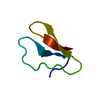
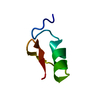
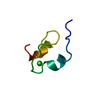
- PDB-1pb5: NMR Structure of a Prototype LNR Module from Human Notch1 -

+
Open data


ID or keywords:

Loading...

-
Basic information

Entry
Database: PDB / ID: 1pb5
TitleNMR Structure of a Prototype LNR Module from Human Notch1
ComponentsNeurogenic locus notch homolog protein 1
KeywordsSIGNALING PROTEIN / Notch signaling / LIN12/Notch repeat / calcium-binding domain / protein module / disulfide bond
Function / homology
Function and homology information


Defective LFNG causes SCDO3 / coronary sinus valve morphogenesis / cardiac right atrium morphogenesis / growth involved in heart morphogenesis / regulation of cardioblast proliferation / mesenchymal cell development / cell differentiation in spinal cord / venous endothelial cell differentiation / arterial endothelial cell differentiation / collecting duct development ...Defective LFNG causes SCDO3 / coronary sinus valve morphogenesis / cardiac right atrium morphogenesis / growth involved in heart morphogenesis / regulation of cardioblast proliferation / mesenchymal cell development / cell differentiation in spinal cord / venous endothelial cell differentiation / arterial endothelial cell differentiation / collecting duct development / cell migration involved in endocardial cushion formation / negative regulation of pro-B cell differentiation / Pre-NOTCH Processing in the Endoplasmic Reticulum / mitral valve formation / : / endocardium morphogenesis / distal tubule development / MAML1-RBP-Jkappa- ICN1 complex / cardiac chamber formation / cardiac atrium morphogenesis / pericardium morphogenesis / atrioventricular node development / cardiac ventricle morphogenesis / positive regulation of transcription of Notch receptor target / negative regulation of endothelial cell chemotaxis / cardiac septum morphogenesis / glomerular mesangial cell development / cellular response to tumor cell / positive regulation of smooth muscle cell differentiation / vasculogenesis involved in coronary vascular morphogenesis / negative regulation of extracellular matrix constituent secretion / regulation of extracellular matrix assembly / chemical synaptic transmission, postsynaptic / positive regulation of apoptotic process involved in morphogenesis / endocardial cell differentiation / left/right axis specification / epithelial to mesenchymal transition involved in endocardial cushion formation / Constitutive Signaling by NOTCH1 t(7;9)(NOTCH1:M1580_K2555) Translocation Mutant / positive regulation of endothelial cell differentiation / cardiac left ventricle morphogenesis / negative regulation of myotube differentiation / coronary vein morphogenesis / negative regulation of glial cell proliferation / cardiac vascular smooth muscle cell development / neuronal stem cell population maintenance / endocardium development / positive regulation of astrocyte differentiation / cardiac muscle cell myoblast differentiation / negative regulation of cell adhesion molecule production / negative regulation of stem cell differentiation / tissue regeneration / T-helper 17 type immune response / positive regulation of cardiac epithelial to mesenchymal transition / cardiac epithelial to mesenchymal transition / heart trabecula morphogenesis / negative regulation of oligodendrocyte differentiation / regulation of cell adhesion involved in heart morphogenesis / interleukin-17-mediated signaling pathway / Pre-NOTCH Processing in Golgi / negative regulation of catalytic activity / negative regulation of myoblast differentiation / cellular response to follicle-stimulating hormone stimulus / negative regulation of collagen biosynthetic process / negative regulation of cardiac muscle hypertrophy / luteolysis / determination of left/right symmetry / pulmonary valve morphogenesis / tube formation / cardiac muscle tissue morphogenesis / oligodendrocyte differentiation / atrioventricular valve morphogenesis / ventricular trabecula myocardium morphogenesis / coronary artery morphogenesis / negative regulation of cell migration involved in sprouting angiogenesis / negative regulation of cell-cell adhesion mediated by cadherin / negative regulation of ossification / negative regulation of biomineral tissue development / response to muramyl dipeptide / astrocyte differentiation / positive regulation of BMP signaling pathway / endocardial cushion morphogenesis / transcription regulator activator activity / homeostasis of number of cells within a tissue / Loss of Function of FBXW7 in Cancer and NOTCH1 Signaling / Regulation of gene expression in late stage (branching morphogenesis) pancreatic bud precursor cells / RUNX3 regulates NOTCH signaling / Notch binding / Regulation of NFE2L2 gene expression / NOTCH4 Intracellular Domain Regulates Transcription / positive regulation of neuroblast proliferation / aortic valve morphogenesis / negative regulation of cold-induced thermogenesis / negative regulation of neuron differentiation / NOTCH3 Intracellular Domain Regulates Transcription / NFE2L2 regulating tumorigenic genes / heart looping / ventricular septum morphogenesis / Notch-HLH transcription pathway / Formation of paraxial mesoderm / Somitogenesis
Similarity search - Function
Neurogenic locus notch homolog protein 1 / Notch, C-terminal / Domain of unknown function / : / Notch / Notch, NOD domain / Notch, NODP domain / NOTCH protein / NOTCH protein / NOD ...Neurogenic locus notch homolog protein 1 / Notch, C-terminal / Domain of unknown function / : / Notch / Notch, NOD domain / Notch, NODP domain / NOTCH protein / NOTCH protein / NOD / NODP / Notch-like domain superfamily / LNR (Lin-12/Notch) repeat profile. / LNR domain / Notch domain / Domain found in Notch and Lin-12 / EGF-like, conserved site / Human growth factor-like EGF / : / Calcium-binding EGF domain / EGF-like domain / EGF-type aspartate/asparagine hydroxylation site / EGF-like calcium-binding, conserved site / Calcium-binding EGF-like domain signature. / Aspartic acid and asparagine hydroxylation site. / EGF-like calcium-binding domain / Calcium-binding EGF-like domain / Epidermal growth factor-like domain. / Ankyrin repeat / EGF-like domain profile. / Growth factor receptor cysteine-rich domain superfamily / EGF-like domain signature 1. / EGF-like domain signature 2. / EGF-like domain / Ankyrin repeat profile. / Ankyrin repeats (3 copies) / Ankyrin repeat region circular profile. / ankyrin repeats / Ankyrin repeat / Ankyrin repeat-containing domain superfamily
Similarity search - Domain/homology
Neurogenic locus notch homolog protein 1
Similarity search - Component
Biological speciesHomo sapiens (human)
MethodSOLUTION NMR / distance geometry, torsion angle dynamics, simulated annealing
Model type detailsminimized average
AuthorsVardar, D. / North, C.L. / Sanchez-Irizarry, C. / Aster, J.C. / Blacklow, S.C.
CitationJournal: Biochemistry / Year: 2003
Title: Nuclear Magnetic Resonance Structure of a Prototype Lin12-Notch Repeat Module from Human Notch1
Authors: Vardar, D. / North, C.L. / Sanchez-Irizarry, C. / Aster, J.C. / Blacklow, S.C.
History
DepositionMay 14, 2003Deposition site: RCSB / Processing site: RCSB
Revision 1.0Jun 17, 2003Provider: repository / Type: Initial release
Revision 1.1Apr 29, 2008Group: Version format compliance
Revision 1.2Jul 13, 2011Group: Version format compliance
Revision 1.3Feb 23, 2022Group: Data collection / Database references / Derived calculations
Category: database_2 / pdbx_nmr_software ...database_2 / pdbx_nmr_software / pdbx_struct_assembly / pdbx_struct_conn_angle / pdbx_struct_oper_list / struct_conn / struct_site
Item: _database_2.pdbx_DOI / _database_2.pdbx_database_accession ..._database_2.pdbx_DOI / _database_2.pdbx_database_accession / _pdbx_nmr_software.name / _pdbx_struct_conn_angle.ptnr1_auth_comp_id / _pdbx_struct_conn_angle.ptnr1_auth_seq_id / _pdbx_struct_conn_angle.ptnr1_label_atom_id / _pdbx_struct_conn_angle.ptnr1_label_comp_id / _pdbx_struct_conn_angle.ptnr1_label_seq_id / _pdbx_struct_conn_angle.ptnr3_auth_comp_id / _pdbx_struct_conn_angle.ptnr3_auth_seq_id / _pdbx_struct_conn_angle.ptnr3_label_atom_id / _pdbx_struct_conn_angle.ptnr3_label_comp_id / _pdbx_struct_conn_angle.ptnr3_label_seq_id / _pdbx_struct_conn_angle.value / _struct_conn.pdbx_dist_value / _struct_conn.ptnr1_auth_comp_id / _struct_conn.ptnr1_auth_seq_id / _struct_conn.ptnr1_label_asym_id / _struct_conn.ptnr1_label_atom_id / _struct_conn.ptnr1_label_comp_id / _struct_conn.ptnr1_label_seq_id / _struct_conn.ptnr2_auth_comp_id / _struct_conn.ptnr2_auth_seq_id / _struct_conn.ptnr2_label_asym_id / _struct_conn.ptnr2_label_atom_id / _struct_conn.ptnr2_label_comp_id / _struct_conn.ptnr2_label_seq_id / _struct_site.pdbx_auth_asym_id / _struct_site.pdbx_auth_comp_id / _struct_site.pdbx_auth_seq_id
Revision 1.4Oct 9, 2024Group: Data collection / Structure summary
Category: chem_comp_atom / chem_comp_bond ...chem_comp_atom / chem_comp_bond / pdbx_entry_details / pdbx_modification_feature

-
Structure visualization

Structure viewerMolecule:
MolmilJmol/JSmol

Downloads & links

-
Assembly

Deposited unit
A: Neurogenic locus notch homolog protein 1
hetero molecules


Theoretical massNumber of molelcules
Total (without water)3,7582
Polymers3,7181
Non-polymers401
Water00
1


  • Idetical with deposited unit
  • defined by author
TypeNameSymmetry operationNumber
identity operation1_555x,y,z1
NMR ensembles
DataCriteria
Number of conformers (submitted / calculated)16 / 50all calculated structures submitted,structures with the lowest energy
RepresentativeModel #1minimized average structure

-
Components

#1: Protein/peptide Neurogenic locus notch homolog protein 1 / Notch 1 / hN1 / translocation-associated notch protein TAN-1


Mass: 3717.964 Da / Num. of mol.: 1 / Fragment: First LNR module
Source method: isolated from a genetically manipulated source
Source: (gene. exp.) Homo sapiens (human) / Plasmid: pMM / Production host: Escherichia coli (E. coli) / Strain (production host): BL21DE3plysS / References: UniProt: P46531

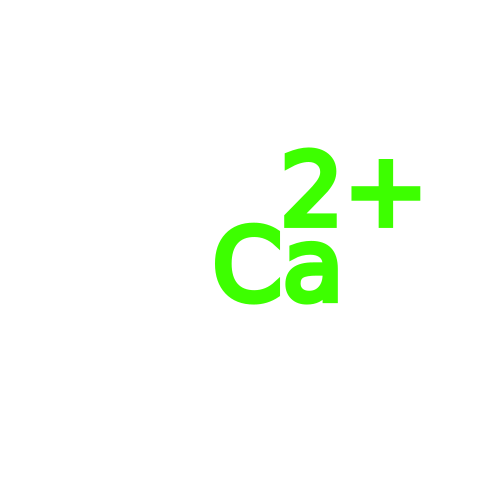
#2: Chemical ChemComp-CA / CALCIUM ION


Mass: 40.078 Da / Num. of mol.: 1 / Source method: obtained synthetically / Formula: Ca
Has protein modificationY

-
Experimental details

-
Experiment

ExperimentMethod: SOLUTION NMR
NMR experiment
Conditions-IDExperiment-IDSolution-IDType
112HNCA, HN(CO)CA, 13C HSQC
1213D 15N-separated TOCSY, 2D TOCSY, 15N-HSQC, 15N-HMQC-J
2333D 15N-separated TOCSY, 2D TOCSY, 15N-HSQC
NMR detailsText: The structure was determined using triple-resonance NMR spectroscopy

-
Sample preparation

Details
Solution-IDContentsSolvent system
11mM LNRA U-15N, 10mM Ca2+, 0.5mM DSS pH 6.590% H2O/10% D2O
21mM LNRA U-15N,13C, 10mM Ca2+, 0.5mM DSS pH 6.590% H2O/10% D2O
31.5mM LNRA U-15N,13C, 10 mM Ca2+, 0.5mM DSS, 50 mM deuterated PIPES pH 7.090% H2O/10% D2O
Sample conditions
Conditions-IDIonic strengthpHPressure (kPa)Temperature (K)
110mM Ca2+ 6.5ambient 298 K
210mM Ca2+, 50mM PIPES 7ambient 283 K
Crystal grow
*PLUS
Method: other / Details: NMR

-
NMR measurement

RadiationProtocol: SINGLE WAVELENGTH / Monochromatic (M) / Laue (L): M
Radiation wavelengthRelative weight: 1
NMR spectrometer
TypeManufacturerModelField strength (MHz)Spectrometer-ID
Bruker DMXBrukerDMX6001
Bruker DMXBrukerDMX5002
Varian UNITYVarianUNITY4003

-
Processing

NMR software
NameVersionDeveloperClassification
XwinNMRcollection
NMRPipeDelaglio, F.processing
NMRView5.0.4Johnson, B.data analysis
CNS1.1Brungerstructure solution
CNS1.1Brungerrefinement
RefinementMethod: distance geometry, torsion angle dynamics, simulated annealing
Software ordinal: 1
NMR representativeSelection criteria: minimized average structure
NMR ensembleConformer selection criteria: all calculated structures submitted,structures with the lowest energy
Conformers calculated total number: 50 / Conformers submitted total number: 16

+
About Yorodumi

-
News

-
Feb 9, 2022. New format data for meta-information of EMDB entries

New format data for meta-information of EMDB entries

  • Version 3 of the EMDB header file is now the official format.
  • The previous official version 1.9 will be removed from the archive.

Related info.:EMDB header

External links:wwPDB to switch to version 3 of the EMDB data model

-
Aug 12, 2020. Covid-19 info

Covid-19 info

URL: https://pdbj.org/emnavi/covid19.php

New page: Covid-19 featured information page in EM Navigator.

Related info.:Covid-19 info / Mar 5, 2020. Novel coronavirus structure data

+
Mar 5, 2020. Novel coronavirus structure data

Novel coronavirus structure data

Related info.:Yorodumi Speices / Aug 12, 2020. Covid-19 info

External links:COVID-19 featured content - PDBj / Molecule of the Month (242):Coronavirus Proteases

+
Jan 31, 2019. EMDB accession codes are about to change! (news from PDBe EMDB page)

EMDB accession codes are about to change! (news from PDBe EMDB page)

  • The allocation of 4 digits for EMDB accession codes will soon come to an end. Whilst these codes will remain in use, new EMDB accession codes will include an additional digit and will expand incrementally as the available range of codes is exhausted. The current 4-digit format prefixed with “EMD-” (i.e. EMD-XXXX) will advance to a 5-digit format (i.e. EMD-XXXXX), and so on. It is currently estimated that the 4-digit codes will be depleted around Spring 2019, at which point the 5-digit format will come into force.
  • The EM Navigator/Yorodumi systems omit the EMD- prefix.

Related info.:Q: What is EMD? / ID/Accession-code notation in Yorodumi/EM Navigator

External links:EMDB Accession Codes are Changing Soon! / Contact to PDBj

+
Jul 12, 2017. Major update of PDB

Major update of PDB

  • wwPDB released updated PDB data conforming to the new PDBx/mmCIF dictionary.
  • This is a major update changing the version number from 4 to 5, and with Remediation, in which all the entries are updated.
  • In this update, many items about electron microscopy experimental information are reorganized (e.g. em_software).
  • Now, EM Navigator and Yorodumi are based on the updated data.

External links:wwPDB Remediation / Enriched Model Files Conforming to OneDep Data Standards Now Available in the PDB FTP Archive

-
Yorodumi

Thousand views of thousand structures

  • Yorodumi is a browser for structure data from EMDB, PDB, SASBDB, etc.
  • This page is also the successor to EM Navigator detail page, and also detail information page/front-end page for Omokage search.
  • The word "yorodu" (or yorozu) is an old Japanese word meaning "ten thousand". "mi" (miru) is to see.

Related info.:EMDB / PDB / SASBDB / Comparison of 3 databanks / Yorodumi Search / Aug 31, 2016. New EM Navigator & Yorodumi / Yorodumi Papers / Jmol/JSmol / Function and homology information / Changes in new EM Navigator and Yorodumi

Read more