 Movie
Movie Controller


+ Open data

- Basic information
| Entry | Database: PDB / ID: 13gj | |||||||||||||||||||||||||||||||||
|---|---|---|---|---|---|---|---|---|---|---|---|---|---|---|---|---|---|---|---|---|---|---|---|---|---|---|---|---|---|---|---|---|---|---|
| Title | IST1 bound to PI(4,5)P2 containing membrane | |||||||||||||||||||||||||||||||||
 Components Components | IST1 homolog | |||||||||||||||||||||||||||||||||
 Keywords Keywords | LIPID BINDING PROTEIN / ESCRT / ESCRT-III / PIP2 / PI(4 / 5)P2 / endosomal / cytokinesis | |||||||||||||||||||||||||||||||||
| Function / homology |  Function and homology information Function and homology informationMIT domain binding / ESCRT III complex disassembly / cytoskeleton-dependent cytokinesis / Sealing of the nuclear envelope (NE) by ESCRT-III / midbody abscission / multivesicular body assembly / Flemming body / endoplasmic reticulum-Golgi intermediate compartment / positive regulation of proteolysis / establishment of protein localization ...MIT domain binding / ESCRT III complex disassembly / cytoskeleton-dependent cytokinesis / Sealing of the nuclear envelope (NE) by ESCRT-III / midbody abscission / multivesicular body assembly / Flemming body / endoplasmic reticulum-Golgi intermediate compartment / positive regulation of proteolysis / establishment of protein localization / intracellular protein localization / azurophil granule lumen / nuclear envelope / protein transport / midbody / cadherin binding / protein domain specific binding / cell division / centrosome / Neutrophil degranulation / protein-containing complex binding / chromatin / extracellular exosome / extracellular region / identical protein binding / cytosol Similarity search - Function | |||||||||||||||||||||||||||||||||
| Biological species |  Homo sapiens (human) Homo sapiens (human) | |||||||||||||||||||||||||||||||||
| Method | ELECTRON MICROSCOPY / helical reconstruction / cryo EM / Resolution: 2 Å | |||||||||||||||||||||||||||||||||
 Authors Authors | Alian, A. / Moss III, F.R. / Talledge, N. / McCullough, J. / Frost, A. / Sundquist, W.I. | |||||||||||||||||||||||||||||||||
| Funding support |  United States, 1items United States, 1items
| |||||||||||||||||||||||||||||||||
 Citation Citation | Journal: Proc Natl Acad Sci U S A / Year: 2026 Title: Phosphatidylinositol diphosphate binding by ESCRT-III filaments. Authors: Akram Alian / John McCullough / Frank R Moss / Nathaniel Talledge / Arshad Mohammed / Cecilia D Gerstner / Jacob A Dalluge / Elliott L Paine / Omar Davulcu / Chi-Lun Chang / Adam Frost / Wesley I Sundquist / Abstract: Different inositol phospholipids (PIPs) distribute to distinct subcellular organelles, creating an addressing system that dictates the sites of action of PIP-binding proteins, including components of ...Different inositol phospholipids (PIPs) distribute to distinct subcellular organelles, creating an addressing system that dictates the sites of action of PIP-binding proteins, including components of the Endosomal Sorting Complexes Required for Transport (ESCRT). The ESCRT machinery is recruited to remodel many different cellular membranes through combinatorial binding interactions made by the early-acting ESCRT-I and ESCRT-II complexes with PIPs, ubiquitin modifications, and membrane-specific adaptors. Membrane remodeling, constriction, and fission are then mediated by membrane-associated filaments formed by subunits of the late-acting ESCRT-III complexes, together with their associated VPS4 AAA ATPases. Here, we describe two different classes of helical ESCRT-III filaments that can surround and tubulate membranes containing PIP lipids. Cryo-EM reconstructions revealed that protofilaments comprising closed IST1 subunits formed 8-stranded nanotubes that encase membrane monolayers. The nanotube coordinates exposed PI(4,5)P or PI(3,5)P headgroups within a basic pocket formed at the junction of three IST1 subunits, and our structures reveal how the pocket can accommodate either PIP isomer with minimal adjustment. In contrast, protofilaments comprising open CHMP1A subunits formed one start helices that encase membrane bilayers and bind exposed PI(4,5)P headgroups across a basic surface that spans adjacent subunits of the CHMP1A protofilament. These two different structures extend the known plasticity of ESCRT-III polymers, reveal how PIP lipids can promote ESCRT-III filament assembly and membrane remodeling, and define the molecular contacts that underlie specific ESCRT-III/PIP interactions. | |||||||||||||||||||||||||||||||||
| History |
|
- Structure visualization
| Structure viewer | Molecule: MolmilJmol/JSmol |
|---|
- Downloads & links
-Download
| PDBx/mmCIF format | 13gj.cif.gz | 82.2 KB | Display | PDBx/mmCIF format |
|---|---|---|---|---|
| PDB format | pdb13gj.ent.gz | 59.1 KB | Display | PDB format |
| PDBx/mmJSON format | 13gj.json.gz | Tree view | PDBx/mmJSON format | |
| Others |  Other downloads Other downloads |
-Validation report
| Arichive directory | https://data.pdbj.org/pub/pdb/validation_reports/3g/13gjftp://data.pdbj.org/pub/pdb/validation_reports/3g/13gj | HTTPS FTP |
|---|
-Related structure data
| Related structure data |  77058MC  13ghC  13gmC C: citing same article ( M: map data used to model this data |
|---|---|
| Similar structure data |


-Links
 PDBj
PDBj- Assembly
| Deposited unit | 
|
|---|---|
| 1 | x 41
|
-Components
| #1: Protein | Mass: 39796.402 Da / Num. of mol.: 1 Source method: isolated from a genetically manipulated source Details: residues 1-2 and 186-364 are unstructured / Source: (gene. exp.) Homo sapiens (human) / Gene: IST1Production host:   Escherichia coli 'BL21-Gold(DE3)pLysS AG' (bacteria) Escherichia coli 'BL21-Gold(DE3)pLysS AG' (bacteria)References: UniProt: P53990 |
|---|---|
| #2: Chemical | ChemComp-PIO / [(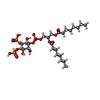  Mass: 746.566 Da / Num. of mol.: 1 / Source method: isolated from a natural source / Formula: C25H49O19P3 / Feature type: SUBJECT OF INVESTIGATION Mass: 746.566 Da / Num. of mol.: 1 / Source method: isolated from a natural source / Formula: C25H49O19P3 / Feature type: SUBJECT OF INVESTIGATION |
| #3: Water | ChemComp-HOH /  Mass: 18.015 Da / Num. of mol.: 82 / Source method: isolated from a natural source / Formula: H2O Mass: 18.015 Da / Num. of mol.: 82 / Source method: isolated from a natural source / Formula: H2O |
| Has ligand of interest | Y |
| Has protein modification | N |
-Experimental details
-Experiment
| Experiment | Method: ELECTRON MICROSCOPY |
|---|---|
| EM experiment | Aggregation state: HELICAL ARRAY / 3D reconstruction method: helical reconstruction |
- Sample preparation
| Component | Name: Regulator of Vps4 activity in the MVB pathway (Ist1) / Type: COMPLEX / Details: Regulator of Vps4 activity in the MVB pathway. / Entity ID: #1 / Source: RECOMBINANT | ||||||||||||
|---|---|---|---|---|---|---|---|---|---|---|---|---|---|
| Molecular weight |
| ||||||||||||
| Source (natural) | Organism: Homo sapiens (human) | ||||||||||||
| Source (recombinant) | Organism: Escherichia coli 'BL21-Gold(DE3)pLysS AG' (bacteria) | ||||||||||||
| Buffer solution | pH: 8 | ||||||||||||
| Specimen | Embedding applied: NO / Shadowing applied: NO / Staining applied: NO / Vitrification applied: YES | ||||||||||||
| Specimen support | Grid material: COPPER / Grid mesh size: 300 divisions/in. / Grid type: EMS Lacey Carbon | ||||||||||||
| Vitrification | Instrument: LEICA EM GP / Cryogen name: ETHANE / Humidity: 85 % / Chamber temperature: 284 K |
- Electron microscopy imaging
| Experimental equipment |  Model: Titan Krios / Image courtesy: FEI Company | ||||||||||||||||||
|---|---|---|---|---|---|---|---|---|---|---|---|---|---|---|---|---|---|---|---|
| Microscopy | Model: TFS KRIOS | ||||||||||||||||||
| Electron gun | Electron source:  FIELD EMISSION GUN / Accelerating voltage: 300 kV / Illumination mode: FLOOD BEAM FIELD EMISSION GUN / Accelerating voltage: 300 kV / Illumination mode: FLOOD BEAM | ||||||||||||||||||
| Electron lens | Mode: OTHER / Nominal magnification: 165000 X / Nominal defocus max: 1300 nm / Nominal defocus min: 400 nm / C2 aperture diameter: 50 µm | ||||||||||||||||||
| Image recording |
| ||||||||||||||||||
| Image scans |
|
- Processing
| EM software |
| ||||||||||||||||||||||||||||
|---|---|---|---|---|---|---|---|---|---|---|---|---|---|---|---|---|---|---|---|---|---|---|---|---|---|---|---|---|---|
| CTF correction | Type: NONE | ||||||||||||||||||||||||||||
| Helical symmerty |
| ||||||||||||||||||||||||||||
| Particle selection | Num. of particles selected: 3381581 | ||||||||||||||||||||||||||||
| 3D reconstruction | Resolution: 2 Å / Resolution method: FSC 0.143 CUT-OFF / Num. of particles: 652823 / Symmetry type: HELICAL | ||||||||||||||||||||||||||||
| Atomic model building | B value: 68.6 / Protocol: FLEXIBLE FIT / Space: REAL | ||||||||||||||||||||||||||||
| Atomic model building | PDB-ID: 3FRR Accession code: 3FRR / Chain residue range: 1-191 / Pdb chain residue range: 1-191 / Source name: PDB / Type: experimental model |

