 Movie
Movie Controller


+ Open data

- Basic information
| Entry | Database: PDB / ID: 13de | |||||||||||||||
|---|---|---|---|---|---|---|---|---|---|---|---|---|---|---|---|---|
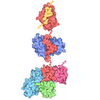
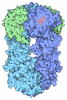
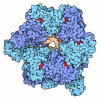
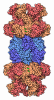
| Title | Cryo-EM structure of ATR-ATRIP-ETAA1 AAD (S95D/S111D) | |||||||||||||||
 Components Components |
| |||||||||||||||
 Keywords Keywords | NUCLEAR PROTEIN / kinase / PI3K-related kinase / complex / activator / replication stress response / replication checkpoint | |||||||||||||||
| Function / homology |  Function and homology information Function and homology informationATR-ATRIP complex / establishment of RNA localization to telomere / positive regulation of telomerase catalytic core complex assembly / nuclear membrane disassembly / establishment of protein-containing complex localization to telomere / MutSalpha complex binding / histone H2AXS139 kinase activity / negative regulation of DNA replication / MutLalpha complex binding / response to arsenic-containing substance ...ATR-ATRIP complex / establishment of RNA localization to telomere / positive regulation of telomerase catalytic core complex assembly / nuclear membrane disassembly / establishment of protein-containing complex localization to telomere / MutSalpha complex binding / histone H2AXS139 kinase activity / negative regulation of DNA replication / MutLalpha complex binding / response to arsenic-containing substance / nucleobase-containing compound metabolic process / mitotic G2/M transition checkpoint / regulation of double-strand break repair / positive regulation of protein serine/threonine kinase activity / K63-linked polyubiquitin modification-dependent protein binding / protein localization to chromosome, telomeric region / regulation of DNA damage checkpoint / HDR through Single Strand Annealing (SSA) / nuclear replication fork / Impaired BRCA2 binding to RAD51 / positive regulation of DNA damage response, signal transduction by p53 class mediator / replicative senescence / Regulation of HSF1-mediated heat shock response / Presynaptic phase of homologous DNA pairing and strand exchange / response to mechanical stimulus / Activation of ATR in response to replication stress / interstrand cross-link repair / DNA damage checkpoint signaling / regulation of cellular response to heat / positive regulation of telomere maintenance via telomerase / protein serine/threonine kinase activator activity / telomere maintenance / replication fork processing / Meiotic synapsis / site of DNA damage / TP53 Regulates Transcription of DNA Repair Genes / Fanconi Anemia Pathway / cellular response to gamma radiation / PML body / G2/M DNA damage checkpoint / double-strand break repair / cellular response to UV / nuclear envelope / Processing of DNA double-strand break ends / Regulation of TP53 Activity through Phosphorylation / DNA replication / protein kinase activity / non-specific serine/threonine protein kinase / nuclear speck / response to xenobiotic stimulus / chromosome / protein serine kinase activity / DNA repair / protein serine/threonine kinase activity / DNA damage response / DNA binding / nucleoplasm / ATP binding / nucleus Similarity search - Function | |||||||||||||||
| Biological species |  Homo sapiens (human) Homo sapiens (human) | |||||||||||||||
| Method | ELECTRON MICROSCOPY / single particle reconstruction / cryo EM / Resolution: 2.9 Å | |||||||||||||||
 Authors Authors | Li, B. / Pavletich, N.P. | |||||||||||||||
| Funding support |  United States, 2items United States, 2items
| |||||||||||||||
 Citation Citation | Journal: Nat Struct Mol Biol / Year: 2026 Title: Structural mechanism of TOPBP1 activating the ATR-ATRIP replication checkpoint kinase. Authors: Buren Li / Ayat Yaseen / Nikola P Pavletich / Abstract: The ATR protein kinase preserves genomic integrity during DNA replication by controlling checkpoints needed for the orderly progression of S phase and for the responses to replication stress. ATR, ...The ATR protein kinase preserves genomic integrity during DNA replication by controlling checkpoints needed for the orderly progression of S phase and for the responses to replication stress. ATR, with its obligate partner ATRIP, is activated by the TOPBP1 and ETAA1 proteins, which control different branches of ATR signaling. TOPBP1 is essential for induction of the S phase checkpoint in response to stalled replication forks, while ETAA1 is required for timely progression to mitosis from an unperturbed S phase. TOPBP1 and ETAA1 contain ATR-activating domains (AADs) of limited homology, but how they activate ATR has not yet been fully elucidated. Here we present the 3.0-Å cryo-EM structure of the human ATR-ATRIP complex bound to the TOPBP1 AAD, showing that TOPBP1 activates ATR by inducing a global conformational change that allosterically realigns active site residues in the kinase domain ~70 Å away. We also present the 3.3-Å structure of the ATR-ATRIP-ETAA1 AAD complex, which reveals a binding mode distinct from TOPBP1. Our data suggest that the distinct binding modes of TOPBP1 and ETAA1 contribute to the different cellular contexts and outcomes of ATR-ATRIP activation. | |||||||||||||||
| History |
|
- Structure visualization
| Structure viewer | Molecule: MolmilJmol/JSmol |
|---|
- Downloads & links
-Download
| PDBx/mmCIF format | 13de.cif.gz | 1.2 MB | Display | PDBx/mmCIF format |
|---|---|---|---|---|
| PDB format | pdb13de.ent.gz | 947.8 KB | Display | PDB format |
| PDBx/mmJSON format | 13de.json.gz | Tree view | PDBx/mmJSON format | |
| Others |  Other downloads Other downloads |
-Validation report
| Arichive directory | https://data.pdbj.org/pub/pdb/validation_reports/3d/13deftp://data.pdbj.org/pub/pdb/validation_reports/3d/13de | HTTPS FTP |
|---|
-Related structure data
| Related structure data |  76990MC  9zcyC  9zd1C  9zd3C  9zd4C C: citing same article ( M: map data used to model this data |
|---|---|
| Similar structure data |


-Links
 PDBj
PDBj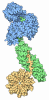
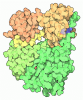
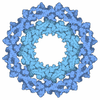
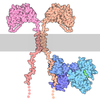
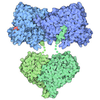

- Assembly
| Deposited unit | 
|
|---|---|
| 1 |
|
-Components
-Protein , 3 types, 6 molecules ABCDFE
| #1: Protein | Mass: 304008.312 Da / Num. of mol.: 2 Source method: isolated from a genetically manipulated source Source: (gene. exp.) Homo sapiens (human) / Gene: ATR, FRP1 / Production host: Homo sapiens (human)References: UniProt: Q13535, non-specific serine/threonine protein kinase #2: Protein | Mass: 88192.039 Da / Num. of mol.: 2 Source method: isolated from a genetically manipulated source Source: (gene. exp.) Homo sapiens (human) / Gene: ATRIP, AGS1 / Production host: Homo sapiens (human) / References: UniProt: Q8WXE1#3: Protein | Mass: 23305.000 Da / Num. of mol.: 2 / Mutation: S95D, S111D Source method: isolated from a genetically manipulated source Source: (gene. exp.) Homo sapiens (human) / Gene: ETAA1, ETAA16 / Production host:   Escherichia coli (E. coli) / References: UniProt: Q9NY74 Escherichia coli (E. coli) / References: UniProt: Q9NY74 |
|---|
-Non-polymers , 3 types, 10 molecules 

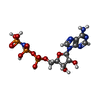
| #4: Chemical | ChemComp-ZN /  Mass: 65.409 Da / Num. of mol.: 4 / Source method: obtained synthetically / Formula: Zn Mass: 65.409 Da / Num. of mol.: 4 / Source method: obtained synthetically / Formula: Zn#5: Chemical | ChemComp-MG /  Mass: 24.305 Da / Num. of mol.: 4 / Source method: obtained synthetically / Formula: Mg Mass: 24.305 Da / Num. of mol.: 4 / Source method: obtained synthetically / Formula: Mg#6: Chemical | 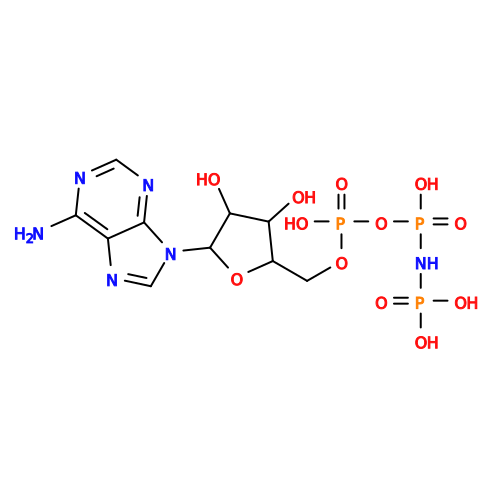 Mass: 506.196 Da / Num. of mol.: 2 / Source method: obtained synthetically / Formula: C10H17N6O12P3 / Comment: AMP-PNP, energy-carrying molecule analogue*YM Mass: 506.196 Da / Num. of mol.: 2 / Source method: obtained synthetically / Formula: C10H17N6O12P3 / Comment: AMP-PNP, energy-carrying molecule analogue*YM |
|---|
-Details
| Has ligand of interest | N |
|---|---|
| Has protein modification | N |
-Experimental details
-Experiment
| Experiment | Method: ELECTRON MICROSCOPY |
|---|---|
| EM experiment | Aggregation state: PARTICLE / 3D reconstruction method: single particle reconstruction |
- Sample preparation
| Component | Name: ATR-ATRIP-ETAA1 AAD (S95D/S111D) / Type: COMPLEX / Entity ID: #1-#3 / Source: RECOMBINANT |
|---|---|
| Source (natural) | Organism: Homo sapiens (human) |
| Source (recombinant) | Organism: Homo sapiens (human) |
| Buffer solution | pH: 8 |
| Specimen | Embedding applied: NO / Shadowing applied: NO / Staining applied: NO / Vitrification applied: YES |
| Vitrification | Cryogen name: ETHANE |
- Electron microscopy imaging
| Experimental equipment |  Model: Titan Krios / Image courtesy: FEI Company |
|---|---|
| Microscopy | Model: TFS KRIOS |
| Electron gun | Electron source:  FIELD EMISSION GUN / Accelerating voltage: 300 kV / Illumination mode: FLOOD BEAM FIELD EMISSION GUN / Accelerating voltage: 300 kV / Illumination mode: FLOOD BEAM |
| Electron lens | Mode: BRIGHT FIELD / Nominal defocus max: 1700 nm / Nominal defocus min: 600 nm |
| Image recording | Electron dose: 53 e/Å2 / Film or detector model: GATAN K3 (6k x 4k) |
- Processing
| EM software |
| ||||||||||||||||
|---|---|---|---|---|---|---|---|---|---|---|---|---|---|---|---|---|---|
| CTF correction | Type: PHASE FLIPPING AND AMPLITUDE CORRECTION | ||||||||||||||||
| 3D reconstruction | Resolution: 2.9 Å / Resolution method: FSC 0.143 CUT-OFF / Num. of particles: 1340199 / Symmetry type: POINT |
