 ムービー
ムービー コントローラー


+ データを開く

- 基本情報
基本情報
| 登録情報 | データベース: PDB / ID: 12bp | |||||||||
|---|---|---|---|---|---|---|---|---|---|---|
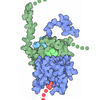
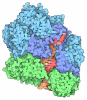
| タイトル | Cryo-EM structure of human DDB1-CRBN-GSPT1 in complex with GT19630 | |||||||||
 要素 要素 |
| |||||||||
 キーワード キーワード | HYDROLASE / Protein Degrader | |||||||||
| 機能・相同性 |  機能・相同性情報 機能・相同性情報translation release factor complex / regulation of translational termination / translation release factor activity / negative regulation of monoatomic ion transmembrane transport / positive regulation by virus of viral protein levels in host cell / spindle assembly involved in female meiosis / nuclear-transcribed mRNA catabolic process, nonsense-mediated decay / epigenetic programming in the zygotic pronuclei / protein methylation / UV-damage excision repair ...translation release factor complex / regulation of translational termination / translation release factor activity / negative regulation of monoatomic ion transmembrane transport / positive regulation by virus of viral protein levels in host cell / spindle assembly involved in female meiosis / nuclear-transcribed mRNA catabolic process, nonsense-mediated decay / epigenetic programming in the zygotic pronuclei / protein methylation / UV-damage excision repair / biological process involved in interaction with symbiont / regulation of mitotic cytokinesis / regulation of mitotic cell cycle phase transition / regulation of miRNA-mediated gene silencing / regulation of natural killer cell activation / WD40-repeat domain binding / regulation of cell cycle phase transition / locomotory exploration behavior / Cul4A-RING E3 ubiquitin ligase complex / Cul4-RING E3 ubiquitin ligase complex / regulation of stem cell population maintenance / Cul4B-RING E3 ubiquitin ligase complex / ubiquitin ligase complex scaffold activity / negative regulation of adipose tissue development / regulation of cellular response to stress / limb development / viral release from host cell / cullin family protein binding / Eukaryotic Translation Termination / positive regulation of Wnt signaling pathway / Nonsense Mediated Decay (NMD) independent of the Exon Junction Complex (EJC) / negative regulation of protein-containing complex assembly / regulation of DNA-templated DNA replication initiation / positive regulation of viral genome replication / positive regulation of gluconeogenesis / translational termination / Nonsense Mediated Decay (NMD) enhanced by the Exon Junction Complex (EJC) / regulation of embryonic development / replication fork processing / G1/S transition of mitotic cell cycle / proteasomal protein catabolic process / epigenetic regulation of gene expression / positive regulation of protein-containing complex assembly / nucleotide-excision repair / regulation of autophagy / Recognition of DNA damage by PCNA-containing replication complex / regulation of circadian rhythm / cell population proliferation / DNA Damage Recognition in GG-NER / Dual Incision in GG-NER / Transcription-Coupled Nucleotide Excision Repair (TC-NER) / Formation of TC-NER Pre-Incision Complex / Regulation of expression of SLITs and ROBOs / Formation of Incision Complex in GG-NER / positive regulation of protein catabolic process / cellular response to UV / cytosolic ribosome / Dual incision in TC-NER / Gap-filling DNA repair synthesis and ligation in TC-NER / regulation of cell population proliferation / rhythmic process / site of double-strand break / Neddylation / spermatogenesis / ubiquitin-dependent protein catabolic process / Potential therapeutics for SARS / damaged DNA binding / proteasome-mediated ubiquitin-dependent protein catabolic process / regulation of apoptotic process / 加水分解酵素; 酸無水物に作用; GTPに作用・細胞または細胞小器官の運動に関与 / transmembrane transporter binding / protein-macromolecule adaptor activity / chromosome, telomeric region / protein ubiquitination / translation / DNA repair / GTPase activity / DNA damage response / nucleolus / GTP binding / protein-containing complex binding / perinuclear region of cytoplasm / protein-containing complex / DNA binding / : / RNA binding / extracellular exosome / nucleoplasm / membrane / metal ion binding / nucleus / cytosol / cytoplasm 類似検索 - 分子機能 | |||||||||
| 生物種 |  Homo sapiens (ヒト) Homo sapiens (ヒト) | |||||||||
| 手法 | 電子顕微鏡法 / 単粒子再構成法 / クライオ電子顕微鏡法 / 解像度: 2.9 Å | |||||||||
 データ登録者 データ登録者 | Huang, J. / Chu, H.F. / Tong, L. | |||||||||
| 資金援助 |  中国, 1件 中国, 1件
| |||||||||
 引用 引用 | ジャーナル: Blood / 年: 2026 タイトル: Dual MYC and GSPT1 Protein Degrader for MYC-Driven Hematologic Malignancies. 著者: Yuki Nishida / Valeria Impedovo / Edward Ayoub / Natalia Baran / Darah A Scruggs / Hideaki Mizuno / Shayaun Khazaei / Lauren B Ostermann / Kazuharu Kamachi / Liang Zhang / Jo Ishizawa / ...著者: Yuki Nishida / Valeria Impedovo / Edward Ayoub / Natalia Baran / Darah A Scruggs / Hideaki Mizuno / Shayaun Khazaei / Lauren B Ostermann / Kazuharu Kamachi / Liang Zhang / Jo Ishizawa / Sandeep Singh / Andrea D Bedoy / Po Yee Mak / Bing Z Carter / Eiji Sugihara / Tetsuya Takimoto / Youzhi Tong / Honghua Yan / Dong Chen / Ji Huang / Hsu-Feng Chu / Liang Tong / Zamal Ahmed / Sarita Namjoshi / John Tainer / Mihai Gagea / Thomas Huynh / Abhishek Maiti / Koji Sasaki / Branko Cuglievan / Steffen Boettcher / Torsten Haferlach / Stefano Tiziani / Liandong Ma / Michael Andreeff /     要旨: Direct targeting of the oncoprotein MYC has not yet been successful. We here report a novel dual protein degrader, GT19630, which binds directly to MYC and G1 to S phase transition protein 1 (GSPT1). ...Direct targeting of the oncoprotein MYC has not yet been successful. We here report a novel dual protein degrader, GT19630, which binds directly to MYC and G1 to S phase transition protein 1 (GSPT1). GT19630 disrupts a novel feedforward loop of MYC and GSPT1, where MYC promotes transcription of GSPT1, and GSPT1 senses the stop codon of MYC to properly terminate its translation. The agent induces integrated stress response and abrogates oxidative phosphorylation through inhibition of the TCA cycle, resulting in apoptosis. GT19630 has superior activity compared to GSPT1- targeting molecular glues. GT19630 induces profound anti-proliferative effects and apoptosis at low nanomolar concentrations in a multitude of leukemia and lymphoma cell lines and primary samples, including those with TP53 mutations. GT19630 is highly active in vivo in models of therapy-resistant hematologic malignancies, including Burkitt's lymphoma, acute myeloid leukemia (AML) and multiple myeloma. CD34+ AML blasts overexpress MYC protein compared to normal hematopoietic stem/progenitor cells (HSPCs) and GT19630 induces greater cytotoxicity in AML cells compared to normal HSPCs. Further, GT19630 restores sensitivity to venetoclax and profoundly prolongs survival in vivo in venetoclax-resistant AML. GT19630 was well tolerated in humanized Crbn mice. In conclusion, our data support the development of the MYC/GSPT1 degrader GT19630 as a therapeutic strategy of MYC-driven hematologic malignancies. | |||||||||
| 履歴 |
|
- 構造の表示
構造の表示
| 構造ビューア | 分子: MolmilJmol/JSmol |
|---|
- ダウンロードとリンク
-ダウンロード
| PDBx/mmCIF形式 | 12bp.cif.gz | 267.2 KB | 表示 | PDBx/mmCIF形式 |
|---|---|---|---|---|
| PDB形式 | pdb12bp.ent.gz | 表示 | PDB形式 | |
| PDBx/mmJSON形式 | 12bp.json.gz | ツリー表示 | PDBx/mmJSON形式 | |
| その他 |  その他のダウンロード その他のダウンロード |
-検証レポート
| アーカイブディレクトリ | https://data.pdbj.org/pub/pdb/validation_reports/2b/12bpftp://data.pdbj.org/pub/pdb/validation_reports/2b/12bp | HTTPS FTP |
|---|
-関連構造データ

-リンク
 PDBj
PDBj

- 集合体
集合体
| 登録構造単位 | 
|
|---|---|
| 1 |
|
-要素
| #1: タンパク質 | 分子量: 24154.234 Da / 分子数: 1 / 由来タイプ: 組換発現 / 由来: (組換発現) Homo sapiens (ヒト) / 遺伝子: GSPT1, ERF3A / 発現宿主:   Escherichia coli (大腸菌) Escherichia coli (大腸菌)参照: UniProt: P15170, 加水分解酵素; 酸無水物に作用; GTPに作用・細胞または細胞小器官の運動に関与 |
|---|---|
| #2: タンパク質 | 分子量: 46653.617 Da / 分子数: 1 / 由来タイプ: 組換発現 / 由来: (組換発現) Homo sapiens (ヒト) / 遺伝子: CRBN, AD-006 / 発現宿主:  Trichoplusia ni (イラクサキンウワバ) / 参照: UniProt: Q96SW2 Trichoplusia ni (イラクサキンウワバ) / 参照: UniProt: Q96SW2 |
| #3: タンパク質 | 分子量: 93347.078 Da / 分子数: 1 Fragment: UNP residues 1-395,706-1140,UNP residues 1-395,706-1140 由来タイプ: 組換発現 / 由来: (組換発現) Homo sapiens (ヒト) / 遺伝子: DDB1, XAP1 / 発現宿主: Trichoplusia ni (イラクサキンウワバ) / 参照: UniProt: Q16531 |
| #4: 化合物 | ChemComp-A1DBR / 分子量: 614.650 Da / 分子数: 1 / 由来タイプ: 合成 / 式: C35H30N6O5 / タイプ: SUBJECT OF INVESTIGATION |
| #5: 化合物 | ChemComp-ZN /   分子量: 65.409 Da / 分子数: 1 / 由来タイプ: 合成 / 式: Zn 分子量: 65.409 Da / 分子数: 1 / 由来タイプ: 合成 / 式: Zn |
| 研究の焦点であるリガンドがあるか | Y |
| Has protein modification | N |
-実験情報
-実験
| 実験 | 手法: 電子顕微鏡法 |
|---|---|
| EM実験 | 試料の集合状態: PARTICLE / 3次元再構成法: 単粒子再構成法 |
- 試料調製
試料調製
| 構成要素 | 名称: Ternary complex of DDB1-CRBN with GSPT1 / タイプ: COMPLEX / Entity ID: #3, #1-#2 / 由来: RECOMBINANT |
|---|---|
| 由来(天然) | 生物種: Homo sapiens (ヒト) |
| 由来(組換発現) | 生物種: Trichoplusia ni (イラクサキンウワバ) |
| 緩衝液 | pH: 8 |
| 試料 | 包埋: NO / シャドウイング: NO / 染色: NO / 凍結: YES |
| 急速凍結 | 凍結剤: ETHANE |
- 電子顕微鏡撮影
| 実験機器 |  モデル: Titan Krios / 画像提供: FEI Company |
|---|---|
| 顕微鏡 | モデル: TFS KRIOS |
| 電子銃 | 電子線源:  FIELD EMISSION GUN / 加速電圧: 300 kV / 照射モード: FLOOD BEAM FIELD EMISSION GUN / 加速電圧: 300 kV / 照射モード: FLOOD BEAM |
| 電子レンズ | モード: BRIGHT FIELD / 最大 デフォーカス(公称値): 2000 nm / 最小 デフォーカス(公称値): 1500 nm |
| 撮影 | 電子線照射量: 58 e/Å2 / フィルム・検出器のモデル: GATAN K3 (6k x 4k) |
- 解析
解析
| EMソフトウェア |
| ||||||||||||||||||||||||
|---|---|---|---|---|---|---|---|---|---|---|---|---|---|---|---|---|---|---|---|---|---|---|---|---|---|
| CTF補正 | タイプ: PHASE FLIPPING AND AMPLITUDE CORRECTION | ||||||||||||||||||||||||
| 3次元再構成 | 解像度: 2.9 Å / 解像度の算出法: FSC 0.143 CUT-OFF / 粒子像の数: 291647 / 対称性のタイプ: POINT | ||||||||||||||||||||||||
| 精密化 | 最高解像度: 2.9 Å 立体化学のターゲット値: REAL-SPACE (WEIGHTED MAP SUM AT ATOM CENTERS) | ||||||||||||||||||||||||
| 拘束条件 |
|
