Movie
 Controller


+ Open data

- Basic information
| Entry | Database: PDB / ID: 12bb | |||||||||||||||
|---|---|---|---|---|---|---|---|---|---|---|---|---|---|---|---|---|
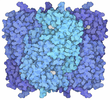
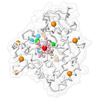
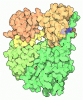
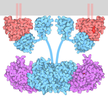
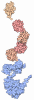
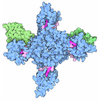
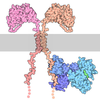
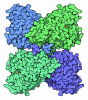
| Title | Cryo-EM structure of the iNOS:CaM engaged state | |||||||||||||||
 Components |
| |||||||||||||||
 Keywords | CYTOSOLIC PROTEIN / Nitric oxide synthase / Calmodulin / Enzyme complex / Heme-binding protein | |||||||||||||||
| Function / homology |  Function and homology information positive regulation of leukocyte mediated cytotoxicity / Inhibition of nitric oxide production / regulation of cellular respiration / prostaglandin secretion / Nitric oxide stimulates guanylate cyclase / ROS and RNS production in phagocytes / tetrahydrobiopterin binding / arginine binding / superoxide metabolic process / peptidyl-cysteine S-nitrosylation ...positive regulation of leukocyte mediated cytotoxicity / Inhibition of nitric oxide production / regulation of cellular respiration / prostaglandin secretion / Nitric oxide stimulates guanylate cyclase / ROS and RNS production in phagocytes / tetrahydrobiopterin binding / arginine binding / superoxide metabolic process / peptidyl-cysteine S-nitrosylation / CaM pathway / Cam-PDE 1 activation / Sodium/Calcium exchangers / Calmodulin induced events / Reduction of cytosolic Ca++ levels / : / Activation of Ca-permeable Kainate Receptor / CREB1 phosphorylation through the activation of CaMKII/CaMKK/CaMKIV cascasde / organelle localization by membrane tethering / Loss of phosphorylation of MECP2 at T308 / CREB1 phosphorylation through the activation of Adenylate Cyclase / CaMK IV-mediated phosphorylation of CREB / regulation of cytokine production involved in inflammatory response / PKA activation / CASP4 inflammasome assembly / Glycogen breakdown (glycogenolysis) / presynaptic endocytosis / Activation of RAC1 downstream of NMDARs / CLEC7A (Dectin-1) induces NFAT activation / negative regulation of ryanodine-sensitive calcium-release channel activity / Fc-gamma receptor signaling pathway involved in phagocytosis / negative regulation of high voltage-gated calcium channel activity / autophagosome membrane docking / negative regulation of calcium ion export across plasma membrane / regulation of cardiac muscle cell action potential / regulation of ryanodine-sensitive calcium-release channel activity / Synthesis of IP3 and IP4 in the cytosol / regulation of insulin secretion / Phase 0 - rapid depolarisation / peroxisomal matrix / Negative regulation of NMDA receptor-mediated neuronal transmission / Unblocking of NMDA receptors, glutamate binding and activation / presynaptic cytosol / calcineurin-mediated signaling / RHO GTPases activate PAKs / regulation of cell communication by electrical coupling involved in cardiac conduction / nitric-oxide synthase (NADPH) / Ion transport by P-type ATPases / Uptake and function of anthrax toxins / Long-term potentiation / protein phosphatase activator activity / Calcineurin activates NFAT / DARPP-32 events / nitric-oxide synthase activity / Regulation of MECP2 expression and activity / Smooth Muscle Contraction / response to bacterium / detection of calcium ion / cellular response to interferon-beta / regulation of cardiac muscle contraction / L-arginine catabolic process / negative regulation of blood pressure / RHO GTPases activate IQGAPs / nitric oxide biosynthetic process / catalytic complex / calcium channel inhibitor activity / eNOS activation / Tetrahydrobiopterin (BH4) synthesis, recycling, salvage and regulation / calyx of Held / regulation of heart rate / regulation of release of sequestered calcium ion into cytosol by sarcoplasmic reticulum / Ion homeostasis / Activation of AMPK downstream of NMDARs / titin binding / Protein methylation / sperm midpiece / cell redox homeostasis / response to hormone / regulation of cardiac muscle contraction by regulation of the release of sequestered calcium ion / voltage-gated potassium channel complex / nitric oxide-cGMP-mediated signaling / FCERI mediated Ca+2 mobilization / substantia nigra development / calcium channel complex / FCGR3A-mediated IL10 synthesis / protein serine/threonine kinase activator activity / Antigen activates B Cell Receptor (BCR) leading to generation of second messengers / positive regulation of receptor signaling pathway via JAK-STAT / Ras activation upon Ca2+ influx through NMDA receptor / adenylate cyclase activator activity / positive regulation of interleukin-8 production / regulation of cytokinesis / VEGFR2 mediated cell proliferation / spindle microtubule / VEGFR2 mediated vascular permeability / calcium channel regulator activity / sarcomere / Translocation of SLC2A4 (GLUT4) to the plasma membrane / negative regulation of protein catabolic process / circadian rhythm Similarity search - Function | |||||||||||||||
| Biological species |  Homo sapiens (human) | |||||||||||||||
| Method | ELECTRON MICROSCOPY / single particle reconstruction / cryo EM / Resolution: 2.96 Å | |||||||||||||||
 Authors | Lee, K. / Southworth, D. | |||||||||||||||
| Funding support |  United States, 4items
| |||||||||||||||
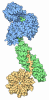
 Citation | Journal: Nat Struct Mol Biol / Year: 2026 Title: Structural basis of electron transfer by the human nitric oxide synthase holoenzyme complex. Authors: Kanghyun Lee / Cristian Martinez-Ramos / Ting Jiang / Thomas H Pospiech / Eric Tse / Miranda Lau / Changjian Feng / Yoichi Osawa / Daniel R Southworth / Abstract: Mammalian nitric oxide synthase (NOS) generates nitric oxide (NO), an essential signaling molecule in neurotransmission, inflammation and cardiovascular regulation. NOS dysregulation contributes to ...Mammalian nitric oxide synthase (NOS) generates nitric oxide (NO), an essential signaling molecule in neurotransmission, inflammation and cardiovascular regulation. NOS dysregulation contributes to neurodegeneration, septic shock and ischemia. The structural basis of NOS function remains unclear, likely because of its dynamic, multicomponent architecture. Catalysis requires electron transfer across five cofactors, with the oxygenase (Oxy) domain converting L-arginine to NO after receiving electrons from the reductase (Red) domain through calmodulin (CaM) activation. Here, we report cryo-electron microscopy structures of the human inducible NOS:CaM holoenzyme, revealing an architecture in which the Red:CaM arm spans the Oxy dimer in an apparent active state for cross-monomer electron transfer. The flavin mononucleotide subdomain is rotated ~90° relative to the Red core, positioning its cofactor ~9 Å from the heme, adjacent to a conserved tryptophan residue within a narrow Oxy domain tunnel. Red-Oxy flexibility in the active state may facilitate electron shuttling among cofactors, defining how NOS cofactors are transiently aligned to enable catalysis. | |||||||||||||||
| History |
|
- Structure visualization
| Structure viewer | Molecule: MolmilJmol/JSmol |
|---|
- Downloads & links
-Download
| PDBx/mmCIF format | 12bb.cif.gz | 348 KB | Display | PDBx/mmCIF format |
|---|---|---|---|---|
| PDB format | pdb12bb.ent.gz | 263.7 KB | Display | PDB format |
| PDBx/mmJSON format | 12bb.json.gz | Tree view | PDBx/mmJSON format | |
| Others |  Other downloads |
-Validation report
| Arichive directory | https://data.pdbj.org/pub/pdb/validation_reports/2b/12bbftp://data.pdbj.org/pub/pdb/validation_reports/2b/12bb | HTTPS FTP |
|---|
-Related structure data
| Related structure data |  76274MC  12bcC  12bdC  12beC M: map data used to model this data C: citing same article ( |
|---|---|
| Similar structure data |


-Links
 PDBj
- Assembly
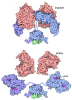
| Deposited unit | 
|
|---|---|
| 1 |
|
-Components
-Protein , 2 types, 3 molecules ABC
| #1: Protein | Mass: 133903.547 Da / Num. of mol.: 2 Source method: isolated from a genetically manipulated source Source: (gene. exp.) Homo sapiens (human) / Gene: NOS2, NOS2A / Production host:   Escherichia coli (E. coli) / References: UniProt: P35228, nitric-oxide synthase (NADPH) #2: Protein | | Mass: 16852.545 Da / Num. of mol.: 1 Source method: isolated from a genetically manipulated source Source: (gene. exp.) Homo sapiens (human) / Gene: CALM1, CALM, CAM, CAM1 / Production host: Escherichia coli (E. coli) / References: UniProt: P0DP23 |
|---|
-Non-polymers , 6 types, 11 molecules 
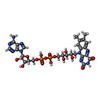

| #3: Chemical | ChemComp-ZN /  Mass: 65.409 Da / Num. of mol.: 1 / Source method: obtained synthetically / Formula: Zn / Feature type: SUBJECT OF INVESTIGATION | ||||||||
|---|---|---|---|---|---|---|---|---|---|
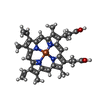
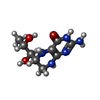
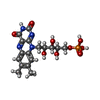
| #4: Chemical |  Mass: 616.487 Da / Num. of mol.: 2 / Source method: obtained synthetically / Formula: C34H32FeN4O4 / Feature type: SUBJECT OF INVESTIGATION #5: Chemical |  Mass: 241.247 Da / Num. of mol.: 2 / Source method: obtained synthetically / Formula: C9H15N5O3 / Feature type: SUBJECT OF INVESTIGATION / Comment: neurotransmitter*YM #6: Chemical | ChemComp-FMN / |  Mass: 456.344 Da / Num. of mol.: 1 / Source method: obtained synthetically / Formula: C17H21N4O9P / Feature type: SUBJECT OF INVESTIGATION #7: Chemical | ChemComp-FAD / |  Mass: 785.550 Da / Num. of mol.: 1 / Source method: obtained synthetically / Formula: C27H33N9O15P2 / Feature type: SUBJECT OF INVESTIGATION / Comment: FAD*YM #8: Chemical | ChemComp-CA /  Mass: 40.078 Da / Num. of mol.: 4 / Source method: obtained synthetically / Formula: Ca / Feature type: SUBJECT OF INVESTIGATION |
-Details
| Has ligand of interest | Y |
|---|---|
| Has protein modification | Y |
-Experimental details
-Experiment
| Experiment | Method: ELECTRON MICROSCOPY |
|---|---|
| EM experiment | Aggregation state: PARTICLE / 3D reconstruction method: single particle reconstruction |
- Sample preparation
| Component | Name: iNOS:CaM Dimer / Type: COMPLEX / Entity ID: #1-#2 / Source: RECOMBINANT |
|---|---|
| Source (natural) | Organism: Homo sapiens (human) |
| Source (recombinant) | Organism: Escherichia coli (E. coli) |
| Buffer solution | pH: 7.5 |
| Specimen | Embedding applied: NO / Shadowing applied: NO / Staining applied: NO / Vitrification applied: YES |
| Vitrification | Cryogen name: ETHANE |
- Electron microscopy imaging
| Experimental equipment |  Model: Titan Krios / Image courtesy: FEI Company |
|---|---|
| Microscopy | Model: TFS KRIOS |
| Electron gun | Electron source:  FIELD EMISSION GUN / Accelerating voltage: 300 kV / Illumination mode: FLOOD BEAM |
| Electron lens | Mode: BRIGHT FIELD / Nominal defocus max: 2000 nm / Nominal defocus min: 1000 nm |
| Image recording | Electron dose: 66 e/Å2 / Film or detector model: GATAN K3 BIOQUANTUM (6k x 4k) |
- Processing
| EM software |
| |||||||||
|---|---|---|---|---|---|---|---|---|---|---|
| CTF correction | Type: PHASE FLIPPING AND AMPLITUDE CORRECTION | |||||||||
| 3D reconstruction | Resolution: 2.96 Å / Resolution method: FSC 0.143 CUT-OFF / Num. of particles: 56656 / Symmetry type: POINT |