 Movie
Movie Controller

[English] 日本語
 Yorodumi
- PDB-12ag: Spermine-blocked open-state cryo-EM structure of human TRPV6 chan... -
+ Open data

- Basic information
| Entry | Database: PDB / ID: 12ag | ||||||||||||||||||||||||
|---|---|---|---|---|---|---|---|---|---|---|---|---|---|---|---|---|---|---|---|---|---|---|---|---|---|
| Title | Spermine-blocked open-state cryo-EM structure of human TRPV6 channel in cNW30 nanodiscs | ||||||||||||||||||||||||
 Components Components | Transient receptor potential cation channel subfamily V member 6 | ||||||||||||||||||||||||
 Keywords Keywords | MEMBRANE PROTEIN / polyamine / spermine / cancer / cryo-EM / TRP channels / TRPV6 / oncochannel / channel block | ||||||||||||||||||||||||
| Function / homology |  Function and homology information Function and homology informationregulation of calcium ion-dependent exocytosis / TRP channels / calcium ion import across plasma membrane / calcium ion homeostasis / calcium channel complex / response to calcium ion / calcium channel activity / calcium ion transport / calcium ion transmembrane transport / calmodulin binding ...regulation of calcium ion-dependent exocytosis / TRP channels / calcium ion import across plasma membrane / calcium ion homeostasis / calcium channel complex / response to calcium ion / calcium channel activity / calcium ion transport / calcium ion transmembrane transport / calmodulin binding / identical protein binding / plasma membrane Similarity search - Function | ||||||||||||||||||||||||
| Biological species |  Homo sapiens (human) Homo sapiens (human) | ||||||||||||||||||||||||
| Method | ELECTRON MICROSCOPY / single particle reconstruction / cryo EM / Resolution: 3.48 Å | ||||||||||||||||||||||||
 Authors Authors | Neuberger, A. / Sobolevsky, A.I. | ||||||||||||||||||||||||
| Funding support |  Germany, Germany,  France, France,  United States, 7items United States, 7items
| ||||||||||||||||||||||||
 Citation Citation | Journal: Nat Commun / Year: 2026 Title: Open-channel block of human TRPV6 by polyamine spermine. Authors: Arthur Neuberger / Irina I Veretenenko / Alexey Shalygin / Yury A Trofimov / Thomas Gudermann / Vladimir Chubanov / Roman G Efremov / Alexander I Sobolevsky /  Abstract: Polyamines are organic cations that are present at sub-millimolar concentrations in the cytoplasm and extracellular fluids and serve as versatile modulators of TRP channels, fine-tuning their ...Polyamines are organic cations that are present at sub-millimolar concentrations in the cytoplasm and extracellular fluids and serve as versatile modulators of TRP channels, fine-tuning their functions in physiological and pathological contexts, including pain, inflammation and cancer. Despite extensive functional studies, the structural basis by which polyamines regulate TRP channels remains unclear. Here, we combine calcium imaging, electrophysiology, cryo-electron microscopy, mutagenesis and molecular dynamics simulations to study regulation of human TRPV6 by polyamine spermine. Our functional experiments demonstrate voltage-dependent block of TRPV6-mediated currents by spermine. Cryo-electron microscopy reveals that spermine binds in the open pore of TRPV6, extending along the pore axis through the selectivity filter and central cavity. Mutagenesis and molecular dynamics simulations confirm the main binding site of spermine in the selectivity filter and suggest a stepwise molecular mechanism of channel block that includes two more binding sites in the pore transiently occupied by spermine. Our findings enrich the knowledge about TRPV6 regulation by endogenous factors and provide details of the ion channel blocking mechanism that can be explored for inhibition of this channel in disease conditions. | ||||||||||||||||||||||||
| History |
|
- Structure visualization
| Structure viewer | Molecule: MolmilJmol/JSmol |
|---|
- Downloads & links
-Download
| PDBx/mmCIF format | 12ag.cif.gz | 452 KB | Display | PDBx/mmCIF format |
|---|---|---|---|---|
| PDB format | pdb12ag.ent.gz | 375.3 KB | Display | PDB format |
| PDBx/mmJSON format | 12ag.json.gz | Tree view | PDBx/mmJSON format | |
| Others |  Other downloads Other downloads |
-Validation report
| Arichive directory | https://data.pdbj.org/pub/pdb/validation_reports/2a/12agftp://data.pdbj.org/pub/pdb/validation_reports/2a/12ag | HTTPS FTP |
|---|
-Related structure data
| Related structure data |  76261MC M: map data used to model this data C: citing same article ( |
|---|---|
| Similar structure data |
-Links
 PDBj
PDBj

- Assembly
| Deposited unit | 
|
|---|---|
| 1 |
|
-Components
-Protein , 1 types, 4 molecules ABCD
| #1: Protein | Mass: 70019.570 Da / Num. of mol.: 4 Source method: isolated from a genetically manipulated source Source: (gene. exp.) Homo sapiens (human) / Gene: TRPV6, ECAC2 / Production host: Homo sapiens (human) / References: UniProt: Q9H1D0 |
|---|
-Non-polymers , 5 types, 33 molecules 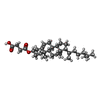
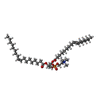
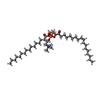
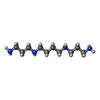

| #2: Chemical | ChemComp-Y01 / 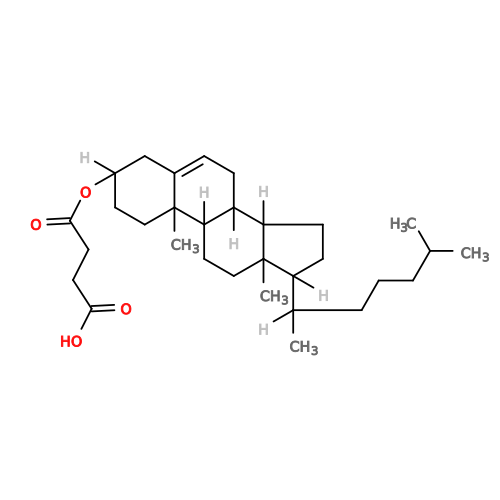 Mass: 486.726 Da / Num. of mol.: 12 / Source method: obtained synthetically / Formula: C31H50O4 Mass: 486.726 Da / Num. of mol.: 12 / Source method: obtained synthetically / Formula: C31H50O4#3: Chemical | ChemComp-PCW / 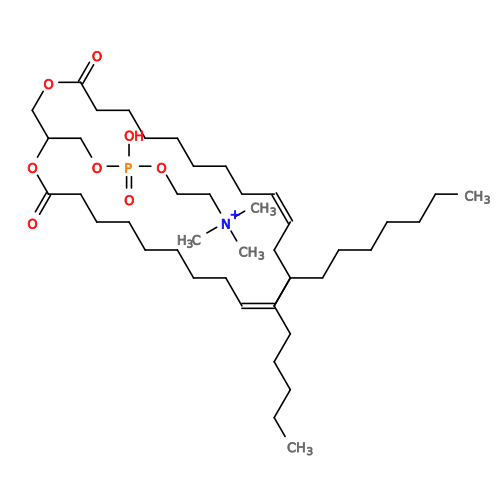 Mass: 787.121 Da / Num. of mol.: 4 / Source method: obtained synthetically / Formula: C44H85NO8P / Comment: DOPC, phospholipid*YM Mass: 787.121 Da / Num. of mol.: 4 / Source method: obtained synthetically / Formula: C44H85NO8P / Comment: DOPC, phospholipid*YM#4: Chemical | ChemComp-POV / ( 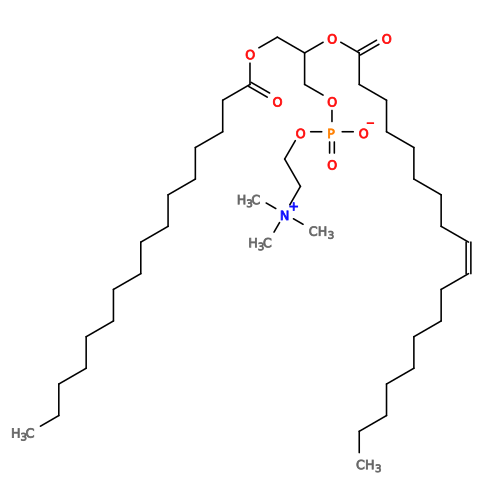 Mass: 760.076 Da / Num. of mol.: 12 / Source method: obtained synthetically / Formula: C42H82NO8P / Comment: phospholipid*YM Mass: 760.076 Da / Num. of mol.: 12 / Source method: obtained synthetically / Formula: C42H82NO8P / Comment: phospholipid*YM#5: Chemical | ChemComp-SPM / | 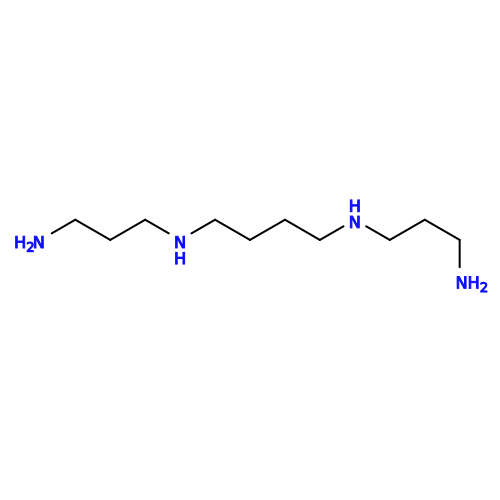 Mass: 202.340 Da / Num. of mol.: 1 / Source method: obtained synthetically / Formula: C10H26N4 / Feature type: SUBJECT OF INVESTIGATION Mass: 202.340 Da / Num. of mol.: 1 / Source method: obtained synthetically / Formula: C10H26N4 / Feature type: SUBJECT OF INVESTIGATION#6: Water | ChemComp-HOH / | Mass: 18.015 Da / Num. of mol.: 4 / Source method: isolated from a natural source / Formula: H2O |
|---|
-Details
| Has ligand of interest | Y |
|---|---|
| Has protein modification | N |
-Experimental details
-Experiment
| Experiment | Method: ELECTRON MICROSCOPY |
|---|---|
| EM experiment | Aggregation state: PARTICLE / 3D reconstruction method: single particle reconstruction |
- Sample preparation
| Component | Name: spermine-blocked open-state homotetrameric human TRPV6 Type: COMPLEX / Entity ID: #1 / Source: RECOMBINANT | |||||||||||||||||||||||||
|---|---|---|---|---|---|---|---|---|---|---|---|---|---|---|---|---|---|---|---|---|---|---|---|---|---|---|
| Molecular weight | Value: 0.08322 MDa / Experimental value: NO | |||||||||||||||||||||||||
| Source (natural) | Organism: Homo sapiens (human) | |||||||||||||||||||||||||
| Source (recombinant) | Organism: Homo sapiens (human) | |||||||||||||||||||||||||
| Buffer solution | pH: 8 | |||||||||||||||||||||||||
| Buffer component |
| |||||||||||||||||||||||||
| Specimen | Conc.: 2.5 mg/ml / Embedding applied: NO / Shadowing applied: NO / Staining applied: NO / Vitrification applied: YES Details: human TRPV6 reconstituted in cNW30 nanodiscs in the presence of spermine | |||||||||||||||||||||||||
| Specimen support | Grid material: GOLD / Grid mesh size: 300 divisions/in. / Grid type: UltrAuFoil R1.2/1.3 | |||||||||||||||||||||||||
| Vitrification | Instrument: FEI VITROBOT MARK IV / Cryogen name: ETHANE / Humidity: 100 % / Chamber temperature: 277 K |
- Electron microscopy imaging
| Experimental equipment |  Model: Titan Krios / Image courtesy: FEI Company |
|---|---|
| Microscopy | Model: TFS KRIOS |
| Electron gun | Electron source:  FIELD EMISSION GUN / Accelerating voltage: 300 kV / Illumination mode: FLOOD BEAM FIELD EMISSION GUN / Accelerating voltage: 300 kV / Illumination mode: FLOOD BEAM |
| Electron lens | Mode: BRIGHT FIELD / Nominal defocus max: 2000 nm / Nominal defocus min: 800 nm / Cs: 2.7 mm |
| Image recording | Average exposure time: 2 sec. / Electron dose: 60 e/Å2 / Film or detector model: GATAN K3 (6k x 4k) / Num. of grids imaged: 1 / Num. of real images: 4487 |
| Image scans | Width: 5760 / Height: 4092 |
- Processing
| EM software |
| ||||||||||||||||||||||||||||||||||||
|---|---|---|---|---|---|---|---|---|---|---|---|---|---|---|---|---|---|---|---|---|---|---|---|---|---|---|---|---|---|---|---|---|---|---|---|---|---|
| CTF correction | Type: NONE | ||||||||||||||||||||||||||||||||||||
| Particle selection | Num. of particles selected: 2191044 | ||||||||||||||||||||||||||||||||||||
| 3D reconstruction | Resolution: 3.48 Å / Resolution method: FSC 0.143 CUT-OFF / Num. of particles: 14018 / Symmetry type: POINT | ||||||||||||||||||||||||||||||||||||
| Atomic model building | Space: REAL | ||||||||||||||||||||||||||||||||||||
| Atomic model building | PDB-ID: 7S89 Accession code: 7S89 / Source name: PDB / Type: experimental model | ||||||||||||||||||||||||||||||||||||
| Refine LS restraints |
|

