 Movie
Movie Controller

[English] 日本語
 Yorodumi
- PDB-11de: Human Slo1-Charybdotoxin complex under divalent chelated conditio... -
+ Open data

- Basic information
| Entry | Database: PDB / ID: 11de | |||||||||
|---|---|---|---|---|---|---|---|---|---|---|
| Title | Human Slo1-Charybdotoxin complex under divalent chelated condition - gating ring masked map | |||||||||
 Components Components |
| |||||||||
 Keywords Keywords | MEMBRANE PROTEIN/TOXIN / BK / human BK / hSlo1 / charybdotoxin / ion channel / MEMBRANE PROTEIN / MEMBRANE PROTEIN-TOXIN complex | |||||||||
| Function / homology |  Function and homology information Function and homology informationmicturition / Acetylcholine inhibits contraction of outer hair cells / large conductance calcium-activated potassium channel activity / Ca2+ activated K+ channels / calcium-activated potassium channel activity / negative regulation of cell volume / smooth muscle contraction involved in micturition / response to carbon monoxide / response to osmotic stress / Sensory processing of sound by inner hair cells of the cochlea ...micturition / Acetylcholine inhibits contraction of outer hair cells / large conductance calcium-activated potassium channel activity / Ca2+ activated K+ channels / calcium-activated potassium channel activity / negative regulation of cell volume / smooth muscle contraction involved in micturition / response to carbon monoxide / response to osmotic stress / Sensory processing of sound by inner hair cells of the cochlea / cGMP effects / ion channel inhibitor activity / defense response to fungus / intracellular potassium ion homeostasis / potassium channel regulator activity / potassium ion transport / voltage-gated potassium channel activity / voltage-gated potassium channel complex / potassium ion transmembrane transport / regulation of membrane potential / response to calcium ion / vasodilation / toxin activity / caveola / actin binding / killing of cells of another organism / response to hypoxia / defense response to bacterium / postsynaptic membrane / apical plasma membrane / positive regulation of apoptotic process / extracellular region / membrane / identical protein binding / plasma membrane Similarity search - Function | |||||||||
| Biological species |  Homo sapiens (human) Homo sapiens (human) Leiurus quinquestriatus (Egyptian scorpion) Leiurus quinquestriatus (Egyptian scorpion) | |||||||||
| Method | ELECTRON MICROSCOPY / single particle reconstruction / cryo EM / Resolution: 3 Å | |||||||||
 Authors Authors | Chowdhury, S. / Pal, K. / Kallure, G.S. | |||||||||
| Funding support |  United States, 1items United States, 1items
| |||||||||
 Citation Citation | Journal: Proc Natl Acad Sci U S A / Year: 2026 Title: Structural underpinnings of human Slo1 inhibition by scorpion and fungal toxins. Authors: Gopal S Kallure / Kamalendu Pal / Gabriel W Prather / Sandipan Chowdhury / Abstract: Slo1 channels regulate key electrochemical signaling events in a variety of excitable and nonexcitable cells. Here, we have investigated the mechanisms by which distinct small molecules inhibit human ...Slo1 channels regulate key electrochemical signaling events in a variety of excitable and nonexcitable cells. Here, we have investigated the mechanisms by which distinct small molecules inhibit human Slo1 (hSlo1) channel activity using single-particle cryo-EM, liposome flux, and toxin-binding assays. We find that unlike classical permeation blockers like scorpion toxins, indole diterpene (ID) class of fungal mycotoxins, paxilline and penitrem A, are ensconced in a binding pocket, deep within the putatively closed hSlo1 pore and sterically restrict its opening. Binding of paxilline to its gating inhibition site dramatically slows dissociation of a fluorescent charybdotoxin derivative, via an allosteric mechanism that likely involves a key residue on the S5 helix (W246). Although four paxilline molecules may concurrently engage the hSlo1 pore, binding of <4 molecules is sufficient for efficacious inhibition of channel opening but inefficient at arresting toxin dissociation. We also find evidence that under divalent and ID free conditions, the ID binding pocket of hSlo1 is occluded by lipids that extend into the hSlo1 pore lumen through interhelical crevices that become constricted in the divalent bound open state. These lipids may not only competitively regulate ID binding but also tune the energetics of channel gating, sterically or by altering the hydration state of the pore vestibule. Our study provides a framework to understand fundamental Slo1 gating mechanisms and aid future developments of therapeutically beneficial small molecule Slo1 inhibitors. | |||||||||
| History |
|
- Structure visualization
| Structure viewer | Molecule: MolmilJmol/JSmol |
|---|
- Downloads & links
-Download
| PDBx/mmCIF format | 11de.cif.gz | 370.2 KB | Display | PDBx/mmCIF format |
|---|---|---|---|---|
| PDB format | pdb11de.ent.gz | 264.5 KB | Display | PDB format |
| PDBx/mmJSON format | 11de.json.gz | Tree view | PDBx/mmJSON format | |
| Others |  Other downloads Other downloads |
-Validation report
| Arichive directory | https://data.pdbj.org/pub/pdb/validation_reports/1d/11deftp://data.pdbj.org/pub/pdb/validation_reports/1d/11de | HTTPS FTP |
|---|
-Related structure data
| Related structure data |  75632MC  11czC  11daC  11dbC  11dcC  11ddC  11dfC M: map data used to model this data C: citing same article ( |
|---|---|
| Similar structure data |


-Links
 PDBj
PDBj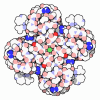
- Assembly
| Deposited unit | 
|
|---|---|
| 1 |
|
-Components
-Protein / Protein/peptide , 2 types, 5 molecules ABCDY
| #1: Protein | Mass: 119988.062 Da / Num. of mol.: 4 Source method: isolated from a genetically manipulated source Source: (gene. exp.) Homo sapiens (human) / Gene: KCNMA1, KCNMA, SLO / Production host: Homo sapiens (human) / References: UniProt: Q12791#2: Protein/peptide | | Mass: 4309.998 Da / Num. of mol.: 1 / Source method: obtained synthetically Source: (synth.) Leiurus quinquestriatus (Egyptian scorpion)References: UniProt: P13487 |
|---|
-Non-polymers , 5 types, 83 molecules 
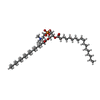
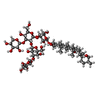
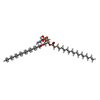

| #3: Chemical |  Mass: 39.098 Da / Num. of mol.: 3 / Source method: obtained synthetically / Formula: K / Feature type: SUBJECT OF INVESTIGATION Mass: 39.098 Da / Num. of mol.: 3 / Source method: obtained synthetically / Formula: K / Feature type: SUBJECT OF INVESTIGATION#4: Chemical | ChemComp-LBN /  Mass: 760.076 Da / Num. of mol.: 36 / Source method: obtained synthetically / Formula: C42H82NO8P / Comment: phospholipid*YM Mass: 760.076 Da / Num. of mol.: 36 / Source method: obtained synthetically / Formula: C42H82NO8P / Comment: phospholipid*YM#5: Chemical | ChemComp-AJP / 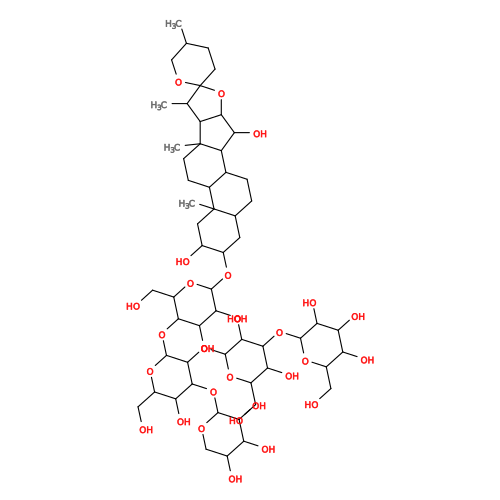 Mass: 1229.312 Da / Num. of mol.: 36 / Source method: obtained synthetically / Formula: C56H92O29 / Comment: detergent*YM Mass: 1229.312 Da / Num. of mol.: 36 / Source method: obtained synthetically / Formula: C56H92O29 / Comment: detergent*YM#6: Chemical | ChemComp-DKB / [( 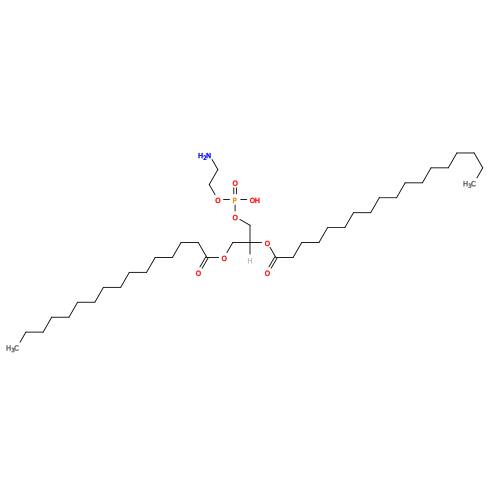 Mass: 720.012 Da / Num. of mol.: 4 / Source method: obtained synthetically / Formula: C39H78NO8P Mass: 720.012 Da / Num. of mol.: 4 / Source method: obtained synthetically / Formula: C39H78NO8P#7: Water | ChemComp-HOH / | Mass: 18.015 Da / Num. of mol.: 4 / Source method: isolated from a natural source / Formula: H2O |
|---|
-Details
| Has ligand of interest | Y |
|---|---|
| Has protein modification | Y |
-Experimental details
-Experiment
| Experiment | Method: ELECTRON MICROSCOPY |
|---|---|
| EM experiment | Aggregation state: PARTICLE / 3D reconstruction method: single particle reconstruction |
- Sample preparation
| Component | Name: human Slo1 in complex with a scorpion toxin, charybdotoxin Type: COMPLEX / Entity ID: #1-#2 / Source: MULTIPLE SOURCES |
|---|---|
| Molecular weight | Experimental value: NO |
| Buffer solution | pH: 7.8 |
| Specimen | Embedding applied: NO / Shadowing applied: NO / Staining applied: NO / Vitrification applied: YES |
| Vitrification | Cryogen name: ETHANE |
- Electron microscopy imaging
| Experimental equipment |  Model: Titan Krios / Image courtesy: FEI Company |
|---|---|
| Microscopy | Model: TFS KRIOS |
| Electron gun | Electron source:  FIELD EMISSION GUN / Accelerating voltage: 300 kV / Illumination mode: FLOOD BEAM FIELD EMISSION GUN / Accelerating voltage: 300 kV / Illumination mode: FLOOD BEAM |
| Electron lens | Mode: BRIGHT FIELD / Nominal defocus max: 2100 nm / Nominal defocus min: 800 nm |
| Image recording | Electron dose: 72 e/Å2 / Film or detector model: GATAN K3 BIOQUANTUM (6k x 4k) |
- Processing
| EM software |
| ||||||||||||||||||||||||
|---|---|---|---|---|---|---|---|---|---|---|---|---|---|---|---|---|---|---|---|---|---|---|---|---|---|
| CTF correction | Type: PHASE FLIPPING AND AMPLITUDE CORRECTION | ||||||||||||||||||||||||
| 3D reconstruction | Resolution: 3 Å / Resolution method: FSC 0.143 CUT-OFF / Num. of particles: 283043 / Symmetry type: POINT | ||||||||||||||||||||||||
| Refinement | Highest resolution: 3 Å Stereochemistry target values: REAL-SPACE (WEIGHTED MAP SUM AT ATOM CENTERS) | ||||||||||||||||||||||||
| Refine LS restraints |
|
