 Movie
Movie Controller

[English] 日本語
 Yorodumi
- EMDB-75629: Human Slo1-Paxilline complex under divalent chelated condition - ... -
+ Open data

- Basic information
| Entry |  | |||||||||
|---|---|---|---|---|---|---|---|---|---|---|
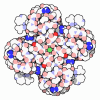
| Title | Human Slo1-Paxilline complex under divalent chelated condition - gating-ring masked | |||||||||
 Map data Map data | Unharpened gating-ring masked map of hSlo1-paxilline complex | |||||||||
 Sample Sample |
| |||||||||
 Keywords Keywords | BK / human BK / hSlo1 / penitrem A / ion channel / MEMBRANE PROTEIN / MEMBRANE PROTEIN-TOXIN complex | |||||||||
| Function / homology |  Function and homology information Function and homology informationmicturition / Acetylcholine inhibits contraction of outer hair cells / large conductance calcium-activated potassium channel activity / Ca2+ activated K+ channels / calcium-activated potassium channel activity / negative regulation of cell volume / smooth muscle contraction involved in micturition / response to carbon monoxide / response to osmotic stress / Sensory processing of sound by inner hair cells of the cochlea ...micturition / Acetylcholine inhibits contraction of outer hair cells / large conductance calcium-activated potassium channel activity / Ca2+ activated K+ channels / calcium-activated potassium channel activity / negative regulation of cell volume / smooth muscle contraction involved in micturition / response to carbon monoxide / response to osmotic stress / Sensory processing of sound by inner hair cells of the cochlea / cGMP effects / intracellular potassium ion homeostasis / potassium ion transport / voltage-gated potassium channel activity / voltage-gated potassium channel complex / potassium ion transmembrane transport / regulation of membrane potential / response to calcium ion / vasodilation / caveola / actin binding / response to hypoxia / postsynaptic membrane / apical plasma membrane / positive regulation of apoptotic process / membrane / identical protein binding / plasma membrane Similarity search - Function | |||||||||
| Biological species |  Homo sapiens (human) Homo sapiens (human) | |||||||||
| Method | single particle reconstruction / cryo EM / Resolution: 2.71 Å | |||||||||
 Authors Authors | Chowdhury S / Pal K / Kallure GS | |||||||||
| Funding support |  United States, 1 items United States, 1 items
| |||||||||
 Citation Citation | Journal: Proc Natl Acad Sci U S A / Year: 2026 Title: Structural underpinnings of human Slo1 inhibition by scorpion and fungal toxins. Authors: Gopal S Kallure / Kamalendu Pal / Gabriel W Prather / Sandipan Chowdhury / Abstract: Slo1 channels regulate key electrochemical signaling events in a variety of excitable and nonexcitable cells. Here, we have investigated the mechanisms by which distinct small molecules inhibit human ...Slo1 channels regulate key electrochemical signaling events in a variety of excitable and nonexcitable cells. Here, we have investigated the mechanisms by which distinct small molecules inhibit human Slo1 (hSlo1) channel activity using single-particle cryo-EM, liposome flux, and toxin-binding assays. We find that unlike classical permeation blockers like scorpion toxins, indole diterpene (ID) class of fungal mycotoxins, paxilline and penitrem A, are ensconced in a binding pocket, deep within the putatively closed hSlo1 pore and sterically restrict its opening. Binding of paxilline to its gating inhibition site dramatically slows dissociation of a fluorescent charybdotoxin derivative, via an allosteric mechanism that likely involves a key residue on the S5 helix (W246). Although four paxilline molecules may concurrently engage the hSlo1 pore, binding of <4 molecules is sufficient for efficacious inhibition of channel opening but inefficient at arresting toxin dissociation. We also find evidence that under divalent and ID free conditions, the ID binding pocket of hSlo1 is occluded by lipids that extend into the hSlo1 pore lumen through interhelical crevices that become constricted in the divalent bound open state. These lipids may not only competitively regulate ID binding but also tune the energetics of channel gating, sterically or by altering the hydration state of the pore vestibule. Our study provides a framework to understand fundamental Slo1 gating mechanisms and aid future developments of therapeutically beneficial small molecule Slo1 inhibitors. | |||||||||
| History |
|
- Structure visualization
| Supplemental images |
|---|

- Downloads & links
-EMDB archive
| Map data | emd_75629.map.gz | 42 MB | EMDB map data format | |
|---|---|---|---|---|
| Header (meta data) | emd-75629-v30.xmlemd-75629.xml | 19.9 KB 19.9 KB | Display Display | EMDB header |
| FSC (resolution estimation) | emd_75629_fsc.xml | 9.2 KB | Display | FSC data file |
| Images |  emd_75629.png emd_75629.png | 53 KB | ||
| Masks | emd_75629_msk_1.map | 83.7 MB | Mask map | |
| Filedesc metadata | emd-75629.cif.gz | 6.9 KB | ||
| Others | emd_75629_additional_1.map.gzemd_75629_half_map_1.map.gzemd_75629_half_map_2.map.gz | 79 MB 77.4 MB 77.4 MB | ||
| Archive directory |  https://data.pdbj.org/pub/emdb/structures/EMD-75629ftp://data.pdbj.org/pub/emdb/structures/EMD-75629 https://data.pdbj.org/pub/emdb/structures/EMD-75629ftp://data.pdbj.org/pub/emdb/structures/EMD-75629 | HTTPS FTP |
-Related structure data
| Related structure data |  11dbMC  11czC  11daC  11dcC  11ddC  11deC  11dfC M: atomic model generated by this map C: citing same article ( |
|---|---|
| Similar structure data |


-Links
| EMDB pages | EMDB (EBI/PDBe) / EMDataResource |
|---|---|
| Related items in Molecule of the Month |
-Map
| File | Download / File: emd_75629.map.gz / Format: CCP4 / Size: 83.7 MB / Type: IMAGE STORED AS FLOATING POINT NUMBER (4 BYTES) | ||||||||||||||||||||||||||||||||||||
|---|---|---|---|---|---|---|---|---|---|---|---|---|---|---|---|---|---|---|---|---|---|---|---|---|---|---|---|---|---|---|---|---|---|---|---|---|---|
| Annotation | Unharpened gating-ring masked map of hSlo1-paxilline complex | ||||||||||||||||||||||||||||||||||||
| Projections & slices | Image control
Images are generated by Spider. | ||||||||||||||||||||||||||||||||||||
| Voxel size | X=Y=Z: 1.04 Å | ||||||||||||||||||||||||||||||||||||
| Density |
| ||||||||||||||||||||||||||||||||||||
| Symmetry | Space group: 1 | ||||||||||||||||||||||||||||||||||||
| Details | EMDB XML:
|
 Z (Sec.)
 Y (Row.)
 X (Col.)


-Supplemental data
-Mask #1
| File | emd_75629_msk_1.map | ||||||||||||
|---|---|---|---|---|---|---|---|---|---|---|---|---|---|
| Projections & Slices |
| ||||||||||||
| Density Histograms |


-Additional map: Sharpened gating-ring masked map of hSlo1-paxilline complex
| File | emd_75629_additional_1.map | ||||||||||||
|---|---|---|---|---|---|---|---|---|---|---|---|---|---|
| Annotation | Sharpened gating-ring masked map of hSlo1-paxilline complex | ||||||||||||
| Projections & Slices |
| ||||||||||||
| Density Histograms |


-Half map: Half-map A
| File | emd_75629_half_map_1.map | ||||||||||||
|---|---|---|---|---|---|---|---|---|---|---|---|---|---|
| Annotation | Half-map A | ||||||||||||
| Projections & Slices |
| ||||||||||||
| Density Histograms |


-Half map: Half-map B
| File | emd_75629_half_map_2.map | ||||||||||||
|---|---|---|---|---|---|---|---|---|---|---|---|---|---|
| Annotation | Half-map B | ||||||||||||
| Projections & Slices |
| ||||||||||||
| Density Histograms |


- Sample components
-Entire : human Slo1 in complex with an indole diterpene alkaloid, paxilline
| Entire | Name: human Slo1 in complex with an indole diterpene alkaloid, paxilline |
|---|---|
| Components |
|
-Supramolecule #1: human Slo1 in complex with an indole diterpene alkaloid, paxilline
| Supramolecule | Name: human Slo1 in complex with an indole diterpene alkaloid, paxilline type: complex / ID: 1 / Parent: 0 / Macromolecule list: #1 |
|---|---|
| Source (natural) | Organism: Homo sapiens (human) |
-Macromolecule #1: Calcium-activated potassium channel subunit alpha-1
| Macromolecule | Name: Calcium-activated potassium channel subunit alpha-1 / type: protein_or_peptide / ID: 1 / Number of copies: 4 / Enantiomer: LEVO |
|---|---|
| Source (natural) | Organism: Homo sapiens (human) |
| Molecular weight | Theoretical: 119.988062 KDa |
| Recombinant expression | Organism: Homo sapiens (human) |
| Sequence | String: MDALIIPVTM EVPCDSRGQR MWWAFLASSM VTFFGGLFII LLWRTLKYLW TVCCHCGGKT KEAQKINNGS SQADGTLKPV DEKEEAVAA EVGWMTSVKD WAGVMISAQT LTGRVLVVLV FALSIGALVI YFIDSSNPIE SCQNFYKDFT LQIDMAFNVF F LLYFGLRF ...String: MDALIIPVTM EVPCDSRGQR MWWAFLASSM VTFFGGLFII LLWRTLKYLW TVCCHCGGKT KEAQKINNGS SQADGTLKPV DEKEEAVAA EVGWMTSVKD WAGVMISAQT LTGRVLVVLV FALSIGALVI YFIDSSNPIE SCQNFYKDFT LQIDMAFNVF F LLYFGLRF IAANDKLWFW LEVNSVVDFF TVPPVFVSVY LNRSWLGLRF LRALRLIQFS EILQFLNILK TSNSIKLVNL LS IFISTWL TAAGFIHLVE NSGDPWENFQ NNQALTYWEC VYLLMVTMST VGYGDVYAKT TLGRLFMVFF ILGGLAMFAS YVP EIIELI GNRKKYGGSY SAVSGRKHIV VCGHITLESV SNFLKDFLHK DRDDVNVEIV FLHNISPNLE LEALFKRHFT QVEF YQGSV LNPHDLARVK IESADACLIL ANKYCADPDA EDASNIMRVI SIKNYHPKIR IITQMLQYHN KAHLLNIPSW NWKEG DDAI CLAELKLGFI AQSCLAQGLS TMLANLFSMR SFIKIEEDTW QKYYLEGVSN EMYTEYLSSA FVGLSFPTVC ELCFVK LKL LMIAIEYKSA NRESRILINP GNHLKIQEGT LGFFIASDAK EVKRAFFYCK ACHDDITDPK RIKKCGCKRL EDEQPST LS PKKKQRNGGM RNSPNTSPKL MRHDPLLIPG NDQIDNMDSN VKKYDSTGMF HWCAPKEIEK VILTRSEAAM TVLSGHVV V CIFGDVSSAL IGLRNLVMPL RASNFHYHEL KHIVFVGSIE YLKREWETLH NFPKVSILPG TPLSRADLRA VNINLCDMC VILSANQNNI DDTSLQDKEC ILASLNIKSM QFDDSIGVLQ ANSQGFTPPG MDRSSPDNSP VHGMLRQPSI TTGVNIPIIT ELVNDTNVQ FLDQDDDDDP DTELYLTQPF ACGTAFAVSV LDSLMSATYF NDNILTLIRT LVTGGATPEL EALIAEENAL R GGYSTPQT LANRDRCRVA QLALLDGPFA DLGDGGCYGD LFCKALKTYN MLCFGIYRLR DAHLSTPSQC TKRYVITNPP YE FELVPTD LIFCLMQFDS NSLEVLFQ UniProtKB: Calcium-activated potassium channel subunit alpha-1 |
-Macromolecule #2: POTASSIUM ION
| Macromolecule | Name: POTASSIUM ION / type: ligand / ID: 2 / Number of copies: 5 / Formula: K |
|---|---|
| Molecular weight | Theoretical: 39.098 Da |
-Macromolecule #3: 1-palmitoyl-2-oleoyl-sn-glycero-3-phosphocholine
| Macromolecule | Name: 1-palmitoyl-2-oleoyl-sn-glycero-3-phosphocholine / type: ligand / ID: 3 / Number of copies: 28 / Formula: LBN |
|---|---|
| Molecular weight | Theoretical: 760.076 Da |
| Chemical component information | 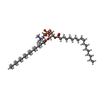 ChemComp-LBN: |
-Macromolecule #4: Digitonin
| Macromolecule | Name: Digitonin / type: ligand / ID: 4 / Number of copies: 36 / Formula: AJP |
|---|---|
| Molecular weight | Theoretical: 1.229312 KDa |
| Chemical component information | 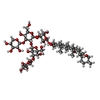 ChemComp-AJP: |
-Macromolecule #5: CHOLESTEROL
| Macromolecule | Name: CHOLESTEROL / type: ligand / ID: 5 / Number of copies: 4 / Formula: CLR |
|---|---|
| Molecular weight | Theoretical: 386.654 Da |
| Chemical component information | 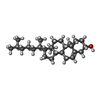 ChemComp-CLR: |
-Macromolecule #6: Paxilline
| Macromolecule | Name: Paxilline / type: ligand / ID: 6 / Number of copies: 4 / Formula: A1C9G |
|---|---|
| Molecular weight | Theoretical: 435.555 Da |
-Macromolecule #7: water
| Macromolecule | Name: water / type: ligand / ID: 7 / Number of copies: 4 / Formula: HOH |
|---|---|
| Molecular weight | Theoretical: 18.015 Da |
| Chemical component information |  ChemComp-HOH: |
-Experimental details
-Structure determination
| Method | cryo EM |
|---|---|
 Processing Processing | single particle reconstruction |
| Aggregation state | particle |
-Sample preparation
| Buffer | pH: 7.8 |
|---|---|
| Vitrification | Cryogen name: ETHANE |
- Electron microscopy
| Microscope | TFS KRIOS |
|---|---|
| Image recording | Film or detector model: GATAN K3 BIOQUANTUM (6k x 4k) / Average electron dose: 72.0 e/Å2 |
| Electron beam | Acceleration voltage: 300 kV / Electron source:  FIELD EMISSION GUN FIELD EMISSION GUN |
| Electron optics | Illumination mode: FLOOD BEAM / Imaging mode: BRIGHT FIELD / Nominal defocus max: 2.1 µm / Nominal defocus min: 0.8 µm |
| Experimental equipment |  Model: Titan Krios / Image courtesy: FEI Company |

