National Institutes of Health/National Institute of Diabetes and Digestive and Kidney Disease (NIH/NIDDK)
NIH-DK090066
United States
Citation
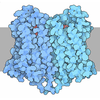
Journal: Proc Natl Acad Sci U S A / Year: 2026 Title: Structure and function of TM6SF1 reveals role in mTORC1 signaling. Authors: Sen Hong / Liangjie Jia / Rong Wang / Nadia Elghobashi-Meinhardt / Helen H Hobbs / Xiaochun Li / Abstract: The transmembrane 6 superfamily (TM6SF) comprises two members: TM6SF1, a ubiquitously expressed lysosomal membrane protein of unknown function, and TM6SF2, an endoplasmic reticulum protein required ...The transmembrane 6 superfamily (TM6SF) comprises two members: TM6SF1, a ubiquitously expressed lysosomal membrane protein of unknown function, and TM6SF2, an endoplasmic reticulum protein required for bulk lipidation of Apolipoprotein B-containing lipoproteins. Here, we used cryo-electron microscopy (cryo-EM) to determine the structure of human TM6SF1 at 2.9-Å resolution. TM6SF1 forms a polytopic homodimer, with each protomer comprising 10 transmembrane helices (TMs). TMs 1-6 form a pocket that accommodates a cholesterol molecule. Cell-based assays revealed that loss of TM6SF1 perturbs mTORC1 signaling, resulting in reduced phosphorylation of S6 kinase 1 and 4E-BP1 and constitutive activation of transcription factor EB (TFEB), and that cholesterol is required for these effects. Biochemical analyses support the model that TM6SF1 directly engages LAMTOR1, a component of Ragulator complex, in a cholesterol-dependent manner. Together, these findings identify TM6SF1 as a lysosomal cholesterol binding protein involved in regulating mTORC1 signaling.
History
Deposition
Feb 9, 2026
Deposition site: RCSB / Processing site: RCSB
Revision 1.0
Sep 9, 2026
Provider: repository / Type: Initial release
Revision 1.0
Sep 9, 2026
Data content type: EM metadata / Data content type: EM metadata / Provider: repository / Type: Initial release
Data content type: EM metadata / Data content type: EM metadata / EM metadata / Group: Database references / Experimental summary / Data content type: EM metadata / EM metadata / EM metadata / Category: citation / citation_author / em_admin Data content type: EM metadata / EM metadata ...EM metadata / EM metadata / EM metadata / EM metadata / EM metadata / EM metadata / EM metadata / EM metadata / EM metadata / EM metadata / EM metadata / EM metadata / EM metadata Item: _citation.country / _citation.journal_abbrev ..._citation.country / _citation.journal_abbrev / _citation.journal_id_ASTM / _citation.journal_id_CSD / _citation.journal_id_ISSN / _citation.journal_volume / _citation.page_first / _citation.page_last / _citation.pdbx_database_id_DOI / _citation.pdbx_database_id_PubMed / _citation.title / _citation.year / _em_admin.last_update
Mass: 41669.824 Da / Num. of mol.: 2 Source method: isolated from a genetically manipulated source Source: (gene. exp.) Homo sapiens (human) / Gene: TM6SF1 / Production host: Homo sapiens (human) / References: UniProt: Q9BZW5
In the structure databanks used in Yorodumi, some data are registered as the other names, "COVID-19 virus" and "2019-nCoV". Here are the details of the virus and the list of structure data.
Jan 31, 2019. EMDB accession codes are about to change! (news from PDBe EMDB page)
EMDB accession codes are about to change! (news from PDBe EMDB page)
The allocation of 4 digits for EMDB accession codes will soon come to an end. Whilst these codes will remain in use, new EMDB accession codes will include an additional digit and will expand incrementally as the available range of codes is exhausted. The current 4-digit format prefixed with “EMD-” (i.e. EMD-XXXX) will advance to a 5-digit format (i.e. EMD-XXXXX), and so on. It is currently estimated that the 4-digit codes will be depleted around Spring 2019, at which point the 5-digit format will come into force.
The EM Navigator/Yorodumi systems omit the EMD- prefix.
Related info.:Q: What is EMD? / ID/Accession-code notation in Yorodumi/EM Navigator
Yorodumi is a browser for structure data from EMDB, PDB, SASBDB, etc.
This page is also the successor to EM Navigator detail page, and also detail information page/front-end page for Omokage search.
The word "yorodu" (or yorozu) is an old Japanese word meaning "ten thousand". "mi" (miru) is to see.
Related info.:EMDB / PDB / SASBDB / Comparison of 3 databanks / Yorodumi Search / Aug 31, 2016. New EM Navigator & Yorodumi / Yorodumi Papers / Jmol/JSmol / Function and homology information / Changes in new EM Navigator and Yorodumi
 Movie
Movie Controller


 Open data
 Basic information
 Components
 Keywords
 Function and homology information
 Homo sapiens (human)
 Authors
 United States, 1items
  Citation
 Structure visualization
 Downloads & links
 Other downloads


 PDBj
PDBj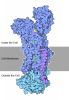
 Assembly
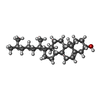
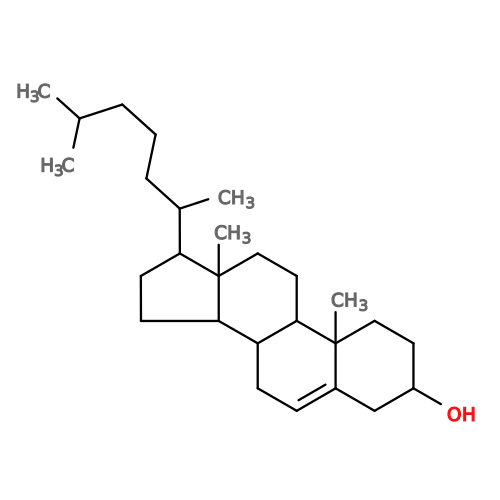 Mass: 386.654 Da / Num. of mol.: 2 / Source method: obtained synthetically / Formula: C27H46O / Feature type: SUBJECT OF INVESTIGATION
 Sample preparation
 Homo (humans)
 Electron microscopy imaging
 FIELD EMISSION GUN / Accelerating voltage: 300 kV / Illumination mode: OTHER
 Processing