 Movie
Movie Controller

[English] 日本語
 Yorodumi
- PDB-10mz: Single particle reconstruction of PilU from Vibrio cholerae El To... -
+ Open data

- Basic information
| Entry | Database: PDB / ID: 10mz | |||||||||||||||||||||||||||
|---|---|---|---|---|---|---|---|---|---|---|---|---|---|---|---|---|---|---|---|---|---|---|---|---|---|---|---|---|
| Title | Single particle reconstruction of PilU from Vibrio cholerae El Tor E7946, form 2 | |||||||||||||||||||||||||||
 Components Components | PilT/PilU family type 4a pilus ATPase | |||||||||||||||||||||||||||
 Keywords Keywords | MOTOR PROTEIN / Retraction ATPase / Structural Genomics / Center for Structural Biology of Infectious Diseases / CSBID | |||||||||||||||||||||||||||
| Function / homology | Pilus retraction protein PilT/PilU / : / Type II/IV secretion system protein / Type II/IV secretion system protein / ATP hydrolysis activity / P-loop containing nucleoside triphosphate hydrolase / ATP binding / PilT/PilU family type 4a pilus ATPase Function and homology information Function and homology information | |||||||||||||||||||||||||||
| Biological species |  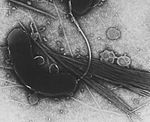 Vibrio cholerae (bacteria) Vibrio cholerae (bacteria) | |||||||||||||||||||||||||||
| Method | ELECTRON MICROSCOPY / single particle reconstruction / cryo EM / Resolution: 3.68 Å | |||||||||||||||||||||||||||
 Authors Authors | Guo, Y. / Shukla, S. / Klose, T. / Tokars, V. / Mondragon, A. / Borek, D. / Satchell, K. / Center for Structural Biology of Infectious Diseases (CSBID) | |||||||||||||||||||||||||||
| Funding support |  United States, 1items United States, 1items
| |||||||||||||||||||||||||||
 Citation Citation | Journal: Protein Sci / Year: 2026 Title: Analysis of the heterogenous structural states of the hexameric ATPase PilU of the type IV pili from Vibrio cholerae. Authors: Yirui Guo / Shantanu Shukla / George Minasov / Nicole L Inniss / Thomas Klose / Valerie L Tokars / Alfonso Mondragón / Zbyszek Otwinowski / Dominika Borek / Karla J F Satchell / Abstract: Type IV pili (T4P) mediate surface motility, host interactions, and DNA uptake through cycles of extension and retraction. While the primary retraction ATPase PilT has been extensively characterized, ...Type IV pili (T4P) mediate surface motility, host interactions, and DNA uptake through cycles of extension and retraction. While the primary retraction ATPase PilT has been extensively characterized, its homolog PilU remains less well understood despite being demonstrated as a PilT-dependent retraction ATPase. Here, we determined six PilU structures by cryo-electron microscopy and x-ray crystallography. The structures reveal a homohexameric assembly stabilized by interactions between the C-terminal catalytic domain of one subunit and the N-terminal PAS-like domain of a neighboring subunit. PilU adopts multiple conformational states, exhibiting different combinations of open and closed interfaces even in the absence of nucleotide. Comparison with PilT highlights structural features that likely underlie PilU's weak ATPase activity and its dependence on PilT for function. Together, these findings provide a structural framework for understanding PilU's role within the T4P retraction machinery. | |||||||||||||||||||||||||||
| History |
|
- Structure visualization
| Structure viewer | Molecule: MolmilJmol/JSmol |
|---|
- Downloads & links
-Download
| PDBx/mmCIF format | 10mz.cif.gz | 361.2 KB | Display | PDBx/mmCIF format |
|---|---|---|---|---|
| PDB format | pdb10mz.ent.gz | 299.9 KB | Display | PDB format |
| PDBx/mmJSON format | 10mz.json.gz | Tree view | PDBx/mmJSON format | |
| Others |  Other downloads Other downloads |
-Validation report
| Arichive directory | https://data.pdbj.org/pub/pdb/validation_reports/0m/10mzftp://data.pdbj.org/pub/pdb/validation_reports/0m/10mz | HTTPS FTP |
|---|
-Related structure data
| Related structure data |  75297MC  10myC  10naC  10nbC  9q6mC  9q6wC M: map data used to model this data C: citing same article ( |
|---|---|
| Similar structure data |


-Links
 PDBj
PDBj
- Assembly
| Deposited unit | 
|
|---|---|
| 1 |
|
-Components
| #1: Protein | Mass: 42949.852 Da / Num. of mol.: 6 Source method: isolated from a genetically manipulated source Source: (gene. exp.) Vibrio cholerae (bacteria) / Gene: BC353_02195, D6U24_12630, FLM02_06300, KIN13_15985 / Production host:  Escherichia coli (E. coli) / References: UniProt: A0A085SZ25 Escherichia coli (E. coli) / References: UniProt: A0A085SZ25Has protein modification | N | |
|---|
-Experimental details
-Experiment
| Experiment | Method: ELECTRON MICROSCOPY |
|---|---|
| EM experiment | Aggregation state: PARTICLE / 3D reconstruction method: single particle reconstruction |
- Sample preparation
| Component | Name: PilU retraction ATPase / Type: ORGANELLE OR CELLULAR COMPONENT / Entity ID: all / Source: RECOMBINANT |
|---|---|
| Molecular weight | Experimental value: NO |
| Source (natural) | Organism: Vibrio cholerae (bacteria) |
| Source (recombinant) | Organism: Escherichia coli (E. coli) |
| Buffer solution | pH: 8.3 |
| Specimen | Embedding applied: NO / Shadowing applied: NO / Staining applied: NO / Vitrification applied: YES |
| Vitrification | Cryogen name: ETHANE |
- Electron microscopy imaging
| Experimental equipment |  Model: Titan Krios / Image courtesy: FEI Company |
|---|---|
| Microscopy | Model: TFS KRIOS |
| Electron gun | Electron source:  FIELD EMISSION GUN / Accelerating voltage: 300 kV / Illumination mode: FLOOD BEAM FIELD EMISSION GUN / Accelerating voltage: 300 kV / Illumination mode: FLOOD BEAM |
| Electron lens | Mode: BRIGHT FIELD / Nominal defocus max: 2500 nm / Nominal defocus min: 500 nm |
| Image recording | Electron dose: 50 e/Å2 / Film or detector model: GATAN K3 (6k x 4k) |
- Processing
| EM software |
| |||||||||
|---|---|---|---|---|---|---|---|---|---|---|
| CTF correction | Type: PHASE FLIPPING AND AMPLITUDE CORRECTION | |||||||||
| 3D reconstruction | Resolution: 3.68 Å / Resolution method: FSC 0.143 CUT-OFF / Num. of particles: 114357 / Symmetry type: POINT |
