 Movie
Movie Controller


+ Open data

- Basic information
| Entry | Database: PDB / ID: 10dw | |||||||||||||||
|---|---|---|---|---|---|---|---|---|---|---|---|---|---|---|---|---|
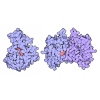
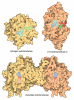
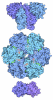
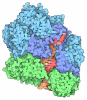
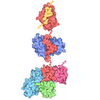
| Title | Structure of CRBN/DDB1dB-KAT2A-Compound4 ternary complex | |||||||||||||||
 Components Components |
| |||||||||||||||
 Keywords Keywords | TRANSFERASE / CRBN / molecular glue / CRBN-MG / KAT2A | |||||||||||||||
| Function / homology |  Function and homology information Function and homology informationpeptide glutaryltransferase activity / protein N-acyltransferase activity / histone H1-4K34 acetyltransferase activity / negative regulation of SCF-dependent proteasomal ubiquitin-dependent catabolic process / histone succinyltransferase activity / peptidyl-lysine glutarylation / histone glutaryltransferase activity / regulation of cartilage development / regulation of bone development / regulation of regulatory T cell differentiation ...peptide glutaryltransferase activity / protein N-acyltransferase activity / histone H1-4K34 acetyltransferase activity / negative regulation of SCF-dependent proteasomal ubiquitin-dependent catabolic process / histone succinyltransferase activity / peptidyl-lysine glutarylation / histone glutaryltransferase activity / regulation of cartilage development / regulation of bone development / regulation of regulatory T cell differentiation / histone H3K9 acetyltransferase activity / peptide butyryltransferase activity / negative regulation of centriole replication / positive regulation of cell projection organization / peptide crotonyltransferase activity / protein propionyltransferase activity / transcription factor TFTC complex / histone H3 acetyltransferase activity / positive regulation of cardiac muscle cell differentiation / internal peptidyl-lysine acetylation / negative regulation of monoatomic ion transmembrane transport / regulation of T cell activation / peptide lactyltransferase (CoA-dependent) activity / ATAC complex / Regulation of gene expression in late stage (branching morphogenesis) pancreatic bud precursor cells / RUNX3 regulates NOTCH signaling / positive regulation by virus of viral protein levels in host cell / NOTCH4 Intracellular Domain Regulates Transcription / positive regulation of cGAS/STING signaling pathway / Cardiogenesis / SAGA complex / spindle assembly involved in female meiosis / NOTCH3 Intracellular Domain Regulates Transcription / epigenetic programming in the zygotic pronuclei / regulation of tubulin deacetylation / UV-damage excision repair / Notch-HLH transcription pathway / acetyltransferase activity / Formation of paraxial mesoderm / biological process involved in interaction with symbiont / regulation of mitotic cytokinesis / Formation of WDR5-containing histone-modifying complexes / regulation of mitotic cell cycle phase transition / regulation of miRNA-mediated gene silencing / regulation of natural killer cell activation / regulation of RNA splicing / WD40-repeat domain binding / histone acetyltransferase activity / regulation of cell cycle phase transition / locomotory exploration behavior / Cul4-RING E3 ubiquitin ligase complex / regulation of stem cell population maintenance / intracellular distribution of mitochondria / Cul4A-RING E3 ubiquitin ligase complex / Cul4B-RING E3 ubiquitin ligase complex / RNA Polymerase I Transcription Initiation / ubiquitin ligase complex scaffold activity / negative regulation of adipose tissue development / regulation of cellular response to stress / Differentiation of naive CD4+ T cells to T helper 2 cells (Th2 cells) / histone acetyltransferase complex / limb development / negative regulation of gluconeogenesis / viral release from host cell / regulation of cell division / cullin family protein binding / positive regulation of Wnt signaling pathway / protein-lysine-acetyltransferase activity / negative regulation of protein-containing complex assembly / regulation of DNA-templated DNA replication initiation / histone acetyltransferase / long-term memory / positive regulation of viral genome replication / positive regulation of gluconeogenesis / Transferases; Acyltransferases; Transferring groups other than aminoacyl groups / rhythmic process / regulation of DNA repair / regulation of embryonic development / replication fork processing / positive regulation of cytokine production / cellular response to tumor necrosis factor / regulation of protein stability / proteasomal protein catabolic process / epigenetic regulation of gene expression / cellular response to nerve growth factor stimulus / positive regulation of protein-containing complex assembly / regulation of synaptic plasticity / nucleotide-excision repair / response to nutrient levels / regulation of autophagy / Recognition of DNA damage by PCNA-containing replication complex / mitotic spindle / B-WICH complex positively regulates rRNA expression / NOTCH1 Intracellular Domain Regulates Transcription / regulation of circadian rhythm / Pre-NOTCH Transcription and Translation / DNA Damage Recognition in GG-NER / Constitutive Signaling by NOTCH1 PEST Domain Mutants / Constitutive Signaling by NOTCH1 HD+PEST Domain Mutants / histone deacetylase binding Similarity search - Function | |||||||||||||||
| Biological species |  Homo sapiens (human) Homo sapiens (human) | |||||||||||||||
| Method | ELECTRON MICROSCOPY / single particle reconstruction / cryo EM / Resolution: 2.9 Å | |||||||||||||||
 Authors Authors | Ojeda, S. / Fischer, E.S. | |||||||||||||||
| Funding support |  United States, 4items United States, 4items
| |||||||||||||||
 Citation Citation | Journal: Science / Year: 2026 Title: Degron-independent recruitment of KAT2A expands the target space of CRBN molecular glues. Authors: Samuel Ojeda / Meng Wang / Kheewoong Baek / Wallace Bourgeois / Alba Sommerschield / Hong Yue / Rebecca J Metivier / Panos Karagiannis / Talya S Levitz / Yuan Xiong / Katherine A Donovan / ...Authors: Samuel Ojeda / Meng Wang / Kheewoong Baek / Wallace Bourgeois / Alba Sommerschield / Hong Yue / Rebecca J Metivier / Panos Karagiannis / Talya S Levitz / Yuan Xiong / Katherine A Donovan / Scott A Armstrong / Eric S Fischer / Abstract: Lysine acetyltransferases (KATs) cooperate with oncogenes such as c-Myc, estrogen receptor, and lysine methyltransferase 2A (KMT2A) fusions to sustain malignant programs. Targeting of KAT proteins ...Lysine acetyltransferases (KATs) cooperate with oncogenes such as c-Myc, estrogen receptor, and lysine methyltransferase 2A (KMT2A) fusions to sustain malignant programs. Targeting of KAT proteins has shown clinical efficacy; however, achieving homolog selectivity for most KATs remains a major challenge. By extending cereblon (CRBN)-based molecular glues beyond the canonical degron space, we developed an exquisitely selective degrader of KAT2A. Cryo-electron microscopy revealed that CRBN recruits KAT2A independently of a degron; instead, the molecular glue engages a surface-exposed tyrosine, mimicking antibody-like molecular recognition. Selective KAT2A degradation leads to potent ablation of histone H3 lysine 9 acetylation (H3K9Ac), antiproliferative effects in acute myeloid leukemia cell lines, and in vivo efficacy in a patient-derived xenograft model, establishing KAT2A as a targetable vulnerability to treat a wide range of malignancies. More generally, degron-independent recruitment extends the CRBN-targetable proteome. | |||||||||||||||
| History |
|
- Structure visualization
| Structure viewer | Molecule: MolmilJmol/JSmol |
|---|
- Downloads & links
-Download
| PDBx/mmCIF format | 10dw.cif.gz | 542.2 KB | Display | PDBx/mmCIF format |
|---|---|---|---|---|
| PDB format | pdb10dw.ent.gz | Display | PDB format | |
| PDBx/mmJSON format | 10dw.json.gz | Tree view | PDBx/mmJSON format | |
| Others |  Other downloads Other downloads |
-Validation report
| Arichive directory | https://data.pdbj.org/pub/pdb/validation_reports/0d/10dwftp://data.pdbj.org/pub/pdb/validation_reports/0d/10dw | HTTPS FTP |
|---|
-Related structure data
| Related structure data |  75101MC M: map data used to model this data C: citing same article ( |
|---|---|
| Similar structure data |
-Links
 PDBj
PDBj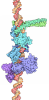

- Assembly
| Deposited unit | 
|
|---|---|
| 1 |
|
-Components
| #1: Protein | Mass: 38581.309 Da / Num. of mol.: 1 Source method: isolated from a genetically manipulated source Details: N-terminal Strep-TEV tagged KAT2A-NTD / Source: (gene. exp.) Homo sapiens (human) / Gene: KAT2A, GCN5, GCN5L2 / Production host:   Escherichia coli (E. coli) Escherichia coli (E. coli)References: UniProt: Q92830, histone acetyltransferase, Transferases; Acyltransferases; Transferring groups other than aminoacyl groups | ||||||
|---|---|---|---|---|---|---|---|
| #2: Protein | Mass: 55144.594 Da / Num. of mol.: 1 Source method: isolated from a genetically manipulated source Details: N terminal Flag-Spy tagged CRBN / Source: (gene. exp.) Homo sapiens (human) / Gene: CRBN / Production host:  Trichoplusia ni (cabbage looper) / References: UniProt: Q96SW2 Trichoplusia ni (cabbage looper) / References: UniProt: Q96SW2 | ||||||
| #3: Protein | Mass: 96193.414 Da / Num. of mol.: 1 Source method: isolated from a genetically manipulated source Details: N terminal His tagged DDB1dB,N terminal His tagged DDB1dB Source: (gene. exp.) Homo sapiens (human) / Gene: DDB1, XAP1 / Production host: Trichoplusia ni (cabbage looper) / References: UniProt: Q16531 | ||||||
| #4: Chemical |   Mass: 65.409 Da / Num. of mol.: 3 / Source method: obtained synthetically / Formula: Zn Mass: 65.409 Da / Num. of mol.: 3 / Source method: obtained synthetically / Formula: Zn#5: Chemical | ChemComp-A1C5C / ( | Mass: 600.668 Da / Num. of mol.: 1 / Source method: obtained synthetically / Formula: C31H36N8O5 / Feature type: SUBJECT OF INVESTIGATION Has ligand of interest | Y | Has protein modification | N | |
-Experimental details
-Experiment
| Experiment | Method: ELECTRON MICROSCOPY |
|---|---|
| EM experiment | Aggregation state: PARTICLE / 3D reconstruction method: single particle reconstruction |
- Sample preparation
| Component |
| ||||||||||||||||||||||||
|---|---|---|---|---|---|---|---|---|---|---|---|---|---|---|---|---|---|---|---|---|---|---|---|---|---|
| Source (natural) |
| ||||||||||||||||||||||||
| Source (recombinant) |
| ||||||||||||||||||||||||
| Buffer solution | pH: 7.4 / Details: 30 mM HEPES/NaOH pH7.4, 150 mM NaCl. | ||||||||||||||||||||||||
| Buffer component |
| ||||||||||||||||||||||||
| Specimen | Embedding applied: NO / Shadowing applied: NO / Staining applied: NO / Vitrification applied: YES | ||||||||||||||||||||||||
| Specimen support | Grid material: GOLD / Grid type: Quantifoil R0.6/1 | ||||||||||||||||||||||||
| Vitrification | Instrument: LEICA EM GP / Cryogen name: ETHANE / Humidity: 90 % / Chamber temperature: 283 K Details: Grids were vitrified using a Leica EM GP plunge freezer operated at 90% humidity and 10C. Grids were first pre-incubated with 4uL of 10uM CRBN-agnostic IKZF1_140-196_Q146A,G151N for 1 minute ...Details: Grids were vitrified using a Leica EM GP plunge freezer operated at 90% humidity and 10C. Grids were first pre-incubated with 4uL of 10uM CRBN-agnostic IKZF1_140-196_Q146A,G151N for 1 minute and then back-blotted for 4s. Afterwards, 4uL of mixture was applied to the grids, followed by blotting for 4s and plunging into liquid ethane at -181 C. |
- Electron microscopy imaging
| Experimental equipment |  Model: Titan Krios / Image courtesy: FEI Company |
|---|---|
| Microscopy | Model: TFS KRIOS / Details: The grid was imaged at a 30-degree tilt |
| Electron gun | Electron source:  FIELD EMISSION GUN / Accelerating voltage: 300 kV / Illumination mode: FLOOD BEAM FIELD EMISSION GUN / Accelerating voltage: 300 kV / Illumination mode: FLOOD BEAM |
| Electron lens | Mode: BRIGHT FIELD / Nominal magnification: 165000 X / Nominal defocus max: 2000 nm / Nominal defocus min: 800 nm / Cs: 2.7 mm / C2 aperture diameter: 50 µm / Alignment procedure: COMA FREE |
| Specimen holder | Cryogen: NITROGEN / Specimen holder model: FEI TITAN KRIOS AUTOGRID HOLDER |
| Image recording | Electron dose: 55.8 e/Å2 / Film or detector model: TFS FALCON 4i (4k x 4k) / Num. of grids imaged: 1 / Num. of real images: 9381 / Details: The grid was imaged at a 30-degree tilt |
- Processing
| EM software |
| ||||||||||||||||||||||||||||
|---|---|---|---|---|---|---|---|---|---|---|---|---|---|---|---|---|---|---|---|---|---|---|---|---|---|---|---|---|---|
| CTF correction | Type: PHASE FLIPPING AND AMPLITUDE CORRECTION | ||||||||||||||||||||||||||||
| 3D reconstruction | Resolution: 2.9 Å / Resolution method: FSC 0.143 CUT-OFF / Num. of particles: 613163 / Symmetry type: POINT | ||||||||||||||||||||||||||||
| Refinement | Highest resolution: 2.9 Å Stereochemistry target values: REAL-SPACE (WEIGHTED MAP SUM AT ATOM CENTERS) | ||||||||||||||||||||||||||||
| Refine LS restraints |
|
