[English] 日本語
Yorodumi
- EMDB-75101: Structure of CRBN/DDB1dB-KAT2A-Compound4 ternary complex -

+
Open data


ID or keywords:

Loading...

-
Basic information

Entry
Database: EMDB / ID: EMD-75101
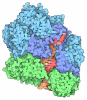
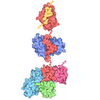
TitleStructure of CRBN/DDB1dB-KAT2A-Compound4 ternary complex
Map dataStructure of CRBN/DDB1dB-KAT2A-Compound4 ternary complex
Sample
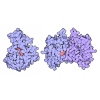
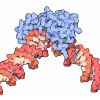
  • Complex: Compound 4 induced DDB1dB/CRBN, KAT2A-NTD ternary complex
    • Complex: DDB1dB/CRBN
      • Protein or peptide: DNA damage-binding protein 1
      • Protein or peptide: Protein cereblon
    • Complex: KAT2A N-terminal domain
      • Protein or peptide: Histone acetyltransferase KAT2A
  • Ligand: ZINC ION
  • Ligand: (3S)-3-[4-({6-(3-tert-butyl-2-oxoimidazolidin-1-yl)-1-[(2S)-oxan-2-yl]-1H-imidazo[4,5-c]pyridin-4-yl}amino)-1-oxo-1,3-dihydro-2H-isoindol-2-yl]piperidine-2,6-dione
KeywordsCRBN / molecular glue / CRBN-MG / KAT2A / TRANSFERASE
Function / homology
Function and homology information


histone H1-4K34 acetyltransferase activity / negative regulation of SCF-dependent proteasomal ubiquitin-dependent catabolic process / histone succinyltransferase activity / peptidyl-lysine glutarylation / histone glutaryltransferase activity / regulation of cartilage development / regulation of bone development / regulation of regulatory T cell differentiation / histone H4K12 acetyltransferase activity / histone H3K9 acetyltransferase activity ...histone H1-4K34 acetyltransferase activity / negative regulation of SCF-dependent proteasomal ubiquitin-dependent catabolic process / histone succinyltransferase activity / peptidyl-lysine glutarylation / histone glutaryltransferase activity / regulation of cartilage development / regulation of bone development / regulation of regulatory T cell differentiation / histone H4K12 acetyltransferase activity / histone H3K9 acetyltransferase activity / negative regulation of centriole replication / positive regulation of cell projection organization / transcription factor TFTC complex / negative regulation of monoatomic ion transmembrane transport / positive regulation of cardiac muscle cell differentiation / internal peptidyl-lysine acetylation / histone H3 acetyltransferase activity / regulation of T cell activation / histone H3K18 acetyltransferase activity / SAGA complex / ATAC complex / Regulation of gene expression in late stage (branching morphogenesis) pancreatic bud precursor cells / positive regulation by virus of viral protein levels in host cell / RUNX3 regulates NOTCH signaling / NOTCH4 Intracellular Domain Regulates Transcription / Cardiogenesis / spindle assembly involved in female meiosis / epigenetic programming in the zygotic pronuclei / NOTCH3 Intracellular Domain Regulates Transcription / regulation of tubulin deacetylation / UV-damage excision repair / Notch-HLH transcription pathway / biological process involved in interaction with symbiont / Formation of paraxial mesoderm / acetyltransferase activity / regulation of mitotic cytokinesis / histone acetyltransferase activity / regulation of mitotic cell cycle phase transition / Formation of WDR5-containing histone-modifying complexes / regulation of miRNA-mediated gene silencing / regulation of natural killer cell activation / WD40-repeat domain binding / locomotory exploration behavior / regulation of cell cycle phase transition / regulation of RNA splicing / Cul4A-RING E3 ubiquitin ligase complex / Cul4-RING E3 ubiquitin ligase complex / regulation of stem cell population maintenance / intracellular distribution of mitochondria / Cul4B-RING E3 ubiquitin ligase complex / ubiquitin ligase complex scaffold activity / negative regulation of adipose tissue development / RNA Polymerase I Transcription Initiation / regulation of cellular response to stress / histone acetyltransferase complex / limb development / viral release from host cell / negative regulation of gluconeogenesis / regulation of cell division / cullin family protein binding / protein-lysine-acetyltransferase activity / positive regulation of Wnt signaling pathway / negative regulation of protein-containing complex assembly / regulation of DNA-templated DNA replication initiation / long-term memory / histone acetyltransferase / positive regulation of viral genome replication / positive regulation of gluconeogenesis / Transferases; Acyltransferases; Transferring groups other than aminoacyl groups / regulation of DNA repair / regulation of embryonic development / replication fork processing / positive regulation of cytokine production / cellular response to tumor necrosis factor / proteasomal protein catabolic process / regulation of protein stability / cellular response to nerve growth factor stimulus / epigenetic regulation of gene expression / positive regulation of protein-containing complex assembly / regulation of synaptic plasticity / nucleotide-excision repair / response to nutrient levels / regulation of autophagy / Recognition of DNA damage by PCNA-containing replication complex / mitotic spindle / B-WICH complex positively regulates rRNA expression / NOTCH1 Intracellular Domain Regulates Transcription / regulation of circadian rhythm / Pre-NOTCH Transcription and Translation / cell population proliferation / DNA Damage Recognition in GG-NER / Constitutive Signaling by NOTCH1 PEST Domain Mutants / Constitutive Signaling by NOTCH1 HD+PEST Domain Mutants / histone deacetylase binding / Dual Incision in GG-NER / Transcription-Coupled Nucleotide Excision Repair (TC-NER) / Formation of TC-NER Pre-Incision Complex / heart development / Formation of Incision Complex in GG-NER / positive regulation of protein catabolic process
Similarity search - Function
PCAF, N-terminal / Histone acetyltransferase GCN5/PCAF / PCAF (P300/CBP-associated factor) N-terminal domain / Histone acetyltransferase GCN5 / Yippee/Mis18/Cereblon / Yippee zinc-binding/DNA-binding /Mis18, centromere assembly / CULT domain / CULT domain profile. / Lon N-terminal domain profile. / Lon protease, N-terminal domain ...PCAF, N-terminal / Histone acetyltransferase GCN5/PCAF / PCAF (P300/CBP-associated factor) N-terminal domain / Histone acetyltransferase GCN5 / Yippee/Mis18/Cereblon / Yippee zinc-binding/DNA-binding /Mis18, centromere assembly / CULT domain / CULT domain profile. / Lon N-terminal domain profile. / Lon protease, N-terminal domain / Lon protease, N-terminal domain superfamily / ATP-dependent protease La (LON) substrate-binding domain / Found in ATP-dependent protease La (LON) / : / RSE1/DDB1/CPSF1 second beta-propeller / Cleavage/polyadenylation specificity factor, A subunit, C-terminal / Cleavage/polyadenylation specificity factor, A subunit, N-terminal / : / CPSF A subunit region / RSE1/DDB1/CPSF1 first beta-propeller / Acetyltransferase (GNAT) family / PUA-like superfamily / Gcn5-related N-acetyltransferase (GNAT) domain profile. / GNAT domain / Acyl-CoA N-acyltransferase / Bromodomain, conserved site / Bromodomain signature. / Bromodomain / bromo domain / Bromodomain / Bromodomain (BrD) profile. / Bromodomain-like superfamily / WD40-repeat-containing domain superfamily / WD40/YVTN repeat-like-containing domain superfamily
Similarity search - Domain/homology
DNA damage-binding protein 1 / Histone acetyltransferase KAT2A / Protein cereblon
Similarity search - Component
Biological speciesHomo sapiens (human)
Methodsingle particle reconstruction / cryo EM / Resolution: 2.9 Å
AuthorsOjeda S / Fischer ES
Funding support United States, 4 items
OrganizationGrant numberCountry
National Institutes of Health/National Center for Complementary and Integrative Health (NIH/NCCIH)P01CA066996 United States
National Institutes of Health/National Center for Complementary and Integrative Health (NIH/NCCIH)R01CA262188 United States
National Institutes of Health/National Center for Complementary and Integrative Health (NIH/NCCIH)R01CA214608 United States
National Institutes of Health/National Center for Complementary and Integrative Health (NIH/NCCIH)R01CA218278 United States
CitationJournal: Science / Year: 2026
Title: Degron-independent recruitment of KAT2A expands the target space of CRBN molecular glues.
Authors: Samuel Ojeda / Meng Wang / Kheewoong Baek / Wallace Bourgeois / Alba Sommerschield / Hong Yue / Rebecca J Metivier / Panos Karagiannis / Talya S Levitz / Yuan Xiong / Katherine A Donovan / ...Authors: Samuel Ojeda / Meng Wang / Kheewoong Baek / Wallace Bourgeois / Alba Sommerschield / Hong Yue / Rebecca J Metivier / Panos Karagiannis / Talya S Levitz / Yuan Xiong / Katherine A Donovan / Scott A Armstrong / Eric S Fischer /
Abstract: Lysine acetyltransferases (KATs) cooperate with oncogenes such as c-Myc, estrogen receptor, and lysine methyltransferase 2A (KMT2A) fusions to sustain malignant programs. Targeting of KAT proteins ...Lysine acetyltransferases (KATs) cooperate with oncogenes such as c-Myc, estrogen receptor, and lysine methyltransferase 2A (KMT2A) fusions to sustain malignant programs. Targeting of KAT proteins has shown clinical efficacy; however, achieving homolog selectivity for most KATs remains a major challenge. By extending cereblon (CRBN)-based molecular glues beyond the canonical degron space, we developed an exquisitely selective degrader of KAT2A. Cryo-electron microscopy revealed that CRBN recruits KAT2A independently of a degron; instead, the molecular glue engages a surface-exposed tyrosine, mimicking antibody-like molecular recognition. Selective KAT2A degradation leads to potent ablation of histone H3 lysine 9 acetylation (H3K9Ac), antiproliferative effects in acute myeloid leukemia cell lines, and in vivo efficacy in a patient-derived xenograft model, establishing KAT2A as a targetable vulnerability to treat a wide range of malignancies. More generally, degron-independent recruitment extends the CRBN-targetable proteome.
History
DepositionJan 14, 2026-
Header (metadata) releaseAug 12, 2026-
Map releaseAug 12, 2026-
UpdateAug 12, 2026-
Current statusAug 12, 2026Processing site: RCSB / Status: Released

-
Structure visualization

Supplemental images

Downloads & links

-
Map

FileDownload / File: emd_75101.map.gz / Format: CCP4 / Size: 216 MB / Type: IMAGE STORED AS FLOATING POINT NUMBER (4 BYTES)
AnnotationStructure of CRBN/DDB1dB-KAT2A-Compound4 ternary complex
Projections & slices

Image control

Size
Brightness
Contrast
Others
AxesZ (Sec.)Y (Row.)X (Col.)
0.74 Å/pix.
x 384 pix.
= 283.008 Å
0.74 Å/pix.
x 384 pix.
= 283.008 Å
0.74 Å/pix.
x 384 pix.
= 283.008 Å

Surface

Projections

Slices (1/3)

Slices (1/2)

Slices (2/3)

Images are generated by Spider.

Voxel sizeX=Y=Z: 0.737 Å
Density
Contour LevelBy AUTHOR: 0.05
Minimum - Maximum-0.0018235896 - 2.2125437
Average (Standard dev.)0.0010611345 (±0.02357482)
SymmetrySpace group: 1
Details

EMDB XML:

Map geometry
Axis orderXYZ
Origin000
Dimensions384384384
Spacing384384384
CellA=B=C: 283.008 Å
α=β=γ: 90.0 °

-
Supplemental data

-
Mask #1

Fileemd_75101_msk_1.map
Projections & Slices
AxesZYX

Projections

Slices (1/2)
Density Histograms

-
Mask #2

Fileemd_75101_msk_2.map
Projections & Slices
AxesZYX

Projections

Slices (1/2)
Density Histograms

-
Additional map: Additional Map B

Fileemd_75101_additional_1.map
AnnotationAdditional Map B
Projections & Slices
AxesZYX

Projections

Slices (1/2)
Density Histograms

-
Additional map: Additional Map A

Fileemd_75101_additional_2.map
AnnotationAdditional Map A
Projections & Slices
AxesZYX

Projections

Slices (1/2)
Density Histograms

-
Half map: Half Map B

Fileemd_75101_half_map_1.map
AnnotationHalf Map B
Projections & Slices
AxesZYX

Projections

Slices (1/2)
Density Histograms

-
Half map: Half Map A

Fileemd_75101_half_map_2.map
AnnotationHalf Map A
Projections & Slices
AxesZYX

Projections

Slices (1/2)
Density Histograms

-
Sample components

-
Entire : Compound 4 induced DDB1dB/CRBN, KAT2A-NTD ternary complex

EntireName: Compound 4 induced DDB1dB/CRBN, KAT2A-NTD ternary complex
Components
  • Complex: Compound 4 induced DDB1dB/CRBN, KAT2A-NTD ternary complex
    • Complex: DDB1dB/CRBN
      • Protein or peptide: DNA damage-binding protein 1
      • Protein or peptide: Protein cereblon
    • Complex: KAT2A N-terminal domain
      • Protein or peptide: Histone acetyltransferase KAT2A
  • Ligand: ZINC ION
  • Ligand: (3S)-3-[4-({6-(3-tert-butyl-2-oxoimidazolidin-1-yl)-1-[(2S)-oxan-2-yl]-1H-imidazo[4,5-c]pyridin-4-yl}amino)-1-oxo-1,3-dihydro-2H-isoindol-2-yl]piperidine-2,6-dione

-
Supramolecule #1: Compound 4 induced DDB1dB/CRBN, KAT2A-NTD ternary complex

SupramoleculeName: Compound 4 induced DDB1dB/CRBN, KAT2A-NTD ternary complex
type: complex / ID: 1 / Parent: 0 / Macromolecule list: #1, #3, #2
Source (natural)Organism: Homo sapiens (human)

-
Supramolecule #2: DDB1dB/CRBN

SupramoleculeName: DDB1dB/CRBN / type: complex / ID: 2 / Parent: 1 / Macromolecule list: #3, #2
Source (natural)Organism: Homo sapiens (human)

-
Supramolecule #3: KAT2A N-terminal domain

SupramoleculeName: KAT2A N-terminal domain / type: complex / ID: 3 / Parent: 1 / Macromolecule list: #1
Source (natural)Organism: Homo sapiens (human)

-
Macromolecule #1: Histone acetyltransferase KAT2A

MacromoleculeName: Histone acetyltransferase KAT2A / type: protein_or_peptide / ID: 1 / Details: N-terminal Strep-TEV tagged KAT2A-NTD / Number of copies: 1 / Enantiomer: LEVO / EC number: histone acetyltransferase
Source (natural)Organism: Homo sapiens (human)
Molecular weightTheoretical: 38.581309 KDa
Recombinant expressionOrganism: Escherichia coli (E. coli)
SequenceString: MDWSHPQFEK DLGTENLYFQ SPARPGLSQQ QRASQRKAQV RGLPRAKKLE KLGVFSACKA NETCKCNGWK NPKPPTAPRM DLQQPAANL SELCRSCEHP LADHVSHLEN VSEDEINRLL GMVVDVENLF MSVHKEEDTD TKQVYFYLFK LLRKCILQMT R PVVEGSLG ...String:
MDWSHPQFEK DLGTENLYFQ SPARPGLSQQ QRASQRKAQV RGLPRAKKLE KLGVFSACKA NETCKCNGWK NPKPPTAPRM DLQQPAANL SELCRSCEHP LADHVSHLEN VSEDEINRLL GMVVDVENLF MSVHKEEDTD TKQVYFYLFK LLRKCILQMT R PVVEGSLG SPPFEKPNIE QGVLNFVQYK FSHLAPRERQ TMFELSKMFL LCLNYWKLET PAQFRQRSQA EDVATYKVNY TR WLCYCHV PQSCDSLPRY ETTHVFGRSL LRSIFTVTRR QLLEKFRVEK DKLVPEKRTL ILTHFPKFLS MLEEEIYGAN SPI WESGFT MPPSE

UniProtKB: Histone acetyltransferase KAT2A

-
Macromolecule #2: Protein cereblon

MacromoleculeName: Protein cereblon / type: protein_or_peptide / ID: 2 / Details: N terminal Flag-Spy tagged CRBN / Number of copies: 1 / Enantiomer: LEVO
Source (natural)Organism: Homo sapiens (human)
Molecular weightTheoretical: 55.144594 KDa
Recombinant expressionOrganism: Trichoplusia ni (cabbage looper)
SequenceString: MDYKDDDDKS AVDENLYFQG GGRGGSAHIV MVDAYKPTKG GSGMAGEGDQ QDAAHNMGNH LPLLPAESEE EDEMEVEDQD SKEAKKPNI INFDTSLPTS HTYLGADMEE FHGRTLHDDD SCQVIPVLPQ VMMILIPGQT LPLQLFHPQE VSMVRNLIQK D RTFAVLAY ...String:
MDYKDDDDKS AVDENLYFQG GGRGGSAHIV MVDAYKPTKG GSGMAGEGDQ QDAAHNMGNH LPLLPAESEE EDEMEVEDQD SKEAKKPNI INFDTSLPTS HTYLGADMEE FHGRTLHDDD SCQVIPVLPQ VMMILIPGQT LPLQLFHPQE VSMVRNLIQK D RTFAVLAY SNVQEREAQF GTTAEIYAYR EEQDFGIEIV KVKAIGRQRF KVLELRTQSD GIQQAKVQIL PECVLPSTMS AV QLESLNK CQIFPSKPVS REDQCSYKWW QKYQKRKFHC ANLTSWPRWL YSLYDAETLM DRIKKQLREW DENLKDDSLP SNP IDFSYR VAACLPIDDV LRIQLLKIGS AIQRLRCELD IMNKCTSLCC KQCQETEITT KNEIFSLSLC GPMAAYVNPH GYVH ETLTV YKACNLNLIG RPSTEHSWFP GYAWTVAQCK ICASHIGWKF TATKKDMSPQ KFWGLTRSAL LPTIPDTEDE ISPDK VILC L

UniProtKB: Protein cereblon

-
Macromolecule #3: DNA damage-binding protein 1

MacromoleculeName: DNA damage-binding protein 1 / type: protein_or_peptide / ID: 3
Details: N terminal His tagged DDB1dB,N terminal His tagged DDB1dB
Number of copies: 1 / Enantiomer: LEVO
Source (natural)Organism: Homo sapiens (human)
Molecular weightTheoretical: 96.193414 KDa
Recombinant expressionOrganism: Trichoplusia ni (cabbage looper)
SequenceString: MGSSHHHHHH SAVDENLYFQ GGGRMSYNYV VTAQKPTAVN GCVTGHFTSA EDLNLLIAKN TRLEIYVVTA EGLRPVKEVG MYGKIAVME LFRPKGESKD LLFILTAKYN ACILEYKQSG ESIDIITRAH GNVQDRIGRP SETGIIGIID PECRMIGLRL Y DGLFKVIP ...String:
MGSSHHHHHH SAVDENLYFQ GGGRMSYNYV VTAQKPTAVN GCVTGHFTSA EDLNLLIAKN TRLEIYVVTA EGLRPVKEVG MYGKIAVME LFRPKGESKD LLFILTAKYN ACILEYKQSG ESIDIITRAH GNVQDRIGRP SETGIIGIID PECRMIGLRL Y DGLFKVIP LDRDNKELKA FNIRLEELHV IDVKFLYGCQ APTICFVYQD PQGRHVKTYE VSLREKEFNK GPWKQENVEA EA SMVIAVP EPFGGAIIIG QESITYHNGD KYLAIAPPII KQSTIVCHNR VDPNGSRYLL GDMEGRLFML LLEKEEQMDG TVT LKDLRV ELLGETSIAE CLTYLDNGVV FVGSRLGDSQ LVKLNVDSNE QGSYVVAMET FTNLGPIVDM CVVDLERQGQ GQLV TCSGA FKEGSLRIIR NGIGKKKKKE IQKLHIRTVP LYESPRKICY QEVSQCFGVL SSRIEVQDTS GGTTALRPSA STQAL SSSV SSSKLFSSST APHETSFGEE VEVHNLLIID QHTFEVLHAH QFLQNEYALS LVSCKLGKDP NTYFIVGTAM VYPEEA EPK QGRIVVFQYS DGKLQTVAEK EVKGAVYSMV EFNGKLLASI NSTVRLYEWT TEKELRTECN HYNNIMALYL KTKGDFI LV GDLMRSVLLL AYKPMEGNFE EIARDFNPNW MSAVEILDDD NFLGAENAFN LFVCQKDSAA TTDEERQHLQ EVGLFHLG E FVNVFCHGSL VMQNLGETST PTQGSVLFGT VNGMIGLVTS LSESWYNLLL DMQNRLNKVI KSVGKIEHSF WRSFHTERK TEPATGFIDG DLIESFLDIS RPKMQEVVAN LQYDDGSGMK REATADDLIK VVEELTRIH

UniProtKB: DNA damage-binding protein 1, DNA damage-binding protein 1

-
Macromolecule #4: ZINC ION

MacromoleculeName: ZINC ION / type: ligand / ID: 4 / Number of copies: 3 / Formula: ZN
Molecular weightTheoretical: 65.409 Da

-
Macromolecule #5: (3S)-3-[4-({6-(3-tert-butyl-2-oxoimidazolidin-1-yl)-1-[(2S)-oxan-...

MacromoleculeName: (3S)-3-[4-({6-(3-tert-butyl-2-oxoimidazolidin-1-yl)-1-[(2S)-oxan-2-yl]-1H-imidazo[4,5-c]pyridin-4-yl}amino)-1-oxo-1,3-dihydro-2H-isoindol-2-yl]piperidine-2,6-dione
type: ligand / ID: 5 / Number of copies: 1 / Formula: A1C5C
Molecular weightTheoretical: 600.668 Da

-
Experimental details

-
Structure determination

Methodcryo EM
Processingsingle particle reconstruction
Aggregation stateparticle

-
Sample preparation

BufferpH: 7.4
Component:
ConcentrationFormulaName
30.0 mMC8H18N2O4SHEPES
150.0 mMNaClSodium chloride

Details: 30 mM HEPES/NaOH pH7.4, 150 mM NaCl.
GridModel: Quantifoil R0.6/1 / Material: GOLD / Support film - Material: GOLD / Support film - topology: HOLEY
VitrificationCryogen name: ETHANE / Chamber humidity: 90 % / Chamber temperature: 283 K / Instrument: LEICA EM GP
Details: Grids were vitrified using a Leica EM GP plunge freezer operated at 90% humidity and 10C. Grids were first pre-incubated with 4uL of 10uM CRBN-agnostic IKZF1_140-196_Q146A,G151N for 1 minute ...Details: Grids were vitrified using a Leica EM GP plunge freezer operated at 90% humidity and 10C. Grids were first pre-incubated with 4uL of 10uM CRBN-agnostic IKZF1_140-196_Q146A,G151N for 1 minute and then back-blotted for 4s. Afterwards, 4uL of mixture was applied to the grids, followed by blotting for 4s and plunging into liquid ethane at -181 C..

-
Electron microscopy

MicroscopeTFS KRIOS
DetailsThe grid was imaged at a 30-degree tilt
Image recordingFilm or detector model: TFS FALCON 4i (4k x 4k) / Number grids imaged: 1 / Number real images: 9381 / Average electron dose: 55.8 e/Å2 / Details: The grid was imaged at a 30-degree tilt
Electron beamAcceleration voltage: 300 kV / Electron source: FIELD EMISSION GUN
Electron opticsC2 aperture diameter: 50.0 µm / Illumination mode: FLOOD BEAM / Imaging mode: BRIGHT FIELD / Cs: 2.7 mm / Nominal defocus max: 2.0 µm / Nominal defocus min: 0.8 µm / Nominal magnification: 165000
Sample stageSpecimen holder model: FEI TITAN KRIOS AUTOGRID HOLDER / Cooling holder cryogen: NITROGEN
Experimental equipment
Model: Titan Krios / Image courtesy: FEI Company

+
Image processing

CTF correctionSoftware - Name: cryoSPARC / Type: PHASE FLIPPING AND AMPLITUDE CORRECTION
Startup modelType of model: INSILICO MODEL
Final reconstructionResolution.type: BY AUTHOR / Resolution: 2.9 Å / Resolution method: FSC 0.143 CUT-OFF / Software - Name: cryoSPARC / Number images used: 613163
Initial angle assignmentType: MAXIMUM LIKELIHOOD / Software - Name: cryoSPARC
Final angle assignmentType: MAXIMUM LIKELIHOOD / Software - Name: cryoSPARC
FSC plot (resolution estimation)

+
About Yorodumi

-
News

-
Feb 9, 2022. New format data for meta-information of EMDB entries

New format data for meta-information of EMDB entries

  • Version 3 of the EMDB header file is now the official format.
  • The previous official version 1.9 will be removed from the archive.

Related info.:EMDB header

External links:wwPDB to switch to version 3 of the EMDB data model

-
Aug 12, 2020. Covid-19 info

Covid-19 info

URL: https://pdbj.org/emnavi/covid19.php

New page: Covid-19 featured information page in EM Navigator.

Related info.:Covid-19 info / Mar 5, 2020. Novel coronavirus structure data

+
Mar 5, 2020. Novel coronavirus structure data

Novel coronavirus structure data

Related info.:Yorodumi Speices / Aug 12, 2020. Covid-19 info

External links:COVID-19 featured content - PDBj / Molecule of the Month (242):Coronavirus Proteases

+
Jan 31, 2019. EMDB accession codes are about to change! (news from PDBe EMDB page)

EMDB accession codes are about to change! (news from PDBe EMDB page)

  • The allocation of 4 digits for EMDB accession codes will soon come to an end. Whilst these codes will remain in use, new EMDB accession codes will include an additional digit and will expand incrementally as the available range of codes is exhausted. The current 4-digit format prefixed with “EMD-” (i.e. EMD-XXXX) will advance to a 5-digit format (i.e. EMD-XXXXX), and so on. It is currently estimated that the 4-digit codes will be depleted around Spring 2019, at which point the 5-digit format will come into force.
  • The EM Navigator/Yorodumi systems omit the EMD- prefix.

Related info.:Q: What is EMD? / ID/Accession-code notation in Yorodumi/EM Navigator

External links:EMDB Accession Codes are Changing Soon! / Contact to PDBj

+
Jul 12, 2017. Major update of PDB

Major update of PDB

  • wwPDB released updated PDB data conforming to the new PDBx/mmCIF dictionary.
  • This is a major update changing the version number from 4 to 5, and with Remediation, in which all the entries are updated.
  • In this update, many items about electron microscopy experimental information are reorganized (e.g. em_software).
  • Now, EM Navigator and Yorodumi are based on the updated data.

External links:wwPDB Remediation / Enriched Model Files Conforming to OneDep Data Standards Now Available in the PDB FTP Archive

-
Yorodumi

Thousand views of thousand structures

  • Yorodumi is a browser for structure data from EMDB, PDB, SASBDB, etc.
  • This page is also the successor to EM Navigator detail page, and also detail information page/front-end page for Omokage search.
  • The word "yorodu" (or yorozu) is an old Japanese word meaning "ten thousand". "mi" (miru) is to see.

Related info.:EMDB / PDB / SASBDB / Comparison of 3 databanks / Yorodumi Search / Aug 31, 2016. New EM Navigator & Yorodumi / Yorodumi Papers / Jmol/JSmol / Function and homology information / Changes in new EM Navigator and Yorodumi

Read more