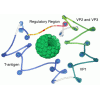
Journal: Proc Natl Acad Sci U S A / Year: 2017 Title: Structures of Qβ virions, virus-like particles, and the Qβ-MurA complex reveal internal coat proteins and the mechanism of host lysis. Authors: Zhicheng Cui / Karl V Gorzelnik / Jeng-Yih Chang / Carrie Langlais / Joanita Jakana / Ry Young / Junjie Zhang / Abstract: In single-stranded RNA bacteriophages (ssRNA phages) a single copy of the maturation protein binds the genomic RNA (gRNA) and is required for attachment of the phage to the host pilus. For the ...In single-stranded RNA bacteriophages (ssRNA phages) a single copy of the maturation protein binds the genomic RNA (gRNA) and is required for attachment of the phage to the host pilus. For the canonical Qβ the maturation protein, A, has an additional role as the lysis protein, by its ability to bind and inhibit MurA, which is involved in peptidoglycan biosynthesis. Here, we determined structures of Qβ virions, virus-like particles, and the Qβ-MurA complex using single-particle cryoelectron microscopy, at 4.7-Å, 3.3-Å, and 6.1-Å resolutions, respectively. We identified the outer surface of the β-region in A as the MurA-binding interface. Moreover, the pattern of MurA mutations that block Qβ lysis and the conformational changes of MurA that facilitate A binding were found to be due to the intimate fit between A and the region encompassing the closed catalytic cleft of substrate-liganded MurA. Additionally, by comparing the Qβ virion with Qβ virus-like particles that lack a maturation protein, we observed a structural rearrangement in the capsid coat proteins that is required to package the viral gRNA in its dominant conformation. Unexpectedly, we found a coat protein dimer sequestered in the interior of the virion. This coat protein dimer binds to the gRNA and interacts with the buried α-region of A, suggesting that it is sequestered during the early stage of capsid formation to promote the gRNA condensation required for genome packaging. These internalized coat proteins are the most asymmetrically arranged major capsid proteins yet observed in virus structures.
History
Deposition
Apr 26, 2017
-
Header (metadata) release
May 24, 2017
-
Map release
May 24, 2017
-
Update
Sep 23, 2026
-
Current status
Sep 23, 2026
Processing site: RCSB / Status: Released
-
Structure visualization
Movie
Surface view with section colored by density value
Entire : Tetrameric complex of native ERdj3 protein complex
Entire
Name: Tetrameric complex of native ERdj3 protein complex
Components
Complex: Tetrameric complex of native ERdj3 protein complex
-
Supramolecule #1: Tetrameric complex of native ERdj3 protein complex
Supramolecule
Name: Tetrameric complex of native ERdj3 protein complex / type: complex / ID: 1 / Parent: 0
Source (natural)
Organism: Homo sapiens (human) / Location in cell: Endoplasmic reticulum
Molecular weight
Theoretical: 153 KDa
-
Experimental details
-
Structure determination
Method
negative staining
Processing
single particle reconstruction
Aggregation state
particle
-
Sample preparation
Concentration
0.025 mg/mL
Buffer
pH: 7.5 / Details: 50 mM HEPES, 300 mM NaCl, 1% (v/v)Glycerol
Staining
Type: NEGATIVE / Material: Uranyl Formate Details: Sample absorbed on carbon surface was stained with 2% (w/v) Uranyl Formate solution, and finally air-dried after blotting off excess stain.
Grid
Model: 400 mesh Cu-Rh maxtaform grids (Electron Microscopy Sciences) that were coated with a thin layer of amorphous carbon. Material: COPPER/RHODIUM / Mesh: 400 / Support film - Material: CARBON / Support film - topology: CONTINUOUS / Pretreatment - Type: GLOW DISCHARGE / Pretreatment - Time: 20 sec. / Pretreatment - Atmosphere: AIR / Details: 15mA current
Details
Mono dispersed protein solution
-
Electron microscopy
Microscope
FEI TECNAI 12
Temperature
Min: 293.0 K / Max: 295.0 K
Image recording
Film or detector model: TVIPS TEMCAM-F416 (4k x 4k) / Digitization - Dimensions - Width: 4096 pixel / Digitization - Dimensions - Height: 4096 pixel / Number grids imaged: 2 / Number real images: 980 / Average exposure time: 0.79 sec. / Average electron dose: 35.0 e/Å2 Details: Automated image acquisition software Leginon was used for data collection.
Electron beam
Acceleration voltage: 120 kV / Electron source: LAB6
Automated image acquisition software Leginon was used for data collection.
Particle selection
Number selected: 385141 Details: Difference of Gaussian (DOG)-based automated particle picker, implemented in Appion processing package was used for particle selection.
CTF correction
Software - Name: CTFFIND4 Details: Ctffind4 was used for determining the CTF of each micrograph. Phases of each micrographs were flipped before particle extraction. Type: PHASE FLIPPING ONLY
In the structure databanks used in Yorodumi, some data are registered as the other names, "COVID-19 virus" and "2019-nCoV". Here are the details of the virus and the list of structure data.
Jan 31, 2019. EMDB accession codes are about to change! (news from PDBe EMDB page)
EMDB accession codes are about to change! (news from PDBe EMDB page)
The allocation of 4 digits for EMDB accession codes will soon come to an end. Whilst these codes will remain in use, new EMDB accession codes will include an additional digit and will expand incrementally as the available range of codes is exhausted. The current 4-digit format prefixed with “EMD-” (i.e. EMD-XXXX) will advance to a 5-digit format (i.e. EMD-XXXXX), and so on. It is currently estimated that the 4-digit codes will be depleted around Spring 2019, at which point the 5-digit format will come into force.
The EM Navigator/Yorodumi systems omit the EMD- prefix.
Related info.:Q: What is EMD? / ID/Accession-code notation in Yorodumi/EM Navigator
Yorodumi is a browser for structure data from EMDB, PDB, SASBDB, etc.
This page is also the successor to EM Navigator detail page, and also detail information page/front-end page for Omokage search.
The word "yorodu" (or yorozu) is an old Japanese word meaning "ten thousand". "mi" (miru) is to see.
Related info.:EMDB / PDB / SASBDB / Comparison of 3 databanks / Yorodumi Search / Aug 31, 2016. New EM Navigator & Yorodumi / Yorodumi Papers / Jmol/JSmol / Function and homology information / Changes in new EM Navigator and Yorodumi
 Movie
Movie Controller

 Yorodumi
 Open data
 Basic information
 Map data
 Sample
 Function and homology information
 Homo sapiens (human)
 Authors
 United States, 1 items
  Citation
 Structure visualization
 UCSF Chimera
 Downloads & links
 emd_8707.png
 https://data.pdbj.org/pub/emdb/structures/EMD-8707

 Z (Sec.)
 Y (Row.)
 X (Col.)


 Sample components
 Processing
 Electron microscopy