Movie
Movie Controller

[English] 日本語
 Yorodumi
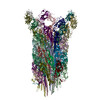
- EMDB-80383: Polyrod without P-ring formed by FlgG (G65V) from the Salmonella ... -
+ Open data

- Basic information
| Entry |  | ||||||||||||||||||||||||||||||
|---|---|---|---|---|---|---|---|---|---|---|---|---|---|---|---|---|---|---|---|---|---|---|---|---|---|---|---|---|---|---|---|
| Title | Polyrod without P-ring formed by FlgG (G65V) from the Salmonella TH26292 strain | ||||||||||||||||||||||||||||||
 Map data Map data | |||||||||||||||||||||||||||||||
 Sample Sample |
| ||||||||||||||||||||||||||||||
 Keywords Keywords | flagella motor. polyrod / P ring on polyrod complex / Cryo-EM / SPA / Salmonella / MOTOR PROTEIN | ||||||||||||||||||||||||||||||
| Biological species |  Salmonella enterica subsp. enterica serovar Typhimurium (bacteria) Salmonella enterica subsp. enterica serovar Typhimurium (bacteria) | ||||||||||||||||||||||||||||||
| Method | single particle reconstruction / cryo EM / Resolution: 2.86 Å | ||||||||||||||||||||||||||||||
 Authors Authors | Yamaguchi T / Kato T / Minamino T / Namba K | ||||||||||||||||||||||||||||||
| Funding support |  Japan, 9 items Japan, 9 items
| ||||||||||||||||||||||||||||||
 Citation Citation | Journal: Commun Biol / Year: 2026 Title: Structural insights into the assembly mechanism of the molecular bushing in the bacterial flagellar motor. Authors: Tomoko Yamaguchi / Tohru Minamino / Takayuki Kato / Fabienne F V Chevance / Kelly T Hughes / Keiichi Namba /  Abstract: The LP-ring complex of the Salmonella flagellar motor acts as a bushing that supports high-speed rotation of the rod, which serves as a drive shaft. The L-ring, P-ring, and distal rod consist of ...The LP-ring complex of the Salmonella flagellar motor acts as a bushing that supports high-speed rotation of the rod, which serves as a drive shaft. The L-ring, P-ring, and distal rod consist of FlgH, FlgI, and FlgG, respectively. LP-ring formation begins with P-ring assembly around the distal rod, where it remains firmly attached until the L-ring assembles above it. L-ring formation induces P-ring detachment, allowing the rod to freely rotate within the LP-ring, but this mechanism remains unclear. Here, we report the cryoEM structure of the P-ring assembled on a polyrod, an unusually elongated rod structure. The P-ring exhibits a slightly elliptical shape with a 2.7° tilt relative to the rod axis for its stable attachment. However, L-ring assembly on the P-ring causes steric clashes with the rod to induce P-ring detachment, allowing it to adopt a circular shape and complete the LP-ring as a functional bushing. | ||||||||||||||||||||||||||||||
| History |
|
- Structure visualization
| Supplemental images |
|---|

- Downloads & links
-EMDB archive
| Map data | emd_80383.map.gz | 188.9 MB |  EMDB map data format EMDB map data format | |
|---|---|---|---|---|
| Header (meta data) | emd-80383-v30.xmlemd-80383.xml | 23.4 KB 23.4 KB | Display Display | EMDB header |
| Images |  emd_80383.png emd_80383.png | 92 KB | ||
| Masks | emd_80383_msk_1.map | 244.1 MB | Mask map | |
| Filedesc metadata | emd-80383.cif.gz | 5.4 KB | ||
| Others | emd_80383_additional_1.map.gzemd_80383_half_map_1.map.gzemd_80383_half_map_2.map.gz | 116.2 MB 185.6 MB 185.6 MB | ||
| Archive directory |  https://data.pdbj.org/pub/emdb/structures/EMD-80383ftp://data.pdbj.org/pub/emdb/structures/EMD-80383 https://data.pdbj.org/pub/emdb/structures/EMD-80383ftp://data.pdbj.org/pub/emdb/structures/EMD-80383 | HTTPS FTP |
-Related structure data


-Links
| EMDB pages | EMDB (EBI/PDBe) / EMDataResource |
|---|
-Map
| File | Download / File: emd_80383.map.gz / Format: CCP4 / Size: 244.1 MB / Type: IMAGE STORED AS FLOATING POINT NUMBER (4 BYTES) | ||||||||||||||||||||||||||||||||||||
|---|---|---|---|---|---|---|---|---|---|---|---|---|---|---|---|---|---|---|---|---|---|---|---|---|---|---|---|---|---|---|---|---|---|---|---|---|---|
| Projections & slices | Image control
Images are generated by Spider. | ||||||||||||||||||||||||||||||||||||
| Voxel size | X=Y=Z: 0.99 Å | ||||||||||||||||||||||||||||||||||||
| Density |
| ||||||||||||||||||||||||||||||||||||
| Symmetry | Space group: 1 | ||||||||||||||||||||||||||||||||||||
| Details | EMDB XML:
|
 Z (Sec.)
 Y (Row.)
 X (Col.)


-Supplemental data
-Mask #1
| File | emd_80383_msk_1.map | ||||||||||||
|---|---|---|---|---|---|---|---|---|---|---|---|---|---|
| Projections & Slices |
| ||||||||||||
| Density Histograms |


-Additional map: #1
| File | emd_80383_additional_1.map | ||||||||||||
|---|---|---|---|---|---|---|---|---|---|---|---|---|---|
| Projections & Slices |
| ||||||||||||
| Density Histograms |


-Half map: #1
| File | emd_80383_half_map_1.map | ||||||||||||
|---|---|---|---|---|---|---|---|---|---|---|---|---|---|
| Projections & Slices |
| ||||||||||||
| Density Histograms |


-Half map: #2
| File | emd_80383_half_map_2.map | ||||||||||||
|---|---|---|---|---|---|---|---|---|---|---|---|---|---|
| Projections & Slices |
| ||||||||||||
| Density Histograms |


- Sample components
-Entire : Polyrod composed of FlgG(G65V)
| Entire | Name: Polyrod composed of FlgG(G65V) |
|---|---|
| Components |
|
-Supramolecule #1: Polyrod composed of FlgG(G65V)
| Supramolecule | Name: Polyrod composed of FlgG(G65V) / type: organelle_or_cellular_component / ID: 1 / Parent: 0 / Macromolecule list: #1 Details: Polyrod isolated from the FlgG (G65V) mutant of the flagellar motor in Salmonella enterica serovar typhimurium |
|---|---|
| Source (natural) | Organism: Salmonella enterica subsp. enterica serovar Typhimurium (bacteria) |
| Molecular weight | Theoretical: 380 KDa |
-Experimental details
-Structure determination
| Method | cryo EM |
|---|---|
 Processing Processing | single particle reconstruction |
| Aggregation state | filament |
-Sample preparation
| Buffer | pH: 8 Component:
Details: 50 mM Tris-HCl, 50 mM NaCl, 25 mM Imidazole, 0.002% (w/v) LMNG, 0.05% (w/v) Triton X-100, pH 8.0 | ||||||||||||||||||
|---|---|---|---|---|---|---|---|---|---|---|---|---|---|---|---|---|---|---|---|
| Grid | Model: Quantifoil R1.2/1.3 / Material: COPPER / Mesh: 200 / Support film - Material: CARBON / Pretreatment - Type: GLOW DISCHARGE | ||||||||||||||||||
| Vitrification | Cryogen name: ETHANE / Chamber humidity: 100 % / Chamber temperature: 277 K / Instrument: FEI VITROBOT MARK IV Details: blotting time of 4 seconds, 1 seconds drain time, force 0. |
- Electron microscopy
| Microscope | JEOL CRYO ARM 300 |
|---|---|
| Image recording | Film or detector model: GATAN K3 (6k x 4k) / Number real images: 28712 / Average exposure time: 6.0 sec. / Average electron dose: 75.0 e/Å2 Details: Using a minimum dose system, two data sets were taken by different conditions; One date set was taken by exposure of 6 seconds, a frame rate of 0.08 sec/frame, an electron dose of 1.0 ...Details: Using a minimum dose system, two data sets were taken by different conditions; One date set was taken by exposure of 6 seconds, a frame rate of 0.08 sec/frame, an electron dose of 1.0 electrons/A^2 per frame. The other was taken by exposure of 2.5 seconds, a frame rate of 0.0625 sec/frame, an electron dose of 1.0 electrons/A^2 per frame. |
| Electron beam | Acceleration voltage: 300 kV / Electron source:  FIELD EMISSION GUN FIELD EMISSION GUN |
| Electron optics | Calibrated defocus max: 2.0 µm / Calibrated defocus min: 0.2 µm / Illumination mode: OTHER / Imaging mode: BRIGHT FIELD / Cs: 2.7 mm / Nominal defocus max: 2.0 µm / Nominal defocus min: 0.2 µm / Nominal magnification: 50000 |
| Sample stage | Cooling holder cryogen: NITROGEN |
+Image processing
-Atomic model buiding 1
| Initial model | PDB ID: Chain - Chain ID: B / Chain - Residue range: 1-260 / Chain - Source name: PDB / Chain - Initial model type: experimental model Details: The initial model consisted of the whole sequence of wild type FlgG |
|---|---|
| Details | Phenix1.21-rc1 , refmac servalcat and ISOLDE was used for fitting, and Phenix was used for final fitting. |
| Refinement | Space: REAL / Protocol: OTHER |