Movie
Movie Controller


+ Open data

- Basic information
| Entry | Database: PDB / ID: 9jqo | |||||||||||||||||||||||||||||||||||||||||||||
|---|---|---|---|---|---|---|---|---|---|---|---|---|---|---|---|---|---|---|---|---|---|---|---|---|---|---|---|---|---|---|---|---|---|---|---|---|---|---|---|---|---|---|---|---|---|---|
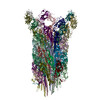
| Title | Polyrod formed by FlgG (G65V) from the Salmonella TH26292 strain | |||||||||||||||||||||||||||||||||||||||||||||
 Components Components | Flagellar basal-body rod protein FlgG | |||||||||||||||||||||||||||||||||||||||||||||
 Keywords Keywords | MOTOR PROTEIN / flagella motor. polyrod / P ring on polyrod complex / Cryo-EM / SPA / Salmonella | |||||||||||||||||||||||||||||||||||||||||||||
| Function / homology |  Function and homology information Function and homology informationbacterial-type flagellum basal body, distal rod / bacterial-type flagellum-dependent swarming motility Similarity search - Function | |||||||||||||||||||||||||||||||||||||||||||||
| Biological species |  Salmonella enterica subsp. enterica serovar Typhimurium (bacteria) Salmonella enterica subsp. enterica serovar Typhimurium (bacteria) | |||||||||||||||||||||||||||||||||||||||||||||
| Method | ELECTRON MICROSCOPY / helical reconstruction / cryo EM / Resolution: 3.37 Å | |||||||||||||||||||||||||||||||||||||||||||||
 Authors Authors | Yamaguchi, T. / Kato, T. / Minamino, T. / Namba, K. | |||||||||||||||||||||||||||||||||||||||||||||
| Funding support |  Japan, 9items Japan, 9items
| |||||||||||||||||||||||||||||||||||||||||||||
 Citation Citation | Journal: Commun Biol / Year: 2026 Title: Structural insights into the assembly mechanism of the molecular bushing in the bacterial flagellar motor. Authors: Tomoko Yamaguchi / Tohru Minamino / Takayuki Kato / Fabienne F V Chevance / Kelly T Hughes / Keiichi Namba /  Abstract: The LP-ring complex of the Salmonella flagellar motor acts as a bushing that supports high-speed rotation of the rod, which serves as a drive shaft. The L-ring, P-ring, and distal rod consist of ...The LP-ring complex of the Salmonella flagellar motor acts as a bushing that supports high-speed rotation of the rod, which serves as a drive shaft. The L-ring, P-ring, and distal rod consist of FlgH, FlgI, and FlgG, respectively. LP-ring formation begins with P-ring assembly around the distal rod, where it remains firmly attached until the L-ring assembles above it. L-ring formation induces P-ring detachment, allowing the rod to freely rotate within the LP-ring, but this mechanism remains unclear. Here, we report the cryoEM structure of the P-ring assembled on a polyrod, an unusually elongated rod structure. The P-ring exhibits a slightly elliptical shape with a 2.7° tilt relative to the rod axis for its stable attachment. However, L-ring assembly on the P-ring causes steric clashes with the rod to induce P-ring detachment, allowing it to adopt a circular shape and complete the LP-ring as a functional bushing. | |||||||||||||||||||||||||||||||||||||||||||||
| History |
|
- Structure visualization
| Structure viewer | Molecule: MolmilJmol/JSmol |
|---|
- Downloads & links
-Download
| PDBx/mmCIF format | 9jqo.cif.gz | 1.8 MB | Display | PDBx/mmCIF format |
|---|---|---|---|---|
| PDB format | pdb9jqo.ent.gz | Display | PDB format | |
| PDBx/mmJSON format | 9jqo.json.gz | Tree view | PDBx/mmJSON format | |
| Others |  Other downloads Other downloads |
-Validation report
| Arichive directory | https://data.pdbj.org/pub/pdb/validation_reports/jq/9jqoftp://data.pdbj.org/pub/pdb/validation_reports/jq/9jqo | HTTPS FTP |
|---|
-Related structure data
| Related structure data |  61731MC  9iycC M: map data used to model this data C: citing same article ( |
|---|---|
| Similar structure data |


-Links
 PDBj
PDBj
- Assembly
| Deposited unit | 
|
|---|---|
| 1 |
|
-Components
| #1: Protein | Mass: 27826.887 Da / Num. of mol.: 48 Source method: isolated from a genetically manipulated source Details: G65V is a natural mutation isolated from the engineered strain TH26292. Source: (gene. exp.) Salmonella enterica subsp. enterica serovar Typhimurium (bacteria)Strain: TH26292 / Gene: flgG, fla FVII, flaL, STY1218, t1741 Production host: Salmonella enterica subsp. enterica serovar Typhimurium (bacteria)Strain (production host): TH26292 / References: UniProt: P0A1J4 Has protein modification | N | |
|---|
-Experimental details
-Experiment
| Experiment | Method: ELECTRON MICROSCOPY |
|---|---|
| EM experiment | Aggregation state: FILAMENT / 3D reconstruction method: helical reconstruction |
- Sample preparation
| Component | Name: Polyrod composed of FlgG(G65V) / Type: ORGANELLE OR CELLULAR COMPONENT Details: Polyrod from the complex of P ring attached to polyrod. The FlgG(G65V) mutant of flagellar motor from Salmonella enterica serva typhimurium Entity ID: all / Source: NATURAL | ||||||||||||||||||||||||||||||
|---|---|---|---|---|---|---|---|---|---|---|---|---|---|---|---|---|---|---|---|---|---|---|---|---|---|---|---|---|---|---|---|
| Molecular weight | Value: 0.38 MDa / Experimental value: NO | ||||||||||||||||||||||||||||||
| Source (natural) | Organism: Salmonella enterica subsp. enterica serovar Typhimurium (bacteria) | ||||||||||||||||||||||||||||||
| Buffer solution | pH: 8 Details: 50 mM Tris-HCl, 50 mM NaCl, 25 mM Imidazole, 0.002% (w/v) LMNG, 0.05% (w/v) Triton X-100, pH 8.0 | ||||||||||||||||||||||||||||||
| Buffer component |
| ||||||||||||||||||||||||||||||
| Specimen | Embedding applied: NO / Shadowing applied: NO / Staining applied: NO / Vitrification applied: YES | ||||||||||||||||||||||||||||||
| Specimen support | Grid material: COPPER / Grid mesh size: 200 divisions/in. / Grid type: Quantifoil R1.2/1.3 | ||||||||||||||||||||||||||||||
| Vitrification | Instrument: FEI VITROBOT MARK IV / Cryogen name: ETHANE / Humidity: 100 % / Chamber temperature: 277 K Details: blotting time of 4 seconds, 1 seconds drain time, force 0 |
- Electron microscopy imaging
| Microscopy | Model: JEOL CRYO ARM 300 |
|---|---|
| Electron gun | Electron source:  FIELD EMISSION GUN / Accelerating voltage: 300 kV / Illumination mode: OTHER FIELD EMISSION GUN / Accelerating voltage: 300 kV / Illumination mode: OTHER |
| Electron lens | Mode: BRIGHT FIELD / Nominal magnification: 50000 X / Nominal defocus max: 2000 nm / Nominal defocus min: 200 nm / Calibrated defocus min: 200 nm / Calibrated defocus max: 2000 nm / Cs: 2.7 mm / Alignment procedure: BASIC |
| Specimen holder | Cryogen: NITROGEN |
| Image recording | Average exposure time: 6 sec. / Electron dose: 75 e/Å2 / Film or detector model: GATAN K3 (6k x 4k) / Num. of real images: 28712 Details: Using a minimum dose system, two data sets were taken by different conditions; One date set was taken by exposure of 6 seconds, a frame rate of 0.08 sec/frame, an electron dose of 1.0 ...Details: Using a minimum dose system, two data sets were taken by different conditions; One date set was taken by exposure of 6 seconds, a frame rate of 0.08 sec/frame, an electron dose of 1.0 electrons/A^2 per frame. The other was taken by exposure of 2.5 seconds, a frame rate of 0.0625 sec/frame, an electron dose of 1.0 electrons/A^2 per frame. |
- Processing
| EM software |
| ||||||||||||||||||||||||
|---|---|---|---|---|---|---|---|---|---|---|---|---|---|---|---|---|---|---|---|---|---|---|---|---|---|
| CTF correction | Type: PHASE FLIPPING AND AMPLITUDE CORRECTION | ||||||||||||||||||||||||
| Helical symmerty | Angular rotation/subunit: 64.9 ° / Axial rise/subunit: 4.31 Å / Axial symmetry: C1 | ||||||||||||||||||||||||
| Particle selection | Num. of particles selected: 386473 | ||||||||||||||||||||||||
| 3D reconstruction | Resolution: 3.37 Å / Resolution method: FSC 0.143 CUT-OFF / Num. of particles: 88969 / Algorithm: FOURIER SPACE / Num. of class averages: 1 / Symmetry type: HELICAL | ||||||||||||||||||||||||
| Atomic model building | Protocol: OTHER / Space: REAL Details: Phenix1.21-rc1 , refmac servalcat and ISOLDE was used for fitting, and Phenix was used for final fitting. | ||||||||||||||||||||||||
| Atomic model building | PDB-ID: 7CBM Pdb chain-ID: B / Accession code: 7CBM / Chain residue range: 1-260 Details: The initial model consisted of the whole sequence of wild type FlgG Pdb chain residue range: 1-260 / Source name: PDB / Type: experimental model |