 Movie
Movie Controller

[English] 日本語
 Yorodumi
- EMDB-76464: Cryo-EM structure of human cannabinoid receptor 2-Gi complex with... -
+ Open data

- Basic information
| Entry |  | |||||||||
|---|---|---|---|---|---|---|---|---|---|---|
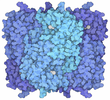
| Title | Cryo-EM structure of human cannabinoid receptor 2-Gi complex with agonist '5249 | |||||||||
 Map data Map data | ||||||||||
 Sample Sample |
| |||||||||
 Keywords Keywords | Human cannabinoid receptor 2 / CNR2 / CB2 receptor / Gi1 / Agonist-bound state / AM12435-bound complex / Active-state GPCR / Class A rhodopsin-like receptor / Cryo-electron microscopy structure / MEMBRANE PROTEIN | |||||||||
| Function / homology |  Function and homology information Function and homology informationnegative regulation of mast cell activation / trans-synaptic signaling by endocannabinoid, modulating synaptic transmission / cannabinoid signaling pathway / cannabinoid receptor activity / negative regulation of action potential / Class A/1 (Rhodopsin-like receptors) / negative regulation of synaptic transmission, GABAergic / extrinsic component of cytoplasmic side of plasma membrane / positive regulation of osteoblast differentiation / G protein-coupled receptor signaling pathway, coupled to cyclic nucleotide second messenger ...negative regulation of mast cell activation / trans-synaptic signaling by endocannabinoid, modulating synaptic transmission / cannabinoid signaling pathway / cannabinoid receptor activity / negative regulation of action potential / Class A/1 (Rhodopsin-like receptors) / negative regulation of synaptic transmission, GABAergic / extrinsic component of cytoplasmic side of plasma membrane / positive regulation of osteoblast differentiation / G protein-coupled receptor signaling pathway, coupled to cyclic nucleotide second messenger / response to amphetamine / regulation of eating behavior / adenylate cyclase inhibitor activity / T cell migration / positive regulation of protein localization to cell cortex / positive regulation of relaxation of smooth muscle / Adenylate cyclase inhibitory pathway / D2 dopamine receptor binding / adenylate cyclase-inhibiting dopamine receptor signaling pathway / adenylate cyclase-inhibiting serotonin receptor signaling pathway / G protein-coupled serotonin receptor binding / regulation of G protein-coupled receptor signaling pathway / cellular response to forskolin / regulation of mitotic spindle organization / mast cell degranulation / chemokine-mediated signaling pathway / establishment of mitotic spindle orientation / neuropeptide signaling pathway / Regulation of insulin secretion / response to prostaglandin E / positive regulation of cholesterol biosynthetic process / G protein-coupled receptor binding / response to peptide hormone / G-protein beta/gamma-subunit complex binding / adenylate cyclase-inhibiting G protein-coupled receptor signaling pathway / adenylate cyclase-modulating G protein-coupled receptor signaling pathway / cell division / Olfactory Signaling Pathway / Activation of the phototransduction cascade / G protein-coupled acetylcholine receptor signaling pathway / G beta:gamma signalling through PLC beta / Presynaptic function of Kainate receptors / Thromboxane signalling through TP receptor / Activation of G protein gated Potassium channels / Inhibition of voltage gated Ca2+ channels via Gbeta/gamma subunits / G-protein activation / Glucagon signaling in metabolic regulation / G beta:gamma signalling through CDC42 / Prostacyclin signalling through prostacyclin receptor / GDP binding / Synthesis, secretion, and inactivation of Glucagon-like Peptide-1 (GLP-1) / photoreceptor disc membrane / G beta:gamma signalling through BTK / ADP signalling through P2Y purinoceptor 12 / Sensory perception of sweet, bitter, and umami (glutamate) taste / Glucagon-type ligand receptors / Adrenaline,noradrenaline inhibits insulin secretion / Vasopressin regulates renal water homeostasis via Aquaporins / G alpha (z) signalling events / Glucagon-like Peptide-1 (GLP1) regulates insulin secretion / ADP signalling through P2Y purinoceptor 1 / cellular response to catecholamine stimulus / G beta:gamma signalling through PI3Kgamma / ADORA2B mediated anti-inflammatory cytokines production / adenylate cyclase-activating dopamine receptor signaling pathway / heterotrimeric G-protein complex / Cooperation of PDCL (PhLP1) and TRiC/CCT in G-protein beta folding / cellular response to prostaglandin E stimulus / GPER1 signaling / G alpha (12/13) signalling events / Inactivation, recovery and regulation of the phototransduction cascade / G-protein beta-subunit binding / response to lipopolysaccharide / spindle pole / extracellular vesicle / Thrombin signalling through proteinase activated receptors (PARs) / adenylate cyclase-activating G protein-coupled receptor signaling pathway / signaling receptor complex adaptor activity / ciliary basal body / GTPase binding / midbody / G protein activity / Ca2+ pathway / cell cortex / High laminar flow shear stress activates signaling by PIEZO1 and PECAM1:CDH5:KDR in endothelial cells / G alpha (i) signalling events / G alpha (s) signalling events / G alpha (q) signalling events / Hydrolases; Acting on acid anhydrides; Acting on GTP to facilitate cellular and subcellular movement / response to ethanol / cytoplasmic side of plasma membrane / perikaryon / Ras protein signal transduction / Extra-nuclear estrogen signaling / postsynaptic membrane / G protein-coupled receptor signaling pathway / lysosomal membrane / centrosome / GTPase activity / dendrite Similarity search - Function | |||||||||
| Biological species |  Homo sapiens (human) / synthetic construct (others) Homo sapiens (human) / synthetic construct (others) | |||||||||
| Method | single particle reconstruction / cryo EM / Resolution: 2.72 Å | |||||||||
 Authors Authors | Sacco M / Wu C / Singal B / Skiniotis G | |||||||||
| Funding support |  United States, 1 items United States, 1 items
| |||||||||
 Citation Citation | Journal: J Med Chem / Year: 2026 Title: Library Docking for Cannabinoid-2 Receptor Ligands. Authors: Moira M Rachman / Christos Iliopoulos-Tsoutsouvas / Michael D Sacco / Xinyu Xu / Cheng-Guo Wu / Emma Santos / Isabella S Glenn / Lu Paris / Michelle K Cahill / Suthakar Ganapathy / Tia A ...Authors: Moira M Rachman / Christos Iliopoulos-Tsoutsouvas / Michael D Sacco / Xinyu Xu / Cheng-Guo Wu / Emma Santos / Isabella S Glenn / Lu Paris / Michelle K Cahill / Suthakar Ganapathy / Tia A Tummino / Yurii S Moroz / Dmytro S Radchenko / Meri Okorie / Vivianne L Tawfik / John J Irwin / Alexandros Makriyannis / Georgios Skiniotis / Brian K Shoichet /  Abstract: Cannabinoid receptors are both therapeutically attractive and are interesting model systems for structure-based methods. Here we investigated topical questions in library docking using the CB2 ...Cannabinoid receptors are both therapeutically attractive and are interesting model systems for structure-based methods. Here we investigated topical questions in library docking using the CB2 receptor. While a CB1R docking campaign found potent but nonselective ligands, here subtype selective ligands were found by targeting polar residues. Hit rates and hit affinities improved with library size, but docking against active and inactive receptor states did not reliably bias toward agonists or antagonists. Cryo-EM structures of two of the new agonists superposed well on the docking predictions. Structure-based optimization led to 10- to 140-fold improvements within three series, consistent with well-behaved ligands. Hit rates with an explicit 2.6 billion molecule library resembled those of an implied 11 billion molecule library from a building-block method, supporting the latter's ability to explore this space, though higher affinities were discovered from the explicit set. Implications for future studies are considered. | |||||||||
| History |
|
- Structure visualization
| Supplemental images |
|---|

- Downloads & links
-EMDB archive
| Map data | emd_76464.map.gz | 32 MB | EMDB map data format | |
|---|---|---|---|---|
| Header (meta data) | emd-76464-v30.xmlemd-76464.xml | 26.8 KB 26.8 KB | Display Display | EMDB header |
| FSC (resolution estimation) | emd_76464_fsc.xml | 8.5 KB | Display | FSC data file |
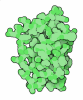
| Images |  emd_76464.png emd_76464.png | 25.3 KB | ||
| Filedesc metadata | emd-76464.cif.gz | 7.5 KB | ||
| Others | emd_76464_half_map_1.map.gzemd_76464_half_map_2.map.gz | 59.3 MB 59.3 MB | ||
| Archive directory |  https://data.pdbj.org/pub/emdb/structures/EMD-76464ftp://data.pdbj.org/pub/emdb/structures/EMD-76464 https://data.pdbj.org/pub/emdb/structures/EMD-76464ftp://data.pdbj.org/pub/emdb/structures/EMD-76464 | HTTPS FTP |
-Related structure data
| Related structure data |  12izMC  12iyC  12jaC M: atomic model generated by this map C: citing same article ( |
|---|---|
| Similar structure data |


-Links
| EMDB pages | EMDB (EBI/PDBe) / EMDataResource |
|---|---|
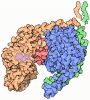
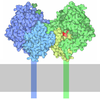
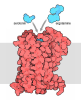
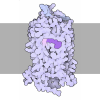
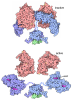
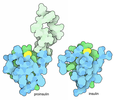
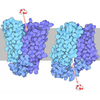
| Related items in Molecule of the Month |

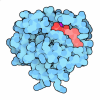

-Map
| File | Download / File: emd_76464.map.gz / Format: CCP4 / Size: 64 MB / Type: IMAGE STORED AS FLOATING POINT NUMBER (4 BYTES) | ||||||||||||||||||||||||||||||||||||
|---|---|---|---|---|---|---|---|---|---|---|---|---|---|---|---|---|---|---|---|---|---|---|---|---|---|---|---|---|---|---|---|---|---|---|---|---|---|
| Projections & slices | Image control
Images are generated by Spider. | ||||||||||||||||||||||||||||||||||||
| Voxel size | X=Y=Z: 0.92 Å | ||||||||||||||||||||||||||||||||||||
| Density |
| ||||||||||||||||||||||||||||||||||||
| Symmetry | Space group: 1 | ||||||||||||||||||||||||||||||||||||
| Details | EMDB XML:
|
 Z (Sec.)
 Y (Row.)
 X (Col.)


-Supplemental data
-Half map: #1
| File | emd_76464_half_map_1.map | ||||||||||||
|---|---|---|---|---|---|---|---|---|---|---|---|---|---|
| Projections & Slices |
| ||||||||||||
| Density Histograms |


-Half map: #2
| File | emd_76464_half_map_2.map | ||||||||||||
|---|---|---|---|---|---|---|---|---|---|---|---|---|---|
| Projections & Slices |
| ||||||||||||
| Density Histograms |


- Sample components
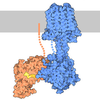
-Entire : Complex of the human cannabinoid receptor 2 with heterotrimeric Gi1
| Entire | Name: Complex of the human cannabinoid receptor 2 with heterotrimeric Gi1 |
|---|---|
| Components |
|
-Supramolecule #1: Complex of the human cannabinoid receptor 2 with heterotrimeric Gi1
| Supramolecule | Name: Complex of the human cannabinoid receptor 2 with heterotrimeric Gi1 type: complex / ID: 1 / Parent: 0 / Macromolecule list: #1-#5 |
|---|---|
| Source (natural) | Organism: Homo sapiens (human) |
-Macromolecule #1: Guanine nucleotide-binding protein G(i) subunit alpha-1
| Macromolecule | Name: Guanine nucleotide-binding protein G(i) subunit alpha-1 type: protein_or_peptide / ID: 1 / Number of copies: 1 / Enantiomer: LEVO EC number: Hydrolases; Acting on acid anhydrides; Acting on GTP to facilitate cellular and subcellular movement |
|---|---|
| Source (natural) | Organism: Homo sapiens (human) |
| Molecular weight | Theoretical: 40.414047 KDa |
| Recombinant expression | Organism:   Spodoptera frugiperda (fall armyworm) Spodoptera frugiperda (fall armyworm) |
| Sequence | String: MGCTLSAEDK AAVERSKMID RNLREDGEKA AREVKLLLLG AGESGKNTIV KQMKIIHEAG YSEEECKQYK AVVYSNTIQS IIAIIRAMG RLKIDFGDSA RADDARQLFV LAGAAEEGFM TAELAGVIKR LWKDSGVQAC FNRSREYQLN DSAAYYLNDL D RIAQPNYI ...String: MGCTLSAEDK AAVERSKMID RNLREDGEKA AREVKLLLLG AGESGKNTIV KQMKIIHEAG YSEEECKQYK AVVYSNTIQS IIAIIRAMG RLKIDFGDSA RADDARQLFV LAGAAEEGFM TAELAGVIKR LWKDSGVQAC FNRSREYQLN DSAAYYLNDL D RIAQPNYI PTQQDVLRTR VKTTGIVETH FTFKDLHFKM FDVGAQRSER KKWIHCFEGV TAIIFCVALS DYDLVLAEDE EM NRMHASM KLFDSICNNK WFTDTSIILF LNKKDLFEEK IKKSPLTICY PEYAGSNTYE EAAAYIQCQF EDLNKRKDTK EIY THFTCS TDTKNVQFVF DAVTDVIIKN NLKDCGLF UniProtKB: Guanine nucleotide-binding protein G(i) subunit alpha-1 |
-Macromolecule #2: Guanine nucleotide-binding protein G(I)/G(S)/G(T) subunit beta-1
| Macromolecule | Name: Guanine nucleotide-binding protein G(I)/G(S)/G(T) subunit beta-1 type: protein_or_peptide / ID: 2 / Number of copies: 1 / Enantiomer: LEVO |
|---|---|
| Source (natural) | Organism: Homo sapiens (human) |
| Molecular weight | Theoretical: 38.534062 KDa |
| Recombinant expression | Organism: Spodoptera frugiperda (fall armyworm) |
| Sequence | String: MHHHHHHGSS GSELDQLRQE AEQLKNQIRD ARKACADATL SQITNNIDPV GRIQMRTRRT LRGHLAKIYA MHWGTDSRLL VSASQDGKL IIWDSYTTNK VHAIPLRSSW VMTCAYAPSG NYVACGGLDN ICSIYNLKTR EGNVRVSREL AGHTGYLSCC R FLDDNQIV ...String: MHHHHHHGSS GSELDQLRQE AEQLKNQIRD ARKACADATL SQITNNIDPV GRIQMRTRRT LRGHLAKIYA MHWGTDSRLL VSASQDGKL IIWDSYTTNK VHAIPLRSSW VMTCAYAPSG NYVACGGLDN ICSIYNLKTR EGNVRVSREL AGHTGYLSCC R FLDDNQIV TSSGDTTCAL WDIETGQQTT TFTGHTGDVM SLSLAPDTRL FVSGACDASA KLWDVREGMC RQTFTGHESD IN AICFFPN GNAFATGSDD ATCRLFDLRA DQELMTYSHD NIICGITSVS FSKSGRLLLA GYDDFNCNVW DALKADRAGV LAG HDNRVS CLGVTDDGMA VATGSWDSFL KIWN UniProtKB: Guanine nucleotide-binding protein G(I)/G(S)/G(T) subunit beta-1 |
-Macromolecule #3: Guanine nucleotide-binding protein G(I)/G(S)/G(O) subunit gamma-2
| Macromolecule | Name: Guanine nucleotide-binding protein G(I)/G(S)/G(O) subunit gamma-2 type: protein_or_peptide / ID: 3 / Number of copies: 1 / Enantiomer: LEVO |
|---|---|
| Source (natural) | Organism: Homo sapiens (human) |
| Molecular weight | Theoretical: 7.861143 KDa |
| Recombinant expression | Organism: Spodoptera frugiperda (fall armyworm) |
| Sequence | String: MASNNTASIA QARKLVEQLK MEANIDRIKV SKAAADLMAY CEAHAKEDPL LTPVPASENP FREKKFFCAI L UniProtKB: Guanine nucleotide-binding protein G(I)/G(S)/G(O) subunit gamma-2 |
-Macromolecule #4: ScFv16
| Macromolecule | Name: ScFv16 / type: protein_or_peptide / ID: 4 / Number of copies: 1 / Enantiomer: LEVO |
|---|---|
| Source (natural) | Organism: synthetic construct (others) |
| Molecular weight | Theoretical: 29.937342 KDa |
| Recombinant expression | Organism:   Escherichia coli 'BL21-Gold(DE3)pLysS AG' (bacteria) Escherichia coli 'BL21-Gold(DE3)pLysS AG' (bacteria) |
| Sequence | String: VLLAAAAHSA FADVQLVESG GGLVQPGGSR KLSCSASGFA FSSFGMHWVR QAPEKGLEWV AYISSGSGTI YYADTVKGRF TISRDDPKN TLFLQMTSLR SEDTAMYYCV RSIYYYGSSP FDFWGQGTTL TVSSGGGGSG GGGSGGGGSD IVMTQATSSV P VTPGESVS ...String: VLLAAAAHSA FADVQLVESG GGLVQPGGSR KLSCSASGFA FSSFGMHWVR QAPEKGLEWV AYISSGSGTI YYADTVKGRF TISRDDPKN TLFLQMTSLR SEDTAMYYCV RSIYYYGSSP FDFWGQGTTL TVSSGGGGSG GGGSGGGGSD IVMTQATSSV P VTPGESVS ISCRSSKSLL HSNGNTYLYW FLQRPGQSPQ LLIYRMSNLA SGVPDRFSGS GSGTAFTLTI SRLEAEDVGV YY CMQHLEY PLTFGAGTKL ELKGSLEVLF QGPAAAHHHH HHHH |
-Macromolecule #5: Cannabinoid receptor 2
| Macromolecule | Name: Cannabinoid receptor 2 / type: protein_or_peptide / ID: 5 / Number of copies: 1 / Enantiomer: LEVO |
|---|---|
| Source (natural) | Organism: Homo sapiens (human) |
| Molecular weight | Theoretical: 41.442398 KDa |
| Recombinant expression | Organism: Spodoptera frugiperda (fall armyworm) |
| Sequence | String: DYKDDDDENL YFQGMEECWV TEIANGSKDG LDSNPMKDYM ILSGPQKTAV AVLCTLLGLL SALENVAVLY LILSSHQLRR KPSYLFIGS LAGADFLASV VFACSFVNFH VFHGVDSKAV FLLKIGSVTM TFTASVGSLL LTAIDRYLCL RYPPSYKALL T RGRALVTL ...String: DYKDDDDENL YFQGMEECWV TEIANGSKDG LDSNPMKDYM ILSGPQKTAV AVLCTLLGLL SALENVAVLY LILSSHQLRR KPSYLFIGS LAGADFLASV VFACSFVNFH VFHGVDSKAV FLLKIGSVTM TFTASVGSLL LTAIDRYLCL RYPPSYKALL T RGRALVTL GIMWVLSALV SYLPLMGWTC CPRPCSELFP LIPNDYLLSW LLFIAFLFSG IIYTYGHVLW KAHQHVASLS GH QDRQVPG MARMRLDVRL AKTLGLVLAV LLICWFPVLA LMAHSLATTL SDQVKKAFAF CSMLCLINSM VNPVIYALRS GEI RSSAHH CLAHWKKCVR GLGSEAKEEA PRSSVTETEA DGKITPWPDS RDLDLSDC UniProtKB: Cannabinoid receptor 2 |
-Macromolecule #6: (3R)-3-{2-oxo-2-[7-(trifluoromethyl)-3,4-dihydro-1,5-benzoxazepin...
| Macromolecule | Name: (3R)-3-{2-oxo-2-[7-(trifluoromethyl)-3,4-dihydro-1,5-benzoxazepin-5(2H)-yl]ethyl}-2-benzofuran-1(3H)-one type: ligand / ID: 6 / Number of copies: 1 / Formula: A1DB5 |
|---|---|
| Molecular weight | Theoretical: 391.341 Da |
-Experimental details
-Structure determination
| Method | cryo EM |
|---|---|
 Processing Processing | single particle reconstruction |
| Aggregation state | particle |
-Sample preparation
| Concentration | 5 mg/mL |
|---|---|
| Buffer | pH: 7.5 |
| Vitrification | Cryogen name: ETHANE / Chamber humidity: 100 % / Chamber temperature: 277.15 K / Instrument: FEI VITROBOT MARK IV |
- Electron microscopy
| Microscope | TFS KRIOS |
|---|---|
| Image recording | Film or detector model: FEI FALCON IV (4k x 4k) / Average electron dose: 50.0 e/Å2 |
| Electron beam | Acceleration voltage: 300 kV / Electron source:  FIELD EMISSION GUN FIELD EMISSION GUN |
| Electron optics | Illumination mode: FLOOD BEAM / Imaging mode: BRIGHT FIELD / Nominal defocus max: 1.6 µm / Nominal defocus min: 0.4 µm |
| Experimental equipment |  Model: Titan Krios / Image courtesy: FEI Company |


