 Movie
Movie Controller

[English] 日本語
 Yorodumi
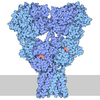
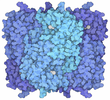
- EMDB-76090: GluA2-STZ open state with partial agonist NOW at 25 degrees C (fu... -
+ Open data

- Basic information
| Entry |  | ||||||||||||||||||||||||
|---|---|---|---|---|---|---|---|---|---|---|---|---|---|---|---|---|---|---|---|---|---|---|---|---|---|
| Title | GluA2-STZ open state with partial agonist NOW at 25 degrees C (full-length composite) | ||||||||||||||||||||||||
 Map data Map data | ETS NOW open composite | ||||||||||||||||||||||||
 Sample Sample |
| ||||||||||||||||||||||||
 Keywords Keywords | ionotropic glutamate receptor (iGluR) / iGluR / GluA2 / transmembrane AMPAR regulatory protein (TARP) y2 / gamma2 / stargazin (STZ) / MEMBRANE PROTEIN | ||||||||||||||||||||||||
| Function / homology |  Function and homology information Function and homology informationPresynaptic depolarization and calcium channel opening / LGI-ADAM interactions / Trafficking of AMPA receptors / eye blink reflex / positive regulation of protein localization to basolateral plasma membrane / positive regulation of AMPA receptor activity / cerebellar mossy fiber / postsynaptic neurotransmitter receptor diffusion trapping / membrane hyperpolarization / regulation of AMPA receptor activity ...Presynaptic depolarization and calcium channel opening / LGI-ADAM interactions / Trafficking of AMPA receptors / eye blink reflex / positive regulation of protein localization to basolateral plasma membrane / positive regulation of AMPA receptor activity / cerebellar mossy fiber / postsynaptic neurotransmitter receptor diffusion trapping / membrane hyperpolarization / regulation of AMPA receptor activity / channel regulator activity / protein targeting to membrane / nervous system process / voltage-gated calcium channel complex / regulation of synaptic plasticity by chemical substance / spine synapse / dendritic spine neck / dendritic spine cytoplasm / dendritic spine head / cellular response to amine stimulus / neurotransmitter receptor localization to postsynaptic specialization membrane / Activation of AMPA receptors / ligand-gated monoatomic cation channel activity / perisynaptic space / Trafficking of GluR2-containing AMPA receptors / response to lithium ion / AMPA glutamate receptor activity / AMPA glutamate receptor clustering / regulation of receptor recycling / neuromuscular junction development / kainate selective glutamate receptor activity / transmission of nerve impulse / AMPA glutamate receptor complex / extracellularly glutamate-gated ion channel activity / ionotropic glutamate receptor complex / membrane depolarization / cellular response to glycine / immunoglobulin binding / asymmetric synapse / Unblocking of NMDA receptors, glutamate binding and activation / glutamate receptor binding / regulation of postsynaptic membrane neurotransmitter receptor levels / positive regulation of synaptic transmission / conditioned place preference / regulation of synaptic transmission, glutamatergic / response to fungicide / voltage-gated calcium channel activity / cytoskeletal protein binding / extracellular ligand-gated monoatomic ion channel activity / glutamate-gated receptor activity / cellular response to brain-derived neurotrophic factor stimulus / positive regulation of synaptic transmission, glutamatergic / regulation of long-term synaptic depression / glutamate-gated calcium ion channel activity / somatodendritic compartment / presynaptic active zone membrane / ionotropic glutamate receptor binding / ionotropic glutamate receptor signaling pathway / excitatory synapse / dendrite cytoplasm / ligand-gated monoatomic ion channel activity involved in regulation of presynaptic membrane potential / dendrite membrane / hippocampal mossy fiber to CA3 synapse / positive regulation of excitatory postsynaptic potential / dendritic shaft / SNARE binding / synaptic membrane / establishment of protein localization / synaptic transmission, glutamatergic / PDZ domain binding / protein tetramerization / long-term synaptic potentiation / receptor internalization / transmitter-gated monoatomic ion channel activity involved in regulation of postsynaptic membrane potential / cerebral cortex development / regulation of membrane potential / response to calcium ion / postsynaptic density membrane / modulation of chemical synaptic transmission / Schaffer collateral - CA1 synapse / terminal bouton / synaptic vesicle membrane / presynapse / synaptic vesicle / amyloid-beta binding / signaling receptor activity / growth cone / scaffold protein binding / chemical synaptic transmission / presynaptic membrane / dendritic spine / perikaryon / postsynaptic membrane / neuron projection / postsynaptic density / external side of plasma membrane / axon / neuronal cell body / dendrite / protein kinase binding Similarity search - Function | ||||||||||||||||||||||||
| Biological species |   Rattus norvegicus (Norway rat) / Rattus norvegicus (Norway rat) /  Mus musculus (house mouse) Mus musculus (house mouse) | ||||||||||||||||||||||||
| Method | single particle reconstruction / cryo EM / Resolution: 3.55 Å | ||||||||||||||||||||||||
 Authors Authors | Newton TP / Yen LY / Gangwar SP / Sobolevsky AI | ||||||||||||||||||||||||
| Funding support |  United States, 7 items United States, 7 items
| ||||||||||||||||||||||||
 Citation Citation | Journal: Nat Struct Mol Biol / Year: 2026 Title: Pre-activation and gating pathway of AMPA receptors revealed by full and partial agonists. Authors: Thomas P Newton / Muhammed Aktolun / Maria V Yelshanskaya / Alexey A Alekseev / Laura Y Yen / Shanti Pal Gangwar / Ivan A Sobolevsky / Maria G Kurnikova / Alexander I Sobolevsky / Abstract: AMPA receptors (AMPARs) mediate fast excitatory neurotransmission. Gating of AMPARs starts with agonist binding and transition into a non-conducting pre-active state, followed by transition into ...AMPA receptors (AMPARs) mediate fast excitatory neurotransmission. Gating of AMPARs starts with agonist binding and transition into a non-conducting pre-active state, followed by transition into conducting open or non-conducting desensitized states. While the terminal apo, open and desensitized states have been structurally characterized, the intermediate pre-active state has remained an enigma. Compared to full agonist glutamate, partial agonists reduce the maximal occupancy of the open state and increase the probability of the pre-active state occurrence. Here we use different partial agonists and time-resolved cryo-electron microscopy (cryo-EM) to capture a structural ensemble of GluA2-γ2 AMPAR complexes in the closed apo, pre-active, open and desensitized states. Binding of partial agonists to the ligand-binding domain (LBD) results in different extents of LBD clamshell closure, with closures exceeding a threshold of ~17° resulting in the open and desensitized states and smaller closures stabilizing the pre-active state. The pre-active state has a distinct gate conformation intermediate between the other two discrete states, completely open and closed. Combined with single-channel current recordings and molecular dynamics simulations, our structural results reveal the complete gating pathway of AMPARs and shed light on the molecular mechanisms of partial agonism and pre-activation. | ||||||||||||||||||||||||
| History |
|
- Structure visualization
| Supplemental images |
|---|

- Downloads & links
-EMDB archive
| Map data | emd_76090.map.gz | 287.6 MB | EMDB map data format | |
|---|---|---|---|---|
| Header (meta data) | emd-76090-v30.xmlemd-76090.xml | 20.3 KB 20.3 KB | Display Display | EMDB header |
| Images |  emd_76090.png emd_76090.png | 70.4 KB | ||
| Filedesc metadata | emd-76090.cif.gz | 7.4 KB | ||
| Archive directory |  https://data.pdbj.org/pub/emdb/structures/EMD-76090ftp://data.pdbj.org/pub/emdb/structures/EMD-76090 https://data.pdbj.org/pub/emdb/structures/EMD-76090ftp://data.pdbj.org/pub/emdb/structures/EMD-76090 | HTTPS FTP |
-Related structure data
| Related structure data |  11wbMC  11vvC  11vwC  11vxC  11vyC  11vzC  11waC  11wcC  11wdC  11weC C: citing same article ( M: atomic model generated by this map |
|---|---|
| Similar structure data |


-Links
| EMDB pages | EMDB (EBI/PDBe) / EMDataResource |
|---|---|
| Related items in Molecule of the Month |
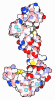
-Map
| File | Download / File: emd_76090.map.gz / Format: CCP4 / Size: 325 MB / Type: IMAGE STORED AS FLOATING POINT NUMBER (4 BYTES) | ||||||||||||||||||||||||||||||||||||
|---|---|---|---|---|---|---|---|---|---|---|---|---|---|---|---|---|---|---|---|---|---|---|---|---|---|---|---|---|---|---|---|---|---|---|---|---|---|
| Annotation | ETS NOW open composite | ||||||||||||||||||||||||||||||||||||
| Projections & slices | Image control
Images are generated by Spider. | ||||||||||||||||||||||||||||||||||||
| Voxel size | X=Y=Z: 0.838 Å | ||||||||||||||||||||||||||||||||||||
| Density |
| ||||||||||||||||||||||||||||||||||||
| Symmetry | Space group: 1 | ||||||||||||||||||||||||||||||||||||
| Details | EMDB XML:
|
 X (Sec.)
 Y (Row.)
 Z (Col.)


-Supplemental data
- Sample components
-Entire : GluA2-STZ open state with partial agonist NOW at 25 degrees C (fu...
| Entire | Name: GluA2-STZ open state with partial agonist NOW at 25 degrees C (full-length composite) |
|---|---|
| Components |
|
-Supramolecule #1: GluA2-STZ open state with partial agonist NOW at 25 degrees C (fu...
| Supramolecule | Name: GluA2-STZ open state with partial agonist NOW at 25 degrees C (full-length composite) type: complex / ID: 1 / Parent: 0 / Macromolecule list: #1 |
|---|---|
| Source (natural) | Organism: Rattus norvegicus (Norway rat) |
| Molecular weight | Theoretical: 470 KDa |
-Macromolecule #1: Isoform Flip of Glutamate receptor 2,Voltage-dependent calcium ch...
| Macromolecule | Name: Isoform Flip of Glutamate receptor 2,Voltage-dependent calcium channel gamma-2 subunit type: protein_or_peptide / ID: 1 / Details: rat GluA2 covalently fused with mouse STZ / Number of copies: 4 / Enantiomer: LEVO |
|---|---|
| Source (natural) | Organism: Mus musculus (house mouse) |
| Molecular weight | Theoretical: 117.49043 KDa |
| Recombinant expression | Organism:  Homo sapiens (human) Homo sapiens (human) |
| Sequence | String: MGKIMHISVL LSPVLWGLIF GVSSNSIQIG GLFPRGADQE YSAFRVGMVQ FSTSEFRLTP HIDNLEVANS FAVTNAFCSQ FSRGVYAIF GFYDKKSVNT ITSFCGTLHV SFITPSFPTD GTHPFVIQMR PDLKGALLSL IEYYQWDKFA YLYDSDRGLS T LQAVLDSA ...String: MGKIMHISVL LSPVLWGLIF GVSSNSIQIG GLFPRGADQE YSAFRVGMVQ FSTSEFRLTP HIDNLEVANS FAVTNAFCSQ FSRGVYAIF GFYDKKSVNT ITSFCGTLHV SFITPSFPTD GTHPFVIQMR PDLKGALLSL IEYYQWDKFA YLYDSDRGLS T LQAVLDSA AEKKWQVTAI NVGNINNDKK DETYRSLFQD LELKKERRVI LDCERDKVND IVDQVITIGK HVKGYHYIIA NL GFTDGDL LKIQFGGAEV SGFQIVDYDD SLVSKFIERW STLEEKEYPG AHTATIKYTS ALTYDAVQVM TEAFRNLRKQ RIE ISRRGN AGDCLANPAV PWGQGVEIER ALKQVQVEGL SGNIKFDQNG KRINYTINIM ELKTNGPRKI GYWSEVDKMV LTED DTSGL EQKTVVVTTI LESPYVMMKK NHEMLEGNER YEGYCVDLAA EIAKHCGFKY KLTIVGDGKY GARDADTKIW NGMVG ELVY GKADIAIAPL TITLVREEVI DFSKPFMSLG ISIMIKKPQK SKPGVFSFLD PLAYEIWMCI VFAYIGVSVV LFLVSR FSP YEWHTEEFED GRETQSSEST NEFGIFNSLW FSLGAFMQQG CDISPRSLSG RIVGGVWWFF TLIIISSYTA NLAAFLT VE RMVSPIESAE DLSKQTEIAY GTLDSGSTKE FFRRSKIAVF DKMWTYMRSA EPSVFVRTTA EGVARVRKSK GKYAYLLE S TMNEYIEQRK PCDTMKVGGN LDSKGYGIAT PKGSSLGTPV NLAVLKLSEQ GVLDKLKNKW WYDKGECGAK DSGSKEKTS ALSLSNVAGV FYILVGGLGL AMLVALIEFC YKSRAEAKRM KGTGLFDRGV QMLLTTVGAF AAFSLMTIAV GTDYWLYSRG VCKTKSVSE DETSKKNEEV MTHSGLWRTC CLEGNFKGLC KQIDHFPEDA DYEADTAEYF LRAVRASSIF PILSVILLFM G GLCIAASE FYKTRHNIIL SAGIFFVSAG LSNIIGIIVY ISANAGDPSK SDSKKNSYSY GWSFYFGALS FIIAEMVGVL AV HMFIDRH KQLTG UniProtKB: Glutamate receptor 2, Voltage-dependent calcium channel gamma-2 subunit |
-Macromolecule #2: 3-(5-nitro-2,4-dioxo-3,4-dihydropyrimidin-1(2H)-yl)-L-alanine
| Macromolecule | Name: 3-(5-nitro-2,4-dioxo-3,4-dihydropyrimidin-1(2H)-yl)-L-alanine type: ligand / ID: 2 / Number of copies: 4 / Formula: NWD |
|---|---|
| Molecular weight | Theoretical: 244.162 Da |
| Chemical component information | 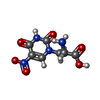 ChemComp-NWD: |
-Macromolecule #3: (2S)-3-(hexadecanoyloxy)-2-[(9Z)-octadec-9-enoyloxy]propyl 2-(tri...
| Macromolecule | Name: (2S)-3-(hexadecanoyloxy)-2-[(9Z)-octadec-9-enoyloxy]propyl 2-(trimethylammonio)ethyl phosphate type: ligand / ID: 3 / Number of copies: 20 / Formula: POV |
|---|---|
| Molecular weight | Theoretical: 760.076 Da |
| Chemical component information | 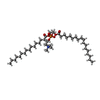 ChemComp-POV: |
-Macromolecule #4: SODIUM ION
| Macromolecule | Name: SODIUM ION / type: ligand / ID: 4 / Number of copies: 1 |
|---|---|
| Molecular weight | Theoretical: 22.99 Da |
-Macromolecule #5: SPERMIDINE
| Macromolecule | Name: SPERMIDINE / type: ligand / ID: 5 / Number of copies: 1 / Formula: SPD |
|---|---|
| Molecular weight | Theoretical: 145.246 Da |
| Chemical component information | 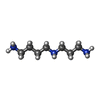 ChemComp-SPD: |
-Experimental details
-Structure determination
| Method | cryo EM |
|---|---|
 Processing Processing | single particle reconstruction |
| Aggregation state | particle |
-Sample preparation
| Concentration | 5 mg/mL | |||||||||||||||
|---|---|---|---|---|---|---|---|---|---|---|---|---|---|---|---|---|
| Buffer | pH: 8 Component:
Details: 150 mM NaCl, 20 mM Tris-HCl pH 8.0, and 0.05% digitonin, 250 uM NOW | |||||||||||||||
| Grid | Model: UltrAuFoil R1.2/1.3 / Material: GOLD / Mesh: 300 / Support film - Material: GOLD / Support film - topology: HOLEY / Support film - Film thickness: 500 / Pretreatment - Type: GLOW DISCHARGE / Pretreatment - Time: 25 sec. / Pretreatment - Atmosphere: AIR / Details: 15 mA | |||||||||||||||
| Vitrification | Cryogen name: ETHANE / Chamber humidity: 100 % / Chamber temperature: 298 K / Instrument: HOMEMADE PLUNGER | |||||||||||||||
| Details | Monodisperse, multiview particles |
- Electron microscopy
| Microscope | TFS KRIOS |
|---|---|
| Image recording | Film or detector model: GATAN K3 BIOQUANTUM (6k x 4k) / Average electron dose: 50.0 e/Å2 |
| Electron beam | Acceleration voltage: 300 kV / Electron source:  FIELD EMISSION GUN FIELD EMISSION GUN |
| Electron optics | C2 aperture diameter: 100.0 µm / Illumination mode: SPOT SCAN / Imaging mode: BRIGHT FIELD / Cs: 2.7 mm / Nominal defocus max: 2.5 µm / Nominal defocus min: 1.0 µm |
| Experimental equipment |  Model: Titan Krios / Image courtesy: FEI Company |
