 Movie
Movie Controller

[English] 日本語
 Yorodumi
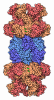
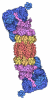
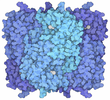
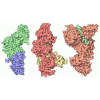
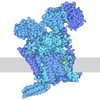
- EMDB-76054: Cryo-EM structure of substrate engaged p97-Ufd1-Npl4-Faf1 complex... -
+ Open data

- Basic information
| Entry |  | |||||||||
|---|---|---|---|---|---|---|---|---|---|---|
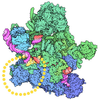
| Title | Cryo-EM structure of substrate engaged p97-Ufd1-Npl4-Faf1 complex in initiating conformation 2 | |||||||||
 Map data Map data | ||||||||||
 Sample Sample |
| |||||||||
 Keywords Keywords | ERAD / ubiquitin / AAA+ ATPase / unfoldase / HYDROLASE | |||||||||
| Function / homology |  Function and homology information Function and homology informationUFD1-NPL4 complex / negative regulation of RIG-I signaling pathway / flavin adenine dinucleotide catabolic process / VCP-NSFL1C complex / endoplasmic reticulum stress-induced pre-emptive quality control / endosome to lysosome transport via multivesicular body sorting pathway / BAT3 complex binding / cellular response to arsenite ion / cytoplasmic ubiquitin ligase complex / Derlin-1 retrotranslocation complex ...UFD1-NPL4 complex / negative regulation of RIG-I signaling pathway / flavin adenine dinucleotide catabolic process / VCP-NSFL1C complex / endoplasmic reticulum stress-induced pre-emptive quality control / endosome to lysosome transport via multivesicular body sorting pathway / BAT3 complex binding / cellular response to arsenite ion / cytoplasmic ubiquitin ligase complex / Derlin-1 retrotranslocation complex / positive regulation of protein K63-linked deubiquitination / protein-DNA covalent cross-linking repair / deubiquitinase activator activity / positive regulation of oxidative phosphorylation / cytoplasm protein quality control / regulation of protein localization to chromatin / ubiquitin-modified protein reader activity / cellular response to misfolded protein / mitotic spindle disassembly / VCP-NPL4-UFD1 AAA ATPase complex / positive regulation of mitochondrial membrane potential / vesicle-fusing ATPase / K48-linked polyubiquitin modification-dependent protein binding / nuclear outer membrane-endoplasmic reticulum membrane network / NAD+ metabolic process / regulation of aerobic respiration / retrograde protein transport, ER to cytosol / K63-linked polyubiquitin modification-dependent protein binding / stress granule disassembly / ATPase complex / negative regulation of type I interferon production / ubiquitin-specific protease binding / regulation of synapse organization / Golgi organization / polyubiquitin modification-dependent protein binding / positive regulation of ATP biosynthetic process / ubiquitin-like protein ligase binding / intracellular membrane-bounded organelle / RHOH GTPase cycle / skeletal system development / autophagosome maturation / MHC class I protein binding / HSF1 activation / endoplasmic reticulum to Golgi vesicle-mediated transport / negative regulation of hippo signaling / mitophagy / interstrand cross-link repair / ATP metabolic process / proteasome complex / protein unfolding / endoplasmic reticulum unfolded protein response / ribosome-associated ubiquitin-dependent protein catabolic process / Attachment and Entry / ERAD pathway / Protein methylation / translesion synthesis / negative regulation of smoothened signaling pathway / viral genome replication / negative regulation of protein localization to chromatin / macroautophagy / rescue of stalled cytosolic ribosome / lipid droplet / Josephin domain DUBs / autophagy / ubiquitin binding / establishment of protein localization / proteasomal protein catabolic process / N-glycan trimming in the ER and Calnexin/Calreticulin cycle / positive regulation of protein-containing complex assembly / positive regulation of non-canonical NF-kappaB signal transduction / ADP binding / Hh mutants are degraded by ERAD / Dengue Virus Genome Translation and Replication / Translesion Synthesis by POLH / Hedgehog ligand biogenesis / Defective CFTR causes cystic fibrosis / AMPK-induced ERAD and lysosome mediated degradation of PD-L1(CD274) / ABC-family protein mediated transport / cytoplasmic stress granule / Ribosome Quality Control (RQC) complex extracts and degrades nascent peptide / double-strand break repair / Aggrephagy / positive regulation of canonical Wnt signaling pathway / positive regulation of protein catabolic process / azurophil granule lumen / Ovarian tumor domain proteases / positive regulation of proteasomal ubiquitin-dependent protein catabolic process / KEAP1-NFE2L2 pathway / site of double-strand break / cellular response to heat / E3 ubiquitin ligases ubiquitinate target proteins / ATPase binding / Neddylation / secretory granule lumen / protein phosphatase binding / ubiquitin-dependent protein catabolic process / ficolin-1-rich granule lumen / proteasome-mediated ubiquitin-dependent protein catabolic process / regulation of apoptotic process / Attachment and Entry Similarity search - Function | |||||||||
| Biological species |  Homo sapiens (human) Homo sapiens (human) | |||||||||
| Method | single particle reconstruction / cryo EM / Resolution: 5.24 Å | |||||||||
 Authors Authors | Liao Z / Martin A | |||||||||
| Funding support |  United States, 1 items United States, 1 items
| |||||||||
 Citation Citation | Journal: bioRxiv / Year: 2025 Title: Faf1 accelerates p97-mediated protein unfolding by promoting ubiquitin engagement. Authors: Zengwei Liao / Connor Arkinson / Andreas Martin / Abstract: P97/VCP is a protein unfoldase of the AAA+ ATPase family that plays essential roles in numerous cellular processes, including ER-associated degradation and DNA replication. P97 utilizes various ...P97/VCP is a protein unfoldase of the AAA+ ATPase family that plays essential roles in numerous cellular processes, including ER-associated degradation and DNA replication. P97 utilizes various cofactors to process different substrates. For unfolding of proteins that are modified with K48-linked ubiquitin chains, p97 works with the heterodimeric cofactor Ufd1-Npl4, and the cofactor Faf1 was shown to enhance this activity in the context of replisome disassembly, yet the underlying mechanisms remain unknown. Here, we employ an reconstituted system with human components for biochemical experiments, mutational studies, FRET-based assays, and cryo-EM structure determination to reveal that Faf1 plays a generic role in accelerating ubiquitin-dependent substrate processing by promoting the unfolding of an initiator ubiquitin and its engagement by the ATPase motor. Faf1 thereby uses its p97-bound C-terminal UBX domain to anchor a long helix that braces the UT3 domain of Ufd1 and apparently stabilizes the Ufd1-Npl4 cofactor for ubiquitin unfolding. Our findings demonstrate how p97 works simultaneously with several cofactors to facilitate the unfolding of ubiquitinated proteins, indicating more complex regulatory mechanisms for substrate selection than for the simpler Cdc48 ortholog in yeast. | |||||||||
| History |
|
- Structure visualization
| Supplemental images |
|---|

- Downloads & links
-EMDB archive
| Map data | emd_76054.map.gz | 32 MB | EMDB map data format | |
|---|---|---|---|---|
| Header (meta data) | emd-76054-v30.xmlemd-76054.xml | 23 KB 23 KB | Display Display | EMDB header |
| Images |  emd_76054.png emd_76054.png | 133.3 KB | ||
| Filedesc metadata | emd-76054.cif.gz | 6.4 KB | ||
| Others | emd_76054_half_map_1.map.gzemd_76054_half_map_2.map.gz | 59.3 MB 59.3 MB | ||
| Archive directory |  https://data.pdbj.org/pub/emdb/structures/EMD-76054ftp://data.pdbj.org/pub/emdb/structures/EMD-76054 https://data.pdbj.org/pub/emdb/structures/EMD-76054ftp://data.pdbj.org/pub/emdb/structures/EMD-76054 | HTTPS FTP |
-Related structure data


-Links
| EMDB pages | EMDB (EBI/PDBe) / EMDataResource |
|---|---|
| Related items in Molecule of the Month |

-Map
| File | Download / File: emd_76054.map.gz / Format: CCP4 / Size: 64 MB / Type: IMAGE STORED AS FLOATING POINT NUMBER (4 BYTES) | ||||||||||||||||||||||||||||||||||||
|---|---|---|---|---|---|---|---|---|---|---|---|---|---|---|---|---|---|---|---|---|---|---|---|---|---|---|---|---|---|---|---|---|---|---|---|---|---|
| Projections & slices | Image control
Images are generated by Spider. | ||||||||||||||||||||||||||||||||||||
| Voxel size | X=Y=Z: 1.4775 Å | ||||||||||||||||||||||||||||||||||||
| Density |
| ||||||||||||||||||||||||||||||||||||
| Symmetry | Space group: 1 | ||||||||||||||||||||||||||||||||||||
| Details | EMDB XML:
|
 Z (Sec.)
 Y (Row.)
 X (Col.)


-Supplemental data
-Half map: #1
| File | emd_76054_half_map_1.map | ||||||||||||
|---|---|---|---|---|---|---|---|---|---|---|---|---|---|
| Projections & Slices |
| ||||||||||||
| Density Histograms |


-Half map: #2
| File | emd_76054_half_map_2.map | ||||||||||||
|---|---|---|---|---|---|---|---|---|---|---|---|---|---|
| Projections & Slices |
| ||||||||||||
| Density Histograms |


- Sample components
-Entire : substrate engaged p97-Ufd1-Npl4-Faf1 complex in initiating confor...
| Entire | Name: substrate engaged p97-Ufd1-Npl4-Faf1 complex in initiating conformation 2 |
|---|---|
| Components |
|
-Supramolecule #1: substrate engaged p97-Ufd1-Npl4-Faf1 complex in initiating confor...
| Supramolecule | Name: substrate engaged p97-Ufd1-Npl4-Faf1 complex in initiating conformation 2 type: complex / ID: 1 / Parent: 0 / Macromolecule list: all |
|---|---|
| Source (natural) | Organism: Homo sapiens (human) |
| Molecular weight | Theoretical: 734 kDa/nm |
-Macromolecule #1: Transitional endoplasmic reticulum ATPase
| Macromolecule | Name: Transitional endoplasmic reticulum ATPase / type: other / ID: 1 / Classification: other |
|---|---|
| Source (natural) | Organism: Homo sapiens (human) |
| Sequence | String: MASGADSKGD DLSTAILKQK NRPNRLIVDE AINEDNSVVS LSQPKMDELQ LFRGDTVLLK GKKRREAVCI VLSDDTCSDE KIRMNRVVRN NLRVRLGDVI SIQPCPDVKY GKRIHVLPID DTVEGITGNL FEVYLKPYFL EAYRPIRKGD IFLVRGGMRA VEFKVVETDP ...String: MASGADSKGD DLSTAILKQK NRPNRLIVDE AINEDNSVVS LSQPKMDELQ LFRGDTVLLK GKKRREAVCI VLSDDTCSDE KIRMNRVVRN NLRVRLGDVI SIQPCPDVKY GKRIHVLPID DTVEGITGNL FEVYLKPYFL EAYRPIRKGD IFLVRGGMRA VEFKVVETDP SPYCIVAPDT VIHCEGEPIK REDEEESLNE VGYDDIGGCR KQLAQIKEMV ELPLRHPALF KAIGVKPPRG ILLYGPPGTG KTLIARAVAN ETGAFFFLIN GPEIMSKLAG ESESNLRKAF EEAEKNAPAI IFIDELDAIA PKREKTHGEV ERRIVSQLLT LMDGLKQRAH VIVMAATNRP NSIDPALRRF GRFDREVDIG IPDATGRLEI LQIHTKNMKL ADDVDLEQVA NETHGHVGAD LAALCSEAAL QAIRKKMDLI DLEDETIDAE VMNSLAVTMD DFRWALSQSN PSALRETVVE VPQVTWEDIG GLEDVKRELQ ELVQYPVEHP DKFLKFGMTP SKGVLFYGPP GCGKTLLAKA IANECQANFI SIKGPELLTM WFGESEANVR EIFDKARQAA PCVLFFDELD SIAKARGGNI GDGGGAADRV INQILTEMDG MSTKKNVFII GATNRPDIID PAILRPGRLD QLIYIPLPDE KSRVAILKAN LRKSPVAKDV DLEFLAKMTN GFSGADLTEI CQRACKLAIR ESIESEIRRE RERQTNPSAM EVEEDDPVPE IRRDHFEEAM RFARRSVSDN DIRKYEMFAQ TLQQSRGFGS FRFPSGNQGG AGPSQGSGGG TGGSVYTEDN DDDLYGVDKL AAALEHHHHH H UniProtKB: Transitional endoplasmic reticulum ATPase |
| Recombinant expression | Organism:   Escherichia coli (E. coli) Escherichia coli (E. coli) |
-Macromolecule #2: Nuclear protein localization protein 4
| Macromolecule | Name: Nuclear protein localization protein 4 / type: other / ID: 2 / Classification: other |
|---|---|
| Source (natural) | Organism: Homo sapiens (human) |
| Sequence | String: MGGGAESIII RVQSPDGVKR ITATKRETAA TFLKKVAKEF GFQNNGFSVY INRNKTGEIT ASSNKSLNLL KIKHGDLLFL FPSSLAGPSS EMETSVPPGF KVFGAPNVVE DEIDQYLSKQ DGKIYRSRDP QLCRHGPLGK CVHCVPLEPF DEDYLNHLEP PVKHMSFHAY ...String: MGGGAESIII RVQSPDGVKR ITATKRETAA TFLKKVAKEF GFQNNGFSVY INRNKTGEIT ASSNKSLNLL KIKHGDLLFL FPSSLAGPSS EMETSVPPGF KVFGAPNVVE DEIDQYLSKQ DGKIYRSRDP QLCRHGPLGK CVHCVPLEPF DEDYLNHLEP PVKHMSFHAY IRKLTGGADK GKFVALENIS CKIKSGCEGH LPWPNGICTK CQPSAITLNR QKYRHVDNIM FENHTVADRF LDFWRKTGNQ HFGYLYGRYT EHKDIPLGIR AEVAAIYEPP QIGTQNSLEL LEDPKAEVVD EIAAKLGLRK VGWIFTDLVS EDTRKGTVRY SRNKDTYFLS SEECITAGDF QNKHPNMCRL SPDGHFGSKF VTAVATGGPD NQVHFEGYQV SNQCMALVRD ECLLPCKDAP ELGYAKESSS EQYVPDVFYK DVDKFGNEIT QLARPLPVEY LIIDITTTFP KDPVYTFSIS QNPFPIENRD VLGETQDFHS LATYLSQNTS SVFLDTISDF HLLLFLVTNE VMPLQDSISL LLEAVRTRNE ELAQTWKRSE QWATIEQLCS TVGGQLPGLH EYGAVGGSTH TATAAMWACQ HCTFMNQPGT GHCEMCSLPR T UniProtKB: Nuclear protein localization protein 4 homolog |
| Recombinant expression | Organism: Escherichia coli (E. coli) |
-Macromolecule #3: Ubiquitin fusion degradation protein 1
| Macromolecule | Name: Ubiquitin fusion degradation protein 1 / type: other / ID: 3 / Classification: other |
|---|---|
| Source (natural) | Organism: Homo sapiens (human) |
| Sequence | String: MFSFNMFDHP IPRVFQNRFS TQYRCFSVSM LAGPNDRSDV EKGGKIIMPP SALDQLSRLN ITYPMLFKLT NKNSDRMTHC GVLEFVADEG ICYLPHWMMQ NLLLEEGGLV QVESVNLQVA TYSKFQPQSP DFLDITNPKA VLENALRNFA CLTTGDVIAI NYNEKIYELR ...String: MFSFNMFDHP IPRVFQNRFS TQYRCFSVSM LAGPNDRSDV EKGGKIIMPP SALDQLSRLN ITYPMLFKLT NKNSDRMTHC GVLEFVADEG ICYLPHWMMQ NLLLEEGGLV QVESVNLQVA TYSKFQPQSP DFLDITNPKA VLENALRNFA CLTTGDVIAI NYNEKIYELR VMETKPDKAV SIIECDMNVD FDAPLGYKEP ERQVQHEEST EGEADHSGYA GELGFRAFSG SGNRLDGKKK GVEPSPSPIK PGDIKRGIPN YEFKLGKITF IRNSRPLVKK VEEDEAGGRF VAFSGEGQSL RKKGRKPHHH HHH UniProtKB: Ubiquitin recognition factor in ER-associated degradation protein 1 |
| Recombinant expression | Organism: Escherichia coli (E. coli) |
-Macromolecule #4: FAS-associated factor 1
| Macromolecule | Name: FAS-associated factor 1 / type: other / ID: 4 / Classification: other |
|---|---|
| Source (natural) | Organism: Homo sapiens (human) |
| Sequence | String: PLGMAAMEIF TAQQQEDIKD EDEREARENV KREQDEAYRL SLEADRAKRE AHEREMAEQF RLEQIRKEQE EEREAIRLSL EQALPPEPKE ENAEPVSKLR IRTPSGEFLE RRFLASNKLQ IVFDFVASKG FPWDEYKLLS TFPRRDVTQL DPNKSLLEVK LFPQETLFLE AKE UniProtKB: Transitional endoplasmic reticulum ATPase |
| Recombinant expression | Organism: Escherichia coli (E. coli) |
-Macromolecule #5: ubiquitin
| Macromolecule | Name: ubiquitin / type: other / ID: 5 / Classification: other |
|---|---|
| Source (natural) | Organism: Homo sapiens (human) |
| Sequence | String: MQIFVKTLTG KTITLEVEPS DTIENVKAKI QDKEGIPPDQ QRLIFAGKQL EDGRTLSDYN IQKESTLHLV LRLRGG |
| Recombinant expression | Organism: Escherichia coli (E. coli) |
-Experimental details
-Structure determination
| Method | cryo EM |
|---|---|
 Processing Processing | single particle reconstruction |
| Aggregation state | particle |
-Sample preparation
| Buffer | pH: 7.5 Details: 50 mM HEPES, pH 7.5, 150 mM KCl, 5 mM MgCl2, 2 mM ATP |
|---|---|
| Grid | Model: Quantifoil R2/2 / Material: COPPER / Mesh: 200 / Support film - Material: CARBON / Support film - topology: CONTINUOUS / Support film - Film thickness: 2 |
| Vitrification | Cryogen name: ETHANE / Chamber humidity: 100 % / Chamber temperature: 277.15 K / Instrument: FEI VITROBOT MARK IV |
- Electron microscopy
| Microscope | TFS KRIOS |
|---|---|
| Image recording | Film or detector model: FEI FALCON IV (4k x 4k) / Number grids imaged: 2 / Number real images: 17244 / Average electron dose: 50.0 e/Å2 |
| Electron beam | Acceleration voltage: 300 kV / Electron source:  FIELD EMISSION GUN FIELD EMISSION GUN |
| Electron optics | Illumination mode: FLOOD BEAM / Imaging mode: BRIGHT FIELD / Cs: 2.7 mm / Nominal defocus max: 1.6 µm / Nominal defocus min: 0.8 µm / Nominal magnification: 105000 |
| Sample stage | Specimen holder model: FEI TITAN KRIOS AUTOGRID HOLDER / Cooling holder cryogen: NITROGEN |
| Experimental equipment |  Model: Titan Krios / Image courtesy: FEI Company |
