Protein or peptide: Type II secretion system core protein G
Ligand: CALCIUM ION
Keywords
Endopilus / T2SS / PROTEIN FIBRIL
Function / homology
Function and homology information
protein secretion by the type II secretion system / type II protein secretion system complex / protein processing / plasma membrane Similarity search - Function
Type II secretion system protein GspG / Type II secretion system protein GspG, C-terminal / Type II secretion system (T2SS), protein G / Bacterial general secretion pathway protein G-type pilin / Prokaryotic N-terminal methylation site. / Prokaryotic N-terminal methylation motif / Prokaryotic N-terminal methylation site / Pilin-like Similarity search - Domain/homology
National Institutes of Health/National Institute of General Medical Sciences (NIH/NIGMS)
GM122510
United States
Citation
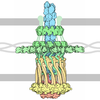
Journal: Structure / Year: 2026 Title: Structural determinants of endopilus assembly, stability, and functional specificity in bacterial type II secretion. Authors: Maylis Lejeune / Stefaniia Ivashchenko / Régine Dazzoni / Benjamin Bardiaux / Ravi R Sonani / Matthijn Vos / Theis Jacobsen / Edward H Egelman / Michael Nilges / Olivera Francetic / ...Authors: Maylis Lejeune / Stefaniia Ivashchenko / Régine Dazzoni / Benjamin Bardiaux / Ravi R Sonani / Matthijn Vos / Theis Jacobsen / Edward H Egelman / Michael Nilges / Olivera Francetic / Vladimir E Shevchik / Nadia Izadi-Pruneyre / Abstract: Gram-negative bacteria employ the type II secretion system (T2SS) to transport folded protein effectors via a periplasmic helical polymer called the endopilus, composed of one major and four minor ...Gram-negative bacteria employ the type II secretion system (T2SS) to transport folded protein effectors via a periplasmic helical polymer called the endopilus, composed of one major and four minor pilin subunits. Endopili resemble type IV pili but feature a conserved calcium-binding site stabilizing their major pilins. Endopilus polymerization is coupled to substrate translocation through a dedicated outer membrane channel. We compared T2SSs from plant and human pathogens, Dickeya dadantii and Klebsiella oxytoca, respectively. Despite different ecological niches and secreted effectors, their major pilins (OutG and PulG) share >77% sequence identity. Using NMR and cryo-EM, we solved structures of calcium-bound OutG monomer, as well as OutG and PulG endopili at 3.6 Å resolution. Combining structural, mutational, and biophysical analyses with in vivo assays, we identified key determinants of secretion specificity and endopilus stability. Our findings reveal how minor sequence variations in conserved nanomachines drive functional adaptation to diverse environments.
In the structure databanks used in Yorodumi, some data are registered as the other names, "COVID-19 virus" and "2019-nCoV". Here are the details of the virus and the list of structure data.
Jan 31, 2019. EMDB accession codes are about to change! (news from PDBe EMDB page)
EMDB accession codes are about to change! (news from PDBe EMDB page)
The allocation of 4 digits for EMDB accession codes will soon come to an end. Whilst these codes will remain in use, new EMDB accession codes will include an additional digit and will expand incrementally as the available range of codes is exhausted. The current 4-digit format prefixed with “EMD-” (i.e. EMD-XXXX) will advance to a 5-digit format (i.e. EMD-XXXXX), and so on. It is currently estimated that the 4-digit codes will be depleted around Spring 2019, at which point the 5-digit format will come into force.
The EM Navigator/Yorodumi systems omit the EMD- prefix.
Related info.:Q: What is EMD? / ID/Accession-code notation in Yorodumi/EM Navigator
Yorodumi is a browser for structure data from EMDB, PDB, SASBDB, etc.
This page is also the successor to EM Navigator detail page, and also detail information page/front-end page for Omokage search.
The word "yorodu" (or yorozu) is an old Japanese word meaning "ten thousand". "mi" (miru) is to see.
Related info.:EMDB / PDB / SASBDB / Comparison of 3 databanks / Yorodumi Search / Aug 31, 2016. New EM Navigator & Yorodumi / Yorodumi Papers / Jmol/JSmol / Function and homology information / Changes in new EM Navigator and Yorodumi
 Movie
Movie Controller


 Open data
 Basic information
 Map data
 Sample
 Keywords
 Function and homology information
 Dickeya dadantii (bacteria)
 Authors
 United States, 1 items
  Citation
 Structure visualization
 Downloads & links
 emd_75832.png
 https://data.pdbj.org/pub/emdb/structures/EMD-75832


 Z (Sec.)
 Y (Row.)
 X (Col.)


 Sample components
 Escherichia coli (E. coli)
 Processing
 Electron microscopy
 FIELD EMISSION GUN

