 Movie
Movie Controller


+ Open data

- Basic information
| Entry |  | |||||||||
|---|---|---|---|---|---|---|---|---|---|---|
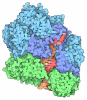
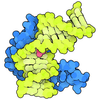
| Title | DNA Ligase IIIa bound to nucleosome containing a nick at SHL0 | |||||||||
 Map data Map data | ||||||||||
 Sample Sample |
| |||||||||
 Keywords Keywords | Nucleosome / DNA Ligase IIIa / DNA Repair / DNA BINDING PROTEIN / DNA BINDING PROTEIN-DNA complex | |||||||||
| Function / homology |  Function and homology information Function and homology informationnegative regulation of mitochondrial DNA replication / DNA ligase III-XRCC1 complex / DNA ligase activity / DNA ligase (ATP) / DNA ligase (ATP) activity / Strand-asynchronous mitochondrial DNA replication / mitochondrial DNA repair / lagging strand elongation / double-strand break repair via alternative nonhomologous end joining / HDR through MMEJ (alt-NHEJ) ...negative regulation of mitochondrial DNA replication / DNA ligase III-XRCC1 complex / DNA ligase activity / DNA ligase (ATP) / DNA ligase (ATP) activity / Strand-asynchronous mitochondrial DNA replication / mitochondrial DNA repair / lagging strand elongation / double-strand break repair via alternative nonhomologous end joining / HDR through MMEJ (alt-NHEJ) / Resolution of AP sites via the single-nucleotide replacement pathway / DNA biosynthetic process / APEX1-Independent Resolution of AP Sites via the Single Nucleotide Replacement Pathway / ChAHP complex assembly / FXIIa activates plasma kallikrein-kinin system / Interaction of NuRD complexes with transcription factors / base-excision repair, gap-filling / NuRD complex assembly / CHD6, CHD7, CHD8, CHD9 subfamily / CHD1 and CHD2 subfamily / negative regulation of megakaryocyte differentiation / protein localization to CENP-A containing chromatin / Chromatin modifying enzymes / Replacement of protamines by nucleosomes in the male pronucleus / Packaging Of Telomere Ends / Recognition and association of DNA glycosylase with site containing an affected purine / Cleavage of the damaged purine / regulation of DNA repair / telomere organization / Interleukin-7 signaling / Deposition of new CENPA-containing nucleosomes at the centromere / Recognition and association of DNA glycosylase with site containing an affected pyrimidine / Cleavage of the damaged pyrimidine / RNA Polymerase I Promoter Opening / Inhibition of DNA recombination at telomere / Assembly of the ORC complex at the origin of replication / SUMOylation of chromatin organization proteins / Regulation of endogenous retroelements by the Human Silencing Hub (HUSH) complex / Meiotic synapsis / DNA methylation / Condensation of Prophase Chromosomes / site of DNA damage / Chromatin modifications during the maternal to zygotic transition (MZT) / HCMV Late Events / mitochondrion organization / SIRT1 negatively regulates rRNA expression / ERCC6 (CSB) and EHMT2 (G9a) positively regulate rRNA expression / Gap-filling DNA repair synthesis and ligation in GG-NER / PRC2 methylates histones and DNA / Regulation of endogenous retroelements by KRAB-ZFP proteins / Defective pyroptosis / HDACs deacetylate histones / Transcriptional regulation by small RNAs / Regulation of endogenous retroelements by Piwi-interacting RNAs (piRNAs) / RNA Polymerase I Promoter Escape / Nonhomologous End-Joining (NHEJ) / double-strand break repair via homologous recombination / HDMs demethylate histones / Activated PKN1 stimulates transcription of AR (androgen receptor) regulated genes KLK2 and KLK3 / RUNX1 regulates genes involved in megakaryocyte differentiation and platelet function / base-excision repair / Negative Regulation of CDH1 Gene Transcription / NoRC negatively regulates rRNA expression / PKMTs methylate histone lysines / G2/M DNA damage checkpoint / Formation of the beta-catenin:TCF transactivating complex / B-WICH complex positively regulates rRNA expression / DNA Damage/Telomere Stress Induced Senescence / Meiotic recombination / Pre-NOTCH Transcription and Translation / Activation of anterior HOX genes in hindbrain development during early embryogenesis / Transcriptional regulation of granulopoiesis / nucleosomal DNA binding / RMTs methylate histone arginines / HCMV Early Events / Metalloprotease DUBs / innate immune response in mucosa / double-strand break repair / Gap-filling DNA repair synthesis and ligation in TC-NER / structural constituent of chromatin / nucleosome / Regulation of PD-L1(CD274) transcription / nucleosome assembly / UCH proteinases / HATs acetylate histones / E3 ubiquitin ligases ubiquitinate target proteins / Recruitment and ATM-mediated phosphorylation of repair and signaling proteins at DNA double strand breaks / Factors involved in megakaryocyte development and platelet production / MLL4 and MLL3 complexes regulate expression of PPARG target genes in adipogenesis and hepatic steatosis / RUNX1 regulates transcription of genes involved in differentiation of HSCs / chromatin organization / Dengue Virus-Host Interactions / Processing of DNA double-strand break ends / antimicrobial humoral immune response mediated by antimicrobial peptide / Senescence-Associated Secretory Phenotype (SASP) / heterochromatin formation / Oxidative Stress Induced Senescence / antibacterial humoral response / Estrogen-dependent gene expression / chromosome, telomeric region Similarity search - Function | |||||||||
| Biological species |  Homo sapiens (human) / synthetic construct (others) Homo sapiens (human) / synthetic construct (others) | |||||||||
| Method | single particle reconstruction / cryo EM / Resolution: 2.5 Å | |||||||||
 Authors Authors | Boesch DJ / Weaver TM | |||||||||
| Funding support | 1 items
| |||||||||
 Citation Citation | Journal: Nat Commun / Year: 2026 Title: Molecular basis of nick ligation in the nucleosome by DNA Ligase III alpha Authors: Boesch DJ / Martin NI / Kontor CA / Nguyen AG / Tomkinson AE / Van Houten B / Gillet N / Bignon E / Whitaker AM / Weaver TM | |||||||||
| History |
|
- Structure visualization
| Supplemental images |
|---|

- Downloads & links
-EMDB archive
| Map data | emd_75526.map.gz | 121.6 MB | EMDB map data format | |
|---|---|---|---|---|
| Header (meta data) | emd-75526-v30.xmlemd-75526.xml | 25.6 KB 25.6 KB | Display Display | EMDB header |
| FSC (resolution estimation) | emd_75526_fsc.xml | 13.2 KB | Display | FSC data file |
| Images |  emd_75526.png emd_75526.png | 116.3 KB | ||
| Filedesc metadata | emd-75526.cif.gz | 7 KB | ||
| Others | emd_75526_half_map_1.map.gzemd_75526_half_map_2.map.gz | 226.9 MB 226.9 MB | ||
| Archive directory |  https://data.pdbj.org/pub/emdb/structures/EMD-75526ftp://data.pdbj.org/pub/emdb/structures/EMD-75526 https://data.pdbj.org/pub/emdb/structures/EMD-75526ftp://data.pdbj.org/pub/emdb/structures/EMD-75526 | HTTPS FTP |
-Related structure data
| Related structure data |  10yeMC  10xzC  10yaC  10ybC  10ycC  10ydC 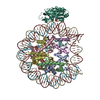 10yfC  10ygC  10yhC  10yiC M: atomic model generated by this map C: citing same article ( |
|---|---|
| Similar structure data |


-Links
| EMDB pages | EMDB (EBI/PDBe) / EMDataResource |
|---|---|
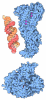
| Related items in Molecule of the Month |

-Map
| File | Download / File: emd_75526.map.gz / Format: CCP4 / Size: 244.1 MB / Type: IMAGE STORED AS FLOATING POINT NUMBER (4 BYTES) | ||||||||||||||||||||||||||||||||||||
|---|---|---|---|---|---|---|---|---|---|---|---|---|---|---|---|---|---|---|---|---|---|---|---|---|---|---|---|---|---|---|---|---|---|---|---|---|---|
| Projections & slices | Image control
Images are generated by Spider. | ||||||||||||||||||||||||||||||||||||
| Voxel size | X=Y=Z: 0.652 Å | ||||||||||||||||||||||||||||||||||||
| Density |
| ||||||||||||||||||||||||||||||||||||
| Symmetry | Space group: 1 | ||||||||||||||||||||||||||||||||||||
| Details | EMDB XML:
|
 Z (Sec.)
 Y (Row.)
 X (Col.)


-Supplemental data
-Half map: #2
| File | emd_75526_half_map_1.map | ||||||||||||
|---|---|---|---|---|---|---|---|---|---|---|---|---|---|
| Projections & Slices |
| ||||||||||||
| Density Histograms |


-Half map: #1
| File | emd_75526_half_map_2.map | ||||||||||||
|---|---|---|---|---|---|---|---|---|---|---|---|---|---|
| Projections & Slices |
| ||||||||||||
| Density Histograms |


- Sample components
+Entire : DNA Ligase IIIa bound to a nucleosome containing a nick at SHL0
+Supramolecule #1: DNA Ligase IIIa bound to a nucleosome containing a nick at SHL0
+Macromolecule #1: Histone H3.2

 Escherichia coli (E. coli)
+Macromolecule #2: Histone H4
+Macromolecule #3: Histone H2A type 1
+Macromolecule #4: Histone H2B type 1-M
+Macromolecule #8: DNA ligase 3
+Macromolecule #5: 601 I strand (non-damaged strand)
+Macromolecule #6: 601 J strand (damaged strand)
+Macromolecule #7: 601 K strand (damaged strand)
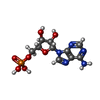
+Macromolecule #9: ADENOSINE MONOPHOSPHATE
-Experimental details
-Structure determination
| Method | cryo EM |
|---|---|
 Processing Processing | single particle reconstruction |
| Aggregation state | particle |
-Sample preparation
| Buffer | pH: 7.5 |
|---|---|
| Vitrification | Cryogen name: ETHANE |
- Electron microscopy
| Microscope | TFS KRIOS |
|---|---|
| Image recording | Film or detector model: GATAN K3 (6k x 4k) / Average electron dose: 50.0 e/Å2 |
| Electron beam | Acceleration voltage: 300 kV / Electron source:  FIELD EMISSION GUN FIELD EMISSION GUN |
| Electron optics | Illumination mode: FLOOD BEAM / Imaging mode: BRIGHT FIELD / Nominal defocus max: 1.8 µm / Nominal defocus min: 1.2 µm |
| Experimental equipment |  Model: Titan Krios / Image courtesy: FEI Company |


