[English] 日本語
Yorodumi
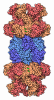
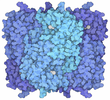
- EMDB-75392: Structure of human VCP/p97 hexamer bound to ADP (DMSO control) -

+
Open data


ID or keywords:

Loading...

-
Basic information

Entry
Database: EMDB / ID: EMD-75392
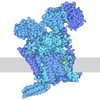
TitleStructure of human VCP/p97 hexamer bound to ADP (DMSO control)
Map data
Sample
  • Complex: Human VCP/p97 bound to ADP (DMSO control)
    • Protein or peptide: Transitional endoplasmic reticulum ATPase
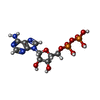
  • Ligand: ADENOSINE-5'-DIPHOSPHATE
  • Ligand: MAGNESIUM ION
  • Ligand: water
Keywordshexamer / VCP / p97 / ADP / CHAPERONE
Function / homology
Function and homology information


flavin adenine dinucleotide catabolic process / VCP-NSFL1C complex / cytoplasmic ubiquitin ligase complex / endoplasmic reticulum stress-induced pre-emptive quality control / endosome to lysosome transport via multivesicular body sorting pathway / BAT3 complex binding / cellular response to arsenite ion / protein-DNA covalent cross-linking repair / Derlin-1 retrotranslocation complex / positive regulation of protein K63-linked deubiquitination ...flavin adenine dinucleotide catabolic process / VCP-NSFL1C complex / cytoplasmic ubiquitin ligase complex / endoplasmic reticulum stress-induced pre-emptive quality control / endosome to lysosome transport via multivesicular body sorting pathway / BAT3 complex binding / cellular response to arsenite ion / protein-DNA covalent cross-linking repair / Derlin-1 retrotranslocation complex / positive regulation of protein K63-linked deubiquitination / deubiquitinase activator activity / cytoplasm protein quality control / positive regulation of oxidative phosphorylation / aggresome assembly / ubiquitin-modified protein reader activity / regulation of protein localization to chromatin / mitotic spindle disassembly / cellular response to misfolded protein / VCP-NPL4-UFD1 AAA ATPase complex / ciliary transition zone / positive regulation of mitochondrial membrane potential / vesicle-fusing ATPase / K48-linked polyubiquitin modification-dependent protein binding / NAD+ metabolic process / regulation of aerobic respiration / retrograde protein transport, ER to cytosol / stress granule disassembly / ATPase complex / ubiquitin-specific protease binding / regulation of synapse organization / positive regulation of ATP biosynthetic process / ubiquitin-like protein ligase binding / MHC class I protein binding / RHOH GTPase cycle / polyubiquitin modification-dependent protein binding / autophagosome maturation / endoplasmic reticulum to Golgi vesicle-mediated transport / negative regulation of hippo signaling / HSF1 activation / interstrand cross-link repair / ATP metabolic process / translesion synthesis / proteasomal protein catabolic process / Attachment and Entry / endoplasmic reticulum unfolded protein response / Protein methylation / ERAD pathway / negative regulation of protein localization to chromatin / ciliary tip / lipid droplet / proteasome complex / viral genome replication / Josephin domain DUBs / N-glycan trimming in the ER and Calnexin/Calreticulin cycle / macroautophagy / negative regulation of smoothened signaling pathway / establishment of protein localization / Hh mutants are degraded by ERAD / positive regulation of protein-containing complex assembly / Hedgehog ligand biogenesis / Defective CFTR causes cystic fibrosis / positive regulation of non-canonical NF-kappaB signal transduction / Translesion Synthesis by POLH / ADP binding / ABC-family proteins mediated transport / autophagy / cytoplasmic stress granule / Aggrephagy / positive regulation of protein catabolic process / azurophil granule lumen / Ovarian tumor domain proteases / KEAP1-NFE2L2 pathway / positive regulation of canonical Wnt signaling pathway / double-strand break repair / positive regulation of proteasomal ubiquitin-dependent protein catabolic process / E3 ubiquitin ligases ubiquitinate target proteins / cellular response to heat / site of double-strand break / Neddylation / secretory granule lumen / protein phosphatase binding / regulation of apoptotic process / intracellular membrane-bounded organelle / ficolin-1-rich granule lumen / ubiquitin-dependent protein catabolic process / proteasome-mediated ubiquitin-dependent protein catabolic process / Attachment and Entry / ciliary basal body / protein ubiquitination / protein domain specific binding / DNA repair / DNA damage response / ubiquitin protein ligase binding / Neutrophil degranulation / lipid binding / endoplasmic reticulum membrane / perinuclear region of cytoplasm / glutamatergic synapse / endoplasmic reticulum / ATP hydrolysis activity
Similarity search - Function
AAA ATPase, CDC48 family / Cell division protein 48 (CDC48), N-terminal domain / : / CDC48, N-terminal subdomain / Cell division protein 48 (CDC48) N-terminal domain / CDC48, domain 2 / Cell division protein 48 (CDC48), domain 2 / Cell division protein 48 (CDC48) domain 2 / CDC48 domain 2-like superfamily / Aspartate decarboxylase-like domain superfamily ...AAA ATPase, CDC48 family / Cell division protein 48 (CDC48), N-terminal domain / : / CDC48, N-terminal subdomain / Cell division protein 48 (CDC48) N-terminal domain / CDC48, domain 2 / Cell division protein 48 (CDC48), domain 2 / Cell division protein 48 (CDC48) domain 2 / CDC48 domain 2-like superfamily / Aspartate decarboxylase-like domain superfamily / AAA ATPase, AAA+ lid domain / AAA+ lid domain / ATPase, AAA-type, conserved site / AAA-protein family signature. / ATPase family associated with various cellular activities (AAA) / ATPase, AAA-type, core / ATPases associated with a variety of cellular activities / AAA+ ATPase domain / P-loop containing nucleoside triphosphate hydrolase
Similarity search - Domain/homology
Transitional endoplasmic reticulum ATPase
Similarity search - Component
Biological speciesHomo sapiens (human)
Methodsingle particle reconstruction / cryo EM / Resolution: 2.3 Å
AuthorsTamayo-Jaramillo D / Shen PS
Funding support United States, 2 items
OrganizationGrant numberCountry
National Institutes of Health/National Institute of General Medical Sciences (NIH/NIGMS)R35 GM133772 United States
National Institutes of Health/National Cancer Institute (NIH/NCI)R01 CA293084 United States
CitationJournal: Adv Sci (Weinh) / Year: 2026
Title: Development and Structural Characterization of UTE-156, a Covalent Inhibitor of the VCP/p97 AAA+ ATPase.
Authors: Daniela Tamayo-Jaramillo / Subramanya Hegde / Xuan Jia / Kimberly Coffman / Hariprasad Vankayalapati / David Bearss / Kevin B Jones / Alex W Stark / Peter S Shen /
Abstract: The AAA+ ATPase valosin-containing protein (VCP/p97) is a central regulator of protein homeostasis that is well characterized for its role in extracting and remodeling ubiquitinated substrates. ...The AAA+ ATPase valosin-containing protein (VCP/p97) is a central regulator of protein homeostasis that is well characterized for its role in extracting and remodeling ubiquitinated substrates. Dysregulation of VCP activity contributes to the pathogenesis of neurodegenerative diseases and cancer, making it an important therapeutic target. Here, we report the development and characterization of UTE-156, a novel covalent small-molecule inhibitor that modifies Cys522 within the D2 ATPase domain of VCP. UTE-156 potently inhibits VCP ATPase activity, while losing activity against a C522A mutant, supporting a covalent mechanism of action. High-resolution cryo-electron microscopy (cryo-EM) structures reveal that UTE-156 occupies the D2 nucleotide-binding site, sterically blocking ATP binding and inducing conformational remodeling of the pocket. Biochemical and cell-based assays demonstrate strong inhibitory potency but limited solubility and rapid metabolic turnover. These pharmacochemical limitations preclude immediate therapeutic use but underscore its value as a chemical probe. Together, these findings establish UTE-156 as a powerful tool for dissecting VCP function and provide a framework for future optimization of covalent modulators of protein homeostasis.
History
DepositionFeb 2, 2026-
Header (metadata) releaseMar 18, 2026-
Map releaseMar 18, 2026-
UpdateMar 18, 2026-
Current statusMar 18, 2026Processing site: RCSB / Status: Released

-
Structure visualization

Supplemental images

Downloads & links

-
Map

FileDownload / File: emd_75392.map.gz / Format: CCP4 / Size: 361.7 MB / Type: IMAGE STORED AS FLOATING POINT NUMBER (4 BYTES)
Projections & slices

Image control

Size
Brightness
Contrast
Others
AxesZ (Sec.)Y (Row.)X (Col.)
0.73 Å/pix.
x 456 pix.
= 333.062 Å
0.73 Å/pix.
x 456 pix.
= 333.062 Å
0.73 Å/pix.
x 456 pix.
= 333.062 Å

Surface

Projections

Slices (1/3)

Slices (1/2)

Slices (2/3)

Images are generated by Spider.

Voxel sizeX=Y=Z: 0.7304 Å
Density
Contour LevelBy AUTHOR: 0.04
Minimum - Maximum-0.1343292 - 0.33033302
Average (Standard dev.)-0.00010340512 (±0.008969796)
SymmetrySpace group: 1
Details

EMDB XML:

Map geometry
Axis orderXYZ
Origin000
Dimensions456456456
Spacing456456456
CellA=B=C: 333.0624 Å
α=β=γ: 90.0 °

-
Supplemental data

-
Half map: #1

Fileemd_75392_half_map_1.map
Projections & Slices
AxesZYX

Projections

Slices (1/2)
Density Histograms

-
Half map: #2

Fileemd_75392_half_map_2.map
Projections & Slices
AxesZYX

Projections

Slices (1/2)
Density Histograms

-
Sample components

-
Entire : Human VCP/p97 bound to ADP (DMSO control)

EntireName: Human VCP/p97 bound to ADP (DMSO control)
Components
  • Complex: Human VCP/p97 bound to ADP (DMSO control)
    • Protein or peptide: Transitional endoplasmic reticulum ATPase
  • Ligand: ADENOSINE-5'-DIPHOSPHATE
  • Ligand: MAGNESIUM ION
  • Ligand: water

-
Supramolecule #1: Human VCP/p97 bound to ADP (DMSO control)

SupramoleculeName: Human VCP/p97 bound to ADP (DMSO control) / type: complex / ID: 1 / Parent: 0 / Macromolecule list: #1
Source (natural)Organism: Homo sapiens (human)
Molecular weightTheoretical: 542 KDa

-
Macromolecule #1: Transitional endoplasmic reticulum ATPase

MacromoleculeName: Transitional endoplasmic reticulum ATPase / type: protein_or_peptide / ID: 1 / Number of copies: 6 / Enantiomer: LEVO / EC number: vesicle-fusing ATPase
Source (natural)Organism: Homo sapiens (human)
Molecular weightTheoretical: 89.43682 KDa
Recombinant expressionOrganism: Escherichia coli (E. coli)
SequenceString: MASGADSKGD DLSTAILKQK NRPNRLIVDE AINEDNSVVS LSQPKMDELQ LFRGDTVLLK GKKRREAVCI VLSDDTCSDE KIRMNRVVR NNLRVRLGDV ISIQPCPDVK YGKRIHVLPI DDTVEGITGN LFEVYLKPYF LEAYRPIRKG DIFLVRGGMR A VEFKVVET ...String:
MASGADSKGD DLSTAILKQK NRPNRLIVDE AINEDNSVVS LSQPKMDELQ LFRGDTVLLK GKKRREAVCI VLSDDTCSDE KIRMNRVVR NNLRVRLGDV ISIQPCPDVK YGKRIHVLPI DDTVEGITGN LFEVYLKPYF LEAYRPIRKG DIFLVRGGMR A VEFKVVET DPSPYCIVAP DTVIHCEGEP IKREDEEESL NEVGYDDIGG CRKQLAQIKE MVELPLRHPA LFKAIGVKPP RG ILLYGPP GTGKTLIARA VANETGAFFF LINGPEIMSK LAGESESNLR KAFEEAEKNA PAIIFIDELD AIAPKREKTH GEV ERRIVS QLLTLMDGLK QRAHVIVMAA TNRPNSIDPA LRRFGRFDRE VDIGIPDATG RLEILQIHTK NMKLADDVDL EQVA NETHG HVGADLAALC SEAALQAIRK KMDLIDLEDE TIDAEVMNSL AVTMDDFRWA LSQSNPSALR ETVVEVPQVT WEDIG GLED VKRELQELVQ YPVEHPDKFL KFGMTPSKGV LFYGPPGCGK TLLAKAIANE CQANFISIKG PELLTMWFGE SEANVR EIF DKARQAAPCV LFFDELDSIA KARGGNIGDG GGAADRVINQ ILTEMDGMST KKNVFIIGAT NRPDIIDPAI LRPGRLD QL IYIPLPDEKS RVAILKANLR KSPVAKDVDL EFLAKMTNGF SGADLTEICQ RACKLAIRES IESEIRRERE RQTNPSAM E VEEDDPVPEI RRDHFEEAMR FARRSVSDND IRKYEMFAQT LQQSRGFGSF RFPSGNQGGA GPSQGSGGGT GGSVYTEDN DDDLYG

UniProtKB: Transitional endoplasmic reticulum ATPase

-
Macromolecule #2: ADENOSINE-5'-DIPHOSPHATE

MacromoleculeName: ADENOSINE-5'-DIPHOSPHATE / type: ligand / ID: 2 / Number of copies: 12 / Formula: ADP
Molecular weightTheoretical: 427.201 Da
Chemical component information

ChemComp-ADP:
ADENOSINE-5'-DIPHOSPHATE / ADP, energy-carrying molecule*YM

-
Macromolecule #3: MAGNESIUM ION

MacromoleculeName: MAGNESIUM ION / type: ligand / ID: 3 / Number of copies: 12 / Formula: MG
Molecular weightTheoretical: 24.305 Da

-
Macromolecule #4: water

MacromoleculeName: water / type: ligand / ID: 4 / Number of copies: 30 / Formula: HOH
Molecular weightTheoretical: 18.015 Da
Chemical component information

ChemComp-HOH:
WATER

-
Experimental details

-
Structure determination

Methodcryo EM
Processingsingle particle reconstruction
Aggregation stateparticle

-
Sample preparation

BufferpH: 7.4 / Details: 20 mM HEPES-KOH pH 7.4, 100mM KOAc, 10mM MgCl2
GridModel: UltrAuFoil R1.2/1.3 / Material: GOLD / Mesh: 300 / Support film - Material: GOLD / Support film - topology: CONTINUOUS / Pretreatment - Type: PLASMA CLEANING / Pretreatment - Atmosphere: OTHER
VitrificationCryogen name: ETHANE / Chamber humidity: 100 % / Chamber temperature: 277.15 K / Instrument: FEI VITROBOT MARK IV

-
Electron microscopy

MicroscopeTFS KRIOS
Image recordingFilm or detector model: FEI FALCON IV (4k x 4k) / Average electron dose: 50.64 e/Å2
Electron beamAcceleration voltage: 300 kV / Electron source: FIELD EMISSION GUN
Electron opticsIllumination mode: FLOOD BEAM / Imaging mode: BRIGHT FIELD / Cs: 2.7 mm / Nominal defocus max: 2.2 µm / Nominal defocus min: 0.4 µm / Nominal magnification: 165000
Experimental equipment
Model: Titan Krios / Image courtesy: FEI Company

+
Image processing

CTF correctionSoftware - Name: cryoSPARC / Type: PHASE FLIPPING AND AMPLITUDE CORRECTION
Startup modelType of model: NONE
Final reconstructionResolution.type: BY AUTHOR / Resolution: 2.3 Å / Resolution method: FSC 0.143 CUT-OFF / Software - Name: cryoSPARC / Number images used: 201432
Initial angle assignmentType: MAXIMUM LIKELIHOOD / Software - Name: cryoSPARC
Final angle assignmentType: MAXIMUM LIKELIHOOD / Software - Name: cryoSPARC

+
About Yorodumi

-
News

-
Feb 9, 2022. New format data for meta-information of EMDB entries

New format data for meta-information of EMDB entries

  • Version 3 of the EMDB header file is now the official format.
  • The previous official version 1.9 will be removed from the archive.

Related info.:EMDB header

External links:wwPDB to switch to version 3 of the EMDB data model

-
Aug 12, 2020. Covid-19 info

Covid-19 info

URL: https://pdbj.org/emnavi/covid19.php

New page: Covid-19 featured information page in EM Navigator.

Related info.:Covid-19 info / Mar 5, 2020. Novel coronavirus structure data

+
Mar 5, 2020. Novel coronavirus structure data

Novel coronavirus structure data

Related info.:Yorodumi Speices / Aug 12, 2020. Covid-19 info

External links:COVID-19 featured content - PDBj / Molecule of the Month (242):Coronavirus Proteases

+
Jan 31, 2019. EMDB accession codes are about to change! (news from PDBe EMDB page)

EMDB accession codes are about to change! (news from PDBe EMDB page)

  • The allocation of 4 digits for EMDB accession codes will soon come to an end. Whilst these codes will remain in use, new EMDB accession codes will include an additional digit and will expand incrementally as the available range of codes is exhausted. The current 4-digit format prefixed with “EMD-” (i.e. EMD-XXXX) will advance to a 5-digit format (i.e. EMD-XXXXX), and so on. It is currently estimated that the 4-digit codes will be depleted around Spring 2019, at which point the 5-digit format will come into force.
  • The EM Navigator/Yorodumi systems omit the EMD- prefix.

Related info.:Q: What is EMD? / ID/Accession-code notation in Yorodumi/EM Navigator

External links:EMDB Accession Codes are Changing Soon! / Contact to PDBj

+
Jul 12, 2017. Major update of PDB

Major update of PDB

  • wwPDB released updated PDB data conforming to the new PDBx/mmCIF dictionary.
  • This is a major update changing the version number from 4 to 5, and with Remediation, in which all the entries are updated.
  • In this update, many items about electron microscopy experimental information are reorganized (e.g. em_software).
  • Now, EM Navigator and Yorodumi are based on the updated data.

External links:wwPDB Remediation / Enriched Model Files Conforming to OneDep Data Standards Now Available in the PDB FTP Archive

-
Yorodumi

Thousand views of thousand structures

  • Yorodumi is a browser for structure data from EMDB, PDB, SASBDB, etc.
  • This page is also the successor to EM Navigator detail page, and also detail information page/front-end page for Omokage search.
  • The word "yorodu" (or yorozu) is an old Japanese word meaning "ten thousand". "mi" (miru) is to see.

Related info.:EMDB / PDB / SASBDB / Comparison of 3 databanks / Yorodumi Search / Aug 31, 2016. New EM Navigator & Yorodumi / Yorodumi Papers / Jmol/JSmol / Function and homology information / Changes in new EM Navigator and Yorodumi

Read more