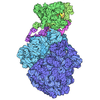
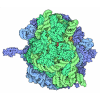
E.coli 50S ribosomal subunit bound to compound 48a
Map data
Sample
Complex: 50S ribosomal subunit
RNA: x 2 types
Protein or peptide: x 29 types
Ligand: x 5 types
Keywords
50S subunit / antibiotic / RIBOSOME
Function / homology
Function and homology information
transcriptional attenuation / endoribonuclease inhibitor activity / positive regulation of ribosome biogenesis / RNA-binding transcription regulator activity / negative regulation of cytoplasmic translation / translation repressor activity / negative regulation of DNA-templated DNA replication initiation / cytosolic ribosome assembly / ribosome assembly / assembly of large subunit precursor of preribosome ...transcriptional attenuation / endoribonuclease inhibitor activity / positive regulation of ribosome biogenesis / RNA-binding transcription regulator activity / negative regulation of cytoplasmic translation / translation repressor activity / negative regulation of DNA-templated DNA replication initiation / cytosolic ribosome assembly / ribosome assembly / assembly of large subunit precursor of preribosome / regulation of cell growth / DNA-templated transcription termination / response to radiation / mRNA 5'-UTR binding / transferase activity / large ribosomal subunit / ribosome binding / 5S rRNA binding / ribosomal large subunit assembly / large ribosomal subunit rRNA binding / cytosolic large ribosomal subunit / tRNA binding / cytoplasmic translation / negative regulation of translation / rRNA binding / ribosome / translation / structural constituent of ribosome / ribonucleoprotein complex / response to antibiotic / negative regulation of DNA-templated transcription / mRNA binding / DNA binding / RNA binding / zinc ion binding / cytosol / cytoplasm Similarity search - Function
Ribosomal protein L11, bacterial-type / Ribosomal protein L25, short-form / Ribosomal protein L11, conserved site / Ribosomal protein L11 signature. / Ribosomal protein L9 signature. / Ribosomal protein L16 signature 1. / Ribosomal protein L21, conserved site / Ribosomal protein L21 signature. / Ribosomal protein L9, bacteria/chloroplast / Ribosomal protein L6, conserved site ...Ribosomal protein L11, bacterial-type / Ribosomal protein L25, short-form / Ribosomal protein L11, conserved site / Ribosomal protein L11 signature. / Ribosomal protein L9 signature. / Ribosomal protein L16 signature 1. / Ribosomal protein L21, conserved site / Ribosomal protein L21 signature. / Ribosomal protein L9, bacteria/chloroplast / Ribosomal protein L6, conserved site / Ribosomal protein L9, C-terminal / Ribosomal protein L9, C-terminal domain / Ribosomal protein L6 signature 1. / Ribosomal protein L9, C-terminal domain superfamily / : / Ribosomal protein L11, N-terminal / Ribosomal protein L11, N-terminal domain / Ribosomal protein L11/L12 / Ribosomal protein L11, C-terminal / Ribosomal protein L11, C-terminal domain superfamily / Ribosomal protein L11/L12, N-terminal domain superfamily / Ribosomal protein L11/L12 / Ribosomal protein L11, RNA binding domain / Ribosomal protein L16 signature 2. / Ribosomal protein L16, conserved site / Ribosomal protein L17 signature. / Ribosomal L25p family / Ribosomal protein L25 / Ribosomal protein L36 signature. / Ribosomal protein L25/Gln-tRNA synthetase, N-terminal / Ribosomal protein L25/Gln-tRNA synthetase, anti-codon-binding domain superfamily / : / Ribosomal protein L33, conserved site / Ribosomal protein L33 signature. / Ribosomal protein L28/L24 superfamily / Ribosomal protein L32p, bacterial type / Ribosomal protein L35, conserved site / Ribosomal protein L35 signature. / Ribosomal protein L9 / Ribosomal protein L9, N-terminal domain superfamily / Ribosomal protein L9, N-terminal / Ribosomal protein L9, N-terminal domain / Ribosomal protein L28 / Ribosomal protein L35, non-mitochondrial / Ribosomal protein L18, bacterial-type / : / Ribosomal protein L6, bacterial-type / Ribosomal protein L9/RNase H1, N-terminal / Ribosomal protein L5, bacterial-type / Ribosomal protein L19, conserved site / Ribosomal protein L19 signature. / : / Ribosomal protein L20 signature. / Ribosomal protein L36 / Ribosomal protein L36 superfamily / Ribosomal protein L36 / Ribosomal protein L34, conserved site / Ribosomal protein L34 signature. / Ribosomal protein L14P, bacterial-type / Ribosomal protein L27, conserved site / Ribosomal protein L27 signature. / Ribosomal protein L22, bacterial/chloroplast-type / Ribosomal protein L35 / Ribosomal protein L35 superfamily / Ribosomal protein L35 / Ribosomal protein L33 / Ribosomal protein L2, bacterial/organellar-type / Ribosomal protein L18 / Ribosomal L18 of archaea, bacteria, mitoch. and chloroplast / Ribosomal protein L33 / Ribosomal L28 family / Ribosomal protein L33 superfamily / Ribosomal protein L28/L24 / Ribosomal protein L30, bacterial-type / L28p-like / Ribosomal protein L16 / Ribosomal protein L20 / Ribosomal protein L20 / Ribosomal protein L20, C-terminal / Ribosomal protein L19 / Ribosomal protein L19 / Ribosomal protein L19 superfamily / : / Large ribosomal subunit protein uL24, C-terminal domain / Ribosomal protein L17 / Ribosomal protein L17 superfamily / Ribosomal protein L17 / Ribosomal protein L27 / Ribosomal L27 protein / Ribosomal protein L34 / Ribosomal protein L34 / Ribosomal protein L24 / Ribosomal L32p protein family / Ribosomal protein L21 / Ribosomal protein L32p / Ribosomal protein L21-like / L21-like superfamily / Ribosomal prokaryotic L21 protein / Ribosomal protein L3, bacterial/organelle-type / Ribosomal protein L15, bacterial-type Similarity search - Domain/homology
Large ribosomal subunit protein bL28 / Large ribosomal subunit protein bL36 / Large ribosomal subunit protein bL32 / Large ribosomal subunit protein uL11 / Large ribosomal subunit protein bL20 / Large ribosomal subunit protein bL34 / Large ribosomal subunit protein uL23 / Large ribosomal subunit protein uL24 / Large ribosomal subunit protein bL21 / Large ribosomal subunit protein uL15 ...Large ribosomal subunit protein bL28 / Large ribosomal subunit protein bL36 / Large ribosomal subunit protein bL32 / Large ribosomal subunit protein uL11 / Large ribosomal subunit protein bL20 / Large ribosomal subunit protein bL34 / Large ribosomal subunit protein uL23 / Large ribosomal subunit protein uL24 / Large ribosomal subunit protein bL21 / Large ribosomal subunit protein uL15 / Large ribosomal subunit protein bL19 / Large ribosomal subunit protein bL27 / Large ribosomal subunit protein uL29 / Large ribosomal subunit protein bL33 / Large ribosomal subunit protein bL35 / Large ribosomal subunit protein bL9 / Large ribosomal subunit protein uL13 / Large ribosomal subunit protein uL14 / Large ribosomal subunit protein uL16 / Large ribosomal subunit protein bL17 / Large ribosomal subunit protein uL30 / Large ribosomal subunit protein uL6 / Large ribosomal subunit protein uL18 / Large ribosomal subunit protein uL2 / Large ribosomal subunit protein uL3 / Large ribosomal subunit protein uL4 / Large ribosomal subunit protein uL22 / Large ribosomal subunit protein uL5 / Large ribosomal subunit protein bL25 Similarity search - Component
Biological species
Escherichia coli (E. coli)
Method
single particle reconstruction / cryo EM / Resolution: 2.49 Å
National Institutes of Health/National Institute of General Medical Sciences (NIH/NIGMS)
GM145238
United States
National Institutes of Health/National Institute of General Medical Sciences (NIH/NIGMS)
GM148184
United States
Citation
Journal: Eur J Med Chem / Year: 2026 Title: Structure-based design and synthesis of group A streptogramins that bind to the nascent peptide exit tunnel of the ribosome. Authors: Isabel J Lee / Qi Li / Tushar Raskar / Jenna Pellegrino / Andrew K Ecker / Sara Y Howard / James S Fraser / Ian B Seiple / Abstract: Natural products and their derivatives have long served as powerful tools for treating bacterial infections, but the rise of antibiotic resistance threatens their continued effectiveness. Targeted ...Natural products and their derivatives have long served as powerful tools for treating bacterial infections, but the rise of antibiotic resistance threatens their continued effectiveness. Targeted structural modification of existing classes of antibiotics is an effective strategy to overcome resistance and extend clinical utility. The development of group A streptogramins that overcome acetyltransferase resistance, a pervasive resistance mechanism to the class, is an example of successful implementation of this strategy. However, the synthetic chemistry to reach these new analogs was limited in its ability to access modifications at the C4 position on the scaffold, a promising modification site that produced the most potent streptogramin to date. Here, we report the development of a modified route to group A streptogramins that enables access to a broad diversity of functionality at C4. Using cryo-EM data to guide structural modifications, we synthesize several series of C4-modified group A streptogramins with sidechains designed to make binding contacts with the exit tunnel of the ribosome. We identify multiple analogs that are active against multidrug-resistant bacteria, including strains that are resistant to macrolides, β-lactams, vancomycin, and first-generation streptogramins. We structurally characterize the binding of two analogs to the bacterial ribosome, revealing new π-stacking interactions between the C4 sidechain and the non-canonical U1782-U2586 base pair. These findings demonstrate how structure-guided drug design can drive the development of next-generation antibiotics and increase the therapeutic potential of the streptogramin class.
In the structure databanks used in Yorodumi, some data are registered as the other names, "COVID-19 virus" and "2019-nCoV". Here are the details of the virus and the list of structure data.
Jan 31, 2019. EMDB accession codes are about to change! (news from PDBe EMDB page)
EMDB accession codes are about to change! (news from PDBe EMDB page)
The allocation of 4 digits for EMDB accession codes will soon come to an end. Whilst these codes will remain in use, new EMDB accession codes will include an additional digit and will expand incrementally as the available range of codes is exhausted. The current 4-digit format prefixed with “EMD-” (i.e. EMD-XXXX) will advance to a 5-digit format (i.e. EMD-XXXXX), and so on. It is currently estimated that the 4-digit codes will be depleted around Spring 2019, at which point the 5-digit format will come into force.
The EM Navigator/Yorodumi systems omit the EMD- prefix.
Related info.:Q: What is EMD? / ID/Accession-code notation in Yorodumi/EM Navigator
Yorodumi is a browser for structure data from EMDB, PDB, SASBDB, etc.
This page is also the successor to EM Navigator detail page, and also detail information page/front-end page for Omokage search.
The word "yorodu" (or yorozu) is an old Japanese word meaning "ten thousand". "mi" (miru) is to see.
Related info.:EMDB / PDB / SASBDB / Comparison of 3 databanks / Yorodumi Search / Aug 31, 2016. New EM Navigator & Yorodumi / Yorodumi Papers / Jmol/JSmol / Function and homology information / Changes in new EM Navigator and Yorodumi
 Movie
Movie Controller


 Open data
 Basic information
 Map data
 Sample
 Keywords
 Function and homology information
 Escherichia coli (E. coli)
 Authors
 United States, 2 items
  Citation
 Structure visualization
 Downloads & links
 emd_75389.png
 https://data.pdbj.org/pub/emdb/structures/EMD-75389
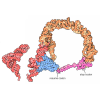
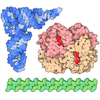
 Z (Sec.)
 Y (Row.)
 X (Col.)


 Sample components
 Processing
 Electron microscopy
 FIELD EMISSION GUN