[English] 日本語
Yorodumi
- EMDB-75232: Cryo-EM structure of a chemically treated Cyanobacterial Photosys... -

+
Open data


ID or keywords:

Loading...

-
Basic information

Entry
Database: EMDB / ID: EMD-75232
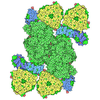
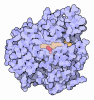
TitleCryo-EM structure of a chemically treated Cyanobacterial Photosystem I core with bound platinum nanoparticles
Map dataCryo-EM structure of a Urea-treated Mesophillic Cyanobacterial PSI-core Complexed with Platinum Nanoparticles.
Sample
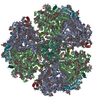
  • Complex: Chemically treated cyanobacterial photosystem I core with bound platinum nanoparticles.
    • Protein or peptide: x 7 types
  • Ligand: x 7 types
KeywordsPhotosystem / Platinum / Nanoparticles / Biohybrid / PHOTOSYNTHESIS
Function / homology
Function and homology information


photosystem I reaction center / photosystem I / photosystem I / plasma membrane-derived thylakoid membrane / chlorophyll binding / photosynthesis / 4 iron, 4 sulfur cluster binding / electron transfer activity / oxidoreductase activity / magnesium ion binding
Similarity search - Function
Photosystem I reaction center subunit PsaK / Photosystem I reaction centre subunit PsaK / Photosystem I reaction centre subunit PsaK superfamily / Photosystem I PsaM, reaction centre superfamily / Photosystem I PsaM, reaction centre / Photosystem I protein M (PsaM) / Photosystem I psaG and psaK proteins signature. / Photosystem I reaction center subunit V/PsaK / Photosystem I psaG / psaK / Photosystem I reaction centre subunit VIII ...Photosystem I reaction center subunit PsaK / Photosystem I reaction centre subunit PsaK / Photosystem I reaction centre subunit PsaK superfamily / Photosystem I PsaM, reaction centre superfamily / Photosystem I PsaM, reaction centre / Photosystem I protein M (PsaM) / Photosystem I psaG and psaK proteins signature. / Photosystem I reaction center subunit V/PsaK / Photosystem I psaG / psaK / Photosystem I reaction centre subunit VIII / Photosystem I reaction centre subunit VIII / Photosystem I reaction centre subunit VIII superfamily / Photosystem I PsaF, reaction centre subunit III / Photosystem I PsaF, reaction centre subunit III superfamily / Photosystem I reaction centre subunit III / Photosystem I PsaJ, reaction centre subunit IX superfamily / Photosystem I PsaJ, reaction centre subunit IX / Photosystem I reaction centre subunit IX / PsaJ / Photosystem I PsaA / Photosystem I PsaB / Photosystem I PsaA/PsaB, conserved site / Photosystem I psaA and psaB proteins signature. / Photosystem I PsaA/PsaB / Photosystem I PsaA/PsaB superfamily / Photosystem I psaA/psaB protein
Similarity search - Domain/homology
Photosystem I reaction center subunit PsaK / Photosystem I reaction center subunit VIII / Photosystem I reaction center subunit III / Photosystem I reaction center subunit XII / Photosystem I P700 chlorophyll a apoprotein A2 / Photosystem I P700 chlorophyll a apoprotein A1 / Photosystem I reaction center subunit IX
Similarity search - Component
Biological speciesSynechococcus elongatus PCC 6301 (bacteria)
Methodsingle particle reconstruction / cryo EM / Resolution: 3.57 Å
AuthorsEmerson MD / Gisriel CJ
Funding support United States, 1 items
OrganizationGrant numberCountry
Department of Energy (DOE, United States) United States
CitationJournal: bioRxiv / Year: 2026
Title: Molecular design principles for Photosystem I-based biohybrid solar fuel catalysts.
Authors: Maximino D Emerson / Siva Naga Sai Damaraju / Audrey H Short / Zachary B Alvord / Zsolt A Palmer / Himanshu S Mehra / Christian M Brininger / Josh V Vermaas / Lisa M Utschig / Christopher J Gisriel /
Abstract: Direct solar-to-chemical conversion offers a compelling route to clean, dispatchable energy. Photosystem I (PSI), an evolutionarily optimized light-driven oxidoreductase central to oxygenic ...Direct solar-to-chemical conversion offers a compelling route to clean, dispatchable energy. Photosystem I (PSI), an evolutionarily optimized light-driven oxidoreductase central to oxygenic photosynthesis, can be repurposed for direct solar-fuel production by efficiently coupling its photochemistry to catalysts, thereby storing sunlight as chemical energy in the H-H bond of H2. One promising architecture integrates PSI with Pt nanoparticle (PtNP) catalysts to create photocatalytic PSI-PtNP biohybrids. Advancing these systems requires molecular-level insight into protein-nanoparticle interactions and the bio-nano electron transfer pathways that govern activity; however, progress has been constrained by limited structural data to guide rational design. Here, we present two molecular structures of active PSI-PtNP assemblies that (a) compare thermophilic and mesophilic PSI scaffolds and (b) probe how removal of the terminal [4Fe-4S] clusters and stromal subunits in PSI reshapes protein-nanoparticle interfaces and photocatalysis. Structural analyses and molecular dynamics simulations define the interface topology, electrostatics, and cofactor-to-nanoparticle distances, revealing key molecular features that control biohybrid formation and electron transfer efficiency. These data establish mechanistic links between scaffold composition, bio-nano interface geometry, and catalytic performance, yielding design principles for optimizing PSI-PtNP architectures. The resulting structure-function insights provide a blueprint for engineering PSI-based solar-fuels systems and, more broadly, inform the design of protein-nanomaterial interfaces for light-driven catalysis.
History
DepositionJan 23, 2026-
Header (metadata) releaseSep 2, 2026-
Map releaseSep 2, 2026-
UpdateSep 2, 2026-
Current statusSep 2, 2026Processing site: RCSB / Status: Released

-
Structure visualization

Supplemental images

Downloads & links

-
Map

FileDownload / File: emd_75232.map.gz / Format: CCP4 / Size: 64 MB / Type: IMAGE STORED AS FLOATING POINT NUMBER (4 BYTES)
AnnotationCryo-EM structure of a Urea-treated Mesophillic Cyanobacterial PSI-core Complexed with Platinum Nanoparticles.
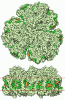
Projections & slices

Image control

Size
Brightness
Contrast
Others
AxesZ (Sec.)Y (Row.)X (Col.)
1.06 Å/pix.
x 256 pix.
= 272.384 Å
1.06 Å/pix.
x 256 pix.
= 272.384 Å
1.06 Å/pix.
x 256 pix.
= 272.384 Å

Surface

Projections

Slices (1/3)

Slices (1/2)

Slices (2/3)

Images are generated by Spider.

Voxel sizeX=Y=Z: 1.064 Å
Density
Contour LevelBy AUTHOR: 0.164
Minimum - Maximum-0.20080946 - 0.61231875
Average (Standard dev.)0.0069168527 (±0.034978516)
SymmetrySpace group: 1
Details

EMDB XML:

Map geometry
Axis orderXYZ
Origin000
Dimensions256256256
Spacing256256256
CellA=B=C: 272.384 Å
α=β=γ: 90.0 °

-
Supplemental data

-
Half map: Half B of a Cryo-EM structure of a...

Fileemd_75232_half_map_1.map
AnnotationHalf B of a Cryo-EM structure of a Urea-treated Mesophillic Cyanobacterial PSI-core Complexed with Platinum Nanoparticles.
Projections & Slices
AxesZYX

Projections

Slices (1/2)
Density Histograms

-
Half map: Half A of a Cryo-EM structure of a...

Fileemd_75232_half_map_2.map
AnnotationHalf A of a Cryo-EM structure of a Urea-treated Mesophillic Cyanobacterial PSI-core Complexed with Platinum Nanoparticles.
Projections & Slices
AxesZYX

Projections

Slices (1/2)
Density Histograms

-
Sample components

+
Entire : Chemically treated cyanobacterial photosystem I core with bound p...

EntireName: Chemically treated cyanobacterial photosystem I core with bound platinum nanoparticles.
Components
  • Complex: Chemically treated cyanobacterial photosystem I core with bound platinum nanoparticles.
    • Protein or peptide: Photosystem I reaction center subunit XII
    • Protein or peptide: Photosystem I P700 chlorophyll a apoprotein A1
    • Protein or peptide: Photosystem I P700 chlorophyll a apoprotein A2
    • Protein or peptide: Photosystem I reaction center subunit III
    • Protein or peptide: Photosystem I reaction center subunit VIII
    • Protein or peptide: Photosystem I reaction center subunit IX
    • Protein or peptide: Photosystem I reaction center subunit PsaK
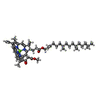
  • Ligand: CHLOROPHYLL A ISOMER
  • Ligand: CHLOROPHYLL A
  • Ligand: PHYLLOQUINONE
  • Ligand: IRON/SULFUR CLUSTER
  • Ligand: BETA-CAROTENE
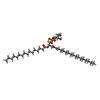
  • Ligand: 1,2-DIPALMITOYL-PHOSPHATIDYL-GLYCEROLE
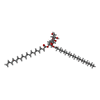
  • Ligand: 1,2-DISTEAROYL-MONOGALACTOSYL-DIGLYCERIDE

+
Supramolecule #1: Chemically treated cyanobacterial photosystem I core with bound p...

SupramoleculeName: Chemically treated cyanobacterial photosystem I core with bound platinum nanoparticles.
type: complex / ID: 1 / Parent: 0 / Macromolecule list: #7, #1-#6
Source (natural)Organism: Synechococcus elongatus PCC 6301 (bacteria)

+
Macromolecule #1: Photosystem I P700 chlorophyll a apoprotein A1

MacromoleculeName: Photosystem I P700 chlorophyll a apoprotein A1 / type: protein_or_peptide / ID: 1 / Number of copies: 1 / Enantiomer: LEVO / EC number: photosystem I
Source (natural)Organism: Synechococcus elongatus PCC 6301 (bacteria)
Molecular weightTheoretical: 83.994336 KDa
SequenceString: MTISPPEREA KVKATVDKNP VPTSFEKWGK PGHFDRTLAK GPKTTTWIWN LHANAHDFDS HTSDLEDISR KIFSAHFGHL AVIFIWLSG AYFHGARFSN FSGWLADPTH VKPSAQVVWP IFGQEILNGD VGGGFHGIQI TSGLFQLWRA SGYTNEFQLY V TAIGALVM ...String:
MTISPPEREA KVKATVDKNP VPTSFEKWGK PGHFDRTLAK GPKTTTWIWN LHANAHDFDS HTSDLEDISR KIFSAHFGHL AVIFIWLSG AYFHGARFSN FSGWLADPTH VKPSAQVVWP IFGQEILNGD VGGGFHGIQI TSGLFQLWRA SGYTNEFQLY V TAIGALVM AGLMLFAGWF HYHKAAPKLE WFQNVESMLN HHLAGLLGLG SLSWAGHQIH VSLPVNKLLD AIDAGEPLVL NG KTIASAA DIPLPHEFLD VSLISQLFPG FEAGVKAFFT LNWSAYADFL TFKGGLNPVT GGLWLTDTAH HHLAIAVLFI VAG HMYRTN WGIGHSLKEI LEAHKGPFTG QGHKGLYEIL TTSWHAQLSI NLAILGSISI IVAHHMYAMP PYPYLATDYP TMLS LFTHH IWIGGFLIVG AGAHAAIFMV RDYDPAKNVD NLLDRVLRHR DAIISHLNWV CIWLGFHSFG LYIHNDTMRA LGRPQ DMFS DSAIQLQPIF AQWIQNIHAL APGNTAPNAL ASVSQVFGGD VVAVGGKVAA APIVLGTADF MVHHIHAFTI HVTALI LLK GVLYARSSRL VPDKANLGFR FPCDGPGRGG TCQVSGWDHV FLGLFWMYNS LSIVIFHYSW KMQSDVWGSV LPDGSVA HI ANGNFAQSAL TINGWLRDFL WAQASQVITS YGSSTSAYGL LFLGAHFVWA FSLMFLFSGR GYWQELIESI VWAHNKLK V APAIQPRALS IIQGRAVGVA HYLLGGIVTT WSFFLARIIA VG

UniProtKB: Photosystem I P700 chlorophyll a apoprotein A1

+
Macromolecule #2: Photosystem I P700 chlorophyll a apoprotein A2

MacromoleculeName: Photosystem I P700 chlorophyll a apoprotein A2 / type: protein_or_peptide / ID: 2 / Number of copies: 1 / Enantiomer: LEVO / EC number: photosystem I
Source (natural)Organism: Synechococcus elongatus PCC 6301 (bacteria)
Molecular weightTheoretical: 81.554742 KDa
SequenceString: MATKFPKFSQ DLAQDPTTRR IWYGIATAHD FESHDGMTEE NLYQKIFASH FGHLAIIFLW VSGNLFHVAW QGNFEQWSQD PLHVRPIAH AIWDPHFGQG AIDAFTQAGA SSPVNVAYSG VYHWWYTIGM RTNGDLYQGS IFLLILSALF LFAGWLHLQP K FRPSLSWF ...String:
MATKFPKFSQ DLAQDPTTRR IWYGIATAHD FESHDGMTEE NLYQKIFASH FGHLAIIFLW VSGNLFHVAW QGNFEQWSQD PLHVRPIAH AIWDPHFGQG AIDAFTQAGA SSPVNVAYSG VYHWWYTIGM RTNGDLYQGS IFLLILSALF LFAGWLHLQP K FRPSLSWF KNAESRLNHH LAGLFGFSSL AWTGHLVHVA IPEARGQHVG WDNFLSTLPH PAGLAPFFTG NWSVYAENPD TA SHAFGTA EGAGTAILTF LGGFHPQTEA LWLTDIAHHH LAIAVIFIIA GHMYRTNFGI GHSIKEILEA HKPPAGGLGA GHK GLYETL NNSLHFQLAL ALASLGVVTS LVAQHMYSMP PYAFIAKDYT TMAALYTHHQ YIATFIMCGA FAHGAIFLIR DYDP EANKN NVLARVLEHK EAIISHLSWV SLFLGFHTLG LYVHNDVVVA FGTPEKQILI EPVFAQFVQA ASGKALYGFN VLLAN ADSA ATAASLGTYL PNWLDAINSG KTALFLPIGP GDFLVHHAIA LGLHTTTLIL VKGALDARGS KLMPDKKDFG YSFPCD GPG RGGTCDISAW DAFYLAVFWA LNTVGWVTFY WHWKNLTVWQ GNVAQFNESS TYLMGWLRDY LWLNSSQLIN GYNPFGT NN LSVWSWMFLF GHLIWATGFM FLISWRGYWQ ELIETIVWAH QRTPLANIVG WKDKPVALSI VQARVVGLAH FTVGYFLT Y AAFLIASTAG KFG

UniProtKB: Photosystem I P700 chlorophyll a apoprotein A2

+
Macromolecule #3: Photosystem I reaction center subunit III

MacromoleculeName: Photosystem I reaction center subunit III / type: protein_or_peptide / ID: 3 / Number of copies: 1 / Enantiomer: LEVO
Source (natural)Organism: Synechococcus elongatus PCC 6301 (bacteria)
Molecular weightTheoretical: 17.125742 KDa
SequenceString:
MRRLFAVVLA ACLWLGFAPQ ASADVAGLTP CSESPRFIQR AEAAATPQAK ARFENYSQAL CGADGLPHLI VDGRLDHAGD FIIPSLLFL YIAGWIGWVG RSYLQAIKSD KDAAGKEIVI DVPLAVKFSL TGFAWPLAAF QEFSSGKLLA KADEITVSPR

UniProtKB: Photosystem I reaction center subunit III

+
Macromolecule #4: Photosystem I reaction center subunit VIII

MacromoleculeName: Photosystem I reaction center subunit VIII / type: protein_or_peptide / ID: 4 / Number of copies: 1 / Enantiomer: LEVO
Source (natural)Organism: Synechococcus elongatus PCC 6301 (bacteria)
Molecular weightTheoretical: 4.002733 KDa
SequenceString:
MSGDFAAAFL PTIFVPLVGL GLPAVLMSLL FTYIESEA

UniProtKB: Photosystem I reaction center subunit VIII

+
Macromolecule #5: Photosystem I reaction center subunit IX

MacromoleculeName: Photosystem I reaction center subunit IX / type: protein_or_peptide / ID: 5 / Number of copies: 1 / Enantiomer: LEVO
Source (natural)Organism: Synechococcus elongatus PCC 6301 (bacteria)
Molecular weightTheoretical: 5.029017 KDa
SequenceString:
MLAMDGLKRY LSSAPILATI WFAITAGILI EFNRFFPDLL FHPL

UniProtKB: Photosystem I reaction center subunit IX

+
Macromolecule #6: Photosystem I reaction center subunit PsaK

MacromoleculeName: Photosystem I reaction center subunit PsaK / type: protein_or_peptide / ID: 6 / Number of copies: 1 / Enantiomer: LEVO
Source (natural)Organism: Synechococcus elongatus PCC 6301 (bacteria)
Molecular weightTheoretical: 8.181596 KDa
SequenceString:
MNPTTVEWNA NVAAIMITAN LFAIAIGYFA IRNRGVGPAL PVPLPAIFSG FGLPELLATA SFGHLLGAGF VLGLAQAGLL

UniProtKB: Photosystem I reaction center subunit PsaK

+
Macromolecule #7: Photosystem I reaction center subunit XII

MacromoleculeName: Photosystem I reaction center subunit XII / type: protein_or_peptide / ID: 7 / Number of copies: 1 / Enantiomer: LEVO
Source (natural)Organism: Synechococcus elongatus PCC 6301 (bacteria)
Molecular weightTheoretical: 3.239867 KDa
SequenceString:
MTDTQVFVAL LLALVPAVLA YRLGTELYR

UniProtKB: Photosystem I reaction center subunit XII

+
Macromolecule #8: CHLOROPHYLL A ISOMER

MacromoleculeName: CHLOROPHYLL A ISOMER / type: ligand / ID: 8 / Number of copies: 1 / Formula: CL0
Molecular weightTheoretical: 893.489 Da
Chemical component information

ChemComp-CL0:
CHLOROPHYLL A ISOMER

+
Macromolecule #9: CHLOROPHYLL A

MacromoleculeName: CHLOROPHYLL A / type: ligand / ID: 9 / Number of copies: 85 / Formula: CLA
Molecular weightTheoretical: 893.489 Da
Chemical component information

ChemComp-CLA:
CHLOROPHYLL A

+
Macromolecule #10: PHYLLOQUINONE

MacromoleculeName: PHYLLOQUINONE / type: ligand / ID: 10 / Number of copies: 2 / Formula: PQN
Molecular weightTheoretical: 450.696 Da
Chemical component information

ChemComp-PQN:
PHYLLOQUINONE

+
Macromolecule #11: IRON/SULFUR CLUSTER

MacromoleculeName: IRON/SULFUR CLUSTER / type: ligand / ID: 11 / Number of copies: 1 / Formula: SF4
Molecular weightTheoretical: 351.64 Da
Chemical component information

ChemComp-FS1:
IRON/SULFUR CLUSTER

+
Macromolecule #12: BETA-CAROTENE

MacromoleculeName: BETA-CAROTENE / type: ligand / ID: 12 / Number of copies: 13 / Formula: BCR
Molecular weightTheoretical: 536.873 Da
Chemical component information

ChemComp-BCR:
BETA-CAROTENE

+
Macromolecule #13: 1,2-DIPALMITOYL-PHOSPHATIDYL-GLYCEROLE

MacromoleculeName: 1,2-DIPALMITOYL-PHOSPHATIDYL-GLYCEROLE / type: ligand / ID: 13 / Number of copies: 2 / Formula: LHG
Molecular weightTheoretical: 722.97 Da
Chemical component information

ChemComp-LHG:
1,2-DIPALMITOYL-PHOSPHATIDYL-GLYCEROLE / phospholipid*YM

+
Macromolecule #14: 1,2-DISTEAROYL-MONOGALACTOSYL-DIGLYCERIDE

MacromoleculeName: 1,2-DISTEAROYL-MONOGALACTOSYL-DIGLYCERIDE / type: ligand / ID: 14 / Number of copies: 1 / Formula: LMG
Molecular weightTheoretical: 787.158 Da
Chemical component information

ChemComp-LMG:
1,2-DISTEAROYL-MONOGALACTOSYL-DIGLYCERIDE

-
Experimental details

-
Structure determination

Methodcryo EM
Processingsingle particle reconstruction
Aggregation stateparticle

-
Sample preparation

BufferpH: 7.4
VitrificationCryogen name: ETHANE

-
Electron microscopy

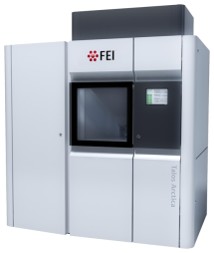
MicroscopeFEI TALOS ARCTICA
Image recordingFilm or detector model: GATAN K3 (6k x 4k) / Average electron dose: 1.0 e/Å2
Electron beamAcceleration voltage: 200 kV / Electron source: FIELD EMISSION GUN
Electron opticsIllumination mode: FLOOD BEAM / Imaging mode: BRIGHT FIELD / Nominal defocus max: 2.2 µm / Nominal defocus min: 0.8 µm
Experimental equipment
Model: Talos Arctica / Image courtesy: FEI Company

+
Image processing

CTF correctionType: PHASE FLIPPING AND AMPLITUDE CORRECTION
Startup modelType of model: PDB ENTRY
PDB model - PDB ID:
Final reconstructionResolution.type: BY AUTHOR / Resolution: 3.57 Å / Resolution method: FSC 0.143 CUT-OFF / Software - Name: cryoSPARC / Number images used: 53098
Initial angle assignmentType: MAXIMUM LIKELIHOOD
Final angle assignmentType: MAXIMUM LIKELIHOOD
FSC plot (resolution estimation)

+
About Yorodumi

-
News

-
Feb 9, 2022. New format data for meta-information of EMDB entries

New format data for meta-information of EMDB entries

  • Version 3 of the EMDB header file is now the official format.
  • The previous official version 1.9 will be removed from the archive.

Related info.:EMDB header

External links:wwPDB to switch to version 3 of the EMDB data model

-
Aug 12, 2020. Covid-19 info

Covid-19 info

URL: https://pdbj.org/emnavi/covid19.php

New page: Covid-19 featured information page in EM Navigator.

Related info.:Covid-19 info / Mar 5, 2020. Novel coronavirus structure data

+
Mar 5, 2020. Novel coronavirus structure data

Novel coronavirus structure data

Related info.:Yorodumi Speices / Aug 12, 2020. Covid-19 info

External links:COVID-19 featured content - PDBj / Molecule of the Month (242):Coronavirus Proteases

+
Jan 31, 2019. EMDB accession codes are about to change! (news from PDBe EMDB page)

EMDB accession codes are about to change! (news from PDBe EMDB page)

  • The allocation of 4 digits for EMDB accession codes will soon come to an end. Whilst these codes will remain in use, new EMDB accession codes will include an additional digit and will expand incrementally as the available range of codes is exhausted. The current 4-digit format prefixed with “EMD-” (i.e. EMD-XXXX) will advance to a 5-digit format (i.e. EMD-XXXXX), and so on. It is currently estimated that the 4-digit codes will be depleted around Spring 2019, at which point the 5-digit format will come into force.
  • The EM Navigator/Yorodumi systems omit the EMD- prefix.

Related info.:Q: What is EMD? / ID/Accession-code notation in Yorodumi/EM Navigator

External links:EMDB Accession Codes are Changing Soon! / Contact to PDBj

+
Jul 12, 2017. Major update of PDB

Major update of PDB

  • wwPDB released updated PDB data conforming to the new PDBx/mmCIF dictionary.
  • This is a major update changing the version number from 4 to 5, and with Remediation, in which all the entries are updated.
  • In this update, many items about electron microscopy experimental information are reorganized (e.g. em_software).
  • Now, EM Navigator and Yorodumi are based on the updated data.

External links:wwPDB Remediation / Enriched Model Files Conforming to OneDep Data Standards Now Available in the PDB FTP Archive

-
Yorodumi

Thousand views of thousand structures

  • Yorodumi is a browser for structure data from EMDB, PDB, SASBDB, etc.
  • This page is also the successor to EM Navigator detail page, and also detail information page/front-end page for Omokage search.
  • The word "yorodu" (or yorozu) is an old Japanese word meaning "ten thousand". "mi" (miru) is to see.

Related info.:EMDB / PDB / SASBDB / Comparison of 3 databanks / Yorodumi Search / Aug 31, 2016. New EM Navigator & Yorodumi / Yorodumi Papers / Jmol/JSmol / Function and homology information / Changes in new EM Navigator and Yorodumi

Read more