[English] 日本語
Yorodumi
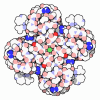
- EMDB-75024: Cryo-EM structure of the human BK channel bound to the agonist NS1619 -

+
Open data


ID or keywords:

Loading...

-
Basic information

Entry
Database: EMDB / ID: EMD-75024
TitleCryo-EM structure of the human BK channel bound to the agonist NS1619
Map data
Sample
  • Complex: hBK NS1619 complex
    • Protein or peptide: Isoform 5 of Calcium-activated potassium channel subunit alpha-1
  • Ligand: MAGNESIUM ION
  • Ligand: CALCIUM ION
  • Ligand: 3-[2-oxidanyl-5-(trifluoromethyl)phenyl]-6-(trifluoromethyl)-1~{H}-benzimidazol-2-one
KeywordsBK / Slo1 / MEMBRANE PROTEIN
Function / homology
Function and homology information


micturition / Acetylcholine inhibits contraction of outer hair cells / large conductance calcium-activated potassium channel activity / Ca2+ activated K+ channels / calcium-activated potassium channel activity / negative regulation of cell volume / smooth muscle contraction involved in micturition / response to carbon monoxide / response to osmotic stress / Sensory processing of sound by inner hair cells of the cochlea ...micturition / Acetylcholine inhibits contraction of outer hair cells / large conductance calcium-activated potassium channel activity / Ca2+ activated K+ channels / calcium-activated potassium channel activity / negative regulation of cell volume / smooth muscle contraction involved in micturition / response to carbon monoxide / response to osmotic stress / Sensory processing of sound by inner hair cells of the cochlea / cGMP effects / intracellular potassium ion homeostasis / voltage-gated potassium channel activity / voltage-gated potassium channel complex / potassium ion transmembrane transport / potassium ion transport / regulation of membrane potential / response to calcium ion / caveola / vasodilation / actin binding / response to hypoxia / postsynaptic membrane / apical plasma membrane / positive regulation of apoptotic process / membrane / metal ion binding / identical protein binding / plasma membrane
Similarity search - Function
: / Ca2+-activated K+ channel Slowpoke, TrkA_C like domain / Calcium-activated potassium channel BK, alpha subunit / : / Calcium-activated BK potassium channel alpha subunit / Calcium-activated potassium channel slowpoke-like RCK domain / Regulator of K+ conductance, N-terminal / RCK N-terminal domain profile. / Ion transport domain / Ion transport protein / NAD(P)-binding domain superfamily
Similarity search - Domain/homology
Calcium-activated potassium channel subunit alpha-1
Similarity search - Component
Biological speciesHomo sapiens (human)
Methodsingle particle reconstruction / cryo EM / Resolution: 3.44 Å
AuthorsGonzalez-Sanabria N / Contreras GF / Perozo E / Latorre R
Funding support United States, Chile, 4 items
OrganizationGrant numberCountry
National Science Foundation (NSF, United States)1230265 United States
National Institutes of Health/National Institute of General Medical Sciences (NIH/NIGMS)R01GM150272 United States
National Institutes of Health/National Institute of General Medical Sciences (NIH/NIGMS)R01GM030376 United States
Agencia Nacional de Investigación y Desarrollo (ANID)21200592 Chile
CitationJournal: Proc Natl Acad Sci U S A / Year: 2026
Title: The BK channel-NS1619 agonist complex reveals molecular insights into allosteric activation gating.
Authors: Naileth Gonzalez-Sanabria / Gustavo F Contreras / Maximiliano Rojas / Yorley Duarte / Fernando D Gonzalez-Nilo / Eduardo Perozo / Ramon Latorre /
Abstract: BK channels play essential roles in a wealth of physiological functions, including regulating smooth muscle tone and neurotransmitter release. Its dysfunction, often caused by loss-of-function ...BK channels play essential roles in a wealth of physiological functions, including regulating smooth muscle tone and neurotransmitter release. Its dysfunction, often caused by loss-of-function mutations, can lead to severe phenotypes, including ataxia and sensory impairment. Despite the therapeutic potential of BK channel agonists, the molecular mechanisms by which they stabilize the pore's open conformation remain unclear. Using cryoelectron microscopy and molecular dynamic simulations, we identified that NS1619, a synthetic benzimidazolone agonist, first described as a BK opener, binds within a pocket formed by the S6/RCK1 linker and the S4 transmembrane segment. Our simulations suggest that agonist binding promotes a twisting motion in the S6 segment, enabling critical interactions with residues K330, K331, and F223. These findings provide a molecular model for the mechanism of NS1619 and suggest that its binding site can accommodate other agonists, highlighting a promising target for therapeutic development.
History
DepositionJan 8, 2026-
Header (metadata) releaseFeb 4, 2026-
Map releaseFeb 4, 2026-
UpdateFeb 11, 2026-
Current statusFeb 11, 2026Processing site: RCSB / Status: Released

-
Structure visualization

Supplemental images

Downloads & links

-
Map

FileDownload / File: emd_75024.map.gz / Format: CCP4 / Size: 64 MB / Type: IMAGE STORED AS FLOATING POINT NUMBER (4 BYTES)
Projections & slices

Image control

Size
Brightness
Contrast
Others
AxesZ (Sec.)Y (Row.)X (Col.)
1.07 Å/pix.
x 256 pix.
= 273.408 Å
1.07 Å/pix.
x 256 pix.
= 273.408 Å
1.07 Å/pix.
x 256 pix.
= 273.408 Å

Surface

Projections

Slices (1/3)

Slices (1/2)

Slices (2/3)

Images are generated by Spider.

Voxel sizeX=Y=Z: 1.068 Å
Density
Contour LevelBy AUTHOR: 0.587
Minimum - Maximum-2.107316 - 3.4304926
Average (Standard dev.)0.03887804 (±0.12816292)
SymmetrySpace group: 1
Details

EMDB XML:

Map geometry
Axis orderXYZ
Origin000
Dimensions256256256
Spacing256256256
CellA=B=C: 273.408 Å
α=β=γ: 90.0 °

-
Supplemental data

-
Half map: #2

Fileemd_75024_half_map_1.map
Projections & Slices
AxesZYX

Projections

Slices (1/2)
Density Histograms

-
Half map: #1

Fileemd_75024_half_map_2.map
Projections & Slices
AxesZYX

Projections

Slices (1/2)
Density Histograms

-
Sample components

-
Entire : hBK NS1619 complex

EntireName: hBK NS1619 complex
Components
  • Complex: hBK NS1619 complex
    • Protein or peptide: Isoform 5 of Calcium-activated potassium channel subunit alpha-1
  • Ligand: MAGNESIUM ION
  • Ligand: CALCIUM ION
  • Ligand: 3-[2-oxidanyl-5-(trifluoromethyl)phenyl]-6-(trifluoromethyl)-1~{H}-benzimidazol-2-one

-
Supramolecule #1: hBK NS1619 complex

SupramoleculeName: hBK NS1619 complex / type: complex / ID: 1 / Parent: 0 / Macromolecule list: #1
Details: Cryo-EM sample of the human BK (KCNMA1) channel in complex with the synthetic agonist NS1619
Source (natural)Organism: Homo sapiens (human)

-
Macromolecule #1: Isoform 5 of Calcium-activated potassium channel subunit alpha-1

MacromoleculeName: Isoform 5 of Calcium-activated potassium channel subunit alpha-1
type: protein_or_peptide / ID: 1 / Number of copies: 4 / Enantiomer: LEVO
Source (natural)Organism: Homo sapiens (human)
Molecular weightTheoretical: 125.343727 KDa
Recombinant expressionOrganism: Homo sapiens (human)
SequenceString: MDALIIPVTM EVPCDSRGQR MWWAFLASSM VTFFGGLFII LLWRTLKYLW TVCCHCGGKT KEAQKINNGS SQADGTLKPV DEKEEAVAA EVGWMTSVKD WAGVMISAQT LTGRVLVVLV FALSIGALVI YFIDSSNPIE SCQNFYKDFT LQIDMAFNVF F LLYFGLRF ...String:
MDALIIPVTM EVPCDSRGQR MWWAFLASSM VTFFGGLFII LLWRTLKYLW TVCCHCGGKT KEAQKINNGS SQADGTLKPV DEKEEAVAA EVGWMTSVKD WAGVMISAQT LTGRVLVVLV FALSIGALVI YFIDSSNPIE SCQNFYKDFT LQIDMAFNVF F LLYFGLRF IAANDKLWFW LEVNSVVDFF TVPPVFVSVY LNRSWLGLRF LRALRLIQFS EILQFLNILK TSNSIKLVNL LS IFISTWL TAAGFIHLVE NSGDPWENFQ NNQALTYWEC VYLLMVTMST VGYGDVYAKT TLGRLFMVFF ILGGLAMFAS YVP EIIELI GNRKKYGGSY SAVSGRKHIV VCGHITLESV SNFLKDFLHK DRDDVNVEIV FLHNISPNLE LEALFKRHFT QVEF YQGSV LNPHDLARVK IESADACLIL ANKYCADPDA EDASNIMRVI SIKNYHPKIR IITQMLQYHN KAHLLNIPSW NWKEG DDAI CLAELKLGFI AQSCLAQGLS TMLANLFSMR SFIKIEEDTW QKYYLEGVSN EMYTEYLSSA FVGLSFPTVC ELCFVK LKL LMIAIEYKSA NRESRILINP GNHLKIQEGT LGFFIASDAK EVKRAFFYCK ACHDDITDPK RIKKCGCKRL EDEQPST LS PKKKQRNGGM RNSPNTSPKL MRHDPLLIPG NDQIDNMDSN VKKYDSTGMF HWCAPKEIEK VILTRSEAAM TVLSGHVV V CIFGDVSSAL IGLRNLVMPL RASNFHYHEL KHIVFVGSIE YLKREWETLH NFPKVSILPG TPLSRADLRA VNINLCDMC VILSANQNNI DDTSLQDKEC ILASLNIKSM QFDDSIGVLQ ANSQGFTPPG MDRSSPDNSP VHGMLRQPSI TTGVNIPIIT ELVNDTNVQ FLDQDDDDDP DTELYLTQPF ACGTAFAVSV LDSLMSATYF NDNILTLIRT LVTGGATPEL EALIAEENAL R GGYSTPQT LANRDRCRVA QLALLDGPFA DLGDGGCYGD LFCKALKTYN MLCFGIYRLR DAHLSTPSQC TKRYVITNPP YE FELVPTD LIFCLMQFDH NAGQSRASLS HSSHSSQSSS KKSSSVHSIP STANRQNRPK SRESRDKQKY VQEERL

UniProtKB: Calcium-activated potassium channel subunit alpha-1

-
Macromolecule #2: MAGNESIUM ION

MacromoleculeName: MAGNESIUM ION / type: ligand / ID: 2 / Number of copies: 4 / Formula: MG
Molecular weightTheoretical: 24.305 Da

-
Macromolecule #3: CALCIUM ION

MacromoleculeName: CALCIUM ION / type: ligand / ID: 3 / Number of copies: 8 / Formula: CA
Molecular weightTheoretical: 40.078 Da

-
Macromolecule #4: 3-[2-oxidanyl-5-(trifluoromethyl)phenyl]-6-(trifluoromethyl)-1~{H...

MacromoleculeName: 3-[2-oxidanyl-5-(trifluoromethyl)phenyl]-6-(trifluoromethyl)-1~{H}-benzimidazol-2-one
type: ligand / ID: 4 / Number of copies: 4 / Formula: A1E02
Molecular weightTheoretical: 362.227 Da

-
Experimental details

-
Structure determination

Methodcryo EM
Processingsingle particle reconstruction
Aggregation stateparticle

-
Sample preparation

Concentration3.5 mg/mL
BufferpH: 8
Component:
ConcentrationFormulaName
20.0 mMTris-HClTris-HCl
320.0 mMKClPotassium chloride
10.0 mMMgCl2Magnesium chloride
10.0 mMCaCl2Calcium chloride
2.0 mMTCEPTris(2-carboxyethyl)phosphine
GridModel: Quantifoil R1.2/1.3 / Material: COPPER / Mesh: 200
VitrificationCryogen name: ETHANE / Chamber humidity: 100 % / Chamber temperature: 295.15 K / Instrument: FEI VITROBOT MARK IV

-
Electron microscopy

MicroscopeTFS KRIOS
Image recordingFilm or detector model: GATAN K3 (6k x 4k) / Average electron dose: 1.0 e/Å2
Electron beamAcceleration voltage: 300 kV / Electron source: FIELD EMISSION GUN
Electron opticsIllumination mode: FLOOD BEAM / Imaging mode: BRIGHT FIELD / Cs: 2.7 mm / Nominal defocus max: 2.4 µm / Nominal defocus min: 0.8 µm
Sample stageSpecimen holder model: FEI TITAN KRIOS AUTOGRID HOLDER
Experimental equipment
Model: Titan Krios / Image courtesy: FEI Company

+
Image processing

CTF correctionSoftware - Name: cryoSPARC / Type: PHASE FLIPPING AND AMPLITUDE CORRECTION
Startup modelType of model: PDB ENTRY
PDB model - PDB ID:
Final reconstructionApplied symmetry - Point group: C4 (4 fold cyclic) / Resolution.type: BY AUTHOR / Resolution: 3.44 Å / Resolution method: FSC 0.143 CUT-OFF / Software - Name: Coot / Number images used: 90000
Initial angle assignmentType: PROJECTION MATCHING / Software - Name: cryoSPARC
Final angle assignmentType: PROJECTION MATCHING
FSC plot (resolution estimation)

-
Atomic model buiding 1

Initial modelPDB ID:

Chain - Source name: PDB / Chain - Initial model type: experimental model
Output model

PDB-10ad:
Cryo-EM structure of the human BK channel bound to the agonist NS1619

+
About Yorodumi

-
News

-
Feb 9, 2022. New format data for meta-information of EMDB entries

New format data for meta-information of EMDB entries

  • Version 3 of the EMDB header file is now the official format.
  • The previous official version 1.9 will be removed from the archive.

Related info.:EMDB header

External links:wwPDB to switch to version 3 of the EMDB data model

-
Aug 12, 2020. Covid-19 info

Covid-19 info

URL: https://pdbj.org/emnavi/covid19.php

New page: Covid-19 featured information page in EM Navigator.

Related info.:Covid-19 info / Mar 5, 2020. Novel coronavirus structure data

+
Mar 5, 2020. Novel coronavirus structure data

Novel coronavirus structure data

Related info.:Yorodumi Speices / Aug 12, 2020. Covid-19 info

External links:COVID-19 featured content - PDBj / Molecule of the Month (242):Coronavirus Proteases

+
Jan 31, 2019. EMDB accession codes are about to change! (news from PDBe EMDB page)

EMDB accession codes are about to change! (news from PDBe EMDB page)

  • The allocation of 4 digits for EMDB accession codes will soon come to an end. Whilst these codes will remain in use, new EMDB accession codes will include an additional digit and will expand incrementally as the available range of codes is exhausted. The current 4-digit format prefixed with “EMD-” (i.e. EMD-XXXX) will advance to a 5-digit format (i.e. EMD-XXXXX), and so on. It is currently estimated that the 4-digit codes will be depleted around Spring 2019, at which point the 5-digit format will come into force.
  • The EM Navigator/Yorodumi systems omit the EMD- prefix.

Related info.:Q: What is EMD? / ID/Accession-code notation in Yorodumi/EM Navigator

External links:EMDB Accession Codes are Changing Soon! / Contact to PDBj

+
Jul 12, 2017. Major update of PDB

Major update of PDB

  • wwPDB released updated PDB data conforming to the new PDBx/mmCIF dictionary.
  • This is a major update changing the version number from 4 to 5, and with Remediation, in which all the entries are updated.
  • In this update, many items about electron microscopy experimental information are reorganized (e.g. em_software).
  • Now, EM Navigator and Yorodumi are based on the updated data.

External links:wwPDB Remediation / Enriched Model Files Conforming to OneDep Data Standards Now Available in the PDB FTP Archive

-
Yorodumi

Thousand views of thousand structures

  • Yorodumi is a browser for structure data from EMDB, PDB, SASBDB, etc.
  • This page is also the successor to EM Navigator detail page, and also detail information page/front-end page for Omokage search.
  • The word "yorodu" (or yorozu) is an old Japanese word meaning "ten thousand". "mi" (miru) is to see.

Related info.:EMDB / PDB / SASBDB / Comparison of 3 databanks / Yorodumi Search / Aug 31, 2016. New EM Navigator & Yorodumi / Yorodumi Papers / Jmol/JSmol / Function and homology information / Changes in new EM Navigator and Yorodumi

Read more