 Movie
Movie Controller

[English] 日本語
 Yorodumi
- EMDB-73861: The structure of TMD with 2 TARPs and 2 CNIHs from all native AMP... -
+ Open data

- Basic information
| Entry |  | |||||||||
|---|---|---|---|---|---|---|---|---|---|---|
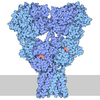
| Title | The structure of TMD with 2 TARPs and 2 CNIHs from all native AMPA receptor subtypes | |||||||||
 Map data Map data | ||||||||||
 Sample Sample |
| |||||||||
 Keywords Keywords | Ionotropic glutamate receptor AMPA receptor / MEMBRANE PROTEIN | |||||||||
| Function / homology |  Function and homology information Function and homology informationPhase 0 - rapid depolarisation / Phase 2 - plateau phase / Activation of AMPA receptors / LGI-ADAM interactions / Unblocking of NMDA receptors, glutamate binding and activation / Trafficking of GluR2-containing AMPA receptors / Trafficking of AMPA receptors / L-type voltage-gated calcium channel complex / positive regulation of AMPA receptor activity / postsynaptic neurotransmitter receptor diffusion trapping ...Phase 0 - rapid depolarisation / Phase 2 - plateau phase / Activation of AMPA receptors / LGI-ADAM interactions / Unblocking of NMDA receptors, glutamate binding and activation / Trafficking of GluR2-containing AMPA receptors / Trafficking of AMPA receptors / L-type voltage-gated calcium channel complex / positive regulation of AMPA receptor activity / postsynaptic neurotransmitter receptor diffusion trapping / protein phosphatase 2B binding / regulation of AMPA receptor activity / channel regulator activity / spine synapse / dendritic spine neck / dendritic spine cytoplasm / dendritic spine head / ligand-gated monoatomic cation channel activity / perisynaptic space / AMPA glutamate receptor activity / AMPA glutamate receptor clustering / transmission of nerve impulse / regulation of receptor recycling / kainate selective glutamate receptor activity / immunoglobulin binding / AMPA glutamate receptor complex / extracellularly glutamate-gated ion channel activity / cellular response to glycine / asymmetric synapse / glutamate receptor binding / positive regulation of synaptic transmission / conditioned place preference / regulation of postsynaptic membrane neurotransmitter receptor levels / voltage-gated calcium channel activity / regulation of synaptic transmission, glutamatergic / extracellular ligand-gated monoatomic ion channel activity / cytoskeletal protein binding / glutamate-gated receptor activity / cellular response to brain-derived neurotrophic factor stimulus / regulation of long-term synaptic depression / positive regulation of synaptic transmission, glutamatergic / glutamate-gated calcium ion channel activity / somatodendritic compartment / presynaptic active zone membrane / ionotropic glutamate receptor signaling pathway / ionotropic glutamate receptor binding / dendrite cytoplasm / dendrite membrane / excitatory synapse / ligand-gated monoatomic ion channel activity involved in regulation of presynaptic membrane potential / positive regulation of excitatory postsynaptic potential / dendritic shaft / SNARE binding / synaptic membrane / PDZ domain binding / calcium channel regulator activity / establishment of protein localization / protein tetramerization / synaptic transmission, glutamatergic / transmitter-gated monoatomic ion channel activity involved in regulation of postsynaptic membrane potential / receptor internalization / postsynaptic density membrane / modulation of chemical synaptic transmission / Schaffer collateral - CA1 synapse / terminal bouton / synaptic vesicle / synaptic vesicle membrane / amyloid-beta binding / presynapse / growth cone / signaling receptor activity / presynaptic membrane / scaffold protein binding / chemical synaptic transmission / dendritic spine / perikaryon / postsynaptic membrane / postsynaptic density / neuron projection / external side of plasma membrane / axon / neuronal cell body / synapse / dendrite / protein kinase binding / protein-containing complex binding / glutamatergic synapse / cell surface / endoplasmic reticulum / protein-containing complex / membrane / identical protein binding / plasma membrane Similarity search - Function | |||||||||
| Biological species |   Mus musculus (house mouse) Mus musculus (house mouse) | |||||||||
| Method | single particle reconstruction / cryo EM / Resolution: 2.87 Å | |||||||||
 Authors Authors | Park J / Gouaux E | |||||||||
| Funding support |  United States, 1 items United States, 1 items
| |||||||||
 Citation Citation | Journal: Protein Sci / Year: 2026 Title: Efficient and rapid isolation of native AMPA receptor complexes for cryo-EM. Authors: Jumi Park / Eric Gouaux / Abstract: Isolating native ion channels for structural characterization is routinely achieved by extraction from membrane fractions of tissue with prolonged mild detergent treatment. AMPA receptors (AMPARs), ...Isolating native ion channels for structural characterization is routinely achieved by extraction from membrane fractions of tissue with prolonged mild detergent treatment. AMPA receptors (AMPARs), glutamatergic receptors that mediate fast excitatory transmission and synaptic plasticity, are coassembled with diverse auxiliary subunits and transiently-interacting partners to finely regulate processes from trafficking to gating kinetics. Previous studies of the composition and architecture of native AMPARs (nAMPARs) isolated from membrane fractions of rodent brain tissue have revealed many different subunit compositions and non-stochastic assemblies of the auxiliary subunits. However, elucidating the molecular architectures of nAMPARs complexed with less populated or transiently bound proteins has proven challenging. Here, we employ strategies for the rapid solubilization and purification of nAMPARs to increase the likelihood of isolating the greatest range of nAMPARs complexes. By utilizing whole brain tissue and reducing solubilization and purification duration, we purify nAMPARs complexed with a wider variety of auxiliary subunits and binding partners in a sufficient quantity and purity for cryo-electron microscopy studies. We resolve previously unreported subunit compositions and conformations that include ones with a half-splayed ATD layer, as well as complexes with four distinct auxiliary subunit arrangements in the TMD layer. | |||||||||
| History |
|
- Structure visualization
| Supplemental images |
|---|

- Downloads & links
-EMDB archive
| Map data | emd_73861.map.gz | 256.6 MB | EMDB map data format | |
|---|---|---|---|---|
| Header (meta data) | emd-73861-v30.xmlemd-73861.xml | 21.5 KB 21.5 KB | Display Display | EMDB header |
| FSC (resolution estimation) | emd_73861_fsc.xml | 16.9 KB | Display | FSC data file |
| Images |  emd_73861.png emd_73861.png | 128.2 KB | ||
| Filedesc metadata | emd-73861.cif.gz | 6.3 KB | ||
| Others | emd_73861_half_map_1.map.gzemd_73861_half_map_2.map.gz | 475.2 MB 475.2 MB | ||
| Archive directory |  http://ftp.pdbj.org/pub/emdb/structures/EMD-73861ftp://ftp.pdbj.org/pub/emdb/structures/EMD-73861 http://ftp.pdbj.org/pub/emdb/structures/EMD-73861ftp://ftp.pdbj.org/pub/emdb/structures/EMD-73861 | HTTPS FTP |
-Related structure data
| Related structure data |  9z6uMC  9z6vC  9z6wC M: atomic model generated by this map C: citing same article ( |
|---|---|
| Similar structure data |


-Links
| EMDB pages | EMDB (EBI/PDBe) / EMDataResource |
|---|---|
| Related items in Molecule of the Month |
-Map
| File | Download / File: emd_73861.map.gz / Format: CCP4 / Size: 512 MB / Type: IMAGE STORED AS FLOATING POINT NUMBER (4 BYTES) | ||||||||||||||||||||||||||||||||||||
|---|---|---|---|---|---|---|---|---|---|---|---|---|---|---|---|---|---|---|---|---|---|---|---|---|---|---|---|---|---|---|---|---|---|---|---|---|---|
| Projections & slices | Image control
Images are generated by Spider. | ||||||||||||||||||||||||||||||||||||
| Voxel size | X=Y=Z: 0.839 Å | ||||||||||||||||||||||||||||||||||||
| Density |
| ||||||||||||||||||||||||||||||||||||
| Symmetry | Space group: 1 | ||||||||||||||||||||||||||||||||||||
| Details | EMDB XML:
|
 Z (Sec.)
 Y (Row.)
 X (Col.)


-Supplemental data
-Half map: #2
| File | emd_73861_half_map_1.map | ||||||||||||
|---|---|---|---|---|---|---|---|---|---|---|---|---|---|
| Projections & Slices |
| ||||||||||||
| Density Histograms |


-Half map: #1
| File | emd_73861_half_map_2.map | ||||||||||||
|---|---|---|---|---|---|---|---|---|---|---|---|---|---|
| Projections & Slices |
| ||||||||||||
| Density Histograms |


- Sample components
-Entire : Native AMPA receptors with 2 TARPs and 2 CNIHs
| Entire | Name: Native AMPA receptors with 2 TARPs and 2 CNIHs |
|---|---|
| Components |
|
-Supramolecule #1: Native AMPA receptors with 2 TARPs and 2 CNIHs
| Supramolecule | Name: Native AMPA receptors with 2 TARPs and 2 CNIHs / type: complex / ID: 1 / Parent: 0 / Macromolecule list: #1-#4 |
|---|---|
| Source (natural) | Organism: Mus musculus (house mouse) |
-Macromolecule #1: Mix of AMPAR subunit (GluA1, GluA2, GluA3 and GluA4)
| Macromolecule | Name: Mix of AMPAR subunit (GluA1, GluA2, GluA3 and GluA4) / type: protein_or_peptide / ID: 1 / Number of copies: 2 / Enantiomer: LEVO |
|---|---|
| Source (natural) | Organism: Mus musculus (house mouse) |
| Molecular weight | Theoretical: 29.723635 KDa |
| Sequence | String: KPGVFSFLDP LAYEIWMCIV FAYIGVSVVL FLVSRFS(UNK)(UNK)(UNK) (UNK)(UNK)(UNK)(UNK)(UNK) (UNK)(UNK)(UNK)(UNK) (UNK)(UNK)(UNK)(UNK)(UNK)(UNK)(UNK)(UNK)(UNK)N EFGIFNSLWF SLGA FMQQG CDISPRSLSG ...String: KPGVFSFLDP LAYEIWMCIV FAYIGVSVVL FLVSRFS(UNK)(UNK)(UNK) (UNK)(UNK)(UNK)(UNK)(UNK) (UNK)(UNK)(UNK)(UNK) (UNK)(UNK)(UNK)(UNK)(UNK)(UNK)(UNK)(UNK)(UNK)N EFGIFNSLWF SLGA FMQQG CDISPRSLSG RIVGGVWWFF TLIIISSYTA NLAAFLTVER MV(UNK)(UNK)(UNK)(UNK)(UNK)(UNK) (UNK) (UNK)(UNK)(UNK)(UNK)(UNK)(UNK)(UNK)(UNK)(UNK)(UNK) (UNK)(UNK)(UNK)(UNK)(UNK) (UNK)(UNK)(UNK)(UNK) (UNK)(UNK)(UNK)(UNK)(UNK)(UNK)(UNK)(UNK)(UNK)(UNK) (UNK)(UNK) (UNK)(UNK)(UNK)(UNK)(UNK)(UNK)(UNK) (UNK)(UNK)(UNK)(UNK)(UNK)(UNK)(UNK)(UNK)(UNK) (UNK)(UNK)(UNK)(UNK)(UNK)(UNK)(UNK)(UNK)(UNK)(UNK) (UNK)(UNK)(UNK)(UNK)(UNK)(UNK) (UNK)(UNK)(UNK) (UNK)(UNK)(UNK)(UNK)(UNK)(UNK)(UNK)(UNK)(UNK)(UNK) (UNK)(UNK)(UNK) (UNK)(UNK)(UNK)(UNK)(UNK)(UNK) (UNK)(UNK)(UNK)(UNK)(UNK)(UNK)(UNK)(UNK)(UNK)(UNK) (UNK)(UNK)(UNK)(UNK)(UNK)(UNK)(UNK)(UNK)(UNK) (UNK)(UNK)(UNK)(UNK)(UNK)(UNK)(UNK) (UNK)(UNK) (UNK)(UNK)(UNK)(UNK)(UNK)(UNK)(UNK)(UNK)(UNK)(UNK) (UNK)(UNK)(UNK)(UNK) (UNK)(UNK)(UNK)(UNK)(UNK) (UNK)(UNK)(UNK)(UNK)(UNK)(UNK)(UNK)(UNK)(UNK)(UNK) (UNK) (UNK)(UNK)(UNK)(UNK)SALS LSNVAGVFYI LAGGLGLAMA VALIEFCYKS RA |
-Macromolecule #2: Glutamate receptor 2
| Macromolecule | Name: Glutamate receptor 2 / type: protein_or_peptide / ID: 2 / Number of copies: 2 / Enantiomer: LEVO |
|---|---|
| Source (natural) | Organism: Mus musculus (house mouse) |
| Molecular weight | Theoretical: 29.83883 KDa |
| Sequence | String: KPGVFSFLDP LAYEIWMCIV FAYIGVSVVL FLVSRFS(UNK)(UNK)(UNK) (UNK)(UNK)(UNK)(UNK)(UNK) (UNK)(UNK)(UNK)(UNK) (UNK)(UNK)(UNK)(UNK)(UNK)(UNK)(UNK)(UNK)(UNK)N EFGIFNSLWF SLGA FMRQG CDISPRSLSG ...String: KPGVFSFLDP LAYEIWMCIV FAYIGVSVVL FLVSRFS(UNK)(UNK)(UNK) (UNK)(UNK)(UNK)(UNK)(UNK) (UNK)(UNK)(UNK)(UNK) (UNK)(UNK)(UNK)(UNK)(UNK)(UNK)(UNK)(UNK)(UNK)N EFGIFNSLWF SLGA FMRQG CDISPRSLSG RIVGGVWWFF TLIIISSYTA NLAAFLTVER MV(UNK)(UNK)(UNK)(UNK)(UNK)(UNK) (UNK) (UNK)(UNK)(UNK)(UNK)(UNK)(UNK)(UNK)(UNK)(UNK)(UNK) (UNK)(UNK)(UNK)(UNK)(UNK) (UNK)(UNK)(UNK)(UNK) (UNK)(UNK)(UNK)(UNK)(UNK)(UNK)(UNK)(UNK)(UNK)(UNK) (UNK)(UNK) (UNK)(UNK)(UNK)(UNK)(UNK)(UNK)(UNK) (UNK)(UNK)(UNK)(UNK)(UNK)(UNK)(UNK)(UNK)(UNK) (UNK)(UNK)(UNK)(UNK)(UNK)(UNK)(UNK)(UNK)(UNK)(UNK) (UNK)(UNK)(UNK)(UNK)(UNK)(UNK) (UNK)(UNK)(UNK) (UNK)(UNK)(UNK)(UNK)(UNK)(UNK)(UNK)(UNK)(UNK)(UNK) (UNK)(UNK)(UNK) (UNK)(UNK)(UNK)(UNK)(UNK)(UNK) (UNK)(UNK)(UNK)(UNK)(UNK)(UNK)(UNK)(UNK)(UNK)(UNK) (UNK)(UNK)(UNK)(UNK)(UNK)(UNK)(UNK)(UNK)(UNK) (UNK)(UNK)(UNK)(UNK)(UNK)(UNK)(UNK) (UNK)(UNK) (UNK)(UNK)(UNK)(UNK)(UNK)(UNK)(UNK)(UNK)(UNK)(UNK) (UNK)(UNK)(UNK)(UNK) (UNK)(UNK)(UNK)(UNK)(UNK) (UNK)(UNK)(UNK)(UNK)(UNK)(UNK)(UNK)(UNK)(UNK)(UNK) (UNK) (UNK)(UNK)(UNK)TSALS LSNVAGVFYI LVGGLGLAML VALIEFCYKS RA UniProtKB: Glutamate receptor 2, Glutamate receptor 2, Glutamate receptor 2 |
-Macromolecule #3: Mix of Protein cornichon homolog 2 and 3
| Macromolecule | Name: Mix of Protein cornichon homolog 2 and 3 / type: protein_or_peptide / ID: 3 / Number of copies: 2 / Enantiomer: LEVO |
|---|---|
| Source (natural) | Organism: Mus musculus (house mouse) |
| Molecular weight | Theoretical: 17.901887 KDa |
| Sequence | String: AFTFAAFCYM LALVLCAALI FFAIWHIIAF DELRTDFKAP IDQANPAAAR ERLANIERIC ALLRKLVAPE YSIHALFCAM FLCAAEWAT LGLNAPLLFY HAWRYFHAPA DASEAAYDAA AAMNADALAY CQKEAWCKLA FYLLSFFYYL YAMAYTLVSA |
-Macromolecule #4: Voltage-dependent calcium channel gamma-8 subunit
| Macromolecule | Name: Voltage-dependent calcium channel gamma-8 subunit / type: protein_or_peptide / ID: 4 / Number of copies: 2 / Enantiomer: LEVO |
|---|---|
| Source (natural) | Organism: Mus musculus (house mouse) |
| Molecular weight | Theoretical: 43.371742 KDa |
| Sequence | String: ESLKRWNEER GLWCEKGVQV LLTTIGAFSA FGLMTIAIST DYWLYTRALI CNTTNLTAGD DGPPHRGGSG SSEKKDPGGL THSGLWRIC CLEGLKRGVC VKINHFPEDT DYDHDSAEYL LRVVRASSIF PILSAILLLL GGVCVAASRV YKSKRNIILG A GILFVAAG ...String: ESLKRWNEER GLWCEKGVQV LLTTIGAFSA FGLMTIAIST DYWLYTRALI CNTTNLTAGD DGPPHRGGSG SSEKKDPGGL THSGLWRIC CLEGLKRGVC VKINHFPEDT DYDHDSAEYL LRVVRASSIF PILSAILLLL GGVCVAASRV YKSKRNIILG A GILFVAAG LSNIIGVIVY ISANAGEPGP KRDEEKKNHY SYGWSFYFGG LSFILAEVIG VLAVNIYIER SREAHCQSRS DL LKAGGGA GGSGGSGPSA ILRLPSYRFR YRRRSRSSSR GSSEASPSRD ASPGGPGGPG FASTDISMYT LSRDPSKGSV AAG LASAGG GGSGAGVGAY GGAAGAAGGG GAGSERDRGS SAGFLTLHNA FPKEAASGVT VTVTGPPAAP APAPAPPAPA APAP GTLSK EAAASNTNTL NRKTTPV UniProtKB: Voltage-dependent calcium channel gamma-8 subunit |
-Macromolecule #5: (2S)-3-(hexadecanoyloxy)-2-[(9Z)-octadec-9-enoyloxy]propyl 2-(tri...
| Macromolecule | Name: (2S)-3-(hexadecanoyloxy)-2-[(9Z)-octadec-9-enoyloxy]propyl 2-(trimethylammonio)ethyl phosphate type: ligand / ID: 5 / Number of copies: 20 / Formula: POV |
|---|---|
| Molecular weight | Theoretical: 760.076 Da |
| Chemical component information | 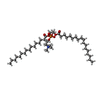 ChemComp-POV: |
-Macromolecule #6: TETRADECANE
| Macromolecule | Name: TETRADECANE / type: ligand / ID: 6 / Number of copies: 18 / Formula: C14 |
|---|---|
| Molecular weight | Theoretical: 198.388 Da |
| Chemical component information | 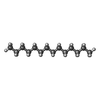 ChemComp-C14: |
-Macromolecule #7: 6-[2-chloro-6-(trifluoromethoxy)phenyl]-1H-benzimidazol-2-ol
| Macromolecule | Name: 6-[2-chloro-6-(trifluoromethoxy)phenyl]-1H-benzimidazol-2-ol type: ligand / ID: 7 / Number of copies: 2 / Formula: XVD |
|---|---|
| Molecular weight | Theoretical: 328.674 Da |
| Chemical component information | 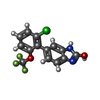 ChemComp-XVD: |
-Macromolecule #8: DODECANE
| Macromolecule | Name: DODECANE / type: ligand / ID: 8 / Number of copies: 6 / Formula: D12 |
|---|---|
| Molecular weight | Theoretical: 170.335 Da |
| Chemical component information | 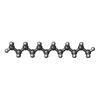 ChemComp-D12: |
-Experimental details
-Structure determination
| Method | cryo EM |
|---|---|
 Processing Processing | single particle reconstruction |
| Aggregation state | particle |
-Sample preparation
| Concentration | 0.12 mg/mL |
|---|---|
| Buffer | pH: 8 |
| Vitrification | Cryogen name: ETHANE |
- Electron microscopy
| Microscope | TFS KRIOS |
|---|---|
| Image recording | Film or detector model: GATAN K3 BIOQUANTUM (6k x 4k) / Average electron dose: 50.0 e/Å2 |
| Electron beam | Acceleration voltage: 300 kV / Electron source:  FIELD EMISSION GUN FIELD EMISSION GUN |
| Electron optics | Illumination mode: FLOOD BEAM / Imaging mode: BRIGHT FIELD / Nominal defocus max: 2.2 µm / Nominal defocus min: 1.0 µm |
| Experimental equipment |  Model: Titan Krios / Image courtesy: FEI Company |

