National Institutes of Health/National Institute of Neurological Disorders and Stroke (NIH/NINDS)
R01 NS038631
United States
Citation
Journal: Protein Sci / Year: 2026 Title: Efficient and rapid isolation of native AMPA receptor complexes for cryo-EM. Authors: Jumi Park / Eric Gouaux / Abstract: Isolating native ion channels for structural characterization is routinely achieved by extraction from membrane fractions of tissue with prolonged mild detergent treatment. AMPA receptors (AMPARs), ...Isolating native ion channels for structural characterization is routinely achieved by extraction from membrane fractions of tissue with prolonged mild detergent treatment. AMPA receptors (AMPARs), glutamatergic receptors that mediate fast excitatory transmission and synaptic plasticity, are coassembled with diverse auxiliary subunits and transiently-interacting partners to finely regulate processes from trafficking to gating kinetics. Previous studies of the composition and architecture of native AMPARs (nAMPARs) isolated from membrane fractions of rodent brain tissue have revealed many different subunit compositions and non-stochastic assemblies of the auxiliary subunits. However, elucidating the molecular architectures of nAMPARs complexed with less populated or transiently bound proteins has proven challenging. Here, we employ strategies for the rapid solubilization and purification of nAMPARs to increase the likelihood of isolating the greatest range of nAMPARs complexes. By utilizing whole brain tissue and reducing solubilization and purification duration, we purify nAMPARs complexed with a wider variety of auxiliary subunits and binding partners in a sufficient quantity and purity for cryo-electron microscopy studies. We resolve previously unreported subunit compositions and conformations that include ones with a half-splayed ATD layer, as well as complexes with four distinct auxiliary subunit arrangements in the TMD layer.
In the structure databanks used in Yorodumi, some data are registered as the other names, "COVID-19 virus" and "2019-nCoV". Here are the details of the virus and the list of structure data.
Jan 31, 2019. EMDB accession codes are about to change! (news from PDBe EMDB page)
EMDB accession codes are about to change! (news from PDBe EMDB page)
The allocation of 4 digits for EMDB accession codes will soon come to an end. Whilst these codes will remain in use, new EMDB accession codes will include an additional digit and will expand incrementally as the available range of codes is exhausted. The current 4-digit format prefixed with “EMD-” (i.e. EMD-XXXX) will advance to a 5-digit format (i.e. EMD-XXXXX), and so on. It is currently estimated that the 4-digit codes will be depleted around Spring 2019, at which point the 5-digit format will come into force.
The EM Navigator/Yorodumi systems omit the EMD- prefix.
Related info.:Q: What is EMD? / ID/Accession-code notation in Yorodumi/EM Navigator
Yorodumi is a browser for structure data from EMDB, PDB, SASBDB, etc.
This page is also the successor to EM Navigator detail page, and also detail information page/front-end page for Omokage search.
The word "yorodu" (or yorozu) is an old Japanese word meaning "ten thousand". "mi" (miru) is to see.
Related info.:EMDB / PDB / SASBDB / Comparison of 3 databanks / Yorodumi Search / Aug 31, 2016. New EM Navigator & Yorodumi / Yorodumi Papers / Jmol/JSmol / Function and homology information / Changes in new EM Navigator and Yorodumi
 Movie
Movie Controller


 Open data
 Basic information
 Map data
 Sample
 Keywords
 Mus musculus (house mouse)
 Authors
 United States, 1 items
  Citation
 Structure visualization
 Downloads & links
 EMDB map data format
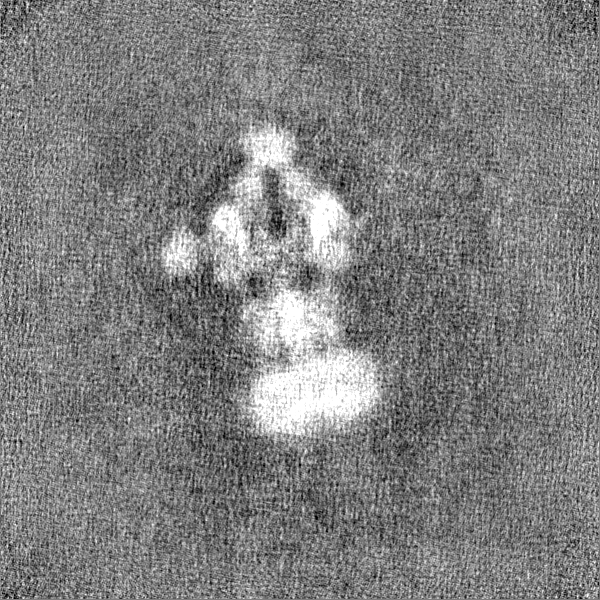
 emd_73853.png
 http://ftp.pdbj.org/pub/emdb/structures/EMD-73853


 Z (Sec.)
 Y (Row.)
 X (Col.)





 Sample components
 Processing
 Electron microscopy
 FIELD EMISSION GUN

