 Movie
Movie Controller


+ Open data

- Basic information
| Entry |  | |||||||||
|---|---|---|---|---|---|---|---|---|---|---|
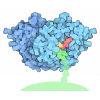
| Title | Chlorella virus hyaluronan synthase bound to DDM | |||||||||
 Map data Map data | ||||||||||
 Sample Sample |
| |||||||||
 Keywords Keywords | Membrane protein / glycosyltransferase / detergent / TRANSFERASE-IMMUNE SYSTEM complex | |||||||||
| Function / homology | hyaluronan synthase activity / Glycosyltransferase like family 2 / hyaluronan biosynthetic process / Nucleotide-diphospho-sugar transferases / plasma membrane / Hyaluronan synthase Function and homology information Function and homology information | |||||||||
| Biological species |  Paramecium bursaria Chlorella virus CZ-2 / Paramecium bursaria Chlorella virus CZ-2 /   Lama glama (llama) Lama glama (llama) | |||||||||
| Method | single particle reconstruction / cryo EM / Resolution: 2.9 Å | |||||||||
 Authors Authors | Stephens Z / Zimmer J | |||||||||
| Funding support |  United States, 1 items United States, 1 items
| |||||||||
 Citation Citation | Journal: bioRxiv / Year: 2025 Title: Insights into substrate binding and utilization by hyaluronan synthase. Authors: Zachery Stephens / Julia Karasinska / Jochen Zimmer / Abstract: Hyaluronan (HA) is an essential polysaccharide of the vertebrate extracellular matrix. It serves as an adhesive, lubricant, signaling molecule, and spatial filler without which embryogenesis would ...Hyaluronan (HA) is an essential polysaccharide of the vertebrate extracellular matrix. It serves as an adhesive, lubricant, signaling molecule, and spatial filler without which embryogenesis would not complete. HA is synthesized by a membrane-integrated glycosyltransferase (HAS) that polymerizes UDP-activated N-acetylglucosamine and glucuronic acid (GlcA) in an alternating fashion. The nascent HA chain is secreted across the plasma membrane during this process. How HAS couples these tasks remains poorly understood. Here, we employ a combination of structural biology, biochemistry and glycobiology to delineate how HAS recognizes and utilizes UDP-GlcA. Using single-particle cryo-EM, we reveal a two-step process by which HAS binds its substrate UDP-GlcA. Prior to proper insertion into the catalytic pocket, the substrate is bound in a proofreading pose that may increase substrate selectivity. This state is accompanied by conformational changes of active site residues surrounding the UDP-binding pocket and involves a pair of basic residues that sense the substrate's carboxyl group. Further, we establish that HAS is unable to catalyze UDP-GlcA turnover in the absence of an acceptor sugar, emphasizing the role of a priming GlcNAc in glycosyl transfer. Lastly, cryo-EM snapshots of a dodecylmaltoside molecule trapped in the active site provide novel insights into substrate promiscuity. Here, our studies demonstrate that HAS catalyzes semi-selective GlcA-transfer to non-canonical β-linked acceptors. | |||||||||
| History |
|
- Structure visualization
| Supplemental images |
|---|

- Downloads & links
-EMDB archive
| Map data | emd_73321.map.gz | 229.8 MB | EMDB map data format | |
|---|---|---|---|---|
| Header (meta data) | emd-73321-v30.xmlemd-73321.xml | 17.4 KB 17.4 KB | Display Display | EMDB header |
| Images |  emd_73321.png emd_73321.png | 26.7 KB | ||
| Filedesc metadata | emd-73321.cif.gz | 6 KB | ||
| Others | emd_73321_half_map_1.map.gzemd_73321_half_map_2.map.gz | 226.8 MB 226.8 MB | ||
| Archive directory |  https://data.pdbj.org/pub/emdb/structures/EMD-73321ftp://data.pdbj.org/pub/emdb/structures/EMD-73321 https://data.pdbj.org/pub/emdb/structures/EMD-73321ftp://data.pdbj.org/pub/emdb/structures/EMD-73321 | HTTPS FTP |
-Related structure data
| Related structure data |  9yq2MC  9yq4C  9yq5C M: atomic model generated by this map C: citing same article ( |
|---|---|
| Similar structure data |


-Links
| EMDB pages | EMDB (EBI/PDBe) / EMDataResource |
|---|---|
| Related items in Molecule of the Month |

-Map
| File | Download / File: emd_73321.map.gz / Format: CCP4 / Size: 244.1 MB / Type: IMAGE STORED AS FLOATING POINT NUMBER (4 BYTES) | ||||||||||||||||||||||||||||||||||||
|---|---|---|---|---|---|---|---|---|---|---|---|---|---|---|---|---|---|---|---|---|---|---|---|---|---|---|---|---|---|---|---|---|---|---|---|---|---|
| Projections & slices | Image control
Images are generated by Spider. | ||||||||||||||||||||||||||||||||||||
| Voxel size | X=Y=Z: 0.652 Å | ||||||||||||||||||||||||||||||||||||
| Density |
| ||||||||||||||||||||||||||||||||||||
| Symmetry | Space group: 1 | ||||||||||||||||||||||||||||||||||||
| Details | EMDB XML:
|
 Z (Sec.)
 Y (Row.)
 X (Col.)




-Supplemental data
-Half map: #1
| File | emd_73321_half_map_1.map | ||||||||||||
|---|---|---|---|---|---|---|---|---|---|---|---|---|---|
| Projections & Slices |
| ||||||||||||
| Density Histograms |


-Half map: #2
| File | emd_73321_half_map_2.map | ||||||||||||
|---|---|---|---|---|---|---|---|---|---|---|---|---|---|
| Projections & Slices |
| ||||||||||||
| Density Histograms |


- Sample components
-Entire : Ternary complex of CvHAS bound to Nb872 and Nb881
| Entire | Name: Ternary complex of CvHAS bound to Nb872 and Nb881 |
|---|---|
| Components |
|
-Supramolecule #1: Ternary complex of CvHAS bound to Nb872 and Nb881
| Supramolecule | Name: Ternary complex of CvHAS bound to Nb872 and Nb881 / type: complex / ID: 1 / Parent: 0 / Macromolecule list: #1-#3 |
|---|---|
| Source (natural) | Organism: Paramecium bursaria Chlorella virus CZ-2 |
-Macromolecule #1: Hyaluronan synthase
| Macromolecule | Name: Hyaluronan synthase / type: protein_or_peptide / ID: 1 / Number of copies: 1 / Enantiomer: LEVO / EC number: hyaluronan synthase |
|---|---|
| Source (natural) | Organism: Paramecium bursaria Chlorella virus CZ-2 |
| Molecular weight | Theoretical: 65.889078 KDa |
| Recombinant expression | Organism:   Escherichia coli BL21(DE3) (bacteria) Escherichia coli BL21(DE3) (bacteria) |
| Sequence | String: MGTSWRTIVS ANLFAVGGAL LMLAPAIVGY VFQWNIGVSA VWGISVYGVF VLGFYIAQIV FSEFNRMRLS DWISLRPDNW NATRVAVII AGYREDPFMF KKCLESVRDS EYGNVARLIC VIDGDEEEDL KMAEIYKQVY NDNVKKPGVV LCESENKNGS T IDSDVSKN ...String: MGTSWRTIVS ANLFAVGGAL LMLAPAIVGY VFQWNIGVSA VWGISVYGVF VLGFYIAQIV FSEFNRMRLS DWISLRPDNW NATRVAVII AGYREDPFMF KKCLESVRDS EYGNVARLIC VIDGDEEEDL KMAEIYKQVY NDNVKKPGVV LCESENKNGS T IDSDVSKN ICILQPHRGK RESLYTGFQL ASMDPSVHAV VLIDSDTVLE KNAILEVVYP LSCDPNIKAV AGECKIWNTD TI LSMLVSW RYFSAFNVER GAQSLWKTVQ CVGGPLGAYT IDIINEIKDP WITQTFLGNK CTYGDNRRLT NEVLMRGKKI VYT PFAVGW SDSPTNVMRY IVQQTRWSKS WCREIWYTLG SAWKHGFSGI YLAFECMYQI MYFFLVMYLF SYIAIKADIR AQTA TVLVS TLVTIIKSSY LALRAKNLKA FYFVLYTYVY FFCMIPARIT AMFTMFDIAW GTRGGNAKMT IGARVWLWAK QFLIT YMWW AGVLAAGVYS IVDNWYFDWA DIQYRFALVG ICSYLVFVSI VLVIYLIGKI TTWNYTPLQK ELIEERYLHN ASENAP EVL EHHHHHHHHH H UniProtKB: Hyaluronan synthase |
-Macromolecule #2: nanobody Nb872
| Macromolecule | Name: nanobody Nb872 / type: protein_or_peptide / ID: 2 / Number of copies: 1 / Enantiomer: LEVO |
|---|---|
| Source (natural) | Organism: Lama glama (llama) |
| Molecular weight | Theoretical: 14.783248 KDa |
| Recombinant expression | Organism: Escherichia coli BL21(DE3) (bacteria) |
| Sequence | String: QVQLVESGGG LVQAGGSLKV SCAASGRAFK TYRMAWFRQA PGKEREFVSG ISALETTYYA DSVKGRFTIS RDNTKNTVSL QMDSLKPED TAVYYCAARR YGGTDYTTTG SYDYWGQGTQ VTVSSHHHHH HEPEA |
-Macromolecule #3: nanobody Nb881
| Macromolecule | Name: nanobody Nb881 / type: protein_or_peptide / ID: 3 / Number of copies: 1 / Enantiomer: LEVO |
|---|---|
| Source (natural) | Organism: Lama glama (llama) |
| Molecular weight | Theoretical: 14.966389 KDa |
| Recombinant expression | Organism: Escherichia coli BL21(DE3) (bacteria) |
| Sequence | String: QVQLVESGGG LVQAGGSLRL ACAASGRIFS SDTLAWFRRA PGKEREFVAA SRWSGGGTDY ADSVKGRFTF SRDNTRNTMC LEMNSLKPE DTAVYYCALR TARDSYYYTR NPTGYDYWGQ GTQSSHHHHH HEPEA |
-Macromolecule #4: CHOLESTEROL HEMISUCCINATE
| Macromolecule | Name: CHOLESTEROL HEMISUCCINATE / type: ligand / ID: 4 / Number of copies: 1 / Formula: Y01 |
|---|---|
| Molecular weight | Theoretical: 486.726 Da |
| Chemical component information | 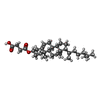 ChemComp-Y01: |
-Macromolecule #5: MANGANESE (II) ION
| Macromolecule | Name: MANGANESE (II) ION / type: ligand / ID: 5 / Number of copies: 2 / Formula: MN |
|---|---|
| Molecular weight | Theoretical: 54.938 Da |
-Macromolecule #6: DODECYL-BETA-D-MALTOSIDE
| Macromolecule | Name: DODECYL-BETA-D-MALTOSIDE / type: ligand / ID: 6 / Number of copies: 1 / Formula: LMT |
|---|---|
| Molecular weight | Theoretical: 510.615 Da |
| Chemical component information | 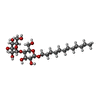 ChemComp-LMT: |
-Experimental details
-Structure determination
| Method | cryo EM |
|---|---|
 Processing Processing | single particle reconstruction |
| Aggregation state | particle |
-Sample preparation
| Buffer | pH: 7.5 |
|---|---|
| Vitrification | Cryogen name: ETHANE |
- Electron microscopy
| Microscope | TFS KRIOS |
|---|---|
| Image recording | Film or detector model: GATAN K3 (6k x 4k) / Average electron dose: 60.0 e/Å2 |
| Electron beam | Acceleration voltage: 300 kV / Electron source:  FIELD EMISSION GUN FIELD EMISSION GUN |
| Electron optics | Illumination mode: FLOOD BEAM / Imaging mode: BRIGHT FIELD / Nominal defocus max: 1.8 µm / Nominal defocus min: 0.8 µm |
| Experimental equipment |  Model: Titan Krios / Image courtesy: FEI Company |
