 Movie
Movie Controller


+ Open data

- Basic information
| Entry |  | |||||||||
|---|---|---|---|---|---|---|---|---|---|---|
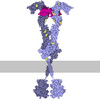
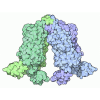
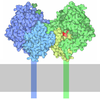
| Title | Human type 2 IP3 receptor dimer complete map (IP3/ATP/Ca2+) | |||||||||
 Map data Map data | Unsharpened consensus map | |||||||||
 Sample Sample |
| |||||||||
 Keywords Keywords | Inositol 1 / 4 / 5-triphosphate / IP3 / receptor / calcium channel / type-2 / IP3R / IP3R-2 / ITPR2 / TRANSPORT PROTEIN | |||||||||
| Function / homology |  Function and homology information Function and homology informationcalcium ion transmembrane transporter activity / DAG and IP3 signaling / inositol 1,4,5-trisphosphate-gated calcium channel activity / platelet dense tubular network membrane / Effects of PIP2 hydrolysis / PLC beta mediated events / Elevation of cytosolic Ca2+ levels / inositol 1,4,5 trisphosphate binding / transport vesicle membrane / CLEC7A (Dectin-1) induces NFAT activation ...calcium ion transmembrane transporter activity / DAG and IP3 signaling / inositol 1,4,5-trisphosphate-gated calcium channel activity / platelet dense tubular network membrane / Effects of PIP2 hydrolysis / PLC beta mediated events / Elevation of cytosolic Ca2+ levels / inositol 1,4,5 trisphosphate binding / transport vesicle membrane / CLEC7A (Dectin-1) induces NFAT activation / Role of phospholipids in phagocytosis / release of sequestered calcium ion into cytosol / Ion homeostasis / FCERI mediated Ca+2 mobilization / cellular response to cAMP / sarcoplasmic reticulum membrane / FCGR3A-mediated IL10 synthesis / phosphatidylinositol binding / Antigen activates B Cell Receptor (BCR) leading to generation of second messengers / secretory granule membrane / VEGFR2 mediated cell proliferation / sarcoplasmic reticulum / Regulation of insulin secretion / Glucagon-like Peptide-1 (GLP1) regulates insulin secretion / scaffold protein binding / cell cortex / Ca2+ pathway / response to hypoxia / transmembrane transporter binding / signaling receptor complex / calcium ion binding / endoplasmic reticulum membrane / signal transduction / ATP binding / membrane / plasma membrane Similarity search - Function | |||||||||
| Biological species |  Homo sapiens (human) Homo sapiens (human) | |||||||||
| Method | single particle reconstruction / cryo EM / Resolution: 4.4 Å | |||||||||
 Authors Authors | Liu C / Lan Y / Tang Q / Karakas E | |||||||||
| Funding support |  United States, 1 items United States, 1 items
| |||||||||
 Citation Citation | Journal: Nat Commun / Year: 2026 Title: Conformational landscape and ligand-dependent clustering of the human type 2 IP receptor. Authors: Caifeng Liu / Yu-Jing Lan / Max G Kushner / Qingyu Tang / Erkan Karakas / Abstract: Inositol 1,4,5-trisphosphate (IP) receptors (IPRs) are tetrameric ER Ca channels that shape intracellular Ca signaling in response to IP, regulating diverse physiological processes. The structural ...Inositol 1,4,5-trisphosphate (IP) receptors (IPRs) are tetrameric ER Ca channels that shape intracellular Ca signaling in response to IP, regulating diverse physiological processes. The structural basis for subtype-specific regulation among the three subtypes (IPR-1-3) remains incompletely understood due to the lack of IPR-2 structures. Here, we report cryo-electron microscopy (cryo-EM) structures of human IPR-2 in distinct conformations in the presence and absence of IP, Ca, and ATP. These structures define the conformational landscape of IPR-2, delineate ligand-binding interactions, and reveal shared architectural features alongside isoform-specific differences. We also resolve ligand-dependent IPR-2 assemblies, identifying a conformation-dependent inter-channel interface. Live-cell imaging demonstrates that IPR-2 undergoes clustering following ligand-induced Ca release, and disruption of this interface selectively abolishes clustering without impairing channel activity. Together, these findings provide a structural framework for human IPR-2 and establish a mechanism linking ligand-dependent conformational changes to inter-channel interactions and post-activation cellular clustering. | |||||||||
| History |
|
- Structure visualization
| Supplemental images |
|---|

- Downloads & links
-EMDB archive
| Map data | emd_73222.map.gz | 212.4 MB | EMDB map data format | |
|---|---|---|---|---|
| Header (meta data) | emd-73222-v30.xmlemd-73222.xml | 28.3 KB 28.3 KB | Display Display | EMDB header |
| FSC (resolution estimation) | emd_73222_fsc.xml | 15.8 KB | Display | FSC data file |
| Images |  emd_73222.png emd_73222.png | 59 KB | ||
| Masks | emd_73222_msk_1.map | 421.9 MB | Mask map | |
| Filedesc metadata | emd-73222.cif.gz | 7.6 KB | ||
| Others | emd_73222_additional_1.map.gzemd_73222_half_map_1.map.gzemd_73222_half_map_2.map.gz | 398.5 MB 391.3 MB 391.2 MB | ||
| Archive directory |  https://data.pdbj.org/pub/emdb/structures/EMD-73222ftp://data.pdbj.org/pub/emdb/structures/EMD-73222 https://data.pdbj.org/pub/emdb/structures/EMD-73222ftp://data.pdbj.org/pub/emdb/structures/EMD-73222 | HTTPS FTP |
-Related structure data
| Related structure data |  9ykkC  9ykyC  9yliC  9ymzC  9ynkC  9ynoC C: citing same article ( |
|---|---|
| Similar structure data |


-Links
| EMDB pages | EMDB (EBI/PDBe) / EMDataResource |
|---|---|
| Related items in Molecule of the Month |






-Map
| File | Download / File: emd_73222.map.gz / Format: CCP4 / Size: 421.9 MB / Type: IMAGE STORED AS FLOATING POINT NUMBER (4 BYTES) | ||||||||||||||||||||||||||||||||||||
|---|---|---|---|---|---|---|---|---|---|---|---|---|---|---|---|---|---|---|---|---|---|---|---|---|---|---|---|---|---|---|---|---|---|---|---|---|---|
| Annotation | Unsharpened consensus map | ||||||||||||||||||||||||||||||||||||
| Projections & slices | Image control
Images are generated by Spider. | ||||||||||||||||||||||||||||||||||||
| Voxel size | X=Y=Z: 1.644 Å | ||||||||||||||||||||||||||||||||||||
| Density |
| ||||||||||||||||||||||||||||||||||||
| Symmetry | Space group: 1 | ||||||||||||||||||||||||||||||||||||
| Details | EMDB XML:
|
 Z (Sec.)
 Y (Row.)
 X (Col.)


-Supplemental data
-Mask #1
| File | emd_73222_msk_1.map | ||||||||||||
|---|---|---|---|---|---|---|---|---|---|---|---|---|---|
| Projections & Slices |
| ||||||||||||
| Density Histograms |


-Additional map: Sharpened Map
| File | emd_73222_additional_1.map | ||||||||||||
|---|---|---|---|---|---|---|---|---|---|---|---|---|---|
| Annotation | Sharpened Map | ||||||||||||
| Projections & Slices |
| ||||||||||||
| Density Histograms |


-Half map: #1
| File | emd_73222_half_map_1.map | ||||||||||||
|---|---|---|---|---|---|---|---|---|---|---|---|---|---|
| Projections & Slices |
| ||||||||||||
| Density Histograms |


-Half map: #2
| File | emd_73222_half_map_2.map | ||||||||||||
|---|---|---|---|---|---|---|---|---|---|---|---|---|---|
| Projections & Slices |
| ||||||||||||
| Density Histograms |


- Sample components
-Entire : Inositol 1,4,5-trisphosphate receptor type 2
| Entire | Name: Inositol 1,4,5-trisphosphate receptor type 2 |
|---|---|
| Components |
|
-Supramolecule #1: Inositol 1,4,5-trisphosphate receptor type 2
| Supramolecule | Name: Inositol 1,4,5-trisphosphate receptor type 2 / type: complex / ID: 1 / Parent: 0 / Macromolecule list: all Details: Protein was reconstituted in MSP1E3D1/DOPC nanodiscs |
|---|---|
| Source (natural) | Organism: Homo sapiens (human) |
| Molecular weight | Theoretical: 1.2 MDa |
-Macromolecule #1: Human type 2 IP3 receptor
| Macromolecule | Name: Human type 2 IP3 receptor / type: protein_or_peptide / ID: 1 / Enantiomer: LEVO |
|---|---|
| Source (natural) | Organism: Homo sapiens (human) |
| Recombinant expression | Organism:   Spodoptera frugiperda (fall armyworm) Spodoptera frugiperda (fall armyworm) |
| Sequence | String: MTEKMSSFLY IGDIVSLYAE GSVNGFISTL GLVDDRCVVH PEAGDLANPP KKFRDCLFKV CPMNRYSAQK QYWKAKQAKQ GNHTEAALLK KLQHAAELEQ KQNESENKKL LGEIVKYSNV IQLLHIKSNK YLTVNKRLPA LLEKNAMRVS LDAAGNEGSW FYIHPFWKLR ...String: MTEKMSSFLY IGDIVSLYAE GSVNGFISTL GLVDDRCVVH PEAGDLANPP KKFRDCLFKV CPMNRYSAQK QYWKAKQAKQ GNHTEAALLK KLQHAAELEQ KQNESENKKL LGEIVKYSNV IQLLHIKSNK YLTVNKRLPA LLEKNAMRVS LDAAGNEGSW FYIHPFWKLR SEGDNIVVGD KVVLMPVNAG QPLHASNIEL LDNPGCKEVN AVNCNTSWKI TLFMKYSSYR EDVLKGGDVV RLFHAEQEKF LTCDEYEKKQ HIFLRTTLRQ SATSATSSKA LWEIEVVHHD PCRGGAGQWN SLFRFKHLAT GNYLAAELNP DYRDAQNEGK NVRDGVPPTS KKKRQAGEKI MYTLVSVPHG NDIASLFELD ATTLQRADCL VPRNSYVRLR HLCTNTWVTS TSIPIDTDEE RPVMLKIGTC QTKEDKEAFA IVSVPLSEVR DLDFANDANK VLATTVKKLE NGTITQNERR FVTKLLEDLI FFVADVPNNG QEVLDVVITK PNRERQKLMR EQNILAQVFG ILKAPFKEKA GEGSMLRLED LGDQRYAPYK YMLRLCYRVL RHSQQDYRKN QEYIAKNFCV MQSQIGYDIL AEDTITALLH NNRKLLEKHI TAKEIETFVS LLRRNREPRF LDYLSDLCVS NTTAIPVTQE LICKFMLSPG NADILIQTKV VSMQADNPME SSILSDDIDD EEVWLYWIDS NKEPHGKAIR HLAQEAKEGT KADLEVLTYY RYQLNLFARM CLDRQYLAIN QISTQLSVDL ILRCVSDESL PFDLRASFCR LMLHMHVDRD PQESVVPVRY ARLWTEIPTK ITIHEYDSIT DSSRNDMKRK FALTMEFVEE YLKEVVNQPF PFGDKEKNKL TFEVVHLARN LIYFGFYSFS ELLRLTRTLL AILDIVQAPM SSYFERLSKF QDGGNNVMRT IHGVGEMMTQ MVLSRGSIFP MSVPDVPPSI HPSKQGSPTE HEDVTVMDTK LKIIEILQFI LSVRLDYRIS YMLSIYKKEF GEDNDNAETS ASGSPDTLLP SAIVPDIDEI AAQAETMFAG RKEKNPVQLD DEGGRTFLRV LIHLIMHDYP PLLSGALQLL FKHFSQRAEV LQAFKQVQLL VSNQDVDNYK QIKADLDQLR LTVEKSELWV EKSSNYENGE IGESQVKGGE EPIEESNILS PVQDGTKKPQ IDSNKSNNYR IVKEILIRLS KLCVQNKKCR NQHQRLLKNM GAHSVVLDLL QIPYEKNDEK MNEVMNLAHT FLQNFCRGNP QNQVLLHKHL NLFLTPGLLE AETMRHIFMN NYHLCNEISE RVVQHFVHCI ETHGRHVEYL RFLQTIVKAD GKYVKKCQDM VMTELINGGE DVLIFYNDRA SFPILLHMMC SERDRGDESG PLAYHITLVE LLAACTEGKN VYTEIKCNSL LPLDDIVRVV THDDCIPEVK IAYVNFVNHC YVDTEVEMKE IYTSNHIWKL FENFLVDMAR VCNTTTDRKH ADIFLEKCVT ESIMNIVSGF FNSPFSDNST SLQTHQPVFI QLLQSAFRIY NCTWPNPAQK ASVESCIRTL AEVAKNRGIA IPVDLDSQVN TLFMKSHSNM VQRAAMGWRL SARSGPRFKE ALGGPAWDYR NIIEKLQDVV ASLEHQFSPM MQAEFSVLVD VLYSPELLFP EGSDARIRCG AFMSKLINHT KKLMEKEEKL CIKILQTLRE MLEKKDSFVE EGNTLRKILL NRYFKGDYSI GVNGHLSGAY SKTAQVGGSF SGQDSDKMGI SMSDIQCLLD KEGASELVID VIVNTKNDRI FSEGIFLGIA LLEGGNTQTQ YSFYQQLHEQ KKSEKFFKVL YDRMKAAQKE IRSTVTVNTI DLGNKKRDDD NELMTSGPRM RVRDSTLHLK EGMKGQLTEA SSATSKAYCV YRREMDPEID IMCTGPEAGN TEEKSAEEVT MSPAIAIMQP ILRFLQLLCE NHNRELQNFL RNQNNKTNYN LVCETLQFLD CICGSTTGGL GLLGLYINEK NVALVNQNLE SLTEYCQGPC HENQTCIATH ESNGIDIIIA LILNDINPLG KYRMDLVLQL KNNASKLLLA IMESRHDSEN AERILFNMRP RELVDVMKNA YNQGLECDHG DDEGGDDGVS PKDVGHNIYI LAHQLARHNK LLQQMLKPGS DPDEGDEALK YYANHTAQIE IVRHDRTMEQ IVFPVPNICE YLTRESKCRV FNTTERDEQG SKVNDFFQQT EDLYNEMKWQ KKIRNNPALF WFSRHISLWG SISFNLAVFI NLAVALFYPF GDDGDEGTLS PLFSVLLWIA VAICTSMLFF FSKPVGIRPF LVSIMLRSIY TIGLGPTLIL LGAANLCNKI VFLVSFVGNR GTFTRGYRAV ILDMAFLYHV AYVLVCMLGL FVHEFFYSFL LFDLVYREET LLNVIKSVTR NGRSIILTAV LALILVYLFS IIGFLFLKDD FTMEVDRLKN RTPVTGSHQV PTMTLTTMME ACAKENCSPT IPASNTADEE YEDGIERTCD TLLMCIVTVL NQGLRNGGGV GDVLRRPSKD EPLFAARVVY DLLFYFIVII IVLNLIFGVI IDTFADLRSE KQKKEEILKT TCFICGLERD KFDNKTVSFE EHIKSEHNMW HYLYFIVLVK VKDPTEYTGP ESYVAQMIVE KNLDWFPRMR AMSLVSNEGD SEQNEIRSLQ EKLESTMSLV KQLSGQLAEL KEQMTEQRKN KQRLGFLGSN TPHVNHHMPP HASASNGLVP RGSAAAGWSH PQFEKGGGSG GGSGGSAWSH PQFEK UniProtKB: Inositol 1,4,5-trisphosphate-gated calcium channel ITPR2 |
-Experimental details
-Structure determination
| Method | cryo EM |
|---|---|
 Processing Processing | single particle reconstruction |
| Aggregation state | particle |
-Sample preparation
| Concentration | 2.5 mg/mL | |||||||||||||||||||||||||||
|---|---|---|---|---|---|---|---|---|---|---|---|---|---|---|---|---|---|---|---|---|---|---|---|---|---|---|---|---|
| Buffer | pH: 8 Component:
Details: 200 mM NaCl, 20 mM Tris-HCl pH 8.0, 5 mM EDTA pH 8.0, 2 mM DTT, 0.025% fluorinated Fos-Choline-8, 0.05 mM IP3, 1 mM ATP and 4 mM CaCl2 | |||||||||||||||||||||||||||
| Grid | Model: Quantifoil R1.2/1.3 / Material: COPPER / Mesh: 300 / Support film - Material: CARBON / Support film - topology: HOLEY | |||||||||||||||||||||||||||
| Vitrification | Cryogen name: ETHANE / Chamber humidity: 100 % / Chamber temperature: 281 K / Instrument: FEI VITROBOT MARK IV Details: PELCO 595 filter paper (Ted Pella, prod. no. 47000-100) was used for vitrification.. | |||||||||||||||||||||||||||
| Details | The sample was reconstituted in MSP1E3D1/DOPC nanodiscs |
- Electron microscopy
| Microscope | TFS KRIOS |
|---|---|
| Image recording | Film or detector model: GATAN K3 BIOQUANTUM (6k x 4k) / Number grids imaged: 1 / Number real images: 11502 / Average electron dose: 54.7 e/Å2 |
| Electron beam | Acceleration voltage: 300 kV / Electron source:  FIELD EMISSION GUN FIELD EMISSION GUN |
| Electron optics | Illumination mode: FLOOD BEAM / Imaging mode: BRIGHT FIELD / Cs: 2.7 mm / Nominal defocus max: 2.0 µm / Nominal defocus min: 0.8 µm / Nominal magnification: 105000 |
| Sample stage | Specimen holder model: FEI TITAN KRIOS AUTOGRID HOLDER / Cooling holder cryogen: NITROGEN |
| Experimental equipment |  Model: Titan Krios / Image courtesy: FEI Company |
+Image processing

-Atomic model buiding 1
| Refinement | Space: REAL / Protocol: FLEXIBLE FIT |
|---|
