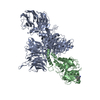
Journal: Nature / Year: 2026 Title: TRI-611, a selective, brain-penetrant molecular glue degrader of ALK. Authors: Andrew R Conery / Daniel S La / Artyom A Alekseyenko / David Marcoux / Aaron G Bart / Matt L Harlow / Patrick R Arsenault / Nico R Cantone / Rebecca L Casaubon / Alexander Constan / Hari B ...Authors: Andrew R Conery / Daniel S La / Artyom A Alekseyenko / David Marcoux / Aaron G Bart / Matt L Harlow / Patrick R Arsenault / Nico R Cantone / Rebecca L Casaubon / Alexander Constan / Hari B Kamadurai / Aravind Prasad Medikonda / Duncan E Nunes / Hannah Szeto / Tim J Wigle / Maolin Yu / Aleksandra Zagulyaeva / Christine M Zarate / Lauren Highfield / Nobuyuki Kondo / Aaron N Hata / Kenneth Ngo / Jisu Lee / Prafulla C Gokhale / Caroline Germa / Kathleen I Seyb / Patrick Trojer / Vito J Palombella / Abstract: Tyrosine kinase inhibitors (TKIs) targeting anaplastic lymphoma kinase (ALK) have transformed the treatment landscape of ALK fusion-positive non-small-cell lung carcinoma (ALK-positive NSCLC), but ...Tyrosine kinase inhibitors (TKIs) targeting anaplastic lymphoma kinase (ALK) have transformed the treatment landscape of ALK fusion-positive non-small-cell lung carcinoma (ALK-positive NSCLC), but the limited options for patients who progress on approved TKIs highlight a continued need for an orthogonal therapeutic approach. TRI-611 is a potent, brain-penetrant molecular glue degrader of ALK fusion proteins with the potential to address this need. TRI-611 promotes the proximity of the ALK kinase domain and CRL4 substrate adaptor CRBN through a unique degron interface distal from the kinase active site. The unique binding interface of TRI-611 leads to selectivity across the proteome including known CRBN neosubstrates and other kinases. TRI-611 treatment induces degradation of all forms of ALK fusion proteins, including wild-type and ALK TKI-resistant versions, leading to regression of cell line and patient-derived subcutaneous and intracranial tumour models of ALK-positive NSCLC. TRI-611 can be combined with orthosteric ALK TKIs, achieving synergistic and durable tumour regressions. TRI-611 represents to our knowledge the first clinical-stage molecular glue degrader targeting an oncogenic gene fusion and has the potential to expand the arsenal of therapeutic options for patients with ALK-positive NSCLC .
In the structure databanks used in Yorodumi, some data are registered as the other names, "COVID-19 virus" and "2019-nCoV". Here are the details of the virus and the list of structure data.
Jan 31, 2019. EMDB accession codes are about to change! (news from PDBe EMDB page)
EMDB accession codes are about to change! (news from PDBe EMDB page)
The allocation of 4 digits for EMDB accession codes will soon come to an end. Whilst these codes will remain in use, new EMDB accession codes will include an additional digit and will expand incrementally as the available range of codes is exhausted. The current 4-digit format prefixed with “EMD-” (i.e. EMD-XXXX) will advance to a 5-digit format (i.e. EMD-XXXXX), and so on. It is currently estimated that the 4-digit codes will be depleted around Spring 2019, at which point the 5-digit format will come into force.
The EM Navigator/Yorodumi systems omit the EMD- prefix.
Related info.:Q: What is EMD? / ID/Accession-code notation in Yorodumi/EM Navigator
Yorodumi is a browser for structure data from EMDB, PDB, SASBDB, etc.
This page is also the successor to EM Navigator detail page, and also detail information page/front-end page for Omokage search.
The word "yorodu" (or yorozu) is an old Japanese word meaning "ten thousand". "mi" (miru) is to see.
Related info.:EMDB / PDB / SASBDB / Comparison of 3 databanks / Yorodumi Search / Aug 31, 2016. New EM Navigator & Yorodumi / Yorodumi Papers / Jmol/JSmol / Function and homology information / Changes in new EM Navigator and Yorodumi
 Movie
Movie Controller


 Open data
 Basic information
 Map data
 Sample
 Keywords
 Function and homology information
 Homo sapiens (human)
 Authors
 Citation
 Structure visualization
 Downloads & links
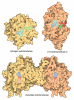
 emd_72353.png
 https://data.pdbj.org/pub/emdb/structures/EMD-72353


 Z (Sec.)
 Y (Row.)
 X (Col.)


 Sample components
 Spodoptera frugiperda (fall armyworm)
 Processing
 Electron microscopy
 FIELD EMISSION GUN