Homologous Recombination Complex / Rad51 Paralog Complex / DNA BINDING PROTEIN / DNA BINDING PROTEIN-DNA complex
Function / homology
Function and homology information
Shu complex / positive regulation of single-strand break repair via homologous recombination / Presynaptic phase of homologous DNA pairing and strand exchange / meiotic joint molecule formation / error-free postreplication DNA repair / heteroduplex formation / Rad51C-XRCC3 complex / Rad51B-Rad51C-Rad51D-XRCC2 complex / meiotic DNA recombinase assembly / methylated-DNA-[protein]-cysteine S-methyltransferase ...Shu complex / positive regulation of single-strand break repair via homologous recombination / Presynaptic phase of homologous DNA pairing and strand exchange / meiotic joint molecule formation / error-free postreplication DNA repair / heteroduplex formation / Rad51C-XRCC3 complex / Rad51B-Rad51C-Rad51D-XRCC2 complex / meiotic DNA recombinase assembly / methylated-DNA-[protein]-cysteine S-methyltransferase / methylated-DNA-[protein]-cysteine S-methyltransferase activity / maintenance of rDNA / meiotic chromosome segregation / mitochondrial chromosome / mitotic recombination-dependent replication fork processing / chromosome organization involved in meiotic cell cycle / mitochondrial DNA repair / DNA recombinase assembly / DNA strand invasion / mitotic recombination / DNA strand exchange activity / telomere maintenance via recombination / reciprocal meiotic recombination / recombinational repair / error-free translesion synthesis / ATP-dependent DNA damage sensor activity / nuclear chromosome / DNA replication origin binding / ATP-dependent activity, acting on DNA / condensed nuclear chromosome / G2/M transition of mitotic cell cycle / replication fork / double-strand break repair via homologous recombination / nucleotide-excision repair / Hydrolases; Acting on acid anhydrides; Acting on acid anhydrides to facilitate cellular and subcellular movement / double-strand break repair / single-stranded DNA binding / site of double-strand break / DNA recombination / double-stranded DNA binding / mitochondrial matrix / DNA repair / nucleolus / DNA binding / ATP binding / identical protein binding / nucleus / cytosol / cytoplasm Similarity search - Function
: / Suppressor of hydroxyurea sensitivity protein 2 / : / Suppressor of HU sensitivity involved in recombination protein 1 / Shu complex, component Psy3 / Chromosome segregation in meiosis protein 2 / Shu complex component Csm2, DNA-binding / Shu complex component Psy3, DNA-binding description / : / : ...: / Suppressor of hydroxyurea sensitivity protein 2 / : / Suppressor of HU sensitivity involved in recombination protein 1 / Shu complex, component Psy3 / Chromosome segregation in meiosis protein 2 / Shu complex component Csm2, DNA-binding / Shu complex component Psy3, DNA-binding description / : / : / Methylguanine DNA methyltransferase, ribonuclease-like domain / KaiC-like domain / 6-O-methylguanine DNA methyltransferase, ribonuclease-like domain / KaiC / Methylated DNA-protein cysteine methyltransferase domain superfamily / Methylated-DNA-[protein]-cysteine S-methyltransferase, active site / Methylated-DNA--protein-cysteine methyltransferase active site. / Methylated-DNA-[protein]-cysteine S-methyltransferase, DNA binding / Methylated DNA-protein cysteine methyltransferase, DNA binding domain / 6-O-methylguanine DNA methyltransferase, DNA binding domain / DNA recombination/repair protein Rad51 / DNA recombination and repair protein, RecA-like / DNA recombination and repair protein Rad51-like, C-terminal / Rad51 / DNA recombination and repair protein RecA, monomer-monomer interface / RecA family profile 2. / DNA recombination and repair protein RecA-like, ATP-binding domain / RecA family profile 1. / DNA repair Rad51/transcription factor NusA, alpha-helical / : / SAM-like Helix-hairpin-helix tandem / Winged helix-like DNA-binding domain superfamily / ATPases associated with a variety of cellular activities / AAA+ ATPase domain / P-loop containing nucleoside triphosphate hydrolase Similarity search - Domain/homology
Suppressor of hydroxyurea sensitivity protein 2 / Methylated-DNA--[protein]-cysteine S-methyltransferase / DNA repair protein RAD57 / DNA repair protein RAD51 / Suppressor of HU sensitivity involved in recombination protein 1 / DNA repair protein RAD55 / Chromosome segregation in meiosis protein 2 / Platinum sensitivity protein 3 Similarity search - Component
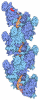
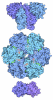
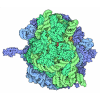
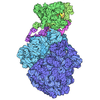
Journal: Mol Cell / Year: 2026 Title: Yeast Rad55-Rad57-SHU paralog complex dynamically promotes Rad51 filament formation. Authors: Christopher W Koo / Steven K Gore / Soo Y Ro / Jie Liu / Christine Yu / Caleigh M Azumaya / Bobby Brillantes / Inna Zilberleyb / Henry Chen / Mariam B Rafiqzada / Lyra Garcia Sanchez / Wolf- ...Authors: Christopher W Koo / Steven K Gore / Soo Y Ro / Jie Liu / Christine Yu / Caleigh M Azumaya / Bobby Brillantes / Inna Zilberleyb / Henry Chen / Mariam B Rafiqzada / Lyra Garcia Sanchez / Wolf-Dietrich Heyer / Claudio Ciferri / Stanislau Yatskevich / Abstract: Homologous recombination (HR) is an important DNA repair pathway that safeguards genome integrity. During HR, the Rad51 nucleoprotein filaments catalyze strand invasion into a homologous duplex DNA. ...Homologous recombination (HR) is an important DNA repair pathway that safeguards genome integrity. During HR, the Rad51 nucleoprotein filaments catalyze strand invasion into a homologous duplex DNA. Filament formation requires a conserved family of Rad51 paralogs that act as tumor suppressors in humans. By capturing six distinct states using cryo-electron microscopy, we reveal that the Saccharomyces cerevisiae Rad51 paralog complex, composed of the Rad55-Rad57 heterodimer and the SHU (Psy3-Csm2-Shu1-Shu2) complex, selectively brings Rad51 to single-stranded DNA to seed filament formation. Rad51 itself is a transient yet integral component of this machinery which binds along the Rad57 subunit to complete a high-affinity DNA-binding site. We also uncover a dual-nucleotide regulatory mechanism: a structural ADP molecule stabilizes the complex, while a second, catalytic ATPase site at the Rad57-Rad51 interface promotes the release of the paralog complex. These structural and mechanistic features provide a blueprint for understanding the function of Rad51 paralogs across eukaryotes.
In the structure databanks used in Yorodumi, some data are registered as the other names, "COVID-19 virus" and "2019-nCoV". Here are the details of the virus and the list of structure data.
Jan 31, 2019. EMDB accession codes are about to change! (news from PDBe EMDB page)
EMDB accession codes are about to change! (news from PDBe EMDB page)
The allocation of 4 digits for EMDB accession codes will soon come to an end. Whilst these codes will remain in use, new EMDB accession codes will include an additional digit and will expand incrementally as the available range of codes is exhausted. The current 4-digit format prefixed with “EMD-” (i.e. EMD-XXXX) will advance to a 5-digit format (i.e. EMD-XXXXX), and so on. It is currently estimated that the 4-digit codes will be depleted around Spring 2019, at which point the 5-digit format will come into force.
The EM Navigator/Yorodumi systems omit the EMD- prefix.
Related info.:Q: What is EMD? / ID/Accession-code notation in Yorodumi/EM Navigator
Yorodumi is a browser for structure data from EMDB, PDB, SASBDB, etc.
This page is also the successor to EM Navigator detail page, and also detail information page/front-end page for Omokage search.
The word "yorodu" (or yorozu) is an old Japanese word meaning "ten thousand". "mi" (miru) is to see.
Related info.:EMDB / PDB / SASBDB / Comparison of 3 databanks / Yorodumi Search / Aug 31, 2016. New EM Navigator & Yorodumi / Yorodumi Papers / Jmol/JSmol / Function and homology information / Changes in new EM Navigator and Yorodumi
 Movie
Movie Controller


 Open data
 Basic information
 Map data
 Sample
 Keywords
 Function and homology information
 Saccharomyces cerevisiae (brewer's yeast) / synthetic construct (others)
 Authors
 Citation
 Structure visualization
 Downloads & links
 emd_72166.png
 https://data.pdbj.org/pub/emdb/structures/EMD-72166


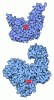
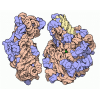
 Z (Sec.)
 Y (Row.)
 X (Col.)


 Sample components
 Trichoplusia ni (cabbage looper)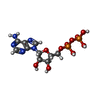
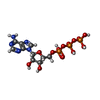
 Processing
 Electron microscopy
 FIELD EMISSION GUN
